



Spacecraft Avionics Market Revenue to Attain USD 9.76 Bn by 2035
Published: 02 Apr 2026
Author: Precedence Research



Spacecraft Avionics Market Revenue and Trends 2026 to 2035
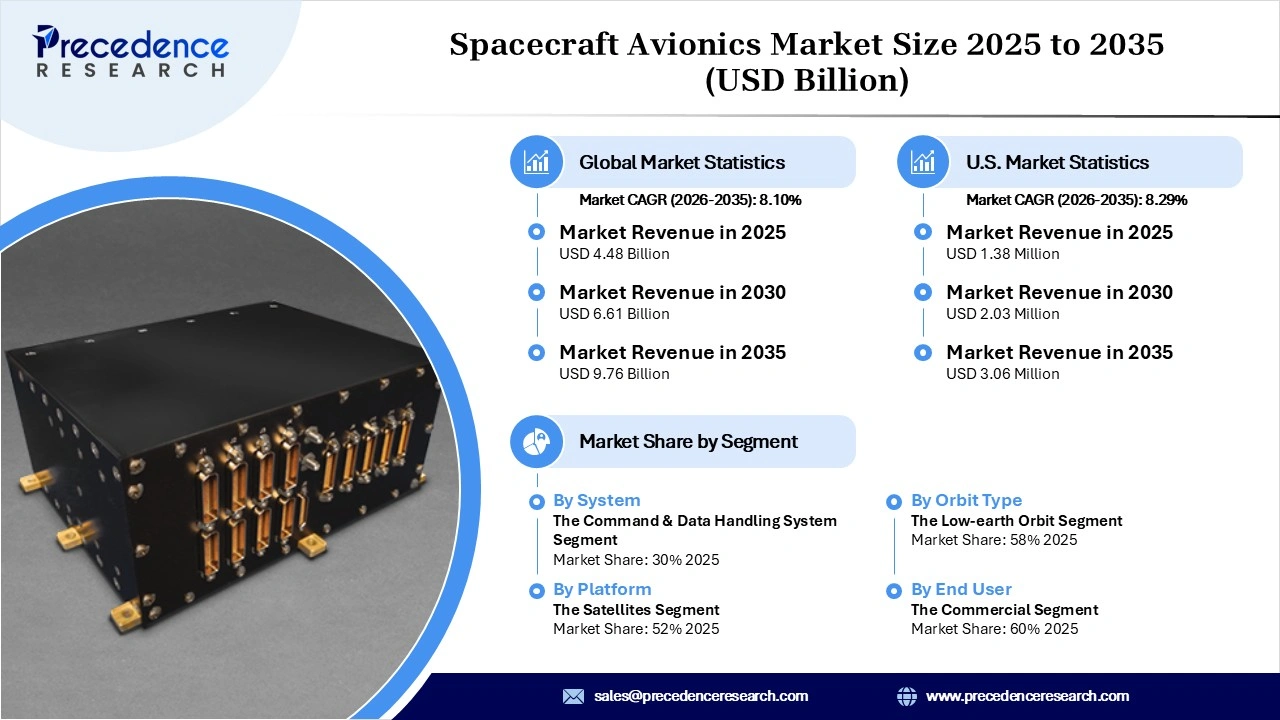
The global spacecraft avionics market revenue surpassed USD 4.48 billion in 2025 and is predicted to attain around USD 9.76 billion by 2035, growing at a CAGR of 8.10%. The market is driven by the increasing number of satellite deployments, the rise of private aerospace ventures, and the demand for intelligent, lightweight, and durable electronic systems.
Market at a Glance
The spacecraft avionics market deals with the development and distribution of navigation, communication, data handling, and power management systems. These systems ensure that everything in space missions can run without fail after launch. The market includes flight computers, telemetry modules, sensors, and onboard software that manage satellites, launch vehicles, and deep-space explorers. Designed for exceptional reliability where repairs are impossible, these technologies are evolving toward greater compactness, intelligence, and cost-efficiency to support both commercial ventures and government space exploration initiatives.
The spacecraft avionics domain extends far beyond basic onboard electronics, encompassing end-to-end systems and mission-specific upgrades. These include components integrated with flight control, communication, navigation, and energy management systems, designed for use on satellites or exploration vehicles, ensuring seamless operation tailored to each mission’s unique requirements.
What Drives the Spacecraft Avionics Market in the Future?
- Expansion of the Commercial Space Sector: The commercial space sector is undergoing a transition, with demand for spacecraft avionics remaining steady. NASA is increasingly procuring communication services from private satellite operators instead of building its own infrastructure. By 2031, the agency plans to rely on commercial vendors for near-Earth missions, creating a sustained demand for avionics systems within these privately managed constellations, a strategy already validated through numerous in-orbit demonstrations with industry partners.
- Rise of Large Constellation Networks: The rise of large constellation networks is shifting spacecraft avionics toward volume production, moving from a few high-value spacecraft to many standardized units. For example, Telesat’s Lightspeed plans to launch approximately 156 satellites by 2027, following validation flights in 2026. Each satellite requires compact navigation, communication, and processing systems, creating a surge in overall avionics demand that far exceeds the needs of any single mission.
- Testing Opportunities Have Broadened Thanks to In-Orbit Demonstration Initiatives: In-orbit demonstration initiatives have expanded testing opportunities in space. NASA, along with partners like SES and SpaceX, has conducted multi-orbit relay tests to validate telemetry, command capabilities, and high-frequency data transfer across various orbital altitudes. These initiatives are rapidly establishing avionics platforms as key tools for experimentation, enabling swift validation and technological progress, with additional demonstration events planned for 2026-2027.
From Thrusters to High-Band Communication: The Backbone of Space Operations
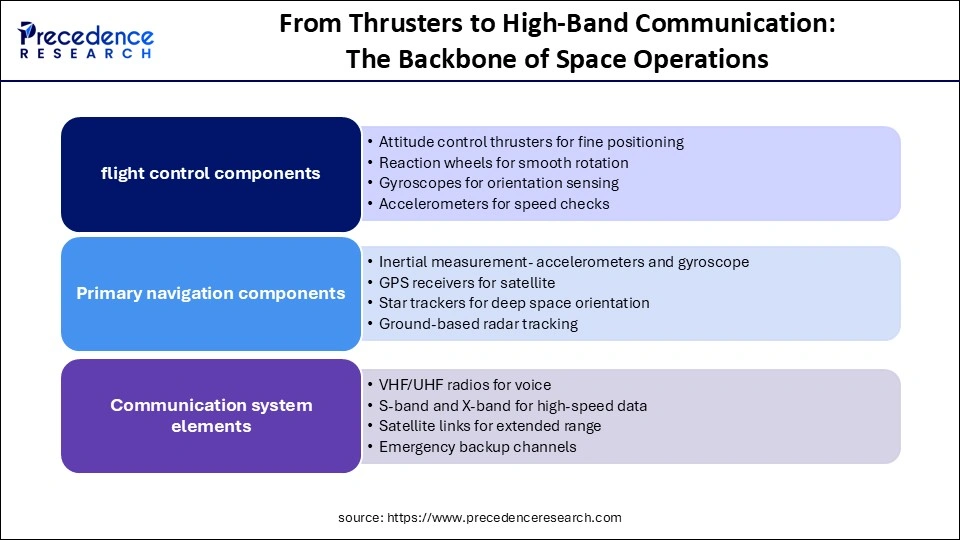
The diagram illustrates three interconnected pillars of spacecraft avionics: flight control, navigation, and communication systems. Thrusters, gyroscopes, and accelerometers keep the spacecraft stable. Navigation relies on inertial measurement units (IMUs), GPS, and star tracking for precise positioning, even in deep space. Communication technologies, including VHF/UHF radios and high-speed S- and X-band links, ensure uninterrupted data transmission across orbital distances.
Market Segmentation Overview
- By system, the command & data handling system segment held a major market share of 30% in 2025. With the growing number of satellite launches, these systems are essential for efficiently processing, storing, and transmitting real-time data, making them critical for mission stability, responsiveness, and continuous connectivity.
- By system, the navigation & guidance system segment is expected to grow at the highest CAGR in the market during the studied years. Advances in commercial autonomous missions and deep space exploration are driving demand for self-sufficient navigation systems capable of making real-time decisions with minimal ground support. These systems provide critical decision support for crew members, enabling accurate, autonomous operations on increasingly distant and complex space missions.
- By platform, the satellites segment led the global spacecraft avionics market with a share of 52% in 2025. The growth of satellite constellations and rising global demand for instant data have made satellites essential platforms for avionics technology, integrating critical systems into space hardware and becoming increasingly indispensable for modern space operations.
- By platform, the crew spacecraft segment is expected to grow at the fastest CAGR in the market between 2026 and 2035. This growth is driven by renewed investments in human spaceflight missions and commercial ventures, including orbital tourism and extended stays beyond Earth’s atmosphere. The increasing need for reliable, life-supportive avionics systems is creating strong demand in this emerging sector.
- By orbit type, the low Earth orbit (LEO) segment accounted for the largest market share of 58% in 2025, driven by the rapid deployment of mega-constellations. The combination of broadband connectivity and high-resolution imaging satellites in LEO has fueled strong demand for compact, energy-efficient avionics capable of supporting frequent launches and ensuring long-term operational reliability.
- By orbit type, the deep space segment is expected to grow at the fastest rate between 2026 and 2035, fueled by increased investment in interplanetary missions. Exploration beyond Earth’s orbit requires avionics systems that can withstand radiation, extreme temperatures, long mission durations, and provide near-complete autonomous operation.
- By end user, the commercial segment held a major revenue share of 60.0% in the market in 2025, driven by rapid growth in private aerospace companies and satellite-based services. The trend toward commercialization, from global internet constellations to Earth observation analytics, has fueled steady demand for cost-efficient, scalable, and reliable avionics solutions.
- By end user, the government & defense segment is expected to expand rapidly in the market in the coming years, fueled by rising defense budgets and a stronger focus on space security. The growing need for surveillance, secure communications, and situational awareness is driving investments in durable, mission-critical avionics systems.
Regional Insights
North America dominated the global spacecraft avionics market with a major share of 41% in 2025, driven by the strong presence of leading aerospace companies. Continuous funding from NASA and defense programs has fostered advanced R&D and the early adoption of next-generation avionics systems. The U.S. leads the market within North America, as the country hosts top aerospace companies and a skilled workforce, enabling the development of cutting-edge navigation, communication, and control systems. Canada contributes steadily through specialized manufacturing focused on satellites and commercial space components, supporting the growing private space industry.
Asia Pacific is expected to grow at the fastest CAGR in the market during the forecast period, driven by rapid advancements in national space programs. Agencies like CNSA, ISRO, and JAXA are accelerating satellite deployments and deep-space initiatives with strong government backing. Simultaneously, low-cost production methods and emerging private sector partners are improving supply chain efficiency, while China leads in large constellation projects and India and Japan strengthen their capabilities in commercial launches and precision avionics development.
Spacecraft Avionics Market Coverage
| Report Attribute | Key Statistics |
| Market Revenue in 2025 | USD 4.48 Billion |
| Market Revenue by 2035 | USD 9.76 Billion |
| CAGR from 2026 to 2035 | 8.10% |
| Quantitative Units | Revenue in USD million/billion, Volume in units |
| Largest Market | North America |
| Base Year | 2025 |
| Regions Covered | North America, Europe, Asia-Pacific, Latin America, and the Middle East & Africa |
Top Companies in the Spacecraft Avionics Market
Honeywell International Inc. and Collins Aerospace dominate the industry with established flight systems and advanced avionics solutions. Defense-focused companies like Northrop Grumman Corporation and Lockheed Martin Corporation drive large-scale innovation through long-term contracts and mission-critical expertise. Collaborative efforts from Thales Group and Airbus Defence and Space advance satellite and integrated avionics systems, while BAE Systems plc and Safran S.A. specialize in highly reliable electronics and navigation technologies engineered for extreme conditions.
Segments Covered in the Report
By System
- Command & Data Handling System
- Communication System
- Navigation & Guidance System
- Power Management System
- Flight Control System
By Platform
- Satellites
- Launch Vehicles
- Space Probes
- Crew Spacecraft
By Orbit Type
- Low Earth Orbit (LEO)
- Medium Earth Orbit (MEO)
- Geostationary Orbit (GEO)
- Deep Space
By End User
- Commercial
- Government & Defense
By Region
- North America
- Asia Pacific
- Europe
- South America
- Middle East & Africa
Get this report to explore global market size, share, CAGR, and trends, featuring detailed segmental analysis and an insightful competitive landscape overview @ https://www.precedenceresearch.com/sample/8263
You can place an order or ask any questions, please feel free to contact us at sales@precedenceresearch.com |+1 804 441 9344