



Spacecraft Avionics Market Trends, Companies, Contract Wins / Project Pipeline, Defense Contracts, Procurement Volume, Government Spending, Production Capacity, Competitive Positioning, and Growth Outlook
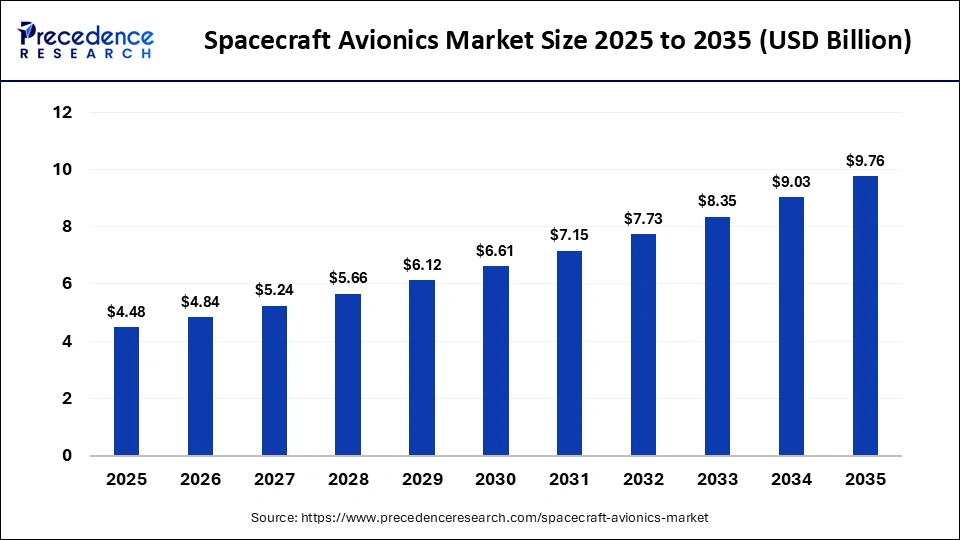
Gautam Mahajan, an Aerospace and Defence Industry Expert, identifies strong market momentum in the spacecraft avionics market, which reached USD 4.84 billion in 2026 and is projected to attain USD 9.76 billion by 2035 at a CAGR of 8.10%. Major spacecraft avionics market companies, including Honeywell International Inc., Collins Aerospace (RTX Corporation), Northrop Grumman Corporation, Lockheed Martin Corporation., compete across critical segments such as By System, By Platform, By Orbit Type, By End User.
Source: https://www.precedenceresearch.com/spacecraft-avionics-market
 Get a Sample
 Table Of Content


What is the Spacecraft Avionics Market Size in 2026?
The global spacecraft avionics market size accounted for USD 4.48 billion in 2025 and is predicted to increase from USD 4.84 billion in 2026 to approximately USD 9.76 billion by 2035, expanding at a CAGR of 8.10% from 2026 to 2035. Advancements in technology, AI integration, and increasing funding for aerospace and aviation are key factors driving growth in the spacecraft avionics market.
Key Takeaways
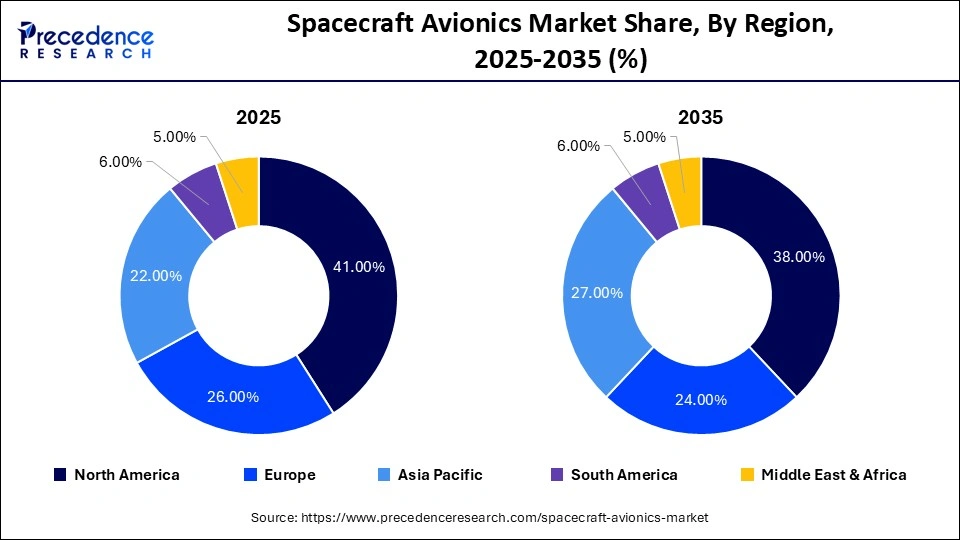
- North America led the spacecraft avionics market in 2025 with approximately 41% share.
- The Asia Pacific is projected to experience the fastest growth in the upcoming period.
- By system, the command & data handling system segment dominated the market in 2025 with a 30% share.
- By system, the navigation & guidance system segment accounted for 18% market share in 2025 and is expected to grow at the fastest rate over the forecast period.
- By platform, the satellites segment dominated the market with a 52% share in 2025.
- By platform, the crew spacecraft segment accounted for a 16% market share in 2025 and is projected to register the fastest growth over the forecast period.
- By orbit type, the low-earth orbit segment dominated the market with a 58% share in 2025.
- By orbit type, the deep space segment accounted for an 8% market share in 2025 and is anticipated to register the fastest growth over the forecast period.
- By end user, the commercial segment dominated the market with a 60% share in 2025.
- By end user, the government & defense segment accounted for a 40% market share in 2025 and is expected to register the fastest growth over the forecast period.
Market Overview
Spacecraft avionics play a critical role in command and data management, communication, electrical power systems, and attitude determination and control, enabling a wide range of scientific, commercial, and government mission objectives. Avionics encompasses the electronic systems used in both aircraft and spacecraft, including navigation, collision-avoidance, and display systems that together determine the aircraft's position, speed, and altitude. Key functions of avionics consist of communication, navigation, fuel management, weather observation, collision avoidance, flight control, and monitoring of health systems. The spacecraft avionics market is highly advanced and driven by continuous technological innovation, making it one of the most critical elements in aerospace control and optimization, and strongly supporting its long-term growth.
Impact of Artificial Intelligence on the Spacecraft Avionics Market
Artificial intelligence significantly impacts the spacecraft avionics market by enabling predictive analysis and condition monitoring. AI-driven systems enable faster, longer-range operations and rapid orbital repositioning, while improving distributed tasking, human-on-the-loop decision-making, resilience under degraded communications, and multi-domain coordination. Across space and aviation missions, AI analyzes large datasets to reveal patterns, optimize mission planning, and support higher levels of autonomy. The integration of AI into spacecraft avionics is enabling the development of more intelligent and responsive systems that can autonomously manage complex tasks, enhance mission reliability and safety, and improve overall operational efficiency.
Spacecraft Avionics Market Trends
- Shift Toward Energy-Efficient, Electric, and Hybrid Systems: The shift toward energy-efficient, electric, and hybrid aircraft systems is increasingly influencing spacecraft avionics development. This transition is driving improved power optimization, reduced energy consumption, and enhanced system performance across aerospace applications.
- Advancements in C&DH and SSA Capabilities: Continuous advancements in command & data handling (C&DH) and space situational awareness (SSA) technologies are creating new opportunities for developing and deploying next-generation avionics solutions. These innovations support enhanced data handling, higher processing efficiency, and improved mission effectiveness.
- Radiation-Tolerant Computing Requirements: Radiation in space poses serious risks to satellite and spacecraft computers, increasing the importance of radiation-tolerant computing systems. Proven radiation-hardened solutions are essential to ensure reliability and consistent performance in demanding aerospace environments.
Market Scope
| Report Coverage | Details |
| Market Size in 2025 | USD 4.48 Billion |
| Market Size in 2026 | USD 4.84 Billion |
| Market Size by 2035 | USD 9.76 Billion |
| Market Growth Rate from 2026 to 2035 | CAGR of 8.10% |
| Dominating Region | North America |
| Fastest Growing Region | Asia-Pacific |
| Base Year | 2025 |
| Forecast Period | 2026 to 2035 |
| Segments Covered | System, Platform, Orbit Type, End User, and Region |
| Regions Covered | North America, Europe, Asia-Pacific, Latin America, and Middle East & Africa |
Market Dynamics
Drivers
Government Support and Commercial Expansion
Government support drives the spacecraft avionics market by providing funding for defense programs, disaster management, and advanced technology development, enabling the creation of reliable and sophisticated avionics systems. Simultaneously, commercial expansion, including satellite communications, Earth observation, and private space ventures, boosts demand for high-performance, cost-effective avionics solutions, further accelerating market growth.
Restraint
High Testing Costs and Cybersecurity Risks
High testing and qualification costs act as a major constraint, limiting the adoption of spacecraft avionics systems. Additionally, increasing cybersecurity risks create challenges in ensuring their secure, reliable, and cost-effective deployment.
Opportunity
Defense-Focused Innovation in Remote Operations
Defense-focused innovation in remote and extreme operations drives demand for advanced spacecraft avionics capable of reliable performance in harsh environments. These developments create market opportunities by enabling more cost-effective, resilient, and high-performance systems that strengthen defense capabilities while attracting both military and commercial adoption.
Segment Insights
System Insights
Spacecraft Avionics Market Share, By System, 2025-2035 (%)
| System | 2025 | 2035 |
| Command & Data Handling | 30% | 28% |
| Communication System | 24% | 23% |
| Navigation & Guidance | 18% | 22% |
| Power Management | 15% | 14% |
| Flight Control | 13% | 13% |
The Command & Data Handling System Segment Dominated the Market in 2025
The command & data handling system segment dominated the spacecraft avionics market while holding approximately 30% share in 2025, driven by increasing satellite deployments and the growing demand for real-time data management, which supports steady adoption. These systems are critical for onboard processing. Command and data handling systems are responsible for controlling the spacecraft, managing internal data flows, and handling data transmitted to or received from other systems. High-performance space data-handling avionics ensure reliable, real-time operations.
The navigation & guidance system segment accounted for nearly 18% market share in 2025 and is projected to grow at the fastest rate over the forecast period. This growth is driven by rising autonomous missions and deep space exploration, which are increasing the need for precision navigation systems. These systems enable spacecraft to determine their location, follow a designated path, and maintain proper orientation while operating in the space environment. It involves both theoretical and practical applications essential for autonomous and high-performance space missions, supporting their broader adoption.
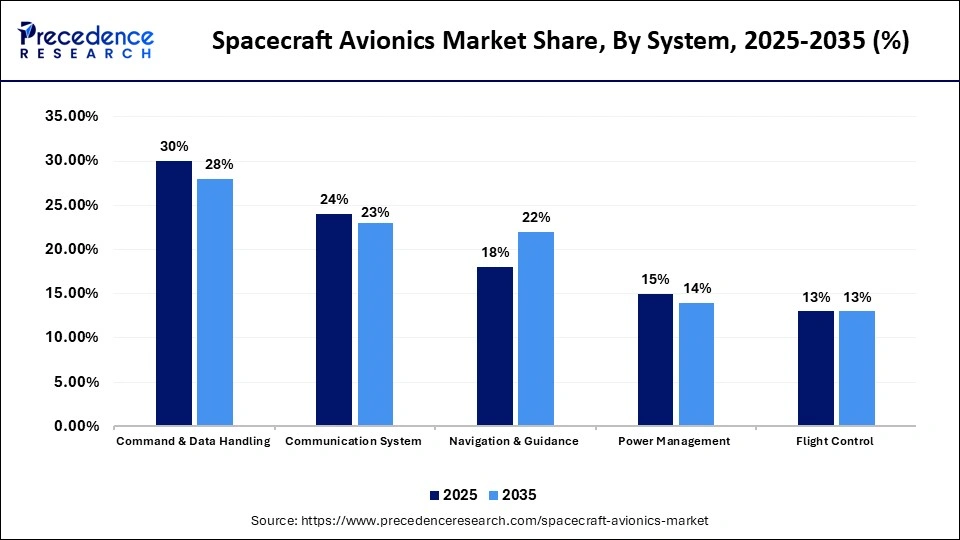
The communication system segment is the second-largest shareholder, holding a 24% share of the market in 2025. This is mainly due to the rising demand for high-speed satellite communications and data transfer, which ensures steady demand. Communication systems facilitate the transmission of data and telemetry from spacecraft to Earth, the reception of commands from ground stations, and the relay of information among spacecraft.
The power management system segment held a 15% share of the market in 2025, driven by the growth of satellite constellations, which increases the need for effective power distribution systems. These systems support the design of power circuits while ensuring high reliability, consistently meeting the demanding requirements of the market even under severe environmental conditions.
Platform Insights
Spacecraft Avionics Market Share, By Platform, 2025-2035 (%)
| Platform | 2025 | 2035 |
| Satellites | 52% | 48% |
| Launch Vehicles | 20% | 19% |
| Space Probes | 12% | 13% |
| Crew Spacecraft | 16% | 20% |
The Satellites Segment Led the Market in 2025 with a 52% Share
In 2025, the satellites segment led the spacecraft avionics market by holding around 52% share, driven by the increasing number of communication and Earth observation satellites that are fueling strong global demand for spacecraft avionics. Satellites rely on advanced avionics to control their attitude, maintain stable communication links, support power generation, and ensure precise sensor alignment while managing external torques from the space environment. Avionics provide an electric power supply, maintain attitude control, withstand the harsh conditions of space, and ensure that mission payloads operate reliably throughout the required mission life.
The crew spacecraft segment accounted for nearly 16% of market share in 2025 and is projected to expand at the fastest rate over the forecast period. This growth is driven by increasing demand for human space missions, including commercial space tourism and government-funded crewed exploration programs. The rising focus on safe, reliable, and advanced avionics systems for astronauts further supports the rapid growth of this segment.
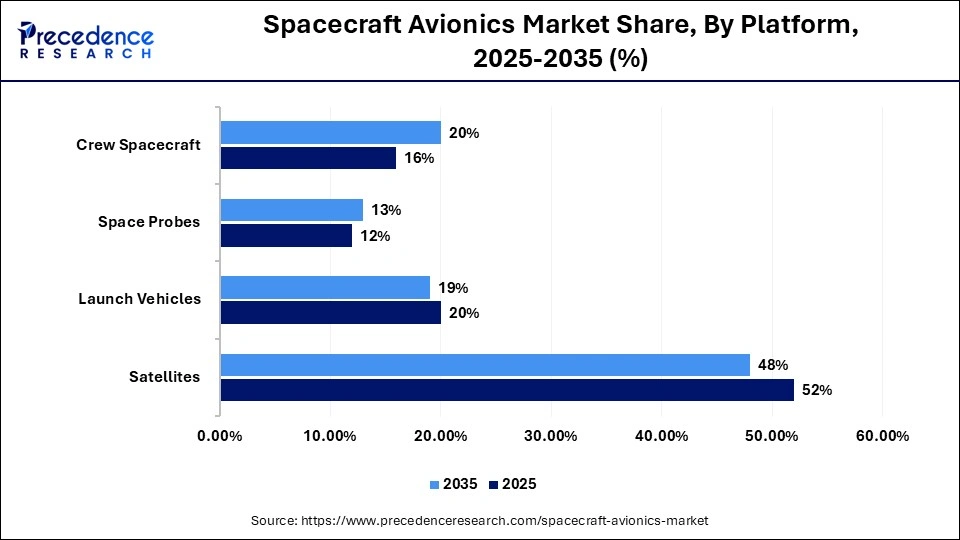
The launch vehicles segment accounted for nearly 20% share of the market in 2025, propelled by an increasing frequency of launches that sustain a consistent demand for avionics integration. Launch vehicles serve the purpose of transporting spacecraft and payloads, including satellites, into outer space. Over the years, there has been a notable improvement in both the reliability and lift capacity of these vehicles. They can deliver payloads such as artificial Earth satellites, crewed spacecraft, space stations, and space probes into designated orbits with greater precision and efficiency.
The space probes segment held nearly 12% share of the market in 2025, bolstered by the growth of scientific and interplanetary missions. Space probes are unmanned spacecraft intended for the exploration of celestial bodies and phenomena, which include materials from Halley's Comet, the solar wind, interplanetary dust particles, and the Martian atmosphere. These probes are utilized to examine the atmosphere and composition of space, as well as other planets, moons, or celestial entities. A probe may embark on a one-way mission or return samples and data to Earth.
Orbit Type Insights
Spacecraft Avionics Market Share, By Orbit Type, 2025-2035 (%)
| Orbit Type | 2025 | 2035 |
| Low Earth Orbit (LEO) | 58% | 54% |
| Medium Earth Orbit (MEO) | 14% | 13% |
| Geostationary Orbit (GEO) | 20% | 18% |
| Deep Space | 8% | 15% |
The Low Earth Orbit (LEO) Segment Led the Market with a 58% Share in 2025
The low Earth orbit (LEO) segment dominated the spacecraft avionics market, holding nearly 58% share in 2025, driven primarily by mega-constellation deployments for broadband connectivity and Earth imaging. These LEOs operate at lower altitudes, enabling higher orbital speeds and stronger signal strength. This configuration improves the geometric relationship between users and satellites and provides a greater number of observations for use in parameter estimation. Operating at altitudes of roughly 500 to 2,000 kilometers above the Earth's surface, LEO systems also deliver lower data transmission latency and faster internet connection speeds compared to higher orbits.
The deep space segment accounted for nearly 8% share of the market in 2025 and is projected to experience the fastest growth over the forecast period, fueled by increasing investments in space exploration and interplanetary missions. This segment encompasses planetary exploration and the examination of the composition, geology, and potential resources of planets, moons, asteroids, and comets. Additionally, it facilitates astronomical research and observations that improve our comprehension of the solar system and the wider universe.
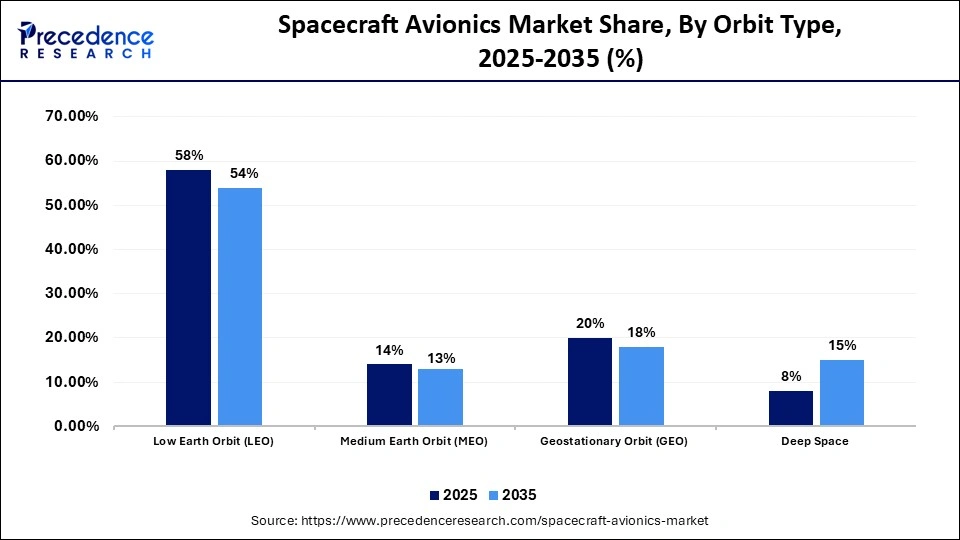
The medium Earth orbit (MEO) segment accounted for nearly 14% market share in 2025, supported by stable demand from navigation systems such as GNSS. MEO plays a critical role in global navigation networks, with the most prominent example being the Global Positioning System (GPS). These satellites transmit signals containing precise timing information, enabling users to calculate their position with a high degree of accuracy.
The geostationary orbit (GEO) segment accounted for roughly 20% share of the market in 2025, propelled by its ongoing utilization in the communication and broadcasting sectors. Situated at an altitude of approximately 35,786 km above the equator of Earth, GEO satellites revolve at the same rotational velocity as the planet. These satellites play a crucial role in facilitating global telecommunications networks, serving as the foundation for internet services, television broadcasting, and secure military communications.
End User Insights
Spacecraft Avionics Market Share, By End User, 2025-2035 (%)
| End User | 2025 | 2035 |
| Commercial | 60% | 57% |
| Government & Defense | 40% | 43% |
The Commercial Segment Dominated the Market with Nearly 60% Share in 2025
The commercial segment dominated the spacecraft avionics market in 2025 with nearly 60% share, driven by the rapid growth of satellite constellations, telecommunications networks, and Earth observation services that rely on advanced avionics systems. Private space companies are investing heavily in high-performance, cost-effective, and reliable spacecraft electronics to support commercial missions, including broadband internet, remote sensing, and space tourism. Additionally, the increasing demand for efficient mission management and automation in commercial operations has further reinforced the segment's market leadership.
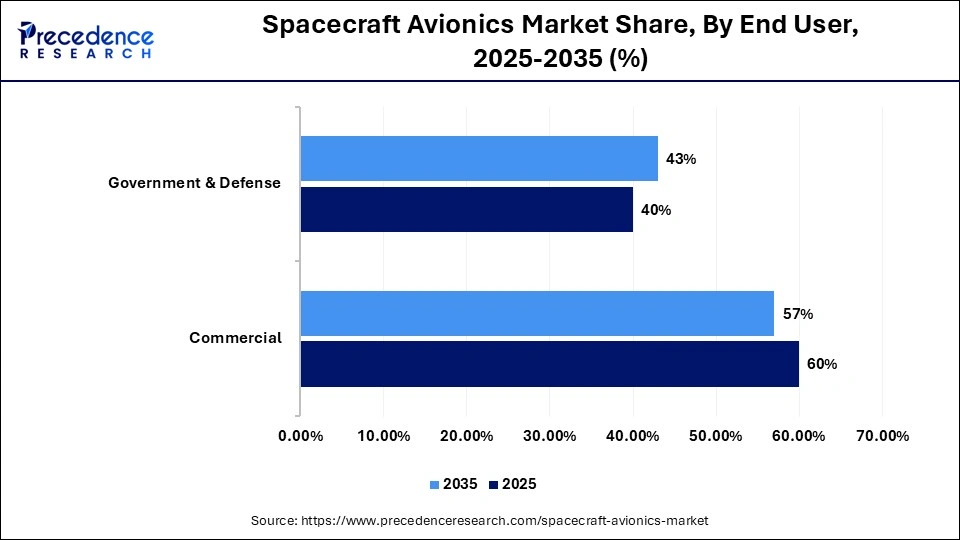
The government & defense segment accounted for 40% of market revenue in 2025 and is projected to be the fastest-growing segment during the forecast year, driven by rising defense budgets and expanding space security initiatives. Governments are increasingly adopting advanced avionics systems to enhance mission reliability, situational awareness, and secure communication in defense and strategic operations. Additionally, the push for modernization and the development of next-generation spacecraft for reconnaissance, navigation, and space exploration is driving sustained growth in this segment.
Regional Insights
North America Spacecraft Avionics Market Size and Growth 2026 to 2035
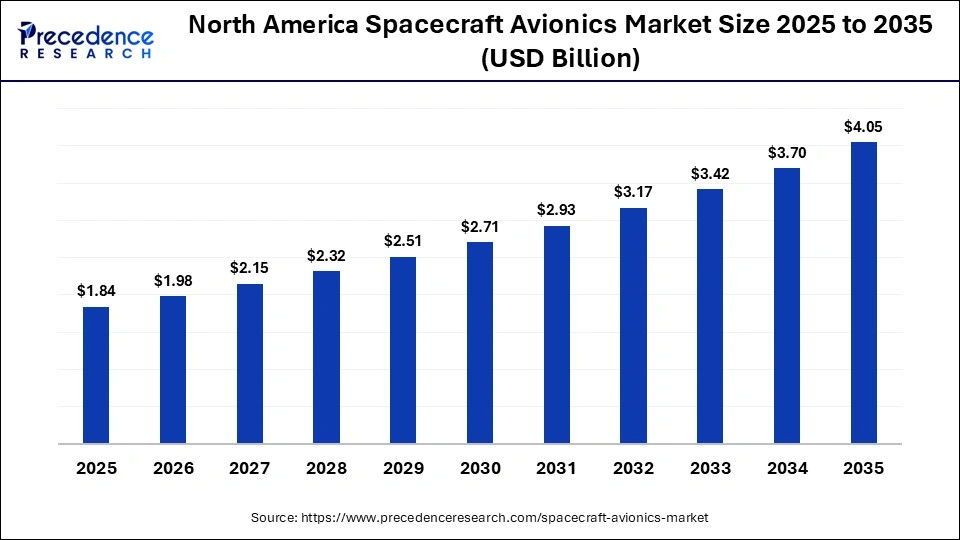
The North America spacecraft avionics market size is estimated at USD 1.84 billion in 2025 and is projected to reach approximately USD 4.05 billion by 2035, with a 8.21% CAGR from 2026 to 2035.
What Made North America the Dominant Region in the Spacecraft Avionics Market?
North America dominated the spacecraft avionics market with a 41% share in 2025, driven by the strong presence of leading aerospace companies, substantial NASA and defense funding, and advanced R&D infrastructure. Early adoption of next-generation avionics and a robust commercial space ecosystem further support continuous innovation in the region. Additionally, mature aviation infrastructure, major aircraft manufacturers, high defense spending, and a modernized aircraft fleet reinforce North America's market leadership.
U.S. Spacecraft Avionics Market Size and Growth 2026 to 2035
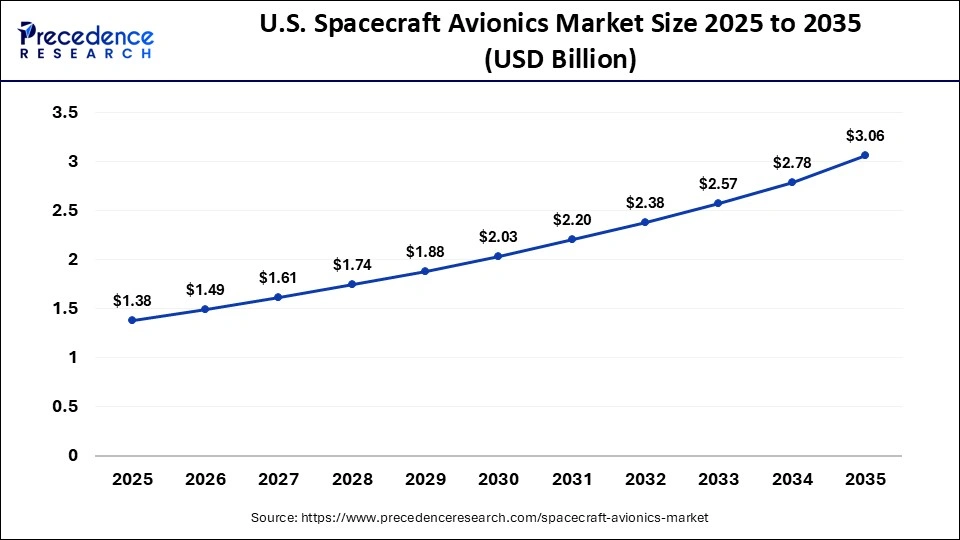
The U.S. spacecraft avionics market size is calculated at USD 1.38 billion in 2025 and is expected to reach nearly USD 3.06 billion in 2035, accelerating at a strong CAGR of 8.29% between 2026 and 2035.
U.S. Market Analysis
The U.S. leads the North American market as commercial, private, and government entities are significantly increasing their investments in domestic space programs. Moreover, the U.S. Department of Defense continues to allocate substantial funding to Defense space programs with advanced avionics capabilities, further catalyzing market growth.
Asia Pacific: The Fastest-Growing Region
Asia Pacific held a 22% share of the market in 2025 and is expected to grow at the fastest rate throughout the forecast period. This growth is fueled by the swift advancement of space programs in China, India, and Japan, a surge in satellite launches, substantial government investment, economical manufacturing processes, and the emergence of private space enterprises. Other factors contributing to this growth include the increase in air passenger traffic, the development of the commercial aviation industry, and heightened aircraft acquisitions from developing economies.
China Market Analysis
China leads the Asia Pacific spacecraft avionics market, driven by rapid aviation growth and increasing air travel demand, which necessitate advanced avionics for safety, efficiency, and reliability. Modernization of the country's aircraft fleet is boosting demand for cutting-edge systems, including flight management, autopilot, and electronic flight instruments. Additionally, advancements in space exploration, strong government investment, and rising demand for sophisticated onboard systems are further accelerating market growth.
Europe: The Second-Largest Market
Europe is the second-largest market for spacecraft avionics, holding around 26% share in 2025, driven by a favorable regulatory framework, strong ESA initiatives, collaborative space missions, and a well-established aerospace sector. Increasing private sector involvement further supports consistent growth in the region. Additionally, Europe benefits from advanced aerospace manufacturing capabilities, leading aircraft OEMs, stringent aviation safety standards, and ongoing investments in research and development.
UK Market Analysis
The UK leads the European spacecraft avionics market, driven by supportive government regulations and sustainability initiatives that are boosting demand. The country holds a strong position in defense aviation, supported by substantial R&D investments and a robust manufacturing sector serving both defense and commercial aerospace needs.
Spacecraft Avionics Market Companies
- Honeywell International Inc.
- Collins Aerospace (RTX Corporation)
- Northrop Grumman Corporation
- Lockheed Martin Corporation
- Thales Group
- Airbus Defence and Space
- BAE Systems plc
- L3Harris Technologies, Inc.
- General Dynamics Corporation
- Safran S.A.
- Cobham Limited
- Leonardo S.p.A.
- Sierra Nevada Corporation
- Ball Aerospace
- Mitsubishi Electric Corporation
Recent Developments
- In March 2026, Aurora Avionics, a young aerospace electronics firm based in Edinburgh, announced that it would supply onboard data acquisition systems for the PHOENIX 2.1 mission, being developed by European re-entry logistics company ATMOS Space Cargo. With this contract, the small Scottish avionics company is quietly positioning itself within one of Europe's most closely watched space logistics programs.(Source: https://aerospaceglobalnews.com)
- In January 2026, a U.S.-based defense and industrial technology company specializing in embedded AI-powered autonomy, advanced avionics, precision components, UAVs, and aerospace engineering announced that its subsidiary, GuideTech, had secured a contract with Portal Space Systems to develop next-generation, maneuverable spacecraft platforms. This deal expands Palladyne AI's presence into the space domain and reinforces its role as a trusted autonomy partner across multiple operational domains.(Source: https://www.businesswire.com)
Segment Covered in the Report
By System
- Command & Data Handling System
- Communication System
- Navigation & Guidance System
- Power Management System
- Flight Control System
By Platform
- Satellites
- Launch Vehicles
- Space Probes
- Crew Spacecraft
By Orbit Type
- Low Earth Orbit (LEO)
- Medium Earth Orbit (MEO)
- Geostationary Orbit (GEO)
- Deep Space
By End User
- Commercial
- Government & Defense
By Region
- North America
- Latin America
- Europe
- Asia-pacific
- Middle and East Africa
For inquiries regarding discounts, bulk purchases, or customization requests, please contact us at sales@precedenceresearch.com
Frequently Asked Questions





Ask For Sample
No cookie-cutter, only authentic analysis – take the 1st step to become a Precedence Research client
 Get a Sample




 sales@precedenceresearch.com
 Schedule a Meeting
