



Thrombus Aspiration Catheter Market Revenue to Attain USD 4.66 Bn by 2035
Published: 13 Apr 2026
Author: Precedence Research



Thrombus Aspiration Catheter Market Revenue and Trends 2026 to 2035
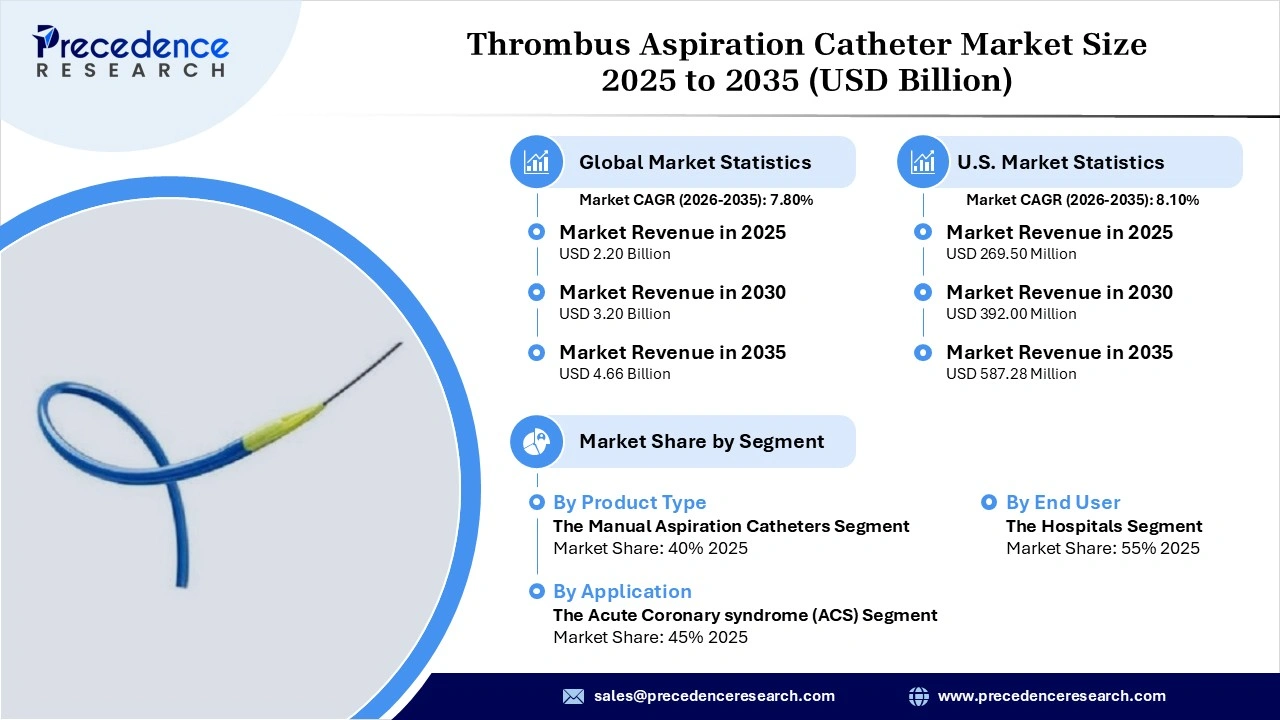
The global thrombus aspiration catheter market revenue surpassed USD 2.20 billion in 2025 and is predicted to attain around USD 4.66 billion by 2035, growing at a CAGR of 7.80%. The market is driven by the growing incidence of cardiovascular diseases, the rise in demand for less invasive clot removal techniques, and the adoption of the latest catheter-based technology.
Market at a Glance
The thrombus aspiration catheter market is defined as the global industry dedicated to the development and marketing of advanced medical catheters utilized to eliminate thrombi (blood clots) from blood vessels through minimally invasive interventions. Such medical devices play an essential role in the treatment of cardiovascular and neurovascular diseases. These diseases include acute myocardial infarction, deep vein thrombosis, and ischemic stroke, in which the quick removal of clots is vital for ensuring proper blood flow.
This market encompasses manual aspiration catheters and mechanical (powered) aspiration catheters with their respective accessories and complementary technologies. These catheters have been widely adopted in hospitals, ambulatory surgical centers, and specialty cardiology and neurology clinics.
Market Forecast
Development of Large-Bore Aspiration Catheters
There is a rising development of large-bore aspiration catheters with corrugated catheter body designs and hydrophilic coatings that enhance suction force and facilitate catheter navigation through difficult vascular networks. This has led to shorter treatment durations and higher success rates during stroke and coronary thrombosis interventions.
- In March 2026, Perfuze, an Irish company, was granted approval from the U.S Food and Drug Administration (FDA) for its Millipede88 aspiration catheter, which was built as a superbore catheter for thrombus aspiration.
Integration of AI
The integration of aspiration catheters with AI analysis software for CT scans, fluoroscopy imaging, and thrombectomy is driving the market by enabling faster detection and navigation in minimally invasive procedures. This advancement facilitates quicker decision-making and improved patient recovery outcomes in stroke centers.
- In 2025, the U.K. National Health Service implemented AI-based stroke scan solutions in over 100 stroke centers across the country.
Expansion of Stroke Units and Emergency Services
The government's efforts to develop stroke treatment facilities, emergency service networks, and advanced stroke units are contributing to the rising acceptance of thrombectomy catheters. In addition, public sector initiatives ensure better availability of procedures that enable minimally invasive stroke care within the country. These programs also ensure quicker response times for treatment through better coordination between emergency departments and specialized centers for stroke care.
- In 2025, the Government of India announced that it would expand its national stroke program to about 500 functional stroke units.
Global Thrombectomy Surge Driving Growth Through Aging Populations, Stroke Epidemics, and Innovation
- In England, only 4.3% of stroke patients received mechanical thrombectomy in 2023-2024, despite clinical estimates suggesting at least 10% of patients are eligible, highlighting significant underutilization of thrombectomy procedures.
- In China, national stroke center expansion programs and clinical studies indicate that annual mechanical thrombectomy (MT) procedure volumes have exceeded 81,865 procedures by 2023, making it one of the fastest-growing markets globally for aspiration catheter utilization.
- The United States remains the most active regulatory market for aspiration thrombectomy devices, with multiple FDA 510(k) clearances granted between 2024 and 2026, including systems from Imperative Care, Vesalio, and Perfuze, highlighting a strong pipeline of innovation and rapid commercialization pathways.
- Global stroke data indicate that more than 12 million new stroke cases occur annually, significantly driving demand for neurovascular thrombectomy procedures compared to cardiovascular indications.
- The global population aged 80 years and older is projected to nearly triple between 2020 and 2050, significantly increasing the patient pool eligible for thrombectomy procedures and driving long-term demand growth.
Market Segmentation Overview
- By Product Type: The manual aspiration catheters segment led the thrombus aspiration catheter market with a 40% share in 2025. This is because they are cost-effective, easy to use, and widely available in hospitals and cardiac facilities. These catheters facilitate effective elimination of thrombi through percutaneous procedures. Manual aspiration catheters are compatible with standard guidewires and require less training to operate.
- By Product Type: The mechanical aspiration catheters segment held the second-largest market share of 35% in 2025 and is expected to expand at a significant rate in the coming years. The growth of this segment is attributed to its benefits in clot extraction in terms of efficiency. These catheters are ideal for complicated thrombus formations and larger clots that cannot be extracted using manual suction. Mechanical aspiration catheters are ideal for advanced treatment techniques, making them common at specialized cardiology and neurology clinics.
- By Product Type: The powered aspiration catheters segment is expected to expand at the highest CAGR during the forecast period. This is due to their ability to perform thrombectomy quickly and efficiently, which makes them suitable for complicated and high-risk scenarios. Powered aspiration catheters are being increasingly adopted in sophisticated heart and neurological vascular procedures.
- By Application: The acute coronary syndrome (ACS) segment dominated the thrombus aspiration catheter market with a 45% share in 2025. This is because acute coronary syndrome is a common cardiovascular disease that requires immediate medical intervention to restore normal flow. Catheters for thrombectomy during percutaneous coronary interventions (PCI) procedures for patients suffering from ACS are the most popular choice for cardiologists.
- By Application: The pulmonary embolism (PE) segment held the second-largest market share of 25% in 2025 and is expected to grow at a robust CAGR during the projection period. The market growth of this segment is attributed to the rising usage of thrombus aspiration catheters to efficiently remove blood clots in pulmonary arteries. The market growth of this segment is further driven by the increasing incidence rate of pulmonary embolism, together with an increased understanding among medical professionals about the efficacy of minimally invasive catheters.
- By End-Use: The hospitals segment led the thrombus aspiration catheter market with a 55% share in 2025. This is because of their well-established infrastructure, dedicated cardiac and neurovascular centers, as well as a significant presence of interventional cardiologists who can conduct thrombectomy procedures. Hospitals take care of the largest number of cardiovascular emergency patients due to the presence of advanced multi-specialty medical equipment in a single location.
- By End-Use: The cardiovascular centers segment held the second-largest market share of 25% in 2025. This is due to the fact that these centers focus on delivering high-level cardiac care, carrying out various interventions such as thrombus aspiration. These centers are equipped with modern catheterization laboratories, imaging equipment, and cardiologists. The market growth of this segment is further driven by the increasing tendency among patients to go to specialized centers and increasing awareness regarding minimally invasive interventions.
Regional Analysis
North America dominated the thrombus aspiration catheter market with a 35% share in 2025. The dominance of this region is attributed to the significant prevalence of cardiovascular disorders, along with the existence of a robust healthcare system. This region has the availability of modern interventional devices, which are supported by efficient reimbursement mechanisms and constant innovation in catheter techniques. The U.S. led the market in North America due to significant consciousness of patients and physicians, along with the fast adoption of minimally invasive methods. In Canada, financial support from the government for cardiac devices has led to steady market growth.
Asia Pacific is expected to grow at the fastest rate from 2026 to 2035. The market growth in this region is driven by rising incidences of cardiovascular diseases and expanding healthcare infrastructure. Growing awareness of minimally invasive methods and the presence of advanced technologies in the healthcare industry help improve market dynamics. China leads the market in Asia Pacific due to the expansion of hospitals and clinics. In India, government initiatives and growing awareness among patients regarding early cardiovascular treatment are fueling market growth.
Thrombus Aspiration Catheter Market Coverage
| Report Attribute | Key Statistics |
| Market Revenue in 2025 | USD 2.20 Billion |
| Market Revenue by 2035 | USD 4.66 Billion |
| CAGR from 2026 to 2035 | 7.80% |
| Quantitative Units | Revenue in USD million/billion, Volume in units |
| Largest Market | North America |
| Base Year | 2025 |
| Regions Covered | North America, Europe, Asia-Pacific, Latin America, and the Middle East & Africa |
Top Companies in the Thrombus Aspiration Catheter Market
Major companies operating in the market include Boston Scientific, Medtronic, Abbott Laboratories, and others. These companies contribute significantly to the market by developing and manufacturing advanced devices designed for efficient clot removal in vascular procedures. Their innovations, such as AI-powered systems, minimally invasive technologies, and enhanced catheter designs, help improve patient outcomes by providing faster, safer, and more effective treatments for conditions like ischemic stroke and peripheral artery disease.
Segments Covered in the Report
By Product Type
- Manual Aspiration Catheters
- Mechanical Aspiration Catheters
- Powered Aspiration Catheters
By Application
- Acute Coronary Syndrome (ACS)
- Pulmonary Embolism (PE)
- Deep Vein Thrombosis (DVT)
- Ischemic Stroke
- Others
By End-Use
- Hospitals
- Cardiovascular Centers
- Ambulatory Surgical Centers (ASCs)
- Others
By Region
- North America
- Latin America
- Europe
- Asia-pacific
- Middle and East Africa
Get this report to explore global market size, share, CAGR, and trends, featuring detailed segmental analysis and an insightful competitive landscape overview @ https://www.precedenceresearch.com/sample/8288
You can place an order or ask any questions, please feel free to contact us at sales@precedenceresearch.com |+1 804 441 9344