



Underwater Wireless Communication Market Revenue to Attain USD 9.36 Bn by 2035
Published: 23 Jun 2026
Author: Precedence Research



Underwater Wireless Communication Market Revenue and Trends 2026 to 2035
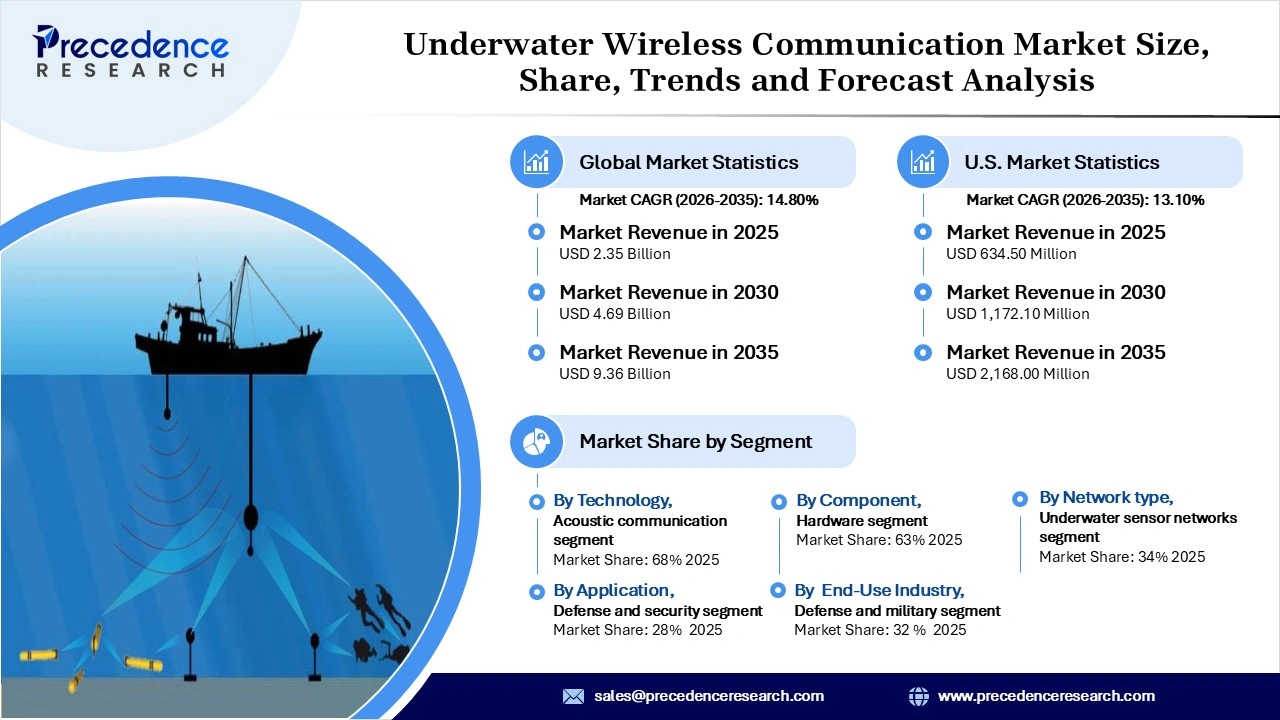
The global underwater wireless communication market revenue surpassed USD 2.35 billion in 2025 and is predicted to attain around USD 9.36 billion by 2035, growing at a CAGR of 14.80%. The market is driven by increasing offshore and gas exploration activities, the expansion of naval defense systems, and the increasing demand for data transfer systems in oceanic monitoring and conservation initiatives.
Wireless Underwater Connectivity
The underwater wireless communication market includes technologies, hardware, and services that allow wireless data communications between submersible devices, vehicles, and surface stations without cables. It comprises acoustic, optical, and radio frequency (RF) technologies. The hardware utilized in this market includes modems, transceivers, hydrophones, and signal processing equipment, as well as software for network and data analysis.
The main applications include subsea oil and gas exploration, maritime defense, oceanography research, environmental monitoring, and aquaculture. This market has been adopted by government agencies, military organizations, the energy sector, research centers, and environmental organizations. This market facilitates real-time data transmission in underwater environments, where the application of cables is financially unviable and technologically difficult.
Innovations in Optical Technology Enhance Underwater Wireless Communication
The market is moving away from conventional acoustic devices in favor of optical solutions capable of transmitting data at incredibly high speeds. This advanced system uses blue and green lasers to bypass the extreme bandwidth restrictions associated with sound-based communication, allowing instantaneous streaming of HD videos and sensor data for marine scientific research. In 2025, Kyocera unveiled its revolutionary UWOC (underwater wireless optical communication) solution that allows transferring data at a rate of 5.2 Gbps within a short range in laboratory experiments.
Deployment of Commercial Underwater Cellular Networks
The underwater wireless communication market is rapidly transitioning from point-to-point acoustic communication systems to scalable cellular networks that allow constant connectivity for multiple mobile assets. Acoustic modems are capable of working as subsea base stations and offer seamless handover, tracking, and bi-directional communication for autonomous underwater vehicles, sensors, and divers. In 2025, Subnero deployed an underwater cellular network in Singapore waters in collaboration with ST Engineering, where three acoustic smart modems deployed on buoys were used as subsea base stations. The unmanned vessels and sensors with onboard modems are able to maintain connectivity continuously during their movements across the overlapping areas of service.
Government Investment to Develop Underwater Mesh Communication Systems
Governments across the world have undertaken initiatives by launching funding programs to deal with the problems associated with radio frequency below the water surface. This effort is geared towards creating a reliable method of communication for submarines, undersea drones, and other such devices by connecting all of them via a kind of web-based network. Such grants help build not only defense technologies but also assist scientific investigations as well as search-and-rescue missions. In 2025, the government of Western Australia gave a grant of USD 131,543 in the category of Defense and Research Teaming for a project to be undertaken by Proteus Maritime and Edith Cowan University to develop an undersea wireless mesh network.
WSense Secures USD 10.8 Million Investment for Underwater IoT Networks Expansion
In 2025, Italian company WSense secured USD 10.8 million pre-Series B investment for the expansion of its underwater wireless communication infrastructure. With this funding round, the company’s total raised capital amounted to more than USD 27 million. WSense aims to enhance its position in the underwater wireless communications sector. The company’s underwater wireless acoustic and optical networks are currently installed in various European projects for offshore energy, aquaculture, and environmental monitoring.
Market Segmentation Overview
- By technology, the acoustic communication segment led the underwater wireless communication market with 68% share in 2025, since it is capable of providing reliable data transmission over long distances, within an aqueous medium. It has been extensively adopted in many underwater application domains, including offshore power, military, scientific, and environmental activities.
- By technology, the optical communication segment is expected to expand at the highest CAGR of 19.8% during the forecast period, due to its significantly better bandwidth and lower latency as compared to the acoustic mode. Optical communication has become imperative for applications requiring the transfer of huge amounts of information, including live video streaming from remotely operated vehicles (ROVs), imaging and data acquisition via large sonar systems in scientific surveys and oceanic engineering.
- By component, the hardware segment dominated the market with 63% share in 2025, because underwater wireless communication technologies need acoustic transducers, hydrophones, optical transmitters and receivers, modems, and pressure housings. Hardware equipment needs to be corrosion and high-pressure-resistant for reliable operations.
- By component, the software segment is expected to grow at the fastest CAGR of 17.4% from 2026 to 2035, since developing next-generation underwater wireless communication technologies needs superior signal processing, dynamic adaptive protocols, interference control using AI, and remotely upgradable software-defined networking.
- By network type, the underwater sensor networks segment led the underwater wireless communication market with 34% share in 2025, due to the fact that it involves thousands of network nodes used for purposes of environmental monitoring, oceanographic studies, military applications, and monitoring of offshore structures. These applications help to transfer small data packets from multiple sensors to a gateway.
- By network type, the autonomous underwater vehicle (AUV) communication segment is expected to expand at the highest CAGR of 18.3% during the forecast period, because of the rising number of deployments of AUVs in offshore infrastructural inspections, mapping of the seabed, military surveillance, and exploration purposes, which need two-way communication to relay data in real-time.
- By application, the defense and security segment dominated the market with 28% share in 2025, owing to the traditionally large investments by the defense sector into underwater wireless communication systems, motivated by the crucial necessity for covert and reliable communication with submarines, unmanned underwater vehicles, networked sensors for anti-submarine warfare, maritime domain awareness, and intelligence collection missions.
- By application, the offshore renewable energy segment is expected to grow at the fastest CAGR of 20.1% from 2026 to 2035, due to the quick development of offshore wind and tidal power farms in deep seawater, which need a scalable system of underwater wireless communication technology. This technology is used in monitoring, controlling, and maintenance operations for subsea turbines and submarine cables.
- By end-use industry, the defense and military segment led the market with 32% share in 2025, since they have emphasized the development and deployment of underwater wireless technologies because of stringent regulations regarding data privacy and the need for stealth monitoring activities for the sake of national safety.
- By end-use industry, the energy and utilities segment is expected to expand at the highest CAGR of 19.3% during the forecast period, because of the rapid development of offshore wind farms, submarine power grids, and deepwater oil and gas facilities that require constant monitoring and remote control using wireless technologies. They use acoustic and optical modems, which offer a cheaper and more flexible replacement for expensive wired networks.
Regional Analysis
North America led the underwater wireless communication market with 36% share in 2025, due to its biggest defense and naval budgets in the world, a well-established research and development ecosystem in submarines and counter-submarine warfare, and the significant presence of prominent underwater technology developers and manufacturers. The U.S. dominated the market in North America because of significant investments in underwater communications, sonar devices, and underwater unmanned vehicles, as well as a strong commercial offshore energy sector that has widely adopted acoustic and optical modems in order to monitor subsea structures. Canada witnessed notable market growth owing to its well-developed offshore energy industry, involvement in the Arctic surveillance program and underwater technology projects, and the significant presence of underwater technologies developers and manufacturers.
Asia-Pacific is expected to expand at the highest CAGR of 18.4% during the forecast period, due to increased marine transportation activities, offshore energy exploration, and high defense expenditure, leading to an overwhelming need for underwater wireless communication technology. China led the market in Asia-Pacific because of rapid naval modernization, a growing ship-building sector, offshore wind and oil energy exploration activities, and government funding towards submarine communications through acoustic and optical systems. India is a significant contributor to the market owing to increased use of underwater sensors, significant investments to enhance naval capability, and government efforts to promote indigenous underwater wireless communication technologies.
Europe held the second-largest market share of 29% in 2025, since it has a well-established marine research sector, robust naval defense capabilities, and a mature offshore oil and gas industry, which is complemented by active involvement in research on underwater communication systems funded by the European Union. Germany dominated the market in Europe due to its well-established marine technology, shipbuilding, and offshore energy sectors, including research and application of underwater acoustic communication to enhance naval defense and scientific oceanography. The UK witnessed notable market growth because of its long-standing naval defense experience, active offshore oil and gas industry in the North Sea, fast-growing offshore wind sector, and an array of underwater acoustic and sensor technology companies that supply communication solutions globally.
Underwater Wireless Communication Market Coverage
| Report Attribute | Key Statistics |
| Market Revenue in 2025 | USD 2.35 Billion |
| Market Revenue by 2035 | USD 9.36 Billion |
| CAGR from 2026 to 2035 | 14.80% |
| Quantitative Units | Revenue in USD million/billion, Volume in units |
| Largest Market | North America |
| Base Year | 2025 |
| Regions Covered | North America, Europe, Asia-Pacific, Latin America, and the Middle East & Africa |
Top Companies in the Underwater Wireless Communication Market
Evologics, Teledyne Marine, Kongsberg Maritime, and Sonardyne International are some of the key players that provide naval acoustic and sonar solutions. L3Harris, Thales, and Ultra Maritime offer submarine and surface ships wireless communication products. DSPComm, Subnero, and LinkQuest are working on software-defined acoustic modems and OFDM acoustic communication platforms. Nortek and AquaSeNT provide products such as acoustic Doppler current profilers and acoustic modems. QEMUAlpha, Red Hat Tech, and Blueprint Subsea are some of the niche vendors concentrating on simulation technology, software-defined networking, and monitoring technologies for subsea networks, respectively.
Segments Covered in This Report
By Technology
- Acoustic Communication
- Optical Communication
- Radio Frequency Communication
By Component
- Hardware
- Software
- Services
By Network Type
- Underwater Sensor Networks
- Autonomous Underwater Vehicle (AUV) Communication
- Remotely Operated Vehicle (ROV) Communication
- Diver Communication Systems
By Application
- Environmental Monitoring
- Oil & Gas Exploration
- Defense & Security
- Scientific Research
- Offshore Renewable Energy
- Underwater Robotics & Inspection
By End-Use Industry
- Defense & Military
- Oil & Gas
- Marine Research Institutes
- Energy & Utilities
- Commercial Marine
- Others
By Region
- North America
- Latin America
- Europe
- Asia-pacific
- Middle and East Africa
Get this report to explore global market size, share, CAGR, and trends, featuring detailed segmental analysis and an insightful competitive landscape overview @ https://www.precedenceresearch.com/sample/8509
You can place an order or ask any questions. Please feel free to contact us at sales@precedenceresearch.com |+1 804 441 9344