



Underwater Wireless Communication Market Trends, Companies, Revenue / Sales Performance, Subscriber Growth, Pricing Strategies, Cloud Adoption, Infrastructure Expansion, Competitive Landscape, and Industry Outlook
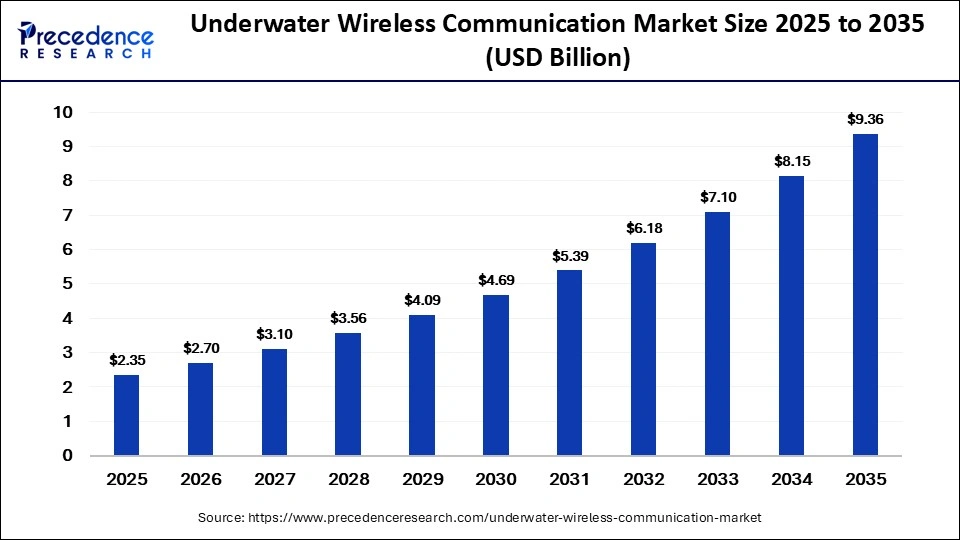
ICT industry specialist Gautam Mahajan estimates the underwater wireless communication market at USD 2.70 billion in 2026, with continued technology adoption expected to take the market to USD 9.36 billion by 2035 at a CAGR of 14.80%. Leading underwater wireless communication market providers such as EvoLogics, Teledyne Marine, Kongsberg Maritime are expanding their capabilities across segments including technology, component, network type, application, end-use industry.
Source: https://www.precedenceresearch.com/underwater-wireless-communication-market
 Get a Sample
 Table Of Content


Underwater Wireless Communication Market Size and Forecast 2026 to 2035
The global underwater wireless communication market size accounted for USD 2.35 billion in 2025 and is predicted to increase from USD 2.70 billion in 2026 to approximately USD 9.36 billion by 2035, expanding at a CAGR of 14.80% from 2026 to 2035. Increasing use of underwater wireless communication in defense applications, oil and gas operations, and marine research activities drives the market.
Key Takeaways
- North America led the underwater wireless communication market with a share of 36% in 2025.
- Asia-Pacific is expected to be the fastest-growing region with a CAGR of 18.4% in the forecasted duration.
- By technology, the acoustic communication segment led the market with 68% share in 2025.
- By technology, the optical communication segment is expected to be the fastest growing, with a CAGR of about 19.8% in the coming years.
- By component, the hardware segment accounted for the highest revenue share with 63% share in 2025.
- By component, the software segment is expected to be the fastest-growing with a CAGR of 17.4% in the foreseeable period.
- By network type, the underwater sensor networks segment held the largest revenue share of 34% in the underwater wireless communication market in 2025.
- By network type, the autonomous underwater vehicle (AUV) communication segment is expected to grow at the fastest CAGR of 18.3% in the forthcoming years.
- By application, the defense and security segment accounted for the highest revenue share of 28% in 2025.
- By application, the offshore renewable energy segment is expected to grow at the highest CAGR of 20.1% in the foreseeable period.
- By end-use industry, the defense and military segment held the largest revenue share of 32% in 2025.
- By end-use industry, the energy and utilities segment is expected to expand rapidly with a CAGR of 19.3% from 2026 to 2035.
Market Overview
Underwater wireless communication refers to the transmission of information within aquatic environments through methods like visible light and acoustic signals. This includes systems designed for real-time voice communication and sophisticated sensor networks for detection and monitoring. Furthermore, underwater wireless communication is essential for various applications, such as long-term marine environmental monitoring, inspection of underwater infrastructure, seabed mapping, and collaborative operations involving multiple autonomous platforms.
Impact of Artificial Intelligence in the Underwater Wireless Communication Industry
Artificial intelligence (AI) is transforming underwater wireless communication into innovative ways. AI accelerators greatly enhance system energy efficiency, facilitate application-specific semantic transmissions, and introduce fresh strategies for mobility and network management. Moreover, AI-driven frameworks are improving energy efficiency and promoting sustainability in marine wildlife monitoring applications within underwater sensor networks.
Underwater Wireless Communication Market Trends
- Advanced Modulation and Signal Processing Trends: The market is witnessing growing adoption of advanced modulation formats, including OFDM-QAM combinations, alongside robust detection, forward-error correction, and adaptive beam shaping technologies to improve underwater communication reliability and performance.
- Swarm AUV and Underwater IoT Integration: A key market trend is the integration of swarm AUVs with underwater IoT ecosystems, enabling enhanced operational coordination, expanded mission capabilities, and more reliable, secure, and versatile communication networks.
- Rising Adoption of Electromagnetic Communication Systems: Increasing deployment of electromagnetic communication technologies for military submarine-to-command-center connectivity is emerging as a significant trend, driven by growing defense modernization initiatives and underwater security requirements.
Market Report Coverage and Key Metrics
| Report Coverage | Details |
| Market Size in 2025 | USD 2.35 Billion |
| Market Size in 2026 | USD 2.70 Billion |
| Market Size by 2035 | USD 9.36 Billion |
| Market Growth Rate from 2026 to 2035 | CAGR of 14.80% |
| Dominating Region | North America |
| Fastest Growing Region | Asia Pacific |
| Base Year | 2025 |
| Forecast Period | 2026 to 2035 |
| Segments Covered | Technology, Component, Network Type, Application, End-Use Industry, and Region |
| Regions Covered | North America, Europe, Asia-Pacific, Latin America, and Middle East & Africa |
Market Dynamics
Drivers
Growing Demand for Advanced Underwater Communication Systems
Increasing underwater exploitation activities, particularly in marine environments, are driving demand for underwater wireless communication systems. Market growth is further supported by the expanding use of underwater robotics, autonomous vehicles, defense applications, oil and gas operations, and marine research initiatives.
Restraint
Technical and Environmental Challenges
The challenging underwater environment continues to restrain market growth due to signal attenuation, interference, limited transmission efficiency, and energy constraints. Additionally, concerns regarding the potential impact of communication technologies on marine ecosystems create adoption challenges.
Opportunity
Advancements in Next-Generation Communication Technologies
Ongoing advancements in communication technologies, particularly 6G research, are creating significant growth opportunities for underwater wireless communication networks. Increasing demand for enhanced connectivity in naval defence, offshore oil and gas operations, and other marine applications is expected to support future market expansion.
Market Segmentation Analysis
Technology Insights
The Acoustic Communication Segment Led the Market with a 68% Share in 2025
The acoustic communication segment led the underwater wireless communication market with a 68% share in 2025, driven by its effective long-range underwater communication capabilities and established use in defense applications. By utilizing acoustic sound waves, this method facilitates data transmission in underwater environments, making it ideal for extensive communication. Additionally, the increasing adoption of ocean monitoring systems and the expansion of underwater sensor networks are significant contributors to this segment's growth.
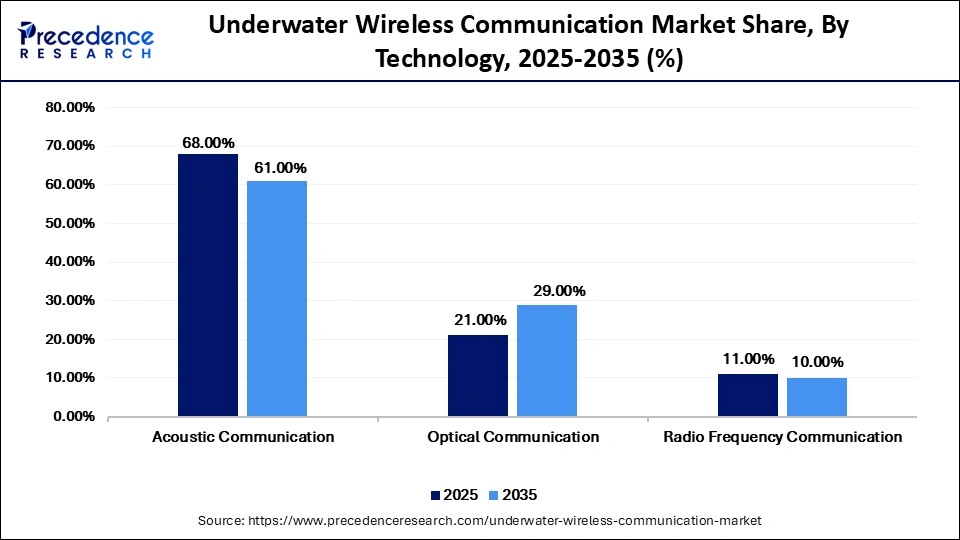
The optical communication segment held 21% of the market share in 2025 and is expected to emerge as the fastest-growing segment with a CAGR of 19.8% from 2026 to 2035, due to its exceptionally high-speed data transmission capabilities and the rising implementation in underwater robotics. By employing light waves, typically through fiber optics, this method enables high-capacity communication systems characterized by extremely high carrier frequencies and unique optical signal properties. Furthermore, the surging demand for real-time video transfer is propelling the growth of this segment.
The radio frequency communication segment held 11% of the market share in 2025 and is expected to grow at a CAGR of 11.1% in the upcoming years, supported by the need for short-range underwater communication and the increasing utilization in shallow-water applications. The radio frequency spectrum, a crucial and limited wireless resource, faces pressure from escalating data demands and long-term government licensing across extensive regions. Additionally, integration with hybrid communication systems is further enhancing growth opportunities in this segment.
Component Insights
The Hardware Segment Dominated the Market with a 63% Share in 2025
The hardware segment dominated the underwater wireless communication market with a 63% share in 2025, driven by the rising deployment of underwater modems and the increasing installation of sensor networks. Furthermore, growth in AUV and ROV systems, expansion of offshore communication infrastructure, and demand for ruggedized communication equipment support its dominance.
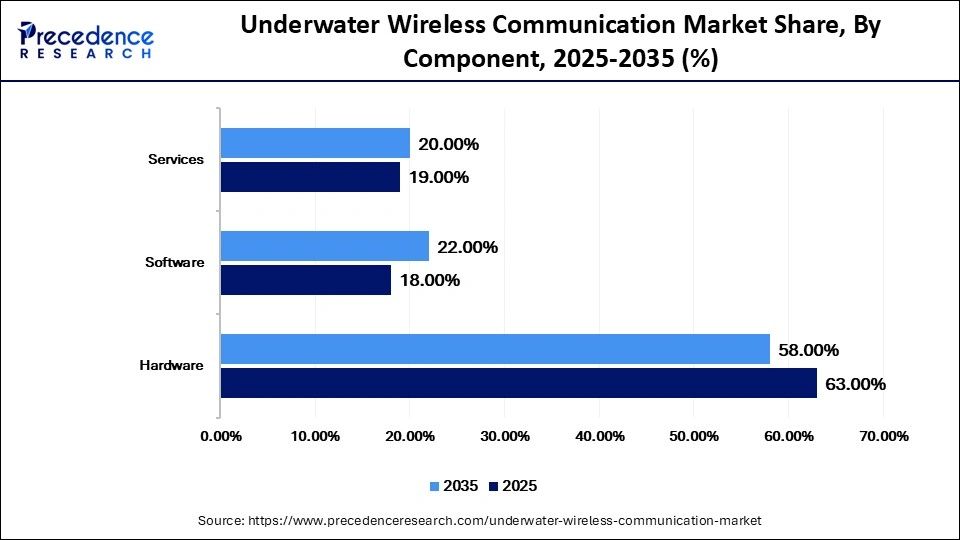
The software segment accounted for about 18% of the market share in 2025 and is projected to be the fastest-growing segment, with a CAGR of 17.4% during the forecast period, due to the increasing need for network management platforms and growth in AI-enabled communication optimization. Rising demand for underwater data analytics, expansion of autonomous marine systems, and improved communication protocol development further support growth.
The services segment secured about 19% of the market share in 2025 and is expected to grow at a CAGR of 15.8% in the coming years, supported by growing demand for system integration services and increasing maintenance of subsea communication networks. Furthermore, the expansion of offshore deployment projects, rising consulting and monitoring services, and the need for lifecycle support solutions promote adoption.
Network Type Insights
The Underwater Sensor Networks Segment Held the Largest Market Share of 34% in 2025
The underwater sensor networks segment held the largest revenue share of 34% in the underwater wireless communication market in 2025, driven by an increasing focus on environmental monitoring projects and heightened offshore asset surveillance. Underwater sensor networks are set to support a range of applications, including oceanographic data collection, pollution monitoring, offshore exploration, disaster prevention, assisted navigation, and tactical surveillance. Additionally, the rise of smart ocean initiatives and the growing demand for marine data collection further bolster this segment's expansion.
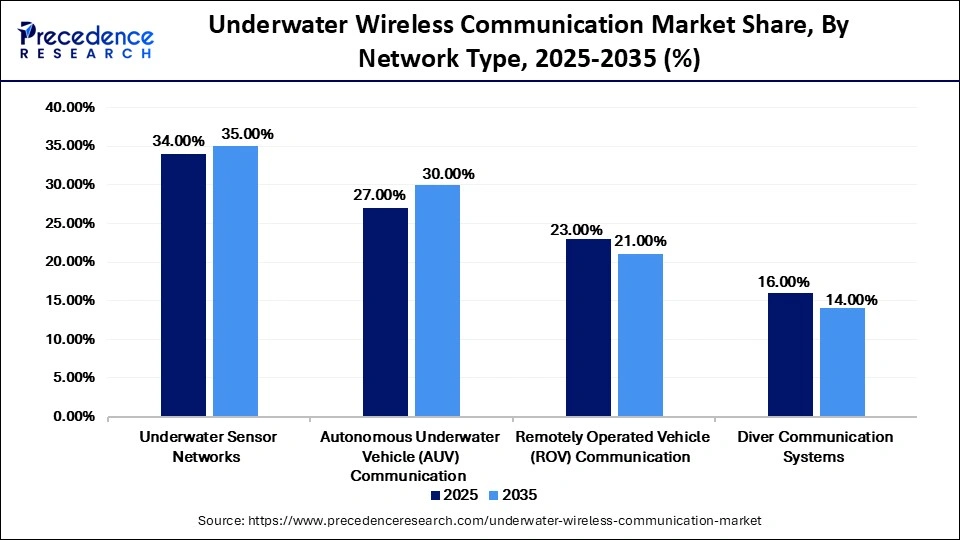
The autonomous underwater vehicle (AUV) communication segment captured 27% of the market share in 2025 and is expected to grow at a CAGR of 18.3% in the coming years, supported by the rising deployment of autonomous marine systems and the increasing need for defense reconnaissance applications. AUVs are self-propelled, unmanned, and untethered, capable of performing simple tasks with minimal human oversight. Furthermore, the expansion of offshore inspection activities and the growing number of deep-sea exploration missions contribute to this segment's advancement.
The remotely operated vehicle (ROV) communication segment held 23% of the market share in 2025 and is expected to grow at a CAGR of 13.1% from 2026 to 2035, driven by offshore oil and gas inspection activities and an increase in subsea maintenance operations. ROVs are underwater vehicles controlled from the surface via a cable, allowing for efficient power and communication. The rise in underwater construction projects and the expansion of underwater infrastructure monitoring also play significant roles in this segment's growth.
Application Insights
The Defense and Security Segment Dominated the Market with a 28% Share in 2025
The defense and security segment dominated the underwater wireless communication market, accounting for a 28% share in 2025, due to naval modernization programs worldwide and increasing underwater surveillance requirements. Furthermore, the rising expansion of anti-submarine warfare capabilities is supporting segment growth.
Underwater Wireless Communication Market Share, By Application, 2025-2035 (%)
| Application | 2025 | 2035 | CAGR (%) |
| Environmental Monitoring | 19.00% | 20.00% | 15.7% |
| Oil & Gas Exploration | 24.00% | 20.00% | 11.6% |
| Defense & Security | 28.00% | 29.00% | 15.6% |
| Scientific Research | 12.00% | 12.00% | 14.4% |
| Offshore Renewable Energy | 8.00% | 11.00% | 20.1% |
| Underwater Robotics & Inspection | 9.00% | 8.00% | 13.8% |
The oil and gas exploration segment secured 24% of the market share in 2025 and is expected to grow at a CAGR of 11.6% during the forecast period, supported by growing offshore exploration activities and increasing subsea asset monitoring needs. Furthermore, the expansion of deepwater projects, rising demand for underwater inspection systems, and increasing operational efficiency requirements are contributing to segment growth.
The offshore renewable energy segment held 8% of the market share in 2025 and is expected expand rapidly with a CAGR of 20.1% in the coming years, driven by the rapid expansion of offshore wind farms and increasing subsea cable monitoring requirements. Moreover, growth in marine energy projects, rising infrastructure inspection activities, and demand for predictive maintenance systems are further supporting the expansion of the market.
End-Use Industry Insights
The Defense and Military Segment Led the Market with a 32% Share in 2025
The defense and military segment led the underwater wireless communication market with a 32% share in 2025, due to increasing naval communication modernization and rising maritime surveillance activities. Furthermore, growth in underwater defence networks, expansion of autonomous underwater systems, and increasing geopolitical security concerns support market growth.
Underwater Wireless Communication Market Share, By End-Use Industry, 2025-2035 (%)
| End-Use Industry | 2025 | 2035 | CAGR (%) |
| Defense & Military | 32.00% | 33.00% | 15.2% |
| Oil & Gas | 26.00% | 22.00% | 11.9% |
| Marine Research Institutes | 15.00% | 15.00% | 15.0% |
| Energy & Utilities | 11.00% | 14.00% | 19.3% |
| Commercial Marine | 10.00% | 10.00% | 14.1% |
| Others | 6.00% | 6.00% | 13.4% |
The oil and gas segment held 26% of the market share in 2025 and is expected to grow at a CAGR of 11.9% in the coming years due to offshore exploration and production growth and increasing subsea asset monitoring. Moreover, rising demand for underwater inspection systems, expansion of deepwater developments, and the need for operational reliability are supporting growth.
The energy and utilities segment held 11% of the market share in 2025 and is expected to witness the fastest growth with a CAGR of 19.3% over the studied period, due to the expansion of offshore renewable energy projects. Furthermore, increasing subsea cable monitoring requirements, rising underwater asset inspection activities, growth in marine energy infrastructure, and demand for predictive maintenance solutions are driving growth.
Market Regional Analysis: North America, Europe, Asia-Pacific
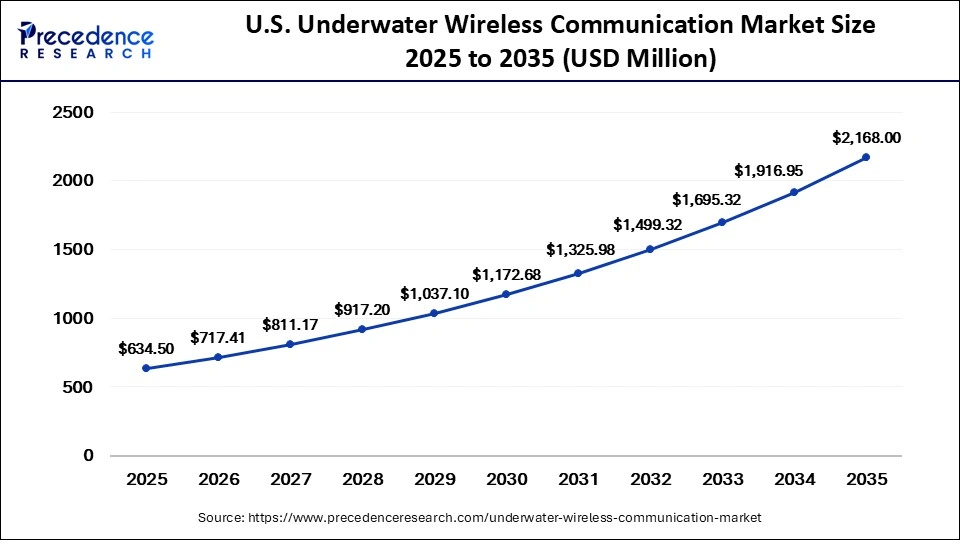
U.S. Underwater Wireless Communication Market Size and Growth 2026 to 2035
The U.S. underwater wireless communication market size was evaluated at USD 634.50 million in 2025 and is projected to reach around USD 2,168.00 million by 2035, growing at a CAGR of 13.10% from 2026 to 2035.
North America: Dominated with 36% Share in 2025
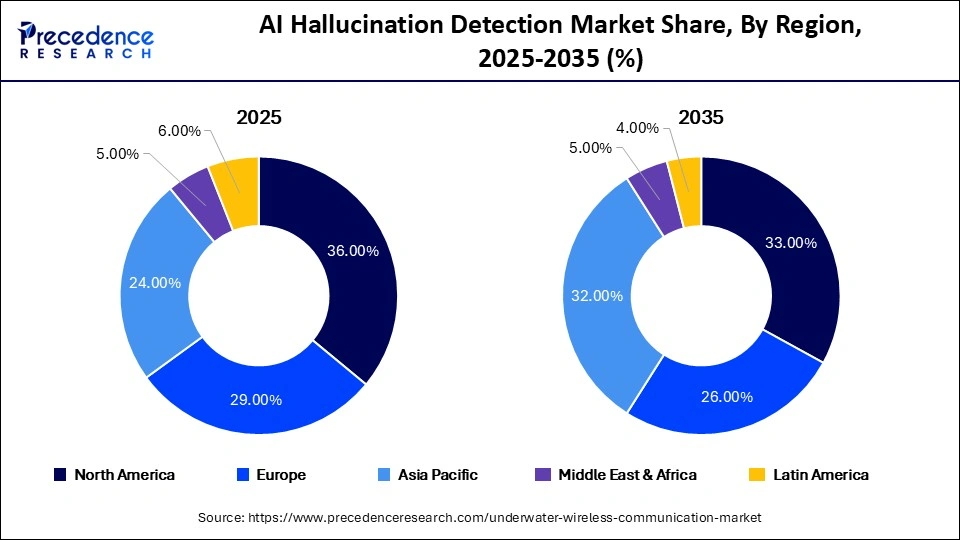
North America held a major revenue share of 36% in the underwater wireless communication market in 2025, driven by rising naval modernization programs and the increasing deployment of underwater sensor networks. Moreover, growth in offshore energy infrastructure monitoring, the expansion of autonomous underwater vehicle operations, and strong marine research investments support the region's dominance.
U.S. Market Analysis
The U.S. is at the forefront of the North American market, supported by highly developed digital infrastructure, widespread enterprise adoption of IoT and automation solutions, a vibrant innovation ecosystem, and high levels of consumer and government investment, all of which create a fertile environment for advancements in underwater wireless communication.
Which Factors Drive the Underwater Wireless Communication Market in Asia-Pacific?
Asia-Pacific held 24% of the market share in 2025 and is expected to experience the fastest growth with a CAGR of 18.4% during the predicted timeframe, supported by rising defense spending across maritime nations and the expansion of offshore oil & gas exploration. Furthermore, the increasing deployment of underwater drones, rising investments in marine research infrastructure, and a growing focus on maritime security support market growth.
China Market Analysis
China is at the forefront of the Asia-Pacific market due to the increasing use of machine learning models, autonomous technologies, and advanced analytics. Industries such as healthcare, automotive, retail, financial services, and technology are investing in high-quality training datasets to improve AI performance.
How is Europe Growing in the Underwater Wireless Communication Market?
Europe held a 29% of the market share in 2025 and is expected to witness substantial growth with a CAGR of 13.8% from 2026 to 2035, supported by the expansion of offshore wind projects and growing maritime surveillance initiatives. Moreover, rising investment in oceanographic research and increasing naval communication modernization are contributing to market growth.
Germany Market Analysis
Germany is performing strongly in the European market, driven by the presence of major key players and increasing research and development activities across the region. Moreover, the development of subsea monitoring systems is further supporting market growth.
Will the Middle East and Africa Grow in the Underwater Wireless Communication Market?
The Middle East and Africa held 5% of the market share in 2025 and is expected to grow at a CAGR of 14.5% in the coming years, driven by the expansion of offshore hydrocarbon exploration and growing subsea infrastructure monitoring needs. Furthermore, increasing naval security investments are supporting market growth.
UAE Market Analysis
The UAE is witnessing significant market growth, driven by the rising adoption of underwater communication technologies. Moreover, growth in offshore energy projects and supportive government policy programs are further contributing to market expansion.
What are the Key Trends of the Market in Latin America?
Latin America held 6% of the market share in 2025 and is expected to grow at a CAGR of 13.7% throughout the forecast period, supported by offshore oil field development activities. Moreover, increasing marine environmental monitoring and rising demand for subsea communication systems are promoting market growth.
Brazil Market Analysis
Brazil is performing well in the Latin American market, driven by the expansion of oceanographic studies and growth in underwater inspection operations.
Market Competitive Landscape: Leading Companies and Strategies
The underwater wireless communication market is currently characterized by a moderate level of consolidation. Key players are concentrating on developing advanced subsea acoustic modems, instrumentation, and sensors that are essential for both defense and offshore energy sectors. Additionally, the market features companies that provide geodata and subsea telemetry solutions, primarily catering to the offshore oil, gas, and renewable energy industries.
Companies face several challenges, including the industry's inherent complexity and significant engineering, environmental, and financial hurdles. Nevertheless, there is a growing emphasis on high-end subsea automation, robotics, and acoustic communication systems, particularly for use in autonomous underwater vehicles (AUVs). Moreover, substantial investments in next-generation research and development are helping these companies establish themselves as leaders in long-range underwater wireless tracking and safety for exploration.
Underwater Wireless Communication Market Companies
- EvoLogics
- Teledyne Marine
- Kongsberg Maritime
- Sonardyne International
- L3Harris Technologies
- Thales
- Ultra Maritime
- OceanAlpha
- EdgeTech
- Blueprint Subsea
- DSPComm
- AquaSeNT
- Subnero
- Nortek
- LinkQuest
Recent Developments Underwater Wireless Communication Market (2025-2026)
- In June 2026, UK-based robotic systems manufacturer HydroSurv Unmanned Survey and underwater wireless communication and networking specialist Subnero established a collaboration to demonstrate an autonomous subsea connectivity layer for persistent offshore and ocean monitoring programs. The integrated solution combines HydroSurv's battery-electric and battery-hybrid unmanned surface vehicles (USVs) with Subnero's acoustic smart modems and underwater networking software.(Source: https://www.bairdmaritime.com)
- In June 2026, Florida Atlantic University (FAU) received a 12-month, $1 million award through the AUKUS Maritime Innovation Challenge, a trilateral defense innovation initiative supported by the United States, Australia, and the United Kingdom. Selected from a highly competitive international field, the project will develop a next-generation underwater communication system that enables autonomous vehicles, sensors, and operators to exchange information more quickly, reliably, and securely beneath the ocean surface.(Source: https://oceannews.com/)
Segments Covered in the Report
By Technology
- Acoustic Communication
- Optical Communication
- Radio Frequency Communication
By Component
- Hardware
- Software
- Services
By Network Type
- Underwater Sensor Networks
- Autonomous Underwater Vehicle (AUV) Communication
- Remotely Operated Vehicle (ROV) Communication
- Diver Communication Systems
By Application
- Environmental Monitoring
- Oil & Gas Exploration
- Defense & Security
- Scientific Research
- Offshore Renewable Energy
- Underwater Robotics & Inspection
By End-use Industry
- Defense & Military
- Oil & Gas
- Marine Research Institutes
- Energy & Utilities
- Commercial Marine
- Others
By Region
- North America
- Latin America
- Europe
- Asia-pacific
- Middle and East Africa
For inquiries regarding discounts, bulk purchases, or customization requests, please contact us at sales@precedenceresearch.com
Frequently Asked Questions





Ask For Sample
No cookie-cutter, only authentic analysis – take the 1st step to become a Precedence Research client
 Get a Sample




 sales@precedenceresearch.com
 Schedule a Meeting
