



Video Surveillance Market Revenue to Attain USD 212.18 Bn by 2033
Published: 03 Dec 2025
Author: Precedence Research



Video Surveillance Market Revenue and Trends 2025 to 2033
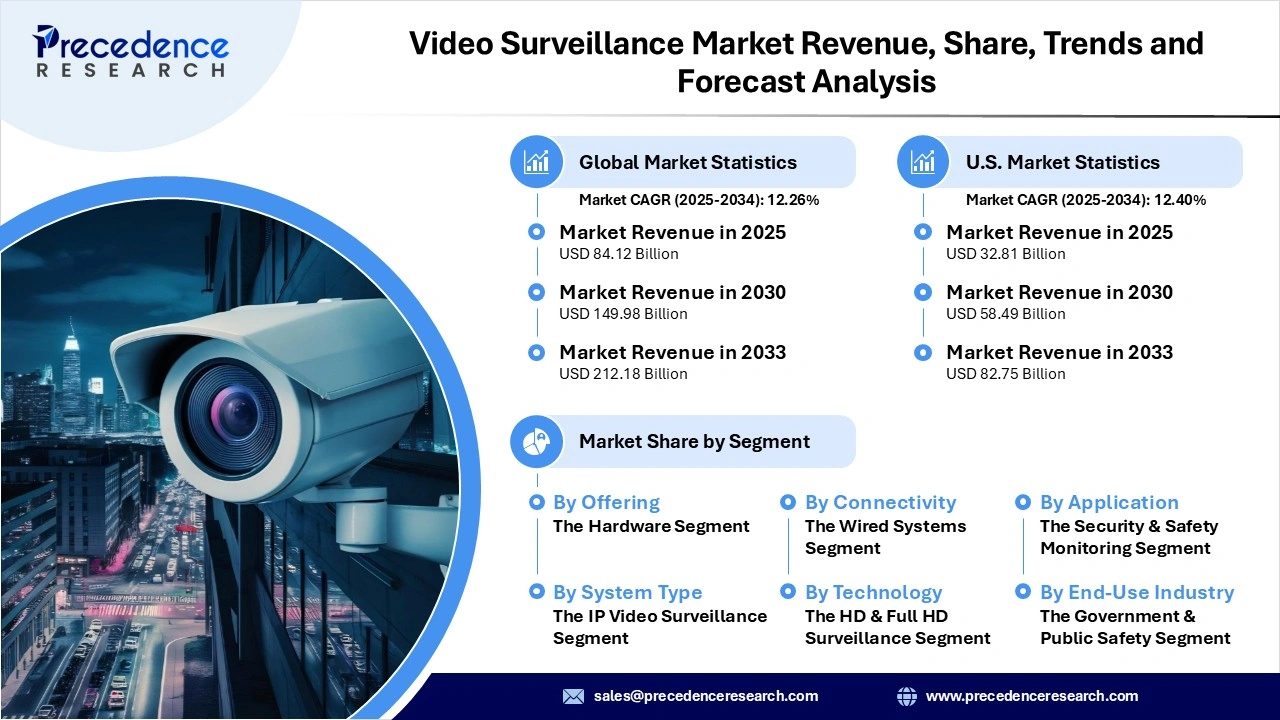
The global video surveillance market revenue surpassed USD 84.12 billion in 2025 and is predicted to attain around USD 212.18 billion by 2033, growing at a CAGR of 12.26%. The market is growing due to rising security challenges, deterrence of crime and unethical activities, the growing need for public and private infrastructure protection, and the global push for smart cities.
What are the Driving Factors of the Video Surveillance Market?
The video surveillance market is expanding significantly due to rising security threats across public, private, and critical infrastructure environments, creating an urgent need to safeguard transportation hubs, commercial facilities, residential complexes, and government assets from real-time risks. Adoption is further accelerated by the integration of advanced technologies such as AI-driven video analytics, cloud storage, edge computing, and IP-based surveillance networks, which collectively improve detection accuracy, situational awareness, and automated response capabilities.
The rapid proliferation of smart devices and IoT ecosystems across urbanizing regions is fueling demand for robust, interconnected surveillance systems that can support large data streams and operate seamlessly within smart city infrastructures. The growing popularity of high-resolution imaging, including 4K and multi-sensor cameras, is also driving the requirement for smarter, scalable storage solutions capable of handling high-bandwidth video data.
Segmental Insights
- By Offering, The hardware segment is dominating due to its critical and fundamental role in the video surveillance systems, including cameras, monitors, and storage systems.
- By System Type, The IP video surveillance segment leads the market due to its excellent image quality and high scalability compared to traditional analogue systems.
- By Connectivity, The wired systems segment is dominant due to its suitability for large-scale installations and its high stability with an uninterrupted power supply.
- By Technology, The HD and Full HD surveillance segment dominates the market owing to the excellent image quality and flexibility in data requirements.
- By Application, The security and safety monitoring segment dominates the market due to the growing priority placed on regional and national security against illegal activities.
- By End User Industry, The government and public safety segment held the largest market share due to stringent safety and national security regulations.
Regional Insights
The Asia-Pacific video surveillance market is leading globally, holding the largest market share due to rapid urbanization, large-scale smart city deployments, and intensified security concerns across densely populated metropolitan areas. Governments in China, India, South Korea, Singapore, and Japan are making substantial investments in national security programs, including modern border monitoring, public-safety analytics, and citywide camera networks integrated with real-time command centers. These initiatives directly elevate demand for AI-enabled surveillance systems, high-resolution IP cameras, and cloud-based monitoring architectures.
Many leading businesses across sectors such as banking, retail, logistics, manufacturing, and transportation are increasingly deploying advanced surveillance solutions to protect high-value assets, deter criminal activity, and maintain continuous environmental and operational oversight.
North America is witnessing the fastest growth rate in the video surveillance market due to heightened security concerns, increasing public-safety mandates, and strong federal and state-level investments in modern surveillance infrastructure for transportation hubs, critical facilities, and urban safety networks. Government programs in the United States and Canada are accelerating the deployment of AI-powered video analytics, cloud-integrated systems, and advanced facial and license-plate recognition technologies to improve real-time threat detection and coordinated emergency response, offering far superior performance compared to traditional analog systems.
The rapid shift toward Video Surveillance-as-a-Service (VSaaS) is gaining strong momentum in the region, as enterprises prefer subscription-based, scalable solutions that reduce upfront hardware spending and simplify long-term maintenance. Retailers, logistics operators, healthcare facilities, and corporate campuses are increasingly leveraging video analytics for workflow optimization, queue management, occupancy tracking, and customer behavior insights, transforming surveillance from a security-only tool into an operations-enhancing asset. These structural shifts, combined with high adoption of cloud services and strong digital infrastructure, are propelling North America’s fast-growing position in the global video surveillance market.
Video Surveillance Market Coverage
| Report Attribute | Key Statistics |
| Market Revenue in 2025 | USD 84.12 Billion |
| Market Revenue by 2033 | USD 212.18 Billion |
| CAGR from 2025 to 2033 | 12.26% |
| Quantitative Units | Revenue in USD million/billion, Volume in units |
| Largest Market | Asia Pacific |
| Base Year | 2024 |
| Regions Covered | North America, Europe, Asia-Pacific, Latin America, and the Middle East & Africa |
Recent Developments
- In November 2025, the railway division of Trichy installed a highly advanced video surveillance system to enhance passenger safety, with high-resolution monitoring of every sensitive area and round-the-clock surveillance.(Source: https://timesofindia.indiatimes.com)
Get this report to explore global market size, share, CAGR, and trends, featuring detailed segmental analysis and an insightful competitive landscape overview @ https://www.precedenceresearch.com/sample/7163
You can place an order or ask any questions, please feel free to contact us at sales@precedenceresearch.com |+1 804 441 9344