



Radioembolization Therapy Market Size, Companies, Share, Patient Volume, Treatment Adoption Rates, Pricing Analysis, Regulatory Landscape, Competitive Positioning, and Demand Forecast
Radioembolization Therapy Market (By Product Type: Yttrium-90 Microspheres, Holmium-166 Microspheres, Other Radioactive Microspheres; By Procedure Type: Selective Internal Radiation Therapy, Whole Liver Radioembolization, Segmental Radioembolization; By Technology: Trans Arterial Radioembolization, Selective Internal Radiation Therapy; By Application: Primary Liver Cancer, Metastatic Liver Cancer, Other Cancers) - Global Industry Analysis, Size, Trends, Leading Companies, Regional Outlook, and Forecast 2026 to 2035
Source: https://www.precedenceresearch.com/radioembolization-therapy-market
 Get a Sample
 Table Of Content


What is the Radioembolization Therapy Market Size in 2026?
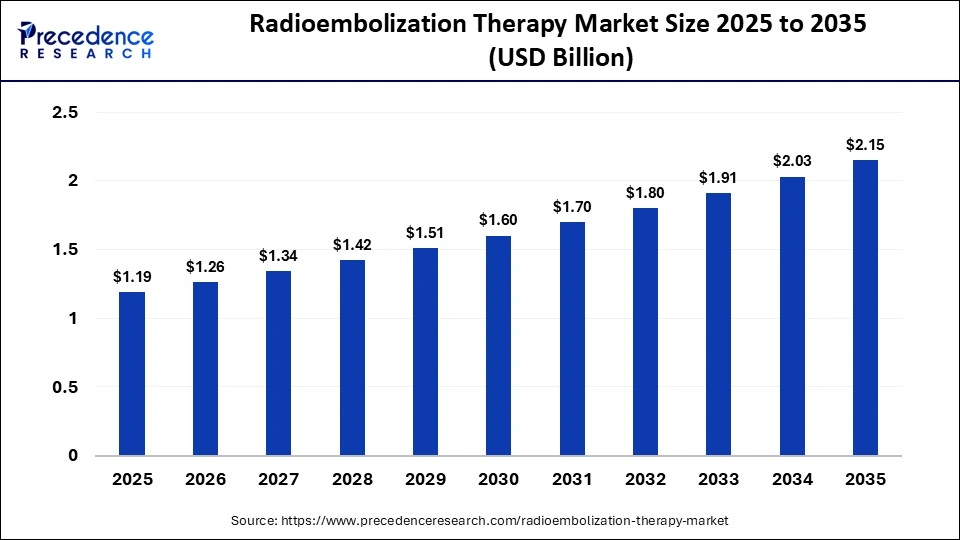
The global radioembolization therapy market size accounted for USD 1.19 billion in 2025 and is predicted to increase from USD 1.26 billion in 2026 to approximately USD 2.15 billion by 2035, expanding at a CAGR of 7.64% from 2026 to 2035. The radioembolization therapy market is observing growth lately due to the rising prevalence of liver cancer globally, higher demand for minimally invasive, effective treatments, and technological advancements for effective and successful procedures. Higher demand for targeted therapies, which deliver effective results and high success rates, also helps fuel the market's growth.
Key Takeaways
- North America dominated the global radioembolization therapy market in 2025.
- Asia Pacific is observed to be the fastest-growing region in the foreseeable period.
- By product type, the Yttrium-90 microspheres segment led the global market in 2025.
- By product type, the Holmium-166 microspheres segment is observed to grow with the highest CAGR in the forecast period.
- By procedure type, the selective internal radiation therapy (SIRT) segment held a majority revenue share in 2025.
- By procedure type, the segmental radioembolization segment is expected to host the fastest-growing market in the coming years.
- By technology, the trans arterial radioembolization segment dominated the market in 2025.
- By technology, the selective internal radiation therapy segment is expected to grow at the fastest CAGR during the forecast period.
- By application, the primary liver cancer segment dominated the market in 2025.
- By application, the metastatic liver cancer segment is expected to grow at the fastest CAGR during the forecast period.
What is the Radioembolization Therapy Market?
The market focuses on the use of targeted therapies to treat liver cancer effectively. The therapy involves delivering high-dose radiation directly to liver tumors via radioactive microspheres with the help of Yttrium-90 injected into the hepatic artery. The market also focuses on palliative, unresectable liver cancer care. The market is inclusive of products, procedures, and devices utilized for internal radiation therapy, combining embolization with radiotherapy. The market is also considered to be a specialized sector of the interventional oncology field. Factors such as target application, dual-action mechanism, and curative radiation also help to fuel the growth of the market. The growing prevalence of liver cancer and the use of advanced technologies for the treatment of a major disease are expected to be the largest drivers of the market's growth.
Role of Technology in the Growth of Radioembolization Therapy Market
The main role of the technological advancements of the industry involves ensuring precision, safety, and efficiency in treating liver cancers. The segment involves the use of sophisticated glass and resin microspheres to allow preciseand high-dose radiation directly to tumors. The segment also focuses on the use of SPECT to predict particle distribution and reduce the risk of complications. The use of AI optimizes dose calculations and treatment planning, which is helpful to improve efficiency. Technological advancements also help to enable faster treatments and single-day treatments to lower the risk of multiple visits to the hospital. Machine learning algorithms help to have an overall look over the dataset of the patient and suggest recommended treatment options to predict the outcome, as well as based on the responses to the treatment options. Various other technologies, such as PET, MRI, and 3D imaging, help in tumor localization and treatment verification.
Radioembolization Therapy Market Trends
- Higher Demand for SIRT: Higher demand for Selective Internal Radiation Therapy due to its effectiveness in treating unresectable hepatocellular carcinoma is one of the major factors propelling the growth of the industry.
- Personalization and Customization: Higher demand for personalized, advanced, and voxel-based dosimetry is used for better radiation mapping of tumors, along with reducing cold spots.
- Higher demand for Minimally Invasive Procedures: Higher demand for minimally invasive procedures over traditional methods for better and effective patient outcomes in stable pricing also fuels the industry's growth.
Market Scope
| Report Coverage | Details |
| Market Size in 2025 | USD 1.19 Billion |
| Market Size in 2026 | USD 1.26 Billion |
| Market Size by 2035 | USD 2.15 Billion |
| Market Growth Rate from 2026 to 2035 | CAGR of 7.64% |
| Dominating Region | North America |
| Fastest Growing Region | Asia Pacific |
| Base Year | 2025 |
| Forecast Period | 2026 to 2035 |
| Segments Covered | Product Type, Procedure Type, Technology, Application, and Region |
| Regions Covered | North America, Europe, Asia-Pacific, Latin America, and Middle East & Africa |
Segmental Insights
Product Type Insights
Which Component of the Product Type Segment Dominated the Market in 2025?
The Yttrium-90 microspheres segment dominated the global radioembolization therapy market in 2025. The segment majorly observes growth due to high usage of Y-90 due to its clinical usage in liver embolization procedures, FDA approvals, and widespread adoption by providers. Such microspheres are available in glass and resin variants. The segment also observes growth as it acts as a critical, minimally invasive, and increasingly frontline, locoregional treatment for primary and secondary liver cancers. The segment also observes growth due to global distribution network, physician familiarity, and consistent clinical outcomes, which are helpful to drive the demand for oncology centres as well. Significant tumor control, high response rate, and the ability to treat tumors in patients with portal thrombosis also fuel the growth of the segment.
The Holmium-166 microspheres segment is observed to have the highest CAGR in the radioembolization therapy market in the studied years. The segment observes growth in the foreseen period due to its unique theranostic capabilities, helpful for individualized and precise dosimetry. The segment also has an essential role in the growth of the market, as it helps to verify the limitations of Y-90 to enhance the treatment planning precision. The segment majorly focuses on the use of the same particle to identify discrepancies between pre-treatment imaging and final treatment delivery, which is helpful to improve safety and enable high-tumor-specific dosing. The dual-imaging capability of the segment enables magnetic resonance imaging, which is helpful for the growth of the segment. The segment is also observed to be expanding through positive clinical outcomes in treating primary and secondary liver tumors.
Procedure Type Insights
Which Component of the Procedure Type Segment Led the Global Market in 2025?
The selective internal radiation therapy (SIRT) segment contributed the biggest revenue share in the radioembolization therapy market in 2025. The segment is also abbreviated as Transcatheter Arterial Radioembolization (TARE), as it is a primary driver in the interventional oncology market. The segment enables controlled and targeted delivery of radioactive microspheres via the hepatic artery to balance the tumor dose coverage for effective results. The segment is mainly considered a standard form of care for hepatocellular carcinoma and liver metastasis, especially when tumors are unresectable. The integration of SIRT with immunotherapy is helping the radioembolization therapy industry to create new therapeutic avenues helpful for the growth of the market. The segment's adaptability across palliative and disease-control settings is expected to sustain high utilization.
The segmental radioembolization segment of the radioembolization therapy market is expected to expand rapidly with the highest CAGR in the expected years. The main aim of the segment is the major shift from palliative lobar therapy to curative-intent treatment for small unresectable tumors. The segment also helps in superior tumor control with the help of the delivery of high ablative doses to specific tumors, resulting in effective tumor control. Limiting the radiation by clinicians to treat smaller, localized tumors, without causing significant radiation damage, also fuels the growth of the market. The segment also emphasizes the use of segmental approaches to induce hypertrophy of the healthy liver. One of the major advantages of the treatment form is that it minimizes adverse effects such as radiation-induced liver disease to boost clinician confidence, further propelling the growth of the market in the foreseen period.
Technology Insights
Which Technology Segment Led the Global Market in 2025?
The trans arterial radioembolization segment held the largest share of the radioembolization therapy market in 2025 by offering a minimally invasive, targeted Yttrium-90 therapy with fewer side effects than chemoembolization. Its superior ability to treat advanced liver cancer, including portal vein thrombosis, and high success in tumor downstaging, cements its market leadership.
The selective internal radiation therapy segment is estimated to grow at the fastest CAGR during the predicted period. SIRT is the fastest-growing radioembolization therapy, driven by surging liver cancer rates, rising demand for minimally invasive procedures, and superior targeted delivery of radioactive microspheres (Y-90), resulting in improved patient outcomes, reduced hospital stays, and expanding clinical applications for inoperable tumors.
Application Insights
How the Primary Liver Cancer Segment Led the Global Market in 2025?
The primary liver cancer segment dominated the radioembolization therapy market in 2025 through targeted Yttrium-90 microsphere delivery, exploiting tumor hypervascularity to maximize damage while sparing healthy tissue. It bridges or downstages unresectable patients, offering superior, minimally invasive, and effective palliative care options, with a rising incidence fueling growth.
The metastatic liver cancer segment is expected to grow at the fastest CAGR during the forecast period due to rising colorectal cancer, increasing adoption of Y-90 for liver metastases, advancements in minimally invasive technologies, and growing clinical evidence showing longer time-to-progression compared to conventional chemotherapy options for patients.
Regional Insights
Why did North America lead the Global Radioembolization Therapy Market in 2025?
North America held a major revenue share of the market in 2025, mainly due to factors such as the growing prevalence of cancer, higher demand for minimally invasive procedures, and higher adoption of technological advancements in radioembolization therapies. The lifestyle traits of the region, leading to observance of major cases of hepatocellular carcinoma and metastatic liver disease, also propel the growth of the market in the region. The region also has a robust network of specialized cancer centers, hospitals, and outpatient ambulatory surgery centers, facilitating the adoption of complex procedures. Inclusion of advanced technology in the liver disease treatment options in the form of AI-driven treatment planning, personalized dosimetry, along with next-generation catheter technologies to enhance precision, also fuels the growth of the industry.
The U.S. Radioembolization Therapy Market Trends
The advanced healthcare infrastructure, prevailing cases of liver cancer, and rapid adoption of minimally invasive surgeries have made a major contribution to the growth of the market in the U.S. Treatment therapies such as TARE are highly used in the region to treat hepatocellular carcinoma cases and elevate the success rate of treating such issues in the region as well. The higher insurance coverage, including Medicare and private insurance in the US, is also one of the major factors propelling the growth of the industry.
Why is the Asia Pacific Observed to be the Fastest Growing Region in the Foreseen Period?
Asia Pacific is observed to be the fastest growing region with the highest CAGR in the expected years due to major reasons such as prevalence of the liver disorder, higher demand for advanced and minimally invasive treatment options, along with growing healthcare infrastructure. The region majorly observes growth due to higher demand for treatment options such as Y-90 and SIRT. Technological advancements in molecular imaging to improve the treatment precision also fuel the market growth in the foreseen period. Government investment in nuclear medicine , along with the development of greenfield hospitals and radiotherapy centers, also boosts the growth of the industry. The market also serves as a bridge-to-transplant therapy in areas with limited deceased donor availability.
China Radioembolization Therapy Market Trends
China has a major contribution to the growth of the market as the country observes major cases of liver cancer every year. Hence, it further leads to higher demand for advanced treatment options for the same. The growing healthcare infrastructure, along with a major shift of the industry from palliative care to advanced interventional procedures, also helps to fuel the growth of the market. The country's government medical plans, which are helpful for the expansion of nuclear medicine, also help to propel the industry's growth. Local production of high-end cancer treatment devices in the region is one of the major drivers of the market in the foreseeable period.
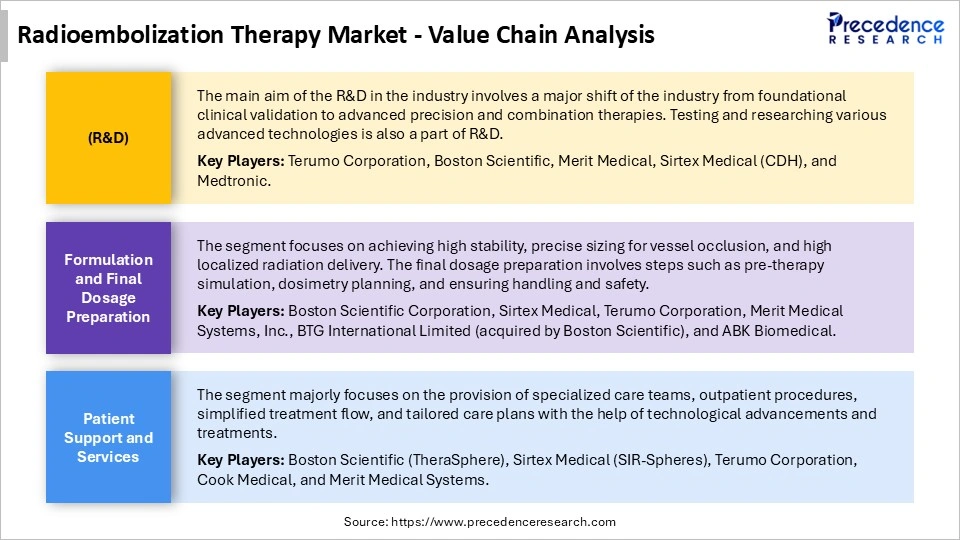
Radioembolization Therapy Market Value Chain Analysis
Radioembolization Therapy Market Companies
- Sirtex Medical
- Boston Scientific Corporation
- Terumo Corporation
- Merit Medical Systems, Inc.
- ABK Biomedical Inc.
- TriSalus Life Sciences
- Guerbet
- Nordion Inc.
- Varian Medical Systems
- China Grand Pharmaceutical and Healthcare Holdings
- Eckert & Ziegler BEBIG
- Cook Medical Inc.
Recent Developments
- In July 2025, the FDA approved Sirtex Medical's SIR-Spheres Y-90 resin microspheres to treat adults with unresectable hepatocellular carcinoma (HCC).
(Sourc: https://www.pharmexec.com) - In April 2025, China announced that it would limit the export of rare earth elements, including several used in medical imaging and treatments. It also launched investigations related to imports of CT x-ray tubes. (Source: https://www.auntminnie.com)
Segments Covered in the Report
By Product Type
- Yttrium-90 Microspheres
- Holmium-166 Microspheres
- Other Radioactive Microspheres
By Procedure Type
- Selective Internal Radiation Therapy
- Whole Liver Radioembolization
- Segmental Radioembolization
By Technology
- Trans Arterial Radioembolization,
- Selective Internal Radiation Therapy
By Application
- Primary Liver Cancer
- Metastatic Liver Cancer
- Other Cancers
By Region
- North America
- Europe
- Asia-Pacific
- Latin America
- Middle East & Africa
For inquiries regarding discounts, bulk purchases, or customization requests, please contact us at sales@precedenceresearch.com
Frequently Asked Questions





Ask For Sample
No cookie-cutter, only authentic analysis – take the 1st step to become a Precedence Research client
 Get a Sample




 sales@precedenceresearch.com
 Schedule a Meeting
