



Small Nuclear Reactor Market Trends, Companies, Contract Wins / Project Pipeline, Installed Capacity, Power Generation, Government Investment, Technology Adoption, Competitive Positioning, and Growth Forecast
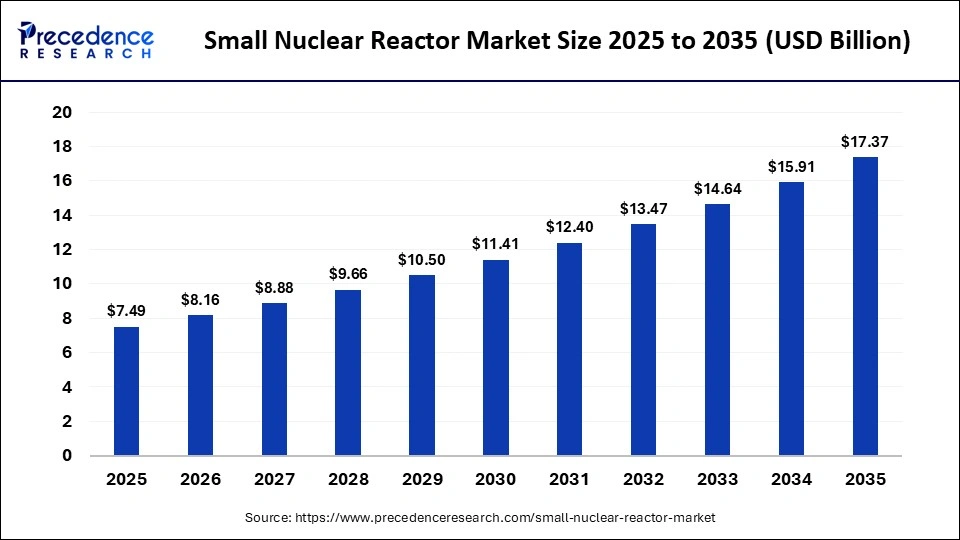
According to energy and power expert Laxmi Narayan, the small nuclear reactor market has reached USD 8.16 billion in 2026 and is expected to grow to USD 17.37 billion by 2035, registering a CAGR of 8.78%. The small nuclear reactor market companies such as Deutsche Post DHL Group, United Parcel Service (UPS), FedEx Corporation, Kuehne + Nagel, DB Schenkerare playing a key role in market expansion, with major opportunities emerging across By Reactor Type, By Power Capacity, By Application, By End User, By Component segments.
Source: https://www.precedenceresearch.com/small-nuclear-reactor-market
 Get a Sample
 Table Of Content


What is the Small Nuclear Reactor Market Size in 2026?
The global small nuclear reactor market size accounted for USD 7.49 billion in 2025 and is predicted to increase from USD 8.16 billion in 2026 to approximately USD 17.37 billion by 2035, expanding at a CAGR of 8.78% from 2026 to 2035. The small nuclear reactor market is driven by rising demand for clean, reliable energy, advancements in modular reactor technology, and increasing government support for low-carbon power generation.
Key Takeaways
- Asia Pacific dominated the small nuclear reactor market with a 35% share in 2025.
- Europe is expected to grow at the fastest rate between 2026 and 2025.
- By reactor type, the heavy water reactors segment dominated the market with a 43% share in 2025.
- By reactor type, the light water reactors segment was the second-largest shareholder in 2025 and is expected to grow at the fastest rate between 2026 and 2035.
- By power capacity, the 201-300 MW segment dominated the market with a 40% share in 2025.
- By power capacity, the 101-200 MW segment was the second-largest shareholder and is expected to grow at the fastest rate between 2026 and 2035.
- By application, the power generation segment dominated the market with a 44% share in 2025.
- By application, the industrial/process heat segment was the second-largest shareholder in 2025 and is expected to grow at the fastest rate between 2026 and 2035.
- By end user, the utilities segment dominated the market with a 50% share in 2025.
- By end user, the industrial sector segment is expected to grow at the fastest rate between 2026 and 2035.
- By component, the reactor equipment segment dominated the market with a 45% share in 2025.
- By component, the turbines & generators segment is expected to grow at the fastest rate between 2026 and 2035.
Market Overview
The small nuclear reactor market refers to the industry focused on the development, production, and deployment of compact nuclear reactors, typically small modular reactors (SMRs), designed to generate low-carbon, reliable, and scalable power for a variety of applications, including electricity generation, industrial use, and remote energy supply. The market is witnessing steady growth, driven by evolving consumer preferences and ongoing technological advancements. Expanding distribution networks, along with rising investments in innovation and digital integration, are enabling businesses to enhance productivity and broaden their customer base. Additionally, supportive regulatory frameworks and growing end-user awareness are further accelerating market expansion.
Emerging markets are creating significant growth opportunities, driven by rapid urbanization and rising disposable incomes that are generating new demand pockets. The integration of advanced technologies such as automation, data analytics, and artificial intelligence is enabling product innovation and service optimization. Companies that focus on customized offerings, sustainable solutions, and strategic partnerships are well-positioned to capitalize on these opportunities and expand their market share.
Major Market Trends
- Shift Toward Clean and Low-Carbon Energy: SMRs are gaining traction as countries focus on decarbonization and reducing greenhouse gas emissions, positioning them as a reliable low-carbon alternative to fossil fuels.
- Rising Demand for Reliable Baseload Power: With increasing electricity demand and the intermittency of renewables like solar and wind, SMRs are being adopted as stable, dispatchable power sources to ensure grid reliability.
- Growth in Modular and Factory-Based Construction: Factory-built modular designs are reducing construction time, lowering capital costs, and improving scalability, making SMRs more commercially viable compared to traditional reactors.
- Increasing Applications Beyond Power Generation: SMRs are finding applications in hydrogen production, desalination, district heating, and industrial process heat, broadening their market potential.
- Strong Government Support and Policy Initiatives: Governments worldwide are promoting SMRs through funding programs, regulatory support, and energy transition policies to enhance energy security and sustainability.
Market Scope
| Report Coverage | Details |
| Market Size in 2025 | USD 7.49 Billion |
| Market Size in 2026 | USD 8.16 Billion |
| Market Size by 2035 | USD 17.37 Billion |
| Market Growth Rate from 2026 to 2035 | CAGR of 8.78% |
| Dominating Region | Asia-Pacific |
| Fastest Growing Region | Europe |
| Base Year | 2025 |
| Forecast Period | 2026 to 2035 |
| Segments Covered | Reactor Type, Power Capacity, Application, End User, Component, and Region |
| Regions Covered | North America, Europe, Asia-Pacific, Latin America, and Middle East & Africa |
Market Dynamics
Drivers
Rising Demand for Low-Carbon Energy
The global push toward reducing carbon emissions is significantly driving the adoption of small nuclear reactors. SMRs provide a stable and low-carbon alternative to fossil fuels, supporting energy transition goals. Their ability to deliver consistent baseload power complements renewable energy sources like wind and solar.
Restraint
High Initial Investment and Regulatory Challenges
Despite their advantages, SMRs face challenges related to high upfront capital costs and complex regulatory approval processes. Licensing, safety compliance, and long project timelines can delay deployment. These factors may discourage investment, particularly in developing regions with limited financial and regulatory resources.
Opportunity
Expansion in Remote and Industrial Applications
SMRs present strong opportunities in remote areas and industrial sectors requiring reliable off-grid power. They can be deployed for applications such as mining operations, hydrogen production, and desalination. Their modular design and scalability make them well-suited for regions with limited infrastructure and growing energy needs.
Segment Insights
Reactor Type Insights
Small Nuclear Reactor Market Share, By Reactor Type, 2025-2035 (%)
| Reactor Type | 2025 | 2035 | CAGR (%) |
| Heavy Water Reactors | 43.00% | 38.00% | 7.50% |
| Light Water Reactors | 30.00% | 34.00% | 9.80% |
| High-Temperature Gas-Cooled Reactors | 12.00% | 13.00% | 9.20% |
| Fast Neutron Reactors | 10.00% | 10.50% | 8.90% |
| Molten Salt Reactors | 5.00% | 4.50% | 7.00% |
The Heavy Water Reactors Segment Held a 43% Market Share in 2025
The heavy water reactors segment dominated the small nuclear reactor market with a 43% share in 2025 because of their ability to use natural uranium as fuel, reducing dependency on enriched uranium and lowering fuel costs. These reactors offer high efficiency, strong neutron economy, and proven reliability, making them suitable for stable and long-term power generation. Additionally, their established technology base and operational track record have encouraged wider adoption, particularly in countries focusing on energy security and fuel flexibility.
The light water reactors segment held a 30% market share in 2025 and is expected to grow at the fastest rate in the upcoming period. This is because of their well-established technology, widespread global deployment, and strong regulatory familiarity. Their proven safety features, availability of enriched fuel supply chains, and compatibility with existing nuclear infrastructure make them a preferred choice for many countries. Additionally, ongoing advancements in light water SMR designs are enhancing efficiency and scalability, further supporting their adoption.
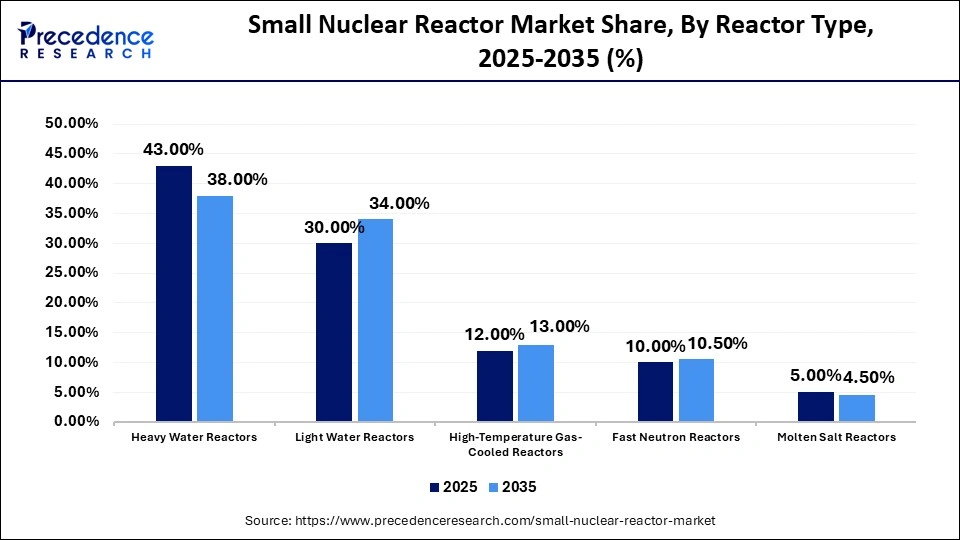
The high-temperature gas-cooled reactors segment held a 12% market share in 2025 because of their capacity to produce process heat and function at greater efficiency. These reactors are becoming more popular for producing hydrogen and are being used in industrial settings. Their modular design and built-in safety features also facilitate future scalability. Adoption of next-generation reactor technologies, including high-temperature gas-cooled reactors, is increasing due to rising investments.
The fast neutron reactors segment held a 10% market share in 2025, motivated by their capacity to use nuclear waste as fuel. They reduce radioactive waste and increase fuel efficiency. The development of cutting-edge nuclear technologies is accelerating, driven by rising investments. Commercialization efforts are also aided by government-funded pilot projects, supporting segmental growth.
Power Capacity Insights
Small Nuclear Reactor Market Share, By Power Capacity, 2025-2035 (%)
| Power Capacity | 2025 | 2035 | CAGR (%) |
| Up to 100 MW | 25.00% | 22.00% | 7.20% |
| 101–200 MW | 35.00% | 33.00% | 8.20% |
| 201–300 MW | 40.00% | 45.00% | 10.10% |
The 201-300 MW Segment Held a 40% Share of the Market in 2025
The 201-300 MW segment led the small nuclear reactor market while holding a 40% share in 2025 due to its greater power output, which enables the production of electricity on a large scale. For utility-scale projects that need steady baseload power, these reactors are recommended. The dominance of this segment is also driven by increasing investments in advanced reactors. The installation of reactors with this power range is also increasing due to rising demand for dependable energy.
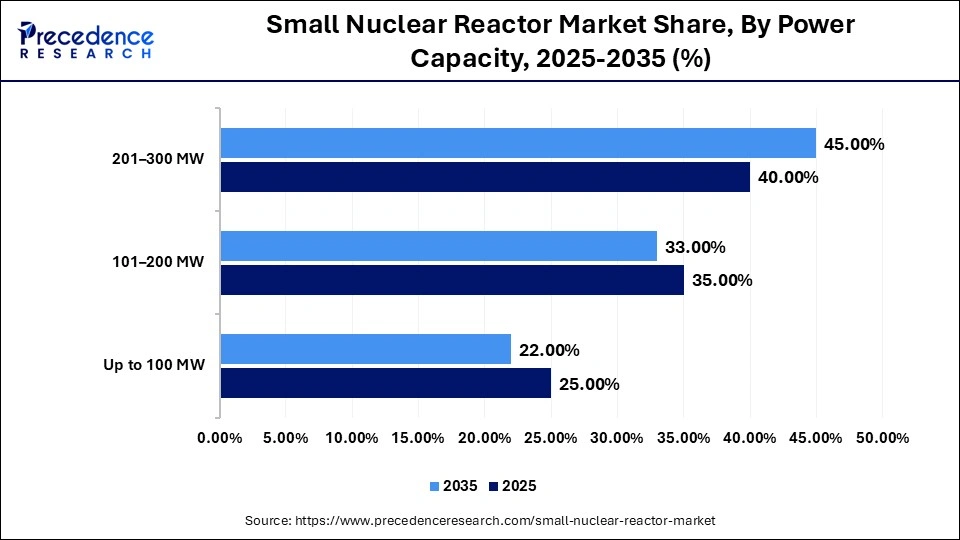
The 101-200 MW segment held a 35% share of the market in 2025 and is expected to grow at the fastest rate over the forecast period because it provides the best possible balance between affordability and scalability. Reactors with this power range are appropriate for industrial uses and mid-sized grids. Their capacity for modular deployment improves adaptability and shortens construction schedules.
The up to 100 MW segment held a 25% market share in 2025 because small modular reactors are becoming increasingly popular. Reactors with this power capacity are perfect for decentralized energy generation and remote areas. They are appealing to emerging markets due to their quicker installation and lower capital requirements. The demand for these reactors is accelerated by a growing emphasis on off-grid power solutions.
Application Insights
Small Nuclear Reactor Market Share, By Application, 2025-2035 (%)
| Application | 2025 | 2035 | CAGR (%) |
| Power Generation | 44.00% | 40.00% | 7.90% |
| Industrial / Process Heat | 20.00% | 24.00% | 10.50% |
| Hydrogen Production | 15.00% | 17.00% | 9.80% |
| Desalination | 10.00% | 9.00% | 7.50% |
| Research & Others | 11.00% | 10.00% | 7.00% |
The Power Generation Segment Held a 44% Market Share in 2025
The power generation segment dominated the small nuclear reactor market with a 44% share in 2025 because SMRs provide a reliable, low-carbon, and scalable source of electricity to meet growing energy demands. Their ability to supply baseload power, complement renewable energy sources, and operate in regions with limited grid infrastructure makes them highly suitable for utility-scale and off-grid applications. Additionally, governments and energy providers are increasingly adopting SMRs to enhance energy security and support decarbonization goals.
The industrial/process heat segment held a 20% market share in 2025 and is expected to grow at the fastest rate in the coming years due to industries' growing need for high-temperature heat. For processes like chemical processing and desalination, nuclear reactors offer reliable and effective heat. They help achieve industrial decarbonization objectives by lowering carbon emissions. Their modular and scalable design allows integration into industrial processes, improving efficiency and supporting sustainable industrial growth.
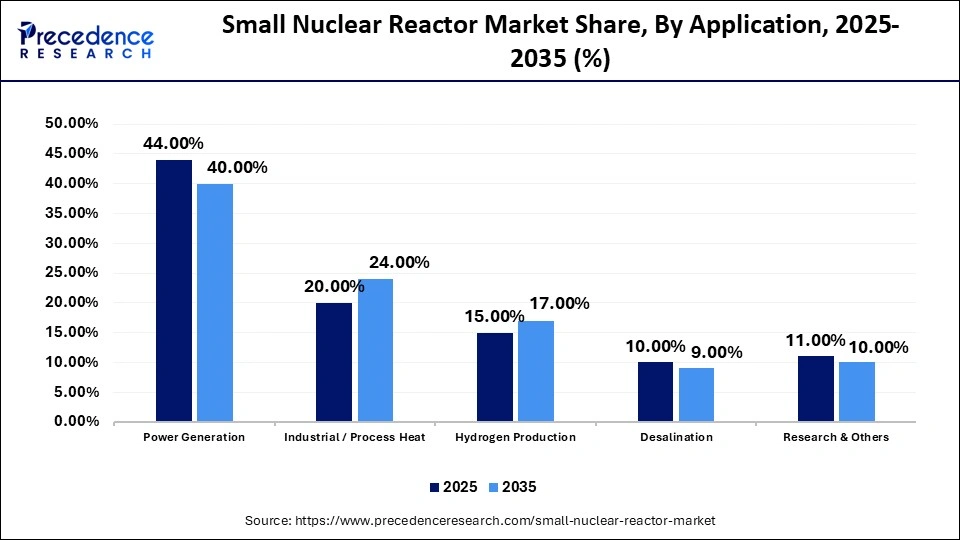
The hydrogen production segment held a 15% market share in 2025 due to the rising global demand for green hydrogen as a clean energy carrier. Small nuclear reactors can provide high-temperature heat and reliable power for water electrolysis and thermochemical hydrogen production processes. This enables large-scale, low-carbon hydrogen generation, supporting decarbonization goals in energy, transportation, and industrial sectors.
The research & others segment held an 11% market share in 2025, driven by the growing use of SMRs in academic, scientific, and experimental applications. These reactors provide a reliable, compact, and safe source of neutrons and heat for research, isotope production, and testing of advanced nuclear technologies. Additionally, their flexibility and modular design make them ideal for universities, national laboratories, and pilot projects exploring innovative nuclear solutions.
End User Insights
The Utilities Segment Held a 50% Share of the Market in 2025
The utilities segment dominated the small nuclear reactor market with a 50% share in 2025 due to significant demand for a steady and uninterrupted supply of electricity. For grid stability and long-term energy security, utilities rely on nuclear power. The dominance of the segment is also supported by increasing electrification and clean energy objectives.
The industrial sector segment held a 20% market share in 2025 and is expected to grow at the fastest rate over the projection period. This is mainly due to increasing demand for reliable, high-temperature heat and power for processes such as chemical production, oil refining, and hydrogen generation. SMRs provide a low-carbon, continuous energy source that can reduce dependence on fossil fuels and lower operational emissions. Their modular and scalable design allows integration into industrial facilities, enhancing efficiency and supporting sustainable industrial growth.
Small Nuclear Reactor Market Share, By End User, 2025-2035 (%)
| End User | 2025 | 2035 | CAGR (%) |
| Utilities | 50.00% | 45.00% | 7.60% |
| Government & Defense | 20.00% | 19.00% | 8.00% |
| Industrial Sector | 20.00% | 26.00% | 10.80% |
| Research Institutions | 10.00% | 10.00% | 8.20% |
The government & defense segment held a 20% market share in 2025 due to the need for secure, reliable, and independent power sources for military bases, remote installations, and strategic facilities. SMRs offer a compact and resilient energy solution that can operate off-grid, ensuring energy security during emergencies or in isolated locations. Additionally, governments invest in SMRs for research, national security, and energy transition initiatives, further supporting adoption in this segment.
The research institutions segment held a 10% market share in 2025, driven by the the increasing use of SMRs for scientific studies, nuclear experiments, and educational purposes. These reactors provide a compact, safe, and reliable source of neutrons and heat for research, isotope production, and testing of advanced nuclear technologies. Their flexibility and modular design make them ideal for universities, national laboratories, and pilot projects exploring innovative nuclear applications.
Component Insights
The Reactor Equipment Segment Held a 45% Share of the Market in 2025
The reactor equipment segment dominated the small nuclear reactor market with a 45% share in 2025 because it includes critical components such as the reactor core, pressure vessels, control rods, and steam generators, which are essential for safe and efficient reactor operation. High demand for reliable and durable reactor equipment ensures stable power generation and compliance with strict nuclear safety standards. Additionally, ongoing technological advancements and modular designs are increasing the adoption of advanced reactor equipment in both commercial and research SMR applications.
Small Nuclear Reactor Market Share, By Component, 2025-2035 (%)
| Component | 2025 | 2035 | CAGR (%) |
| Reactor Equipment | 45.00% | 41.00% | 7.80% |
| Instrumentation & Control | 20.00% | 21.00% | 9.20% |
| Steam Generators | 15.00% | 14.00% | 7.60% |
| Turbines & Generators | 20.00% | 24.00% | 10.30% |
The turbines & generators segment held a 20% market share in 2025 and is expected to grow at the fastest rate between 2026 and 2035. This is because these components are essential for converting thermal energy produced by the reactor into electricity. High demand for efficient, reliable, and high-capacity turbines and generators ensures optimal power output and stable grid integration. Additionally, advancements in turbine and generator technology, including compact and modular designs, support the growing deployment of SMRs in both power generation and industrial applications.
The steam generators segment held a 15% market share in 2025, driven by their vital role in producing power and transferring heat. In nuclear plants, these elements guarantee effective energy conversion. Their efficiency and reliability directly impact the overall performance and safety of SMRs. Additionally, growing demand for modular and high-performance steam generators is supporting wider adoption in both power generation and industrial applications.
Region Insights
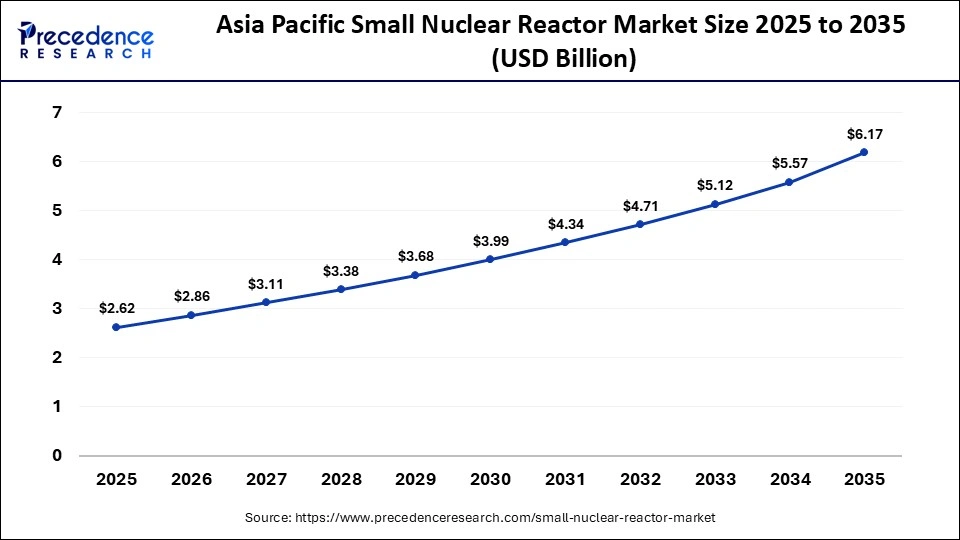
Asia Pacific Small Nuclear Reactor Market Size and Growth 2026 to 2035
The Asia Pacific small nuclear reactor market size is expected to be worth USD 6.17 billion by 2035, increasing from USD 2.62 billion by 2025, growing at a CAGR of 8.94% from 2026 to 2035.
What Made Asia Pacific the Dominant Region in the Small Nuclear Reactor Market?
Asia Pacific dominated the small nuclear reactor market with a 35% share in 2025 due to the rapid expansion of the nuclear power plants in nations like China and India. Growing energy demand and strong government support are major factors ensuring the long-term dominance in the market. The market is being accelerated by investments in small and advanced modular reactors. Regional adoption is also being accelerated by a greater emphasis on energy security.
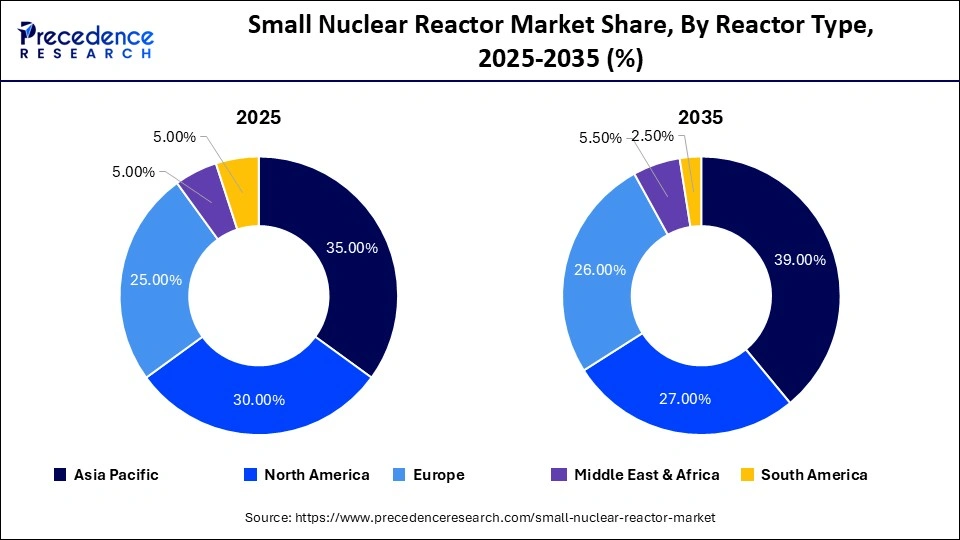
What Makes Europe the Fastest-Growing Region in the Small Nuclear Reactor Market?
Europe is expected to grow at the fastest rate during the forecast period due to strong policy support for clean energy transition, significant investments in advanced nuclear technologies, and a strategic focus on energy security. Regional governments and the European Union have introduced favorable frameworks and funding mechanisms to accelerate SMR deployment as part of broader decarbonization goals. Additionally, rising demand for reliable baseload power to complement renewable energy sources, coupled with active research collaborations and industrial partnerships, is further driving market growth across the region.
Japan Market Analysis
Japan's market is driven by surging industrial energy requirements and grid reliability needs. SMR commercialization is heavily funded by government-backed roadmaps that project deployments by the mid-2030s. As Japan's foremost nuclear producer, MHI is spearheading the development of advanced light-water SMRs. They are also leading national High-Temperature Gas-cooled Reactor programs programmed for clean hydrogen production. MHI's technologies are aiming for commercial rollout in the mid-2030s.
Germany Market Analysis
Germany is driven by a national push for energy security along with climate independence. The European SMR market is surging. Germany is actively debating SMRs to stabilize volatile renewable grids, though concrete domestic acceptance faces political hurdles.
How is the Small Nuclear Reactor Market Evolving in North America?
North America is expected to grow at a significant CAGR during the forecast period. It is driven by surging electricity demands from AI data centers along with corporate decarbonization goals. The regional market is backed by expedited regulatory reforms and even aggressive private investments. The U.S. Nuclear Regulatory Commission (NRC) has implemented major rule reforms, which include an 18-month expedited pathway for reactor designs tested safely under federal programs, remarkably reducing historical approval bottlenecks.
U.S. Market Analysis
The U.S. market is experiencing rapid expansion, fueled by skyrocketing electricity demands from AI data centers, federal funding, and even a push for zero-emission baseload power. Hyperscalers and tech firms are aggressively seeking continuous, high-capacity power to run massive AI data centers, thus turning to nuclear fission as a reliable alternative to wind and solar.
Why is the Latin America Small Nuclear Reactor Market Gaining Momentum?
Latin America is expected to grow at a lucrative CAGR during the forecast period. This is due to its lower upfront capital requirements, modular designs that allow flexible deployment in remote regions, and the demand for reliable, thus, baseload clean energy to meet ambitious net-zero targets.
Brazil Market Analysis
Brazil's market is driven by the demand to expand beyond traditional capacity, and the sector is seeing increased international technology collaborations and progressive regulatory frameworks contributed by the National Nuclear Energy Commission (CNEN). Brazil's vast territory, mainly the Amazon region, includes remote communities and large-scale mining operations that currently depend on expensive, carbon-intensive diesel generators. SMRs and microreactors provide an off-grid, clean-energy alternative.
How will Small Nuclear Reactors Shape the Future of Energy in the Middle East and Africa?
The Middle East and Africa are expected to grow at a notable CAGR during the forecast period. By providing decentralized, scalable, and reliable baseload power. With lower upfront capital costs than gigawatt-scale plants, SMRs are well-suited for smaller national grids, remote mining operations, and the rapid growth of data center hubs.
Saudi Arabia Market Analysis
Saudi Arabia's market is rapidly evolving as a strategic element of the nation's Vision 2030 and 2060 net-zero goals. The market is driven by the demand to diversify the energy mix away from fossil fuels, offer scalable power to remote regions, and then support massive desalination infrastructure. SMRs can be leveraged to produce green or pink hydrogen during non-peak energy hours, working with the Kingdom's push to become a global hydrogen exporter.
Small Nuclear Reactor Market Companies
- Deutsche Post DHL Group
- United Parcel Service (UPS)
- FedEx Corporation
- Kuehne + Nagel
- DB Schenker
- CEVA Logistic
- Agility Logistics
- C.H. Robinso
- Kerry Logistics
- Nippon Express
- DSV
- SF Express
- AmerisourceBergen
- Cardinal Health
- Maersk
Recent Developments
- In April 2026, Nano Nuclear Energy submitted a construction permit application for its “Kronos” micro modular reactor to the U.S. NRC. This marks a major step toward the commercialization of microreactor technology in the U.S. The move highlights increasing private sector participation in next-generation nuclear deployment. (Source: https://www.investors.com)
- In March 2026, Blykalla announced plans to develop a multi-unit SMR park with lead-cooled reactors in Sweden. The project aims to establish advanced Generation IV nuclear capabilities in Europe. It also reflects growing interest in alternative cooling technologies for enhanced efficiency and safety. (Source: https://www.world-nuclear-news.org)
- In March 2026, Ontario Power Generation completed excavation works for the Darlington BWRX-300 SMR project. This development represents one of the most advanced SMR construction projects in North America. The progress strengthens Canada's position as a leader in early SMR deployment. (Source: https://www.nucnet.org)
- In March 2026, the UK government & Rolls-Royce SMR granted nuclear justification for the SMR design. This approval confirms the technology's economic and environmental benefits. It brings the UK closer to deploying its first SMR project in the coming decade. (Source: https://www.nucnet.org)
- In February 2026, the U.S. DOE accelerated SMR deployment through the Advanced Reactor Pilot Program. Multiple startups are progressing toward prototype development under federal support. The program is improving investor confidence and speeding up commercialization timelines.
(Source: https://www.reuters.com)
Segments Covered in the Report
By Reactor Type
- Heavy Water Reactors
- Light Water Reactors
- High-Temperature Gas-Cooled Reactors
- Fast Neutron Reactors
- Molten Salt Reactors
By Power Capacity
- Up to 100 MW
- 101-200 MW
- 201-300 MW
By Application
- Power Generation
- Industrial/Process Heat
- Hydrogen Production
- Desalination
- Research & Others
By End User
- Utilities
- Government & Defense
- Industrial Sector
- Research Institutions
By Component
- Reactor Equipment
- Instrumentation & Control
- Steam Generators
- Turbines & Generators
By Region
- North America
- Latin America
- Europe
- Asia-pacific
- Middle and East Africa
For inquiries regarding discounts, bulk purchases, or customization requests, please contact us at sales@precedenceresearch.com
Frequently Asked Questions





Ask For Sample
No cookie-cutter, only authentic analysis – take the 1st step to become a Precedence Research client
 Get a Sample




 sales@precedenceresearch.com
 Schedule a Meeting
