



Smart Drugs Market Size, Companies, Share, Patient Volume, Treatment Adoption Rates, Pricing Analysis, Regulatory Landscape, Competitive Positioning, and Demand Forecast
Smart Drugs Market (By Drug Class: Stimulants, Wakefulness-promoting agents, NMDA receptor antagonists, Others; By Indication: Attention-deficit hyperactivity disorder, Alzheimer’s disease and dementia, Cognitive enhancement in healthy adults; By Distribution Channel: Hospital pharmacy, Retail pharmacy, Online pharmacy, Others; By Dosage Form: Tablets, Capsules, Oral liquids, Transdermal patches, Others; By End User: Hospitals, Specialty neurology and psychiatry clinics, Homecare patients, Academic and research institutes, Others) - Global Industry Analysis, Size, Trends, Leading Companies, Regional Outlook, and Forecast 2026 to 2035
Source: https://www.precedenceresearch.com/smart-drugs-market
 Get a Sample
 Table Of Content


What is the Smart Drugs Market Size in 2026?
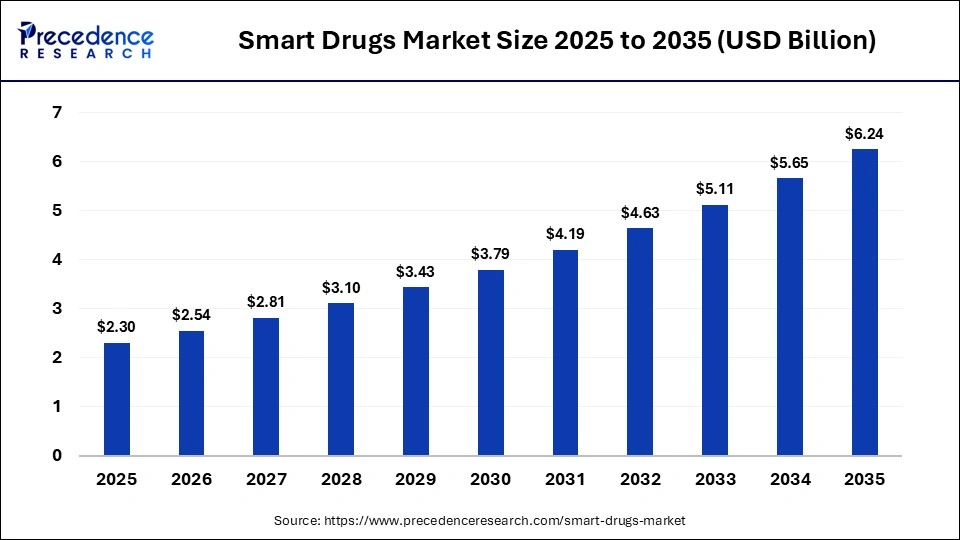
The global smart drugs market size was calculated at USD 2.30 billion in 2025 and is predicted to increase from USD 2.54 billion in 2026 to approximately USD 6.24 billion by 2035, expanding at a CAGR of 10.50% from 2026 to 2035. The smart drugs market is observing rapid expansion due to growing demand for drugs to maintain cognitive health, especially among students and professionals, and also to avoid different types of cognitive health issues through non-invasive methods. Advancements in neurotechnology and biotechnology also help to propel the growth of the market.
Key Takeaways
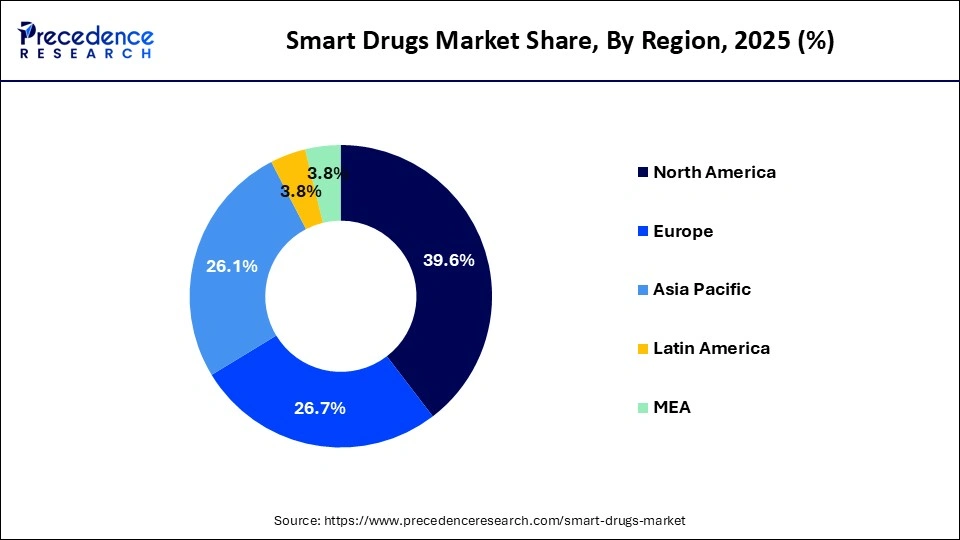
- North America led the global smart drugs market with 39.60% market share in 2025.
- Asia Pacific is observed to be the fastest-growing region in the foreseeable period.
- By drug class, the stimulants segment held a major dominance over the global market with 36.70% share in 2025.
- By drug class, the other segment is expected to expand rapidly with 11.70% CAGR in the coming years.
- By indication, the attention deficit hyperactivity disorder segment led the global market with 33.60% market share in 2025.
- By indication, the cognitive enhancement in healthy adults segment is expected to have the highest CAGR of 10.40% in the foreseeable period.
- By distribution channel, the retail pharmacy segment had a major dominance over the global smart drugs market with 55.70% share in 2025.
- By distribution channel, the online pharmacy segment is observed to have the highest CAGR in the foreseeable period.
- By dosage form, the tablets segment dominated the global market with 56.60% share in 2025.
- By dosage form, the transdermal patches segment is observed to be the fastest-growing segment with the highest CAGR in the coming years.
- By end user, the specialty neurology and psychiatry clinics segment led the global smart drugs market with 34.80% share in 2025 and is also observed as the fastest-growing segment with a CAGR of 7.70% in the foreseeable period.
What is the Smart Drugs Market?
Smart drugs are prescription and regulated pharmacological agents used to improve attention, wakefulness, memory, and cognitive performance in clinical conditions, and in limited cases for off-label cognitive enhancement. The market covers stimulants, wakefulness-promoting agents, cholinesterase inhibitors, NMDA antagonists, and related therapies supplied through hospital, retail, and online channels. Value includes branded and generic drug sales and associated dispensing. Demand is supported by increasing diagnoses of ADHD, neurodegenerative disorders, sleep disorders, and rising focus on cognition outcomes.
Role of Technology in the Growth of Smart Drugs Market
- Growing Usage of AI: AI helps to minimize the research time of the industry from years to months by predicting molecular interactions.
- Smart Pills: Smart pills with microchips and sensors for real-time monitoring are also a major market driver.
- Internet of Medical Things (IoMT): The segment involves the usage of smart wearables and smart biosensors for continuous monitoring of cognitive psychological responses to smart drugs.
Smart Drugs Market Trends
- Personalization: Usage of AI and data analytics to create personalized nootropics as per the patient's genetics, lifestyle, and real-time cognitive needs helps elevate the market.
- Technological Advancements: Use of wearable devices and smart pills for real-time monitoring, effective results, and tracking a patient's health continuously is also a major market driver.
- Growing Demand for Clean-Label Products: Patients today prefer clean-label drugs such as organic nootropics as a safer and more effective option.
Market Scope
| Report Coverage | Details |
| Market Size in 2025 | USD 2.30 Billion |
| Market Size in 2026 | USD 2.54 Billion |
| Market Size by 2035 | USD 6.24 Billion |
| Market Growth Rate from 2026 to 2035 | CAGR of 10.50% |
| Dominating Region | North America |
| Fastest Growing Region | Asia Pacific |
| Base Year | 2025 |
| Forecast Period | 2026 to 2035 |
| Segments Covered | Drug Class, Indication, Distribution Channel , Dosage Form, End User, and region |
| Regions Covered | North America, Europe, Asia-Pacific, Latin America, and Middle East & Africa |
Segmental Insights
Drug Class Insights
Which Component of the Drug Class Segment led the Global Market in 2025?
The stimulants segment dominated the global smart drugs market with 36.70% market share in 2025. The market is majorly driven by factors such as improved focus, alertness, and cognitive performance. Stimulants are primarily used to treat ADHD and narcolepsy to enhance productivity and concentration. The high-performance professionals also use stimulants to hack their brains for improved productivity. Methylphenidate and Amphetamines are a few dominating stimulants helpful for the market's growth. Higher requirements to maintain an ideal balance between cognitive enhancement and safety and regulatory compliance.
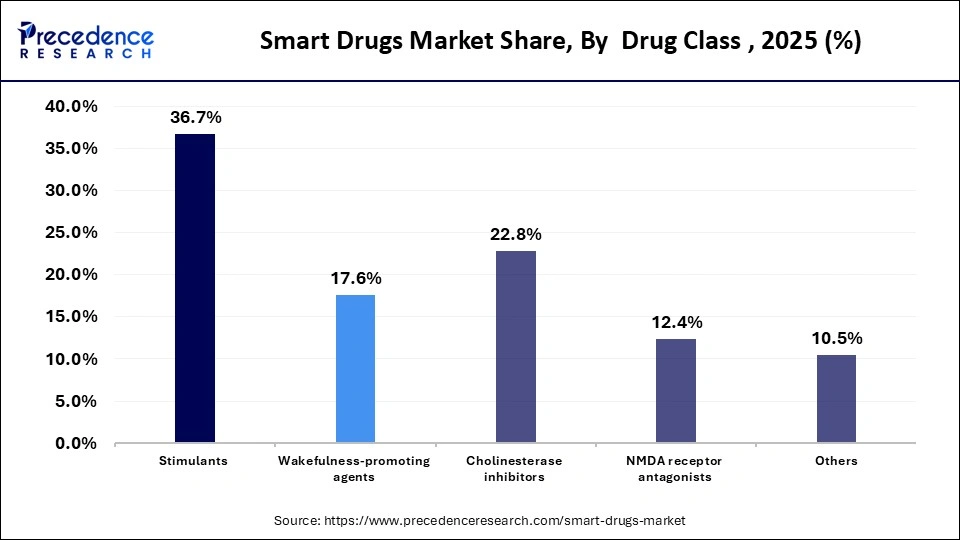
The other segment is observed to be the fastest-growing segment with 11.70% CAGR in the forecast period. The segment involves niche disease indications, emerging end-user settings, and less common applications. The segment also consists of a variety of specialized medical conditions supported by technological advancements. The segment is also inclusive of cardiovascular and metabolic disorders, mental and neurological disorders, rare and inherited diseases, and other similar issues. Nutritional monitoring, vital sign monitoring, and diagnostic mapping are some of the application segments highlighted for the market's growth.
Indication Insights
Which Component of the Indication Segment led the Global Smart Drugs Market in 2025?
The attention deficit hyperactivity disorder segment dominated the global market with 33.60% share in 2025. The segment is driven by stimulant medications helpful to treat children and adults by improving mental health awareness, increasing adult diagnoses, and reflecting advancements in long-acting formulas. Stimulants are helpful to lower the symptoms of attention deficit hyperactivity disorder in 70 to 80% patients. Non-stimulants such as atomoxetine and bupropion are also helpful for the market's growth for patients who do not respond to stimulants. The treatment options combined with increased awareness and improved diagnostic rates also propel the market's growth.
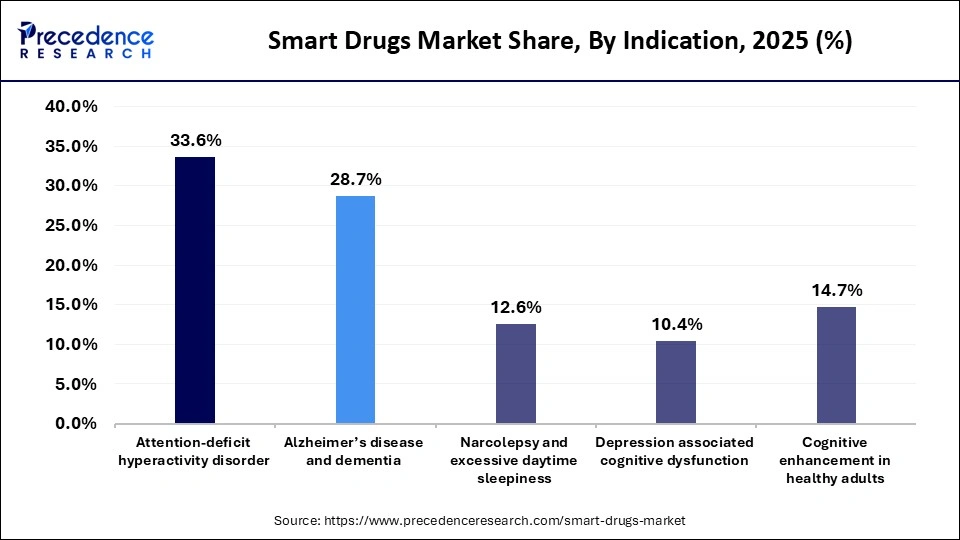
The cognitive enhancement in healthy adults segment is observed to expand rapidly with 10.40% CAGR in the foreseen period. The segment's growth is mainly driven by students and professionals who have the major requirement of cognitive enhancement. The segment involves off-label use of stimulants and consumption of OTC nootropics. Such drugs are also highly consumed by professionals to manage high-pressure work environments and stay alert during exhausting shifts. Smart drugs such as Modafinil and Methylphenidate help to improve focus, memory, and academic performance of students during exam periods, further fueling the industry's growth in the foreseen period.
Distribution Channel Insights
Which Component of the Distribution Channel Led the Global Smart Drugs Market in 2025?
The retail pharmacy segment had a major dominance over the global market with 55.70% market share in 2025. The segment makes a major contribution to the growth of the market due to the immediate availability of required products and extensive physical networks. The brick-and-mortar retail pharmacies have a major contribution to the growth of the market as they provide immediate access to prescription and OTC cognitive enhancers. Medications such as Adderall, Ritalin, and Modafinil are highly utilized for cognitive conditions such as ADHD and narcolepsy, also driving the market's growth majorly. Higher demand for vitamins, minerals, and nootropics such as Bacopa Monnieri and Ginkgo biloba is also a major market driver.
Smart Drugs Market Share, By Distribution Channel, 2025 (%)
| Distribution Channel | Market Share (%) |
| Hospital Pharmacy | 21.8% |
| Retail Pharmacy | 55.7% |
| Online Pharmacy | 16.4% |
| Others | 6.1% |
The online pharmacy segment is expected to expand rapidly with the highest CAGR in the coming years. Growing internet penetration and growing demand for digital health solutions also propel the industry's growth in the foreseeable period. Growing demand for app-based ordering and AI-based recommendations as per a patient's medical data is also a major segment driver. Growing preventive healthcare and self-actualization are also some of the major factors for the industry's growth in the foreseeable period. Availability of medications for chronic conditions, instant delivery, and the convenience of getting required medications at the convenience of being at home are a set of other major factors helpful for the industry's growth in the foreseen period.
Dosage Form Insights
Why did the Tablets Segment lead the Global Smart Drugs Market in 2025?
The tablets segment dominated the global market with 56.60% share in 2025. Growing demand for non-invasive, effective, and easy treatment options for cognitive issues is one of the major market growth drivers. The segment also observes growth due to growing demand for capsules and tablets containing sensors or imaging technology for capsule endoscopy and targeted drug delivery. The segment also observes growth due to factors such as stability, long shelf life, and cost-effective manufacturing. Tablets are essential as they are the primary form of digital medicine to track compliance in psychiatric treatment.
Smart Drugs Market Share, By Dosage Form , 2025 (%)
| Dosage Form | Market Share (%) |
| Tablets | 56.6% |
| Capsules | 24.7% |
| Oral liquids | 9.4% |
| Transdermal patches | 4.6% |
| Others | 4.7% |
The transdermal patches segment is expected to expand rapidly with the highest CAGR in the forecast period. The segment is majorly dominated by drug in-adhesive patches and multi-layer drug in-adhesive patches. Such patches help to propel the segment's growth in the foreseen period due to their consistent, controlled, and non-invasive delivery. Controlled release, improved bioavailability, and reduced dosing frequency are also some of the vital factors for the industry's growth. Such patches are also preferred for their simplicity, precision, and sustained release. They are helpful for pain management, hormonal therapy, cardiovascular disease treatment, and smoking cessation. Technologically advanced patches include microneedle patches for better absorption and real-time monitoring.
End User Insights
Which Component of the End User Segment led the Global Market in 2025?
The specialty neurology and psychiatry clinics segment dominated the global smart drugs market with 34.80% share in 2025 and is also observed to be the fastest-growing segment with a CAGR of 7.70% in the foreseen period. Growing demand for precision medicine, rise of neurodegenerative diseases, and adoption of advanced and AI-enabled diagnostics are some of the major factors helpful for the market's growth. The growing aging population with cognitive issues such as Alzheimer's and Parkinson's disease requiring personalized drugs, care, and treatment, also propels the growth of the market. Specialized clinics use advanced therapeutic services with deep brain stimulation, transcranial magnetic stimulation, and AI-integrated neuro tools for effective treatment.
Smart Drugs Market Share, By End User , 2025 (%)
| End User | Market Share (%) |
| Hospitals | 26.4% |
| Specialty neurology and psychiatry clinics | 34.8% |
| Homecare patients | 29.7% |
| Academic and research institutes | 4.4% |
| Others | 4.7% |
Regional Insights
North America Smart Drugs Market Size and Growth 2026 to 2035
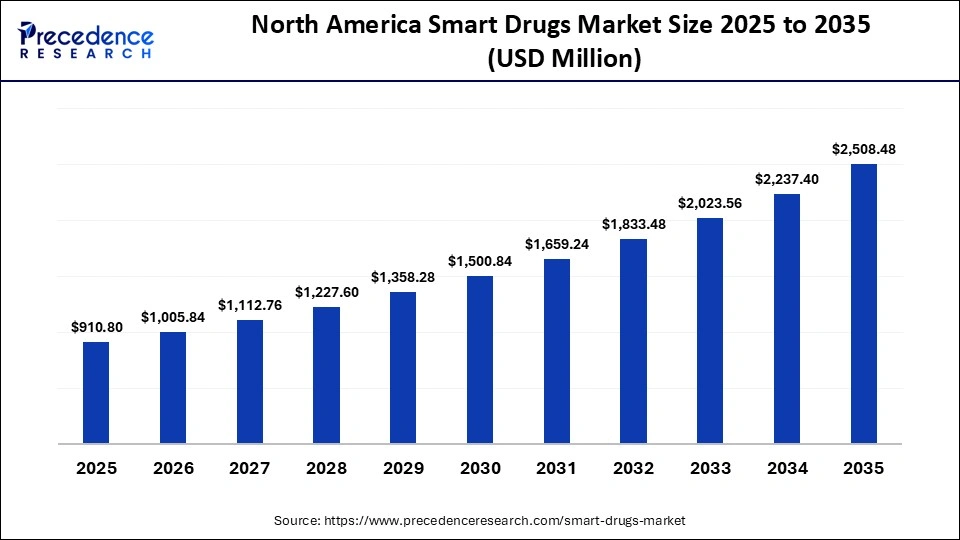
The North America smart drugs market size is estimated at USD 910.80 million in 2025 and is projected to reach approximately USD 2,508.48 million by 2035, with a 10.66% CAGR from 2026 to 2035.
Why did North America lead the Global Smart Drugs Market in 2025?
North America had a major dominance over the global market with 39.60% market share in 2025. The market in the region is mainly defined into ingestible and cognitive enhancers. The market is also propelled by rising disorders such as gastrointestinal issues and ADHD. The growing aging population of the region, leading to growing health issues, is another major factor propelling the growth of the market. Such factors also lead to higher demand for non-invasive and diagnostic treatment options in the form of smart pills.
U.S. Smart Drugs Market Size and Growth 2026 to 2035
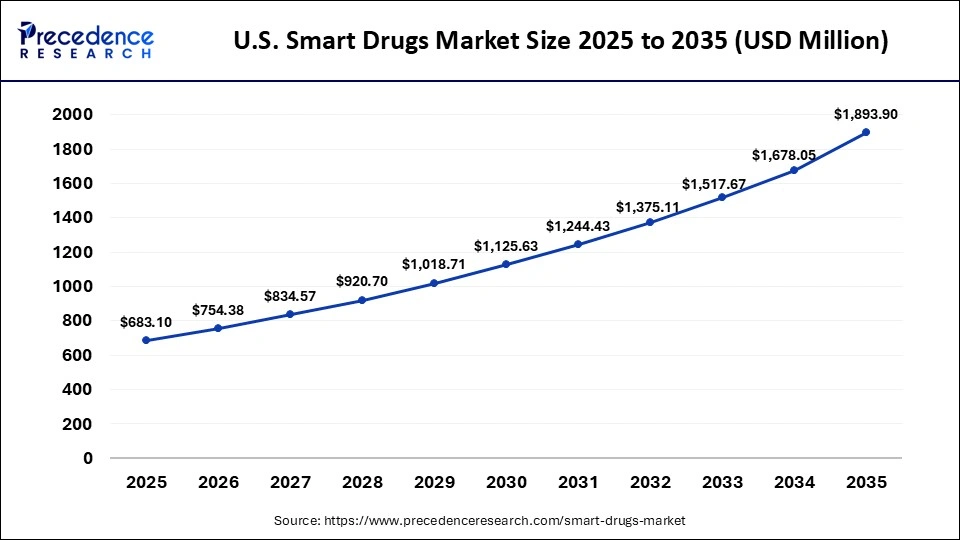
The U.S. smart drugs market size is calculated at USD 683.10 million in 2025 and is expected to reach nearly USD 1,893.90 million in 2035, accelerating at a strong CAGR of 10.74% between 2026 and 2035.
The U.S. Smart Drugs Market Trends
The market's growth is mainly driven by FDA approvals due to capsule endoscopy and targeted drug delivery. Minimally invasive diagnostics, rising gastrointestinal disorders, and advanced and connected patient-centric care options are also some of the major factors helpful for the market's growth. Technological advancements, growing medical needs, and focus on efficiency are also some of the major market drivers in the region.
Why is the Asia Pacific observed to be the Fastest-Growing Region in the Foreseen Period?
Asia Pacific is expected to expand rapidly in the foreseen period due to factors such as a growing aging population, higher demand for natural and traditional remedies, and growing competition in the region among professionals and students. The market is also highly demanding in the region due to the availability of retail and e-commerce pharmacies with a broader product category.
China Smart Drugs Market Trends
The market is highly demanding in China, as it is also termed the world's second-largest pharmaceutical market. Growing performance pressure among students and professionals and the growing aging population are also the major market drivers. The industry is also observing rapid growth in China due to the growing digital healthcare infrastructure and the growth of Direct-to-Patient channels in the region.
Smart Drugs Market VAlue Chain Analysis

Smart Drugs Market Companies
- Teva Pharmaceutical Industries
- Novartis
- Pfizer
- Johnson and Johnson
- Takeda Pharmaceutical
- AbbVie
- Eli Lilly and Company
- Otsuka Holdings
- Viatris
- Sandoz
- Sun Pharmaceutical Industries
- Dr. Reddy's Laboratories
- Aurobindo Pharma
- Cipla
- Hikma Pharmaceuticals
Recent Developments
- In October 2025, Scientists at the Scripps Research Translational Institute invited people with long COVID across the U.S. to join a remote clinical trial testing whether an existing FDA-approved therapy, tirzepatide, can provide relief from long COVID symptoms.(Source- https://www.scripps.edu)
- In July 2025, 10x Genomics, Inc. announced a research collaboration for the Target Inference from Spatialomics & Histology Using Multimodal AI & Phenotypes (TISHUMAP) project. (Source- https://www.prnewswire.com)
Segments Covered in the Report
By Drug Class
- Stimulants
- Wakefulness-promoting agents
- Cholinesterase inhibitors
- NMDA receptor antagonists
- Others
By Indication
- Attention-deficit hyperactivity disorder
- Alzheimer's disease and dementia
- Narcolepsy and excessive daytime sleepiness
- Depression associated cognitive dysfunction
- Cognitive enhancement in healthy adults
By Distribution Channel
- Hospital pharmacy
- Retail pharmacy
- Online pharmacy
- Others
By Dosage Form
- Tablets
- Capsules
- Oral liquids
- Transdermal patches
- Others
By End User
- Hospitals
- Specialty neurology and psychiatry clinics
- Homecare patients
- Academic and research institutes
- Others
By Region
- North America
- Latin America
- Europe
- Asia-pacific
- Middle and East Africa
For inquiries regarding discounts, bulk purchases, or customization requests, please contact us at sales@precedenceresearch.com
Frequently Asked Questions
Tags





Ask For Sample
No cookie-cutter, only authentic analysis – take the 1st step to become a Precedence Research client
 Get a Sample
.webp)



 sales@precedenceresearch.com
 Schedule a Meeting
