


Spot Welding Robots Market Trends, Leading Companies, Company Revenue / Sales Performance, Production Capacity, Equipment Utilization, Pricing Analysis, Distribution Performance, Competitive Landscape, and Demand Forecast
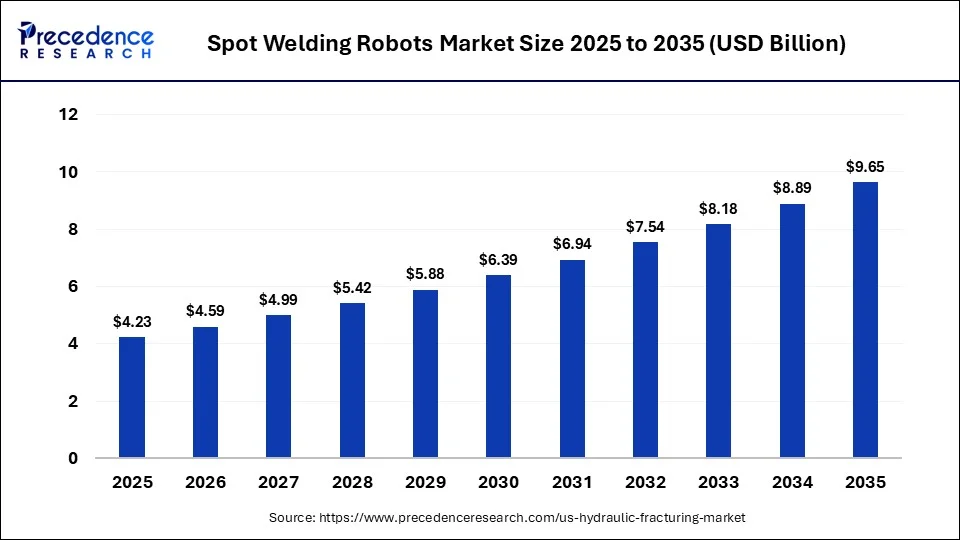
The spot welding robots market accounted for USD 4.59 billion in 2026. The market growth is being driven by significant factory automation investments, increasing adoption of electric automobiles, development of programmable welding systems, and significant efforts to decrease the intricacies involved in manufacturing. These trends were evaluated by our Senior Research Analyst, Laxmi Narayan, to curate this well-researched report. His analysis benefits machinery manufacturers, distributors, industry researchers, and stakeholders in conducting competitive analysis and making well-informed decisions.Â
Source: https://www.precedenceresearch.com/spot-welding-robots-market
 Get a Sample
 Table Of Content


Spot Welding Robots Market Size, Share, Trends, and Growth Forecast 2035
The spot welding robots market is forecasted to expand from USD 4.59 billion in 2026 to USD 9.65 billion by 2035, growing at a CAGR of 8.6% from 2026 to 2035. Labor shortages, rapid adoption of automation technologies, increasing demand for highly efficient production and welding consistency, expansion of the EV manufacturing ecosystem, and growing focus on process traceability and quality control are benefiting the market. Laxmi Narayan, our Senior Research Analyst, has over 5 years of experience in the machinery and equipment industry. According to him, the development of advanced robot technologies is enhancing market adoption in precision manufacturing operations.
Key Takeaways
- Automotive manufacturing is the most important demand driver for spot welding robots.
- Europe has deployed around 23,000 industrial robots in automotive manufacturing in 2024, and the U.S. has deployed approximately 13,700.
- The demand for robotic welding is being increasingly influenced by broader factory-automation investment rather than just welding replacement.
- Cobots currently have a relatively smaller ecosystem, but their significance is expected to increase in niche low-volume applications.
- Japan, China, Germany, and South Korea contributed to around 70% of global industrial-robot production.
- Asia accounted for approximately 74% of new industrial-robot deployments in 2024.
The global spot welding robots market accounted for approximately USD 4.23 billion in 2025, with the market projected to reach approximately USD 4.59 billion in 2026 and USD 9.65 billion by 2035, representing an estimated 8.6% CAGR over 2026-2033. Public market estimates differ materially depending on whether the definition includes robot arms only, complete robotic cells, welding peripherals, or broader robotic-welding solutions; the report therefore establishes a consistent bottom-up market boundary before sizing the opportunity.
Asia Pacific represents approximately 44.9% of global revenue, equivalent to roughly USD 1.9 billion in 2025, while automotive applications account for approximately 50.6%, or more than USD 2.1 billion. Articulated robots represent approximately 58.9% of revenue, while resistance spot welding accounts for roughly 74.9%. The 151–300 kg payload class represents approximately 27%, reflecting the heavy servo-gun and reach requirements of automotive body structures.
The structural opportunity goes beyond new vehicle manufacturing. Labor scarcity, rising manufacturing wages, EV platform investment, higher weld traceability needs, flexible manufacturing, and growing use of high-strength steel and aluminum are raising the importance of faster, lighter, and more software-integrated welding cells.
Key Coverage
- 2021 - 2025 historical market development
- 2025 - 2033 revenue forecast and scenario analysis
- Robot, welding technology, payload, application, and geography splits
- Installed-base and replacement-cycle analysis
- Automotive body-in-white versus non-automotive demand
- China, Japan, India, South Korea, Europe and North America opportunity pools
- Market concentration and supplier positioning
Market Size & Forecast - A USD 3.67 Billion Incremental Revenue Pool Emerges by 2033
The default case places the market at USD 4.23 billion in 2025 and USD 7.9 billion in 2033, creating approximately USD 3.67 billion of incremental annual revenue opportunity. Alternative public estimates place 2025 market value between approximately USD 3.5 billion and USD 4.4 billion, demonstrating the importance of scope normalization.
At the reported 8.23% CAGR, the market crosses approximately USD 5.6 billion by 2030. A downside case around 5–6% CAGR would produce a 2033 market near USD 6.4–6.7 billion, while a higher-automation case around 10% would place the market near USD 9.0 billion.
Key Coverage: historical revenue; base/upside/downside forecasts; incremental opportunity; unit-equivalent deployment estimates; regional contribution; segment growth; replacement demand; new-line demand.
Segmentation Analysis - Heavy Articulated Robots Dominate, While Compact and Collaborative Systems Create the Next Adoption Layer
Articulated robots account for approximately 58.9% of revenue, reflecting their reach, payload, and flexibility across vehicle body assembly. Resistance spot welding represents approximately 74%, while projection welding is positioned as a faster-growing niche for nuts, studs, brackets, and localized joining.
The 151–300 kg category holds about 27%, while the 51–150 kg range is estimated at roughly 37% in alternative market definitions. The distinction is economically important: the former supports heavier guns and complex body structures, while the latter is a workhorse class for standardized automotive stations.
Cobots remain a smaller portion of spot-welding demand but are expected to expand at 10%+ CAGR in flexible, lower-volume applications.
Key Coverage: axis count; articulated/collaborative; 50 kg and below; 51–150 kg; 151–300 kg; above 300 kg; resistance/projection; automotive/electronics/metals/aerospace; OEM/Tier-1/Tier-2 demand.
Which Structural Forces Are Most Likely to Accelerate Spot Welding Robot Adoption Over the Next Five Years?
Automotive manufacturing remains the principal demand engine for spot welding robots, with Europe deploying approximately 23,000 industrial robots in automotive manufacturing in 2024 and the U.S. deploying approximately 13,700. India installed roughly 9,100 industrial robots across manufacturing, with automotive accounting for approximately 45% of installations. These figures indicate that robotic welding demand is increasingly tied to broader factory-automation investment rather than standalone welding replacement. Our analysis indicates that labor availability, production-cycle requirements, and manufacturing localization are converging to make robotic spot welding a capacity-enabling investment, particularly in automotive body-in-white and structural assembly.
Our assessment is that EV manufacturing will reinforce this structural shift rather than simply add incremental robot demand. EV platforms require high-volume production of body structures, battery enclosures and other assemblies where repeatable joining, dimensional consistency and traceability are critical. At the same time, increasing use of high-strength steels and mixed materials raises process-control requirements, strengthening the economic case for programmable welding systems. We believe the most significant implication is that purchasing decisions will increasingly be evaluated on cycle time, weld quality, uptime and lifetime production economics, rather than robot purchase price alone.
Capital intensity remains the principal adoption constraint. A complete spot-welding cell includes the robot, servo gun, transformer, controller, fixtures, safety equipment, programming, commissioning and process validation, meaning the installed cost can substantially exceed the price of the robot arm itself. In our view, this creates a two-tier opportunity: large automotive manufacturers can justify sophisticated multi-robot systems through high utilization and production volumes, while smaller manufacturers require compact, standardized cells with shorter payback periods. Suppliers capable of reducing integration complexity and commissioning time should therefore be better positioned to expand the addressable market beyond traditional automotive production lines.
The full analysis quantifies these dynamics through labor-cost sensitivity, robotic-cell ROI, cycle-time economics, EV production exposure, payload requirements, plant utilization, capex intensity, integrator availability and regional automation penetration, with specific assessment of Europe, North America, China, India and other emerging manufacturing hubs. The same intelligence can be structured into a granular dataset covering country, industry, annual robot installations, automotive share, application, robot type, payload, estimated cell investment, utilization, labor-cost indicators, automation penetration and year, enabling geographic filtering, cross-market benchmarking and identification of markets where automation economics are strongest.
Pricing Analysis -The Robot Arm is Only One Component of a Multi-Layer Automation Investment
Indicative market pricing shows a wide range. General-purpose resistance spot-welding cells can fall around USD 40,000–100,000 per station, while complex automotive installations can reach several multiples of this after tooling, programming, safety, traceability, and line integration.
A representative cell cost structure places the robot and controller at roughly 30–40%, tooling/fixtures at 15–25%, integration/programming at 10–15%, the weld gun at approximately 8–15%, and welding control/transformer equipment around 5–10%.
This makes the appropriate commercial metric USD per robot, USD per welding station, USD per completed cell, and USD per production line, rather than robot ASP alone.
Key Coverage: robot ASP; servo-gun pricing; controller/transformer economics; fixture costs; integration fees; maintenance; spare parts; regional pricing; turnkey versus component economics; lifecycle cost.
Which Supply-Chain and Integration Capabilities Will Determine Value Capture Beyond the Robot Arm?
The spot welding robot value chain spans servo motors, drives, reducers and controllers → robot arm → welding gun, transformer and electrodes → fixtures and positioners → safety systems → programming and simulation → system integration → commissioning → aftermarket service. At the deployment level, however, customers are purchasing an integrated production outcome cycle time, weld quality, uptime and traceability rather than the manipulator alone. With Japan, China, Germany and South Korea accounting for approximately 70% of global industrial-robot production and Asia representing 74% of new industrial-robot deployments in 2024, supply-chain concentration remains a significant structural feature of the market.
Our analysis indicates that value capture is increasingly shifting toward integration-intensive activities surrounding the robot itself. Application engineering, welding-process expertise, fixtures, software, commissioning, and aftermarket service directly influence whether a robotic cell achieves its targeted throughput and quality levels. Our assessment is that these capabilities can create stronger customer lock-in than hardware differentiation alone because replacing an integrated solution may require revalidation of programs, tooling, process parameters, and production performance. This makes integration capability particularly important where automotive customers operate high-utilization production lines and have limited tolerance for commissioning delays or process instability.
In our view, the most significant implication is that supply-chain resilience and integration depth will increasingly become competitive differentiators alongside robot manufacturing scale. Component dependencies in drives, reducers, controllers, and welding equipment can create upstream bottlenecks, while shortages of qualified integrators can constrain downstream deployment even when robot hardware is available. From our assessment, this creates an opportunity for suppliers with localized integration, commissioning, and service networks to reduce lead-time exposure and capture a larger share of the total installed-system economics. The strategic question therefore shifts from who can supply a robot to who can reliably deliver, commission and support a production-ready welding cell.
The full report further evaluates component dependency, manufacturing concentration, welding-gun and transformer supply, integrator economics, distributor structures, service-network coverage, lead times, utilization, bottlenecks and localization strategies, including how these factors influence total system cost and deployment speed across major manufacturing regions. The underlying intelligence can also be structured into a granular supply-chain dataset tracking component category, supplier geography, manufacturing location, integration stage, lead time, localization status, service coverage, application, customer industry, and year, enabling supply-chain mapping, regional benchmarking and identification of potential bottlenecks or localization opportunities.
Technology & Innovation - Weld Intelligence is Moving From Motion Automation Toward Closed-Loop Process Control
The technology roadmap is shifting from simply moving a welding gun to integrated motion, welding control, sensing, and data analytics. Current systems increasingly integrate weld schedules directly into robot controllers, electrode-wear compensation, automated tip dressing, force calibration, weld-data storage, and traceability.
AI-enabled vision, simulation, digital twins, predictive maintenance, and offline programming are creating additional differentiation. Lightweight servo guns are also becoming strategically important because reducing end-of-arm mass allows faster acceleration and shorter air-cut time.
Key Coverage: servo guns; MFDC; adaptive welding; vision; AI; offline programming; digital twins; predictive maintenance; weld-quality monitoring; electrode-wear compensation; patent activity.
Regulation & Sustainability - Safety, Energy Efficiency and Digital Compliance Become Competitive Requirements
The 2025 revisions to ISO 10218-1 and ISO 10218-2 materially update the safety framework for industrial robots and robot cells, covering robot design as well as integration, commissioning, operation and maintenance.
The EU Machinery Regulation becomes mandatory from 20 January 2027, with stronger provisions covering connected machinery, AI-enabled safety functions, digital documentation and cybersecurity-related machinery requirements.
Sustainability is increasingly quantified through welding energy, cooling-water consumption, electrode life, compressed-air consumption, and machine utilization.
Key Coverage: ISO compliance; machinery regulation; CE requirements; cybersecurity; safety systems; energy consumption; water usage; electrode consumption; lifecycle emissions.
Customer & Application Analysis - Automotive Captures the Majority of Revenue, but Electronics and Flexible Fabrication Expand the Addressable Base
Automotive represents approximately 50.6% of market revenue, supported by body-in-white, chassis, and structural assembly. A vehicle body can contain roughly 4,000–5,000 weld points, illustrating why even small cycle-time improvements have substantial production economics.
The next opportunity layer includes electrical enclosures, appliances, metal fabrication, construction equipment, rail, and aerospace. These markets generally favor smaller, flexible cells rather than massive multi-robot automotive lines.
Key Coverage: OEMs; Tier-1/Tier-2 suppliers; body-in-white; chassis; battery structures; electrical assemblies; metal fabrication; purchasing criteria; qualification cycles; switching costs.
Competitive Landscape - Five Global Robot Platforms Form the Core Competitive Structure, While Welding Specialists and Chinese Challengers Expand the Field
The competitive structure is moderately concentrated. Directional market estimates indicate that the five largest suppliers collectively account for approximately 62–68% of 2025 spot-welding robot revenue, with the remaining market fragmented among regional robot manufacturers, welding specialists, and system integrators.
The leading companies combine robot hardware with controllers, software, welding packages, service infrastructure, and long-standing automotive relationships. The critical competitive battleground is therefore shifting from arm specifications toward total cell economics, cycle time, installed base, application engineering and software integration.
Tentative Leading Company Universe
| Company | Headquarters | Market Position | Core Strength | Major Applications |
| FANUC | Japan | Global leader | Industrial robots/CNC | Automotive, general industry |
| ABB Robotics | Switzerland | Global leader | Robotics/software | Automotive, manufacturing |
| Yaskawa Electric | Japan | Global leader | MOTOMAN robotics | Automotive, metal |
| KUKA | Germany | Global leader | High-payload automation | Automotive, aerospace |
| Kawasaki Heavy Industries | Japan | Major supplier | Automotive robots | Body-in-white |
| Comau | Italy | Welding specialist | Turnkey automation | Automotive |
| NACHI-FUJIKOSHI | Japan | Specialist | Spot-welding robots | Automotive |
| DAIHEN | Japan | Welding/robot specialist | Integrated welding | Automotive, fabrication |
| DENSO | Japan | Specialist | Compact industrial robots | Automotive/electronics |
| Mitsubishi Electric | Japan | Automation supplier | FA/robotics | Automotive/electronics |
| Panasonic | Japan | Welding specialist | Welding equipment/automation | Automotive |
| SIASUN | China | Emerging challenger | Domestic robot platforms | Automotive |
| ESTUN | China | Emerging challenger | Broad robot portfolio | Automotive/metal |
| Hyundai Robotics | South Korea | Regional challenger | Industrial robots | Automotive |
| Staubli | Switzerland | Technology specialist | Precision robotics | Industrial |
| Omron | Japan | Emerging challenger | Robotics/control | Manufacturing |
| Epson Robots | Japan | Automation specialist | Precision robots | Electronics |
| Doosan Robotics | South Korea | Cobot challenger | Collaborative robotics | Flexible automation |
| JAKA Robotics | China | Cobot challenger | Flexible welding | SMEs/metal |
| EFORT Robotics | China | Cost-focused challenger | Industrial robots | Metal/automotive |
| Techman Robot | Taiwan | Cobot specialist | Collaborative automation | Electronics/metal |
| Lincoln Electric | U.S. | Welding specialist | Welding systems | Industrial fabrication |
Detailed profiles cover the 22-company universe across revenue, robotics exposure, market role, product portfolio, payload, welding technology, geographic footprint, manufacturing, R&D, partnerships, acquisitions, and customer exposure.
Strategic positioning distinguishes global scale leaders, automotive specialists, technology leaders, welding specialists, regional leaders, and emerging cost challengers without converting the analysis into a proprietary score.
Market Share & Competitive Ranking – Scale, Installed Base and Automotive Qualification Create High Entry Barriers
Directional 2025 market-share analysis places FANUC, ABB Robotics, KUKA and Yaskawa in the leading group, followed by Kawasaki, Comau, NACHI-FUJIKOSHI and DAIHEN. Public estimates differ considerably; therefore, the full study uses share bands rather than false single-point precision.
Indicative 2025 share bands are approximately FANUC 14–18%, ABB 13–16%, KUKA 11–14%, Yaskawa 10–13%, Kawasaki 6–9%, Comau 5–8%, NACHI-FUJIKOSHI 4–6% and DAIHEN 3–5%. The remaining market is distributed among specialists and regional challengers.
The competitive benchmark also separates robot revenue from actual spot-welding exposure, avoiding the common error of treating total corporate robotics revenue as spot-welding revenue.
Competitive Benchmarking - Installed Base and Engineering Depth Matter More Than Headline Robot ASP
FANUC's Robot business generated approximately JPY 329.6 billion in FY2025, while Yaskawa's Robotics segment generated approximately JPY 247.0 billion in FY2026. Kawasaki's Robot Business Division generated approximately JPY 104.1 billion, including JPY 41.8 billion from autobody assembly and painting. These figures are corporate segment revenues rather than spot-welding revenue, but they demonstrate the scale of the leading platform suppliers.
ABB Robotics generated approximately USD 2.3 billion in 2025, with roughly 7,000 employees and a 2024 operational EBITA margin of 12.1%.
Key Coverage: revenue; growth; robotics exposure; profitability; installed base; application engineering; service footprint; software; payload range; automotive penetration.
Product Portfolio Benchmarking - Broad Robot Families Compete With Welding-Specific Optimization
The benchmark compares high-payload six-axis platforms, compact spot robots, servo-gun packages, controllers, simulation tools, and complete welding cells.
Welding-specific differentiation includes hollow-arm cable routing, integrated weld timers, automatic force calibration, electrode-wear compensation, and reduced air-cut time. Yaskawa's spot-welding portfolio spans approximately 80–235 kg payloads, while individual Kawasaki and NACHI spot platforms extend beyond 200 kg.
Key Coverage: payload; reach; speed; repeatability; gun compatibility; controller; software; traceability; cell architecture.
Technology & Innovation Benchmarking - The Competitive Frontier Is Shifting Toward Intelligent Welding Cells
The study benchmarks robot controllers, AI-assisted programming, digital twin, simulation, weld monitoring, vision, adaptive control, servo-gun integration, and predictive maintenance.
NACHI integrates spot-welding controls and process data into the robot teach pendant, while DAIHEN emphasizes electrode-wear compensation and automated tip-dressing functionality. Comau's newer welding-gun architecture targets lower maintenance time and reduced water consumption.
Key Coverage: patents; R&D; software; sensing; AI; adaptive welding; digitalization; commercial deployments.
Application & Geographic Competitive Benchmarking - China and Asia Are the Main Battleground for Scale and Cost
China combines the world's largest industrial-robot installation base with rapidly expanding domestic robot suppliers. Approximately 295,000 industrial robots were installed in China in 2024, representing 54% of global installations. India reached approximately 9,100 installations, while automotive accounted for about 45% of Indian installations.
Chinese challengers are increasingly relevant in automotive welding: one domestic platform supplier reports deployments of more than 200 robots on a single automotive-parts welding line, while another reports automotive lines operating around 60 jobs per hour with weld-point pass rates above 99%.
Key Coverage: China; Japan; South Korea; India; Germany; U.S.; Mexico; Southeast Asia; local manufacturing; channel networks; regional pricing.
Manufacturing & Capacity Benchmarking - Localization is Becoming a Strategic Differentiator
The benchmark evaluates robot factories, welding-gun production, regional assembly, service centers, and system-integration capability.
The competitive advantage increasingly comes from local-for-local production and engineering. Regional manufacturing reduces logistics exposure while shortening commissioning and service response times particularly important for multinational automotive programs.
Key Coverage: factories; production capacity; regional hubs; utilization; localization; vertical integration; expansion projects; service infrastructure.
Customer & Channel Benchmarking - Long Qualification Cycles Protect Incumbents
Automotive customers place unusually high value on reliability, repeatability, global service, spare-parts availability, and process qualification. Once a robot platform is standardized across a body shop, switching can require controller changes, programming redevelopment, retraining, and process revalidation.
The analysis therefore benchmarks direct OEM relationships, Tier-1 penetration, integrator networks, application engineering, service response, and aftermarket revenue.
Key Coverage: OEM/Tier-1 relationships; integrators; distributors; technical support; qualification; switching costs; customer concentration.
Strategic Developments & M&A - Robotics is Becoming a Strategic AI and Automation Asset
The most significant recent transaction is the planned USD 5.375 billion acquisition of ABB's Robotics business by SoftBank, with closing expected in the second half of 2026. The business generated approximately USD 2.3 billion in 2025 revenue, making the transaction a significant valuation benchmark for industrial robotics.
Comau also underwent a strategic ownership transition, with One Equity Partners becoming majority shareholder while Stellantis retained a minority interest. DAIHEN expanded its European and U.S. system-integration footprint through acquisitions, including Rolan Robotics and Force Design.
Key Coverage: 2024–2026 acquisitions; ownership changes; partnerships; plant expansion; welding-gun launches; robotics/software integration; geographic M&A.
Opportunity & White-Space Analysis - Flexible Automation and Emerging Manufacturing Regions Offer the Largest Uncaptured Pools
The report identifies four major white spaces:
SME robotic spot-welding cells, where simplified programming and lower integration costs can materially boost adoption.
India and Southeast Asia, where industrial automation proliferation remains below that of the most automated manufacturing economies.
EV structural joining, particularly battery enclosures, lightweight structures and mixed-material assemblies.
Software-enabled retrofit, where installed robots can gain productivity through novel controllers, sensing, simulation and weld monitoring rather than complete replacement.
India's broader robotic-welding systems market is estimated at roughly USD 300–420 million in 2025, with double-digit growth potential, creating a meaningful regional opportunity for localized cells and integrators.
Industry Structure - High Rivalry, High Buyer Requirements and Significant Entry Barriers
| Force | Assessment | Evidence |
| Supplier power | Medium | Specialized drives, reducers, controllers and welding components |
| Buyer power | High | Large automotive OEMs purchase at scale and demand qualification |
| New entrants | Medium–Low | High engineering, service and installed-base requirements |
| Substitutes | Medium | Manual welding, laser welding, projection systems and alternative joining |
| Rivalry | High | Global incumbents plus rapidly improving regional suppliers |
PESTLE Analysis - Manufacturing Investment, Trade Policy and Digital Regulation Shape Deployment Economics
- Political: industrial localization and manufacturing incentives.
- Economic: vehicle-production cycles, interest rates and factory capex.
- Social: skilled-welder shortages and workplace safety.
- Technological: AI, vision, simulation and adaptive welding.
- Legal: machinery safety, CE compliance and robot-cell standards.
- Environmental: energy consumption, cooling water, electrode usage and production efficiency.
Market Attractiveness - Growth Is Strongest Where Automation ROI and Production Complexity Intersect
The market contains several distinct attractiveness profiles. High-volume automotive body shops favor high-payload, high-speed systems; Tier-2 manufacturers prefer compact cells with short payback periods; upcoming manufacturing regions favor lower-cost platforms and localized integration; and sophisticated OEMs increasingly value data-enabled weld quality over hardware specifications alone.
Future Outlook - The Market Moves From Robot Automation Toward Intelligent, Connected Welding Infrastructure
The base case reaches approximately USD 7.9 billion by 2033, while a stronger automation cycle could push the market toward approximately USD 9 billion. The next growth phase is likely to be characterized by compact automation, collaborative deployment, AI-assisted programming, adaptive weld control, predictive maintenance, and greater software content.
The competitive profit pool should increasingly migrate toward integrated cells, application engineering, software, service and recurring aftermarket revenue, rather than standalone robot arms.
The study evaluates 2030–2035 scenarios across automotive production, EV manufacturing, regional automation penetration, technology substitution, robot pricing, capacity additions, and M&A.
Experts Insights
According to our Senior Researcher, Aditi Shivarkar, localized supply chains is an important differentiator as it helps vendors control logistics costs and decreases service response latency. The adoption of SME robotic spot welding cells and ecosystem expansion in underutilized regions have the potential to propel the market growth.
Our Experts
- The primary market research process was carried out by Laxmi Narayan, Senior Research Associate, who also designed the methodology and did market segmentation, regional trend analysis, buyer intelligence, competitive analysis, and forecasts, laying the foundation for the analytical part of the report.
- Aman Singh, Head of Research, has gathered and checked regulatory policies, company financial information, spot welding robot applications information, production information, commodity price information, and various other quantitative information sources, which were obtained independently, thereby increasing the quality of evidence supporting the calculations of the market values.
- Aditi Shivarkar, VP Research, has validated and refined the research material, verified facts, corrected inconsistencies, and completed the research document, making it accurate and to the point.
Spot Welding Robots Market Segments Covered in the Report
By Robot Type
- Articulated Robots
- Collaborative Robots (Cobots)
- Other Robot Types
By Payload
- Up to 50 kg
- 51–150 kg
- 151–300 kg
- Above 300 kg
By Welding Technology
- Resistance Spot Welding
- Projection Welding
- Other Welding Technologies
By Application
- Automotive
- Body-in-White
- Chassis
- Battery Structures
- Other Automotive Applications
- Electronics
- Metal Fabrication
- Construction Equipment
- Aerospace
- Appliances
- Rail
- Other Applications
By Customer Type
- Automotive OEMs
- Tier-1 Suppliers
- Tier-2 Suppliers
- Other Manufacturers
By Robot Configuration
- Six-Axis Robots
- Other Configurations
By Region
- North America
- U.S.
- Canada
- Mexico
- Europe
- Germany
- Italy
- France
- U.K.
- Spain
- Rest of Europe
- Asia Pacific
- China
- Japan
- South Korea
- India
- Southeast Asia
- Rest of Asia Pacific
- Latin America
- Brazil
- Mexico
- Rest of Latin America
- Middle East & Africa
- GCC Countries
- South Africa
- Rest of Middle East & Africa
For inquiries regarding discounts, bulk purchases, or customization requests, please contact us at sales@precedenceresearch.com
Frequently Asked Questions





Ask For Sample
No cookie-cutter, only authentic analysis – take the 1st step to become a Precedence Research client
 Get a Sample




 sales@precedenceresearch.com
 Schedule a Meeting