



Track Laying Equipment Market Trends, Companies, Revenue / Sales Performance, Production Capacity, Equipment Utilization, Pricing Analysis, Distribution Performance, Competitive Landscape, and Demand Forecast
Track Laying Equipment Market (By Size: Small, Medium, Large; By Type: Bulldozers, Excavators, Graders, Loaders, Skid Steers; By Propulsion: Diesel, Electric, Hybrid; By Application: Construction, Mining, Agriculture, Forestry, Military; By Operating Weight: Less than 10 tons, 10-25 tons, 25-50 tons, Over 50 tons) - Global Industry Analysis, Size, Trends, Leading Companies, Regional Outlook, and Forecast 2026 to 2035
Source: https://www.precedenceresearch.com/track-laying-equipment-market
 Get a Sample
 Table Of Content


What is the Track Laying Equipment Market Size in 2026?
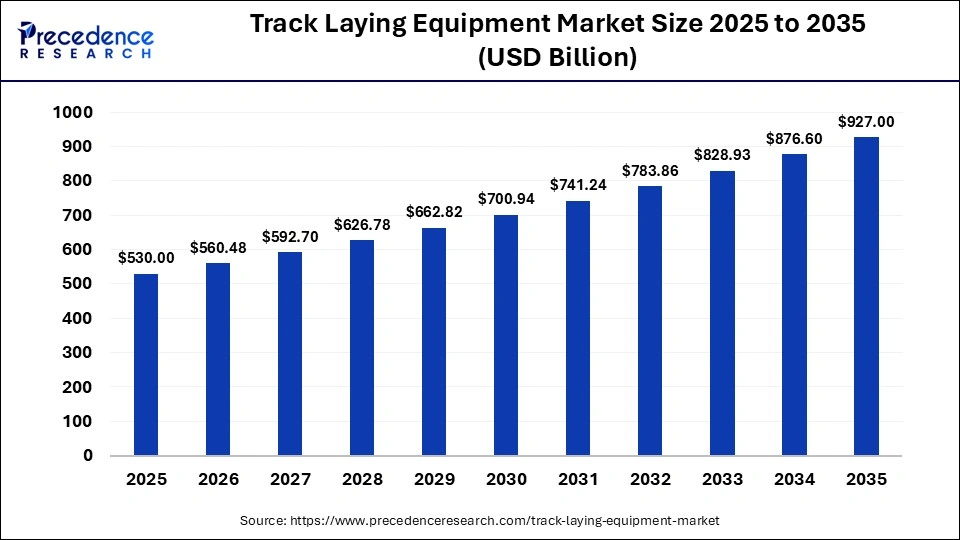
The global track laying equipment market size accounted for USD 530.00 billion in 2025 and is predicted to increase from USD 560.48 billion in 2026 to approximately USD 927.00 billion by 2035, expanding at a CAGR of 5.75% from 2026 to 2035. This market is growing due to railway infrastructure expansion and demand for efficient heavy-duty machinery in construction and mining.
Key Takeaways
- North America dominated the global track laying equipment market share of 42% in 2025.
- Asia Pacific is expected to grow at the fastest CAGR between 2026 and 2035.
- By size, the large segment held the biggest market share in 2025.
- By size, the small segment is expected to expand at the fastest CAGR between 2026 and 2035.
- By type, the excavators segment contributed to the highest market share in 2025.
- By type, the bulldozers segment is growing at a strong CAGR between 2026 and 2035.
- By propulsion, the diesel segment held a major market share in 2025.
- By propulsion, the electric segment is expected to expand at the fastest CAGR from 2026 to 2035.
- By application, the construction segment generated the biggest market share in 2025.
- By application, the mining segment is expanding at the fastest CAGR between 2026 and 2035.
- By operating weight, the 10-25 tons segment held a major market share in 2025.
- By operating weight, the 25-50 tons segment is expected to expand at the fastest CAGR from 2026 to 2035.
What Drives the Growth of the Track Laying Equipment Market?
The track laying equipment market is experiencing steady growth because more money is being spent on building railway infrastructure, expanding high-speed rail and metro projects, and updating existing rail networks. Governments in both developed and emerging nations are concentrating on enhancing rail connectivity to facilitate sustainable mobility, freight transportation, and urbanization. The market is also driven by the growing demand for automated and highly efficient track installation equipment as contractors look to cut labor costs and complete projects more quickly. Additionally, the rising focus on sustainable and durable construction practices is encouraging the adoption of modern track laying machines across industries.
How is Artificial Intelligence Transforming the Track Laying Equipment Market?
Artificial intelligence is revolutionizing the track laying equipment market by enhancing predictive maintenance capabilities, efficiency, and accuracy. Artificial intelligence-driven sensors and data analytics reduce construction errors and downtime by tracking the stability of ballast distribution and alignment accuracy in real time. By anticipating possible equipment failures and reducing operational interruptions, advanced machine learning algorithms make predictive maintenance possible. AI-driven automation also helps railway infrastructure projects run more quickly, rely less on labels, and have higher safety standards.
Major Market Trends
- Expansion of High-Speed Rail Networks: Increasing investments in high-speed rail corridors are driving demand for advanced, precision-based track-laying machinery capable of handling complex rail structures.
- Growing Adoption of Automation: Automated and semi-automated track laying systems are gaining popularity to reduce manual labor, enhance accuracy, and accelerate project timelines.
- Integration of AI & Smart Monitoring: Smart sensors and AI-based monitoring systems are being integrated into equipment to improve real-time alignment tracking and predictive maintenance.
- Focus on Sustainable Rail Infrastructure: Governments are promoting eco-friendly rail construction practices, boosting demand for energy-efficient and low-emission equipment.
- Rapid Metro & Urban Transit Development: Expanding metro rail projects in urban areas increases the need for compact and efficient track installation machinery.
- Technological Advancements in Heavy Machinery: Continuous innovations in hydraulic systems, GPS tracking, and precision engineering are improving operational performance.
- Digital Project Management Integration: Construction firms are adopting digital platforms and data-driven project management tools to enhance coordination and efficiency.
- Public-Private Partnerships (PPPs): Growing collaboration between governments and private players is accelerating railway expansion projects globally.
Future Market Outlook
- Emerging Market Infrastructure Development: Developing economies present strong growth potential due to expanding railway connectivity projects.
- Dedicated Freight Corridor Projects: Rising freight transportation needs to create opportunities for heavy-duty and high-capacity track-laying systems.
- Railway Modernization & Upgradation: Replacement of old rail tracks and upgrading to modern systems offer recurring equipment demand.
- Demand for Customized Equipment Solutions: Manufacturers can capitalize by offering project-specific and terrain-specific machinery solutions.
- Aftermarket & Maintenance Services Growth: Increasing installed equipment base creates long-term service, repair, and spare parts opportunities.
- Smart Railway Infrastructure Projects: The shift toward digital rail networks opens opportunities for intelligent and sensor-integrated track laying systems.
- Cross-Border Rail Connectivity Initiatives: International rail connectivity programs are boosting large-scale infrastructure investments.
- Green Rail Transportation Initiatives: Rising focus on reducing carbon emissions supports demand for energy-efficient and hybrid-powered equipment.
Market Scope
| Report Coverage | Details |
| Market Size in 2025 | USD 530.00 Billion |
| Market Size in 2026 | USD 560.48 Billion |
| Market Size by 2035 | USD 927.00 Billion |
| Market Growth Rate from 2026 to 2035 | CAGR of 5.75% |
| Dominating Region | North America |
| Fastest Growing Region | Asia Pacific |
| Base Year | 2025 |
| Forecast Period | 2026 to 2035 |
| Segments Covered | Size, Type, Propulsion, Application, Operating Weight, and Region |
| Regions Covered | North America, Europe, Asia-Pacific, Latin America, and Middle East & Africa |
How Does Track Laying Equipment Offer Strong ROI Opportunities?
| Factors Prompting the Adoption of Equipment | How It Improves Returns | Benefits for Investors & Companies |
| High-Speed Rail Projects | High-speed rail projects are largely funded by governments, ensuring long-term and stable contracts. | This provides predictable revenue and secures long-term profitability. |
| Metro & Urban Rail Expansion | Rapid urbanization is increasing the development of metro and urban rail networks worldwide. | This creates continuous project opportunities and a steady income flow. |
| Automation Adoption | The adoption of automated track laying equipment reduces labor costs and improves operational efficiency. | This results in higher profit margins and faster return on investment. |
| Railway Modernization | Aging railway infrastructure requires regular upgrades and track replacements. | This generates recurring demand and repeat business opportunities. |
| Aftermarket Services | Track-laying equipment requires regular maintenance, spare parts, and servicing. | This ensures long-term recurring revenue beyond initial equipment sales. |
| Green Rail Initiatives | Governments support sustainable rail infrastructure with financial incentives. | This improves project viability and enhances overall returns. |
| Public-Private Partnerships | Public-private partnerships help share financial risks in large rail projects. | This reduces investment risk while ensuring stable returns. |
Segment Insights
Size Insights
Why Did the Large Segment Dominate the Track Laying Equipment Market?
The large segment dominated the market with the largest share in 2025 because large-sized track-laying equipment delivers high power capacity and improved performance, making them suitable for large-scale infrastructure development projects. Contractors often adopt large-sized equipment for their capacity to manage intricate track installation tasks. The segment's market dominance is further reinforced by rising investments in railway modernization. Large equipment also increases efficiency and productivity in long-term projects. The availability of sophisticated automation features also decreased downtime and increased operational accuracy.
The small segment is expected to grow at the fastest CAGR in the coming years due to the fact that small-sized track-laying equipment is appropriate for construction sites with limited space and urban rail projects. Small and medium-sized contractors find it appealing due to their enhanced mobility and reduced operating costs. Compact equipment demand is increasing due to last-mile connectivity projects and growing metro expansion. Improvements in technology are also improving fuel economy and performance. Rapid expansion is further supported by inexpensive maintenance and simple transportation.
Type Insights
What Made Excavators the Dominant Segment in the Track Laying Equipment Market?
The excavators segment dominated the market while holding the largest share in 2025 due to their unmatched versatility and efficiency across construction, mining, and infrastructure projects. Their ability to perform multiple tasks, such as digging, lifting, demolition, and material handling, makes them indispensable on job sites. Track-based designs provide superior stability and mobility on uneven or soft terrains, giving them an advantage over wheeled equipment. Moreover, continuous innovations in hydraulic systems, automation, and fuel efficiency have further strengthened their productivity and cost-effectiveness, solidifying their leadership in the market.
The bulldozers segment is expected to grow at the fastest rate in the upcoming period due to rising demand for land clearing, earthmoving, and site preparation activities in construction and mining projects. Their robust track-based design allows them to operate efficiently on rough, uneven, and soft terrains where wheeled machinery struggles. Increasing infrastructure development and large-scale industrial projects are boosting the need for high-capacity, durable bulldozers. Additionally, advancements in fuel efficiency, blade control technology, and operator comfort are making modern bulldozers more productive and cost-effective, further driving their adoption.
Propulsion Insights
What Made Diesel the Dominant Segment in the Track Laying Equipment Market?
The diesel segment dominated the market in 2025 because of its high power output, reliability, and suitability for heavy-duty operations in construction, mining, and infrastructure projects. Diesel engines provide the torque and endurance needed to operate large track-laying machines efficiently over rugged and uneven terrains. Their widespread availability, lower operating costs compared to alternative fuels, and compatibility with advanced hydraulic and control systems further reinforce their dominance.
The electric segment is expected to grow at the fastest CAGR throughout the forecast period due to the growing emphasis on emission reduction and sustainability. To lessen carbon footprints, governments are encouraging the use of greener construction equipment. Efficiency gains are being brought about by developments in battery technology and charging infrastructure. Electric-powered machinery adoption is also being aided by rising fuel prices. Growth is further supported by lower operating expenses and fewer maintenance needs.
Application Insights
Why Did the Construction Segment Dominate the Track Laying Equipment Market?
The construction segment dominated the market by capturing a major share in 2025 because extensive track laying and site preparation equipment are necessary for infrastructure development projects. Track-laying machines like excavators and bulldozers are essential for heavy-duty earthmoving, site preparation, and material handling in construction sites. Their ability to operate on uneven and challenging terrains makes them more effective than wheeled equipment in large-scale projects. Additionally, government investments and private-sector spending on residential, commercial, and industrial construction continue to drive strong demand for reliable and efficient track-laying equipment.
The mining segment is expected to grow at the fastest CAGR in the upcoming period because mining operations require heavy machinery for material extraction and transportation. Rising mining activities in emerging economies are supporting growth. Technological improvements are enhancing the operational efficiency of track-laying equipment in harsh environments.
Operating Weight Insights
Why Did the 10-25 Tons Segment Dominate the Track Laying Equipment Market?
The 10-25 tons segment dominated the market in 2025 since it provides a balance between power mobility and cost effectiveness. This range is preferred by contractors because it is portable and has a variety of uses. Its dominance was reinforced by strong demand from infrastructure development projects. When compared to heavier models, it also offers better fuel efficiency. Long-term operations find it appealing due to their lower maintenance costs.
The 25-50 tons segment is expected to grow at the fastest rate during the projection period due to its optimal balance of power, versatility, and maneuverability for a wide range of construction and mining applications. Machines in this weight class can handle heavy-duty tasks like earthmoving, excavation, and site preparation while still being flexible enough for mid-sized projects. Increasing infrastructure development and urban construction activities are boosting demand for equipment that offers high productivity without the logistical challenges of larger, ultra-heavy machinery.
Region Insights
North America Track Laying Equipment Market Size and Growth 2026 to 2035
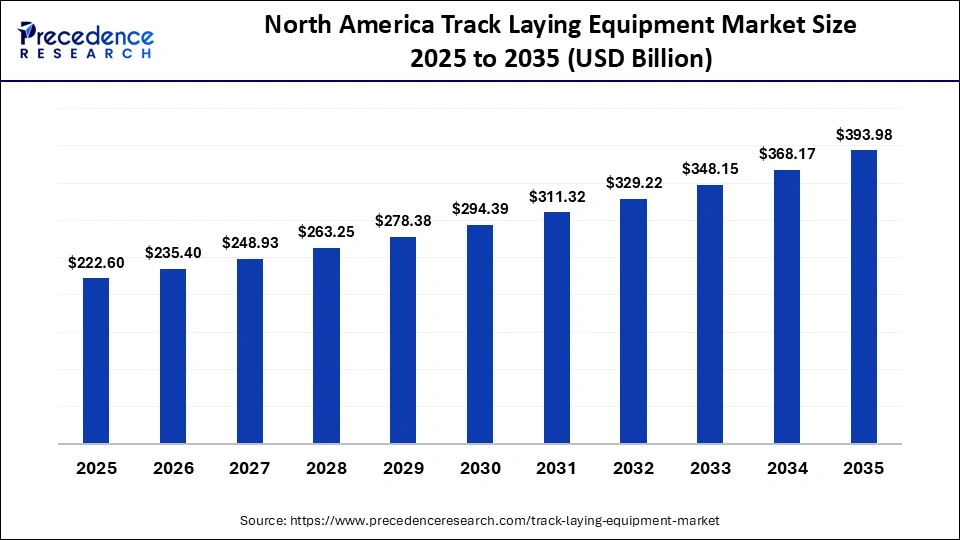
The North America track laying equipment market size is estimated at USD 222.60 billion in 2025 and is projected to reach approximately USD 393.98 billion by 2035, with a 5.88% CAGR from 2026 to 2035.
Why Did North America Dominate the Track Laying Equipment Market?
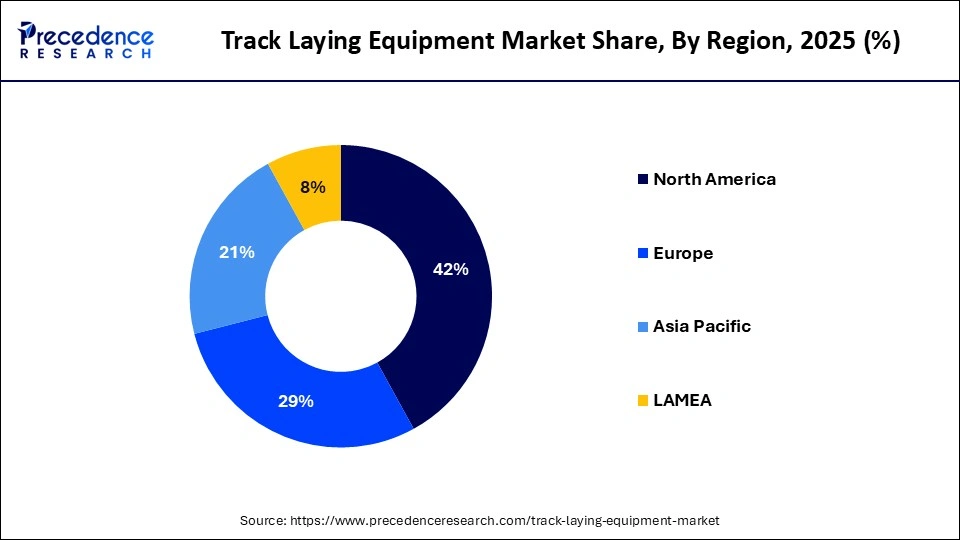
North America dominated the track laying equipment market by holding the largest share of 42% in 2025. The region's dominant position in the market is attributed to significant investments in infrastructure upgrades, freight network expansion, and railway modernization. Strong government funding and ongoing development initiatives further fueled the demand for track-laying equipment. The presence of leading equipment manufacturers in the region enhanced supply capabilities, while the adoption of advanced technologies boosted project productivity and operational efficiency.
U.S. Track Laying Equipment Market Size and Growth 2026 to 2035
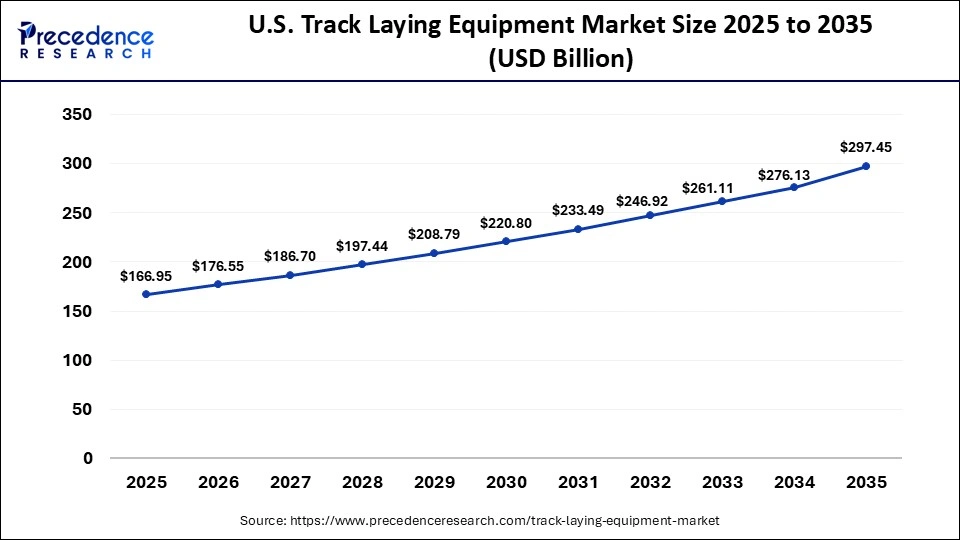
The U.S. track laying equipment market size is calculated at USD 166.95 billion in 2025 and is expected to reach nearly USD 297.45 billion in 2035, accelerating at a strong CAGR of 5.95% between 2026 and 2035.
U.S. Track Laying Equipment Market Trends
The U.S. is a major contributor to the North American market because of large-scale investments in railway infrastructure and freight corridor expansion. Federal funding initiatives and transportation modernization programs increased equipment demand. Strong industrial activity and rail network upgrades further supported the country's market leadership.
How is the Opportunistic Rise of Asia Pacific in the Market?
Asia Pacific is expected to grow at the fastest CAGR in the market due to rapid urbanization, industrialization, and large-scale infrastructure projects across countries like China, India, and Japan. Expanding road networks, railway modernization, and mining activities are driving strong demand for versatile and efficient track-laying machinery. Government initiatives and foreign investments aimed at boosting construction and industrial growth are further accelerating market expansion.
India Track Laying Equipment Market Trends
India is leading the market within Asia Pacific because of major railway expansion projects and government initiatives supporting infrastructure development. Large investments in metro rail, freight corridors, and high-speed rail boosted demand for track-laying equipment. The availability of cost-effective local manufacturing and increasing adoption of advanced technologies are further supporting market growth in the country.
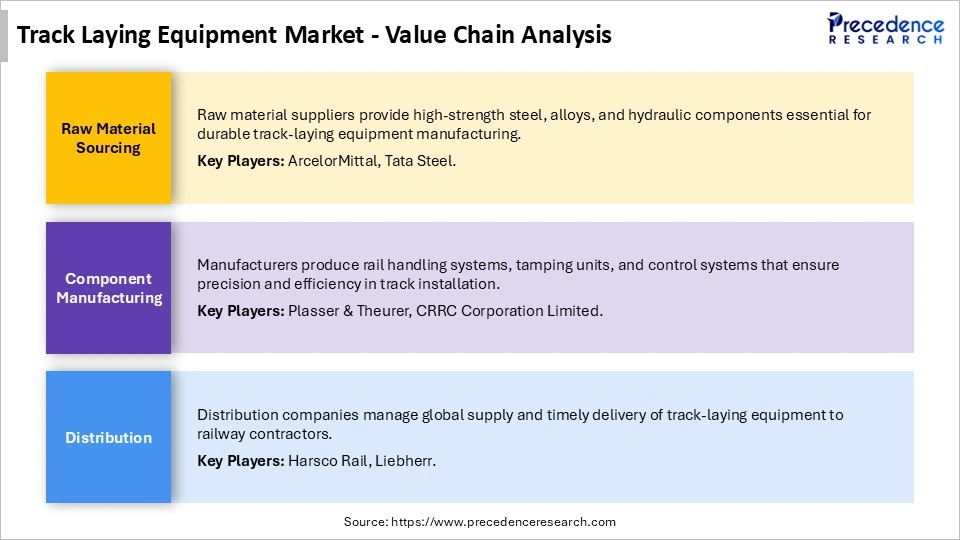
Track Laying Equipment Market Value Chain Analysis
Track Laying Equipment Market Companies
- Plasser & Theurer
- Geismar
- Matisa
- Harsco Rail/Enviri
- CRRC Corporation Limited
- Vossloh AG
- Techne Kirow GmbH
- Salcef Group S.p.A.
- Robel Bahnbaumaschinen GmbH
Recent Developments
- In March 2025, L&T Technology Services (LTTS) announced the launch of TrackEi, an AI-powered railway track inspection solution utilizing the NVIDIA Jetson platform. The system offers real-time, high-speed inspection to identify track defects, aimed at enhancing global railway safety. This technology was showcased at the NVIDIA GTC 2025 AI Conference following an innovation award win. (Source: https://www.thehindu.com)
Segments Covered in the Report
By Size
- Small
- Medium
- Large
By Type
- Bulldozers
- Excavators
- Graders
- Loaders
- Skid Steers
By Propulsion
- Diesel
- Electric
- Hybrid
By Application
- Construction
- Mining
- Agriculture
- Forestry
- Military
By Operating Weight
- Less than 10 tons
- 10-25 tons
- 25-50 tons
- Over 50 tons
By Region
- North America
- Europe
- Asia-Pacific
- Latin America
- Middle East & Africa
For inquiries regarding discounts, bulk purchases, or customization requests, please contact us at sales@precedenceresearch.com
Frequently Asked Questions





Ask For Sample
No cookie-cutter, only authentic analysis – take the 1st step to become a Precedence Research client
 Get a Sample




 sales@precedenceresearch.com
 Schedule a Meeting
