



U.S. Biosensors Market Size, Companies, Share, Patient Volume, Treatment Adoption Rates, Pricing Analysis, Regulatory Landscape, Competitive Positioning, and Demand Forecast
Rohan Patil, a Healthcare Industry Expert, highlights that the U.S. biosensors market has reached USD 11.69 billion in 2026 and is on track to reach USD 20.42 billion by 2035, advancing at a CAGR of 6.51%. Key U.S. biosensors market companies shaping the market include Abbott Laboratories, Dexcom Inc., Bio-Rad Laboratories, Inc., while major growth segments span By Technology, By Application, By End Use.
Source: https://www.precedenceresearch.com/us-biosensors-market
 Get a Sample
 Table Of Content


US Biosensors Market Size and Forecast 2026 to 2035
The US biosensors market size accounted for USD 10.87 billion in 2025 and is predicted to increase from USD 11.69 billion in 2026 to approximately USD 20.42 billion by 2035, expanding at a CAGR of 6.51% from 2026 to 2035. The market is driven by the rising prevalence of chronic diseases, increasing demand for point-of-care testing, and advancements in wearable healthcare technologies.
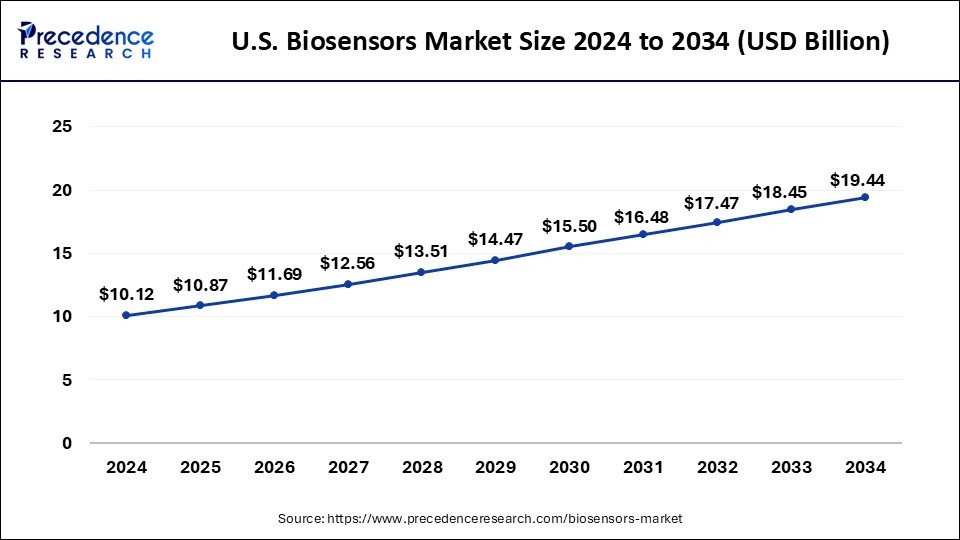
Key Takeaways
- By technology, the electrochemical segment contributed the highest market share in 2025.
- By technology, the optical segment is expected to grow at a strong CAGR between 2026 and 2035.
- By application, the medical segment held a major market share in 2025.
- By application, the agriculture segment is expected to expand at the fastest CAGR from 2026 to 2035.
- By end-use, the POC testing segment captured the highest market share in 2025.
- By end use, the research laboratories segment is poised to grow at a significant CAGR between 2026 and 2035.
Market Overview
Biosensors are analytical instruments that emit an electrical response after a biological reaction occurs, giving measurable responses when detecting a specific analyte. These are frequently used in medical, agriculture, environment monitoring, food safety, and scientific research fields of application, etc. The trend of personalized healthcare, growing demand for non-invasive wearable devices, and the need for more health monitoring drive the growth of the market. Moreover, increasing research collaborations and continuous advancement in medical technologies are stimulating product innovations.
How is AI Transforming the U.S. Biosensors Market?
The market is expanding with the introduction of artificial intelligence (AI) and machine learning (ML), which enhance the diagnostic capabilities for diseases and increase precision. Continuous monitoring is enhanced with the uptake of more precise wearable biosensors, so that patients are more continuously monitored, and data becomes more accessible. For biosensor development, AI can assist in choosing the most appropriate analyte, designing the recognition element, optimising the signal transduction process, and interpreting the data.
U.S. Biosensors Market Trends
- Expanding Clinical and Therapeutic Applications: Biosensors are gaining significance in many other applications such as monitoring cancer markers, anaesthesia monitoring, and intraoperative care. These allow for expanded adoption, particularly in highly populated states such as California and Texas, for high-end clinical applications, also enables decentralized diagnostics.
- Business Expansions and Local Hardware Manufacturing: Manufacturers are increasing their investments in microfabrication and cleanroom facilities to limit risks in the chain of supply. Beyond its work in biological surface patterning and manufacturing of MEMS, additional local capabilities will allow the company to provide stable biosensors to the U.S. healthcare enterprise.
- Proliferation of Remote Patient Monitoring and Outpatient Centers: The market has been rising in popularity due in part to the provision of home healthcare services and ambulatory surgical centers. Real-time telemetry patches and mobile devices enable decentralized diagnostics, which allow for continuous monitoring, improving outcomes, and adding in-hospital efficiency.
- Government Initiatives and Supply Chain Fortification: U.S. government programs under the CHIPS Act and the FDA help build domestic manufacturing and supply chain resiliency for the MEMS industry. These policies are designed to improve the capacity of the diagnostic facilities and to promote local production.
- Heavy Investments in Automation and Biofabrication Infrastructure: The investments are substantial in the direction of automated biofabrication systems like roll-to-roll printing and laser microfluidics. These advances are exploited to design scalable biosensor test strips and chips that can enhance the efficiency, accuracy, and commercialisation.
- Regulatory Approvals and Stringent Biocompatibility Quality Control: Biocompatibility, safety, and accuracy of biosensors follow strict guidelines by the FDA. Huge Investments are poured into clinical testing and quality control processes by medical companies to ensure that it lives up to the standards necessary for regulatory approval, security of data, and their reliability for medical applications.
Market Report Coverage and Key Metrics
| Report Coverage | Details |
| Market Size in 2025 | USD 10.87 Billion |
| Market Size in 2024 | USD 11.69 Billion |
| Market Size by 2035 | USD 20.42 Billion |
| Growth Rate from 2026 to 2035 | CAGR of 6.51% |
| Base Year | 2025 |
| Forecast Period | 2026 to 2035 |
| Segments Covered | Technology, Application, and End Use |
Market Dynamics
Drivers
Growing Demand for Point-of-Care Diagnostic Solutions
There is a demand for more rapid, reliable, and mobile diagnostic instruments that can be used at or near the patient's site. Biosensors have the potential to measure different levels of biomarkers in real time to aid in more accurate patient care responses and therefore improve patient outcomes. POC testing can be much quicker than traditional laboratory testing, particularly if an immediate result is needed, and having shorter turnaround times.
Restraint
Limitations Associated with the Use of Biosensors
While rapid growth is expected, there are several constraints to take into account that inhibit the further expansion of the market. Degradation over time can lead to the reliability of results being compromised from a diagnostic, making them not useful in the critical care application of the devices. In addition, complex manufacturing and strict quality requirements make highly sophisticated biosensors more costly and necessitate the use of costly materials.
Opportunity
Advancements in Nanomaterials Enhancing Sensor Sensitivity and Miniaturization
The use of nanomaterials in the sensors enhances their sensitivity, accuracy, and miniaturisation, offering the market a tremendous growth potential. Innovative materials like MXenes, graphene, carbon nanotubes, and gold nanoparticles improve the efficiency of the transference of electrons. Miniaturized sensors have a long wear life, better health monitoring attributes, and are more user-friendly, and remain an important part of the field of personalized medicine.
How are Government Initiatives Supporting the U.S. Biosensors Market?
The government's initiatives are driving innovation, restructuring of the healthcare system, and preparedness for upcoming timely innovations that will influence the market. Wearable health monitoring devices, POD, and personalized medicine are being developed to improve patient outcomes and improve disease identification, and these are being supported by the federal government with investment in technology.
- For instance, in 2024, the U.S. government's Advanced Research Projects Agency for Health (ARPA-H) opened up the Delphi mission to back the growth of low-cost wearable biosensors that can track several biological signals over the duration of a few years. The program aims to promote and advance prototype development and innovation for modular sensor elements.
Market Segmentation Analysis
Technology Insights
How did the Electrochemical Segment Lead the U.S. Biosensors Market?
The electrochemical segment led the market in 2025, owing to its wide adoption in biochemical and biological analysis. In diagnostics, they are being widely used and are very reliable in cases of measuring and detecting important analytes such as glucose and cholesterol. The advantages of such a scheme are low cost, high sensitivity, easy miniaturisation, and wearable versions. These properties have made a significant inroad for its application in healthcare and point-of-care applications.
The optical segment is expected to grow at the fastest CAGR during the forecast period, due to its ability to deliver real-time and accurate diagnostics and leading-edge diagnostics. They use light detection system technology for non-invasive, highly sensitive analysis of the interaction of biological systems. These are increasingly being seen in point-of-care testing, particularly in home health care settings, in emergency units, and satellite hospitals. The increasing occurrence of chronic diseases, like cardiovascular disease and diabetes, is creating a momentum toward the demand for continuous monitoring solutions.
Application Insights
The Medical Segment Dominated the U.S. Biosensors Market in 2025
The medical segment dominated the market with a major share in 2025, due to its extensive use of biosensors in the diagnostic, monitoring, and therapeutic applications. Cholesterol level testing, blood glucose monitoring, disease detection - infectious disease, blood gas monitoring, and discovery of drugs are monitored and tested using biosensors to monitor enzyme activity. They also provide a rapid and highly accurate diagnosis, which is particularly useful in the diagnosis of point-of-care and emergencies.
The agriculture segment is expected to grow at the fastest CAGR during the forecast period, owing to the growing demand for precision farming and sustainable farming practices. The use of biosensors can help farmers to make better use of their resources and optimize their crop growth. They also help to identify diseases, control irrigation, and control pesticide application. Also, biosensors play an important role in the detection of contamination of agricultural products and food safety.
End User Insights
Which End User Segment Dominated the U.S. Biosensors Market?
The PoC testing segment held the largest share of the market in 2025. Demanding rapidness and accuracy of diagnostics, which are distributed to guide immediate clinical decisions. New developments in technology allow for new printable biosensors that are extremely sensitive and can be used in biological fluids such as blood, saliva, urine, and sweat in PoC applications. The innovations help to detect disease in an early stage, manage chronic diseases successfully, and monitor health at home.
The research laboratories segment is expected to grow at a significant CAGR during the forecast period, due to the rising demand for research-oriented sophisticated analyzers, especially for biomedical research applications. Biosensors have become a common tool in the drug discovery process, biomarker identification, and disease mechanism studies, providing a platform for quicker innovation in the field of science. They are applied in studies for high-throughput screening, cell culture, and validation of diagnostic assays.
US Biosensors Market Value Chain Analysis
- R&D: Flexible electronics is being developed using the use of biosensors, as well as the development of new methods that incorporate artificial intelligence approaches to analyse health parameters and enhance the sensitivity and accuracy of biosensors.
Key Players: Abbott Laboratories, Medtronic, Dexcom, Inc.
- Clinical Trials and Regulatory Approvals: The biocompatibility, analytical sensitivity/specificity on biosensors, to demonstrate that they are safe, accurate, and meet regulatory requirements to move them to market.
Key Players: Abbott Laboratories, Dexcom, Inc., Bio-Rad Laboratories, Inc.
- Patient Support and Services: These include insurance support, assistance with procedures, remote monitoring systems, mobile apps, and more to enhance treatment adherence & engage patients.
Key Players: Dexcom, Inc., LifeScan IP Holdings, LLC, Nova Biomedical.
Market Competitive Landscape: Leading Companies and Strategies
Large companies such as Abbott Laboratories, Dexcom, Inc., and Medtronic have recently taken up a significant portion of the market, and the companies are introducing innovations. Competition is driven by the need for real-time solutions for health monitoring, technology, and regulations, as well as pricing. For instance, Nix signed an agreement with Baylor University Athletics in April 2026 and interfaced with 19 universities, including 450+ students playing sports across the state, who Nix covered in their performance biosensors program.
The healthcare industry is transforming and experiencing heightened competition as it looks to deliver personalised healthcare, remotely track workers' health, and assist patients. Researchers are interested in enhancing the scalability of manufacturing, in miniaturisation, and in cloud-based ecosystems.
Top Companies in the U.S. Biosensors Market
- Abbott Laboratories
- Dexcom Inc.
- Bio-Rad Laboratories, Inc.
- DuPont
- Nova Biomedical
- Masimo
- LifeScan IP Holdings, LLC
- Molecular Devices, LLC.
Recent Developments US Biosensors Market (2025-2026)
- In September 2025, Biolinq Incorporated achieved De Novo Classification for its first product, Biolinq Shine™. The approval allows marketing of its next-generation ‘scaling' wearable multi-analyte biosensors, which are easy to use and comfortable, allowing for more convenient and comfortable tracking of metabolic health.(Source: https://www.biolinq.com)
- In July 2025, Abbott Laboratories partnered with Beta Bionics to integrate its dual sensor technology to help individuals manage their diabetes in real time with the help of the iLet Bionic Pancreas system. This collaboration will facilitate the development of automation of insulin delivery and hence improve patient diabetes outcomes.(Source: https://investors.betabionics.com)
Segments Covered in the Report
By Technology
- Thermal
- Electrochemical
- Piezoelectric
- Optical
By Application
- Medical
- Cholesterol
- Blood glucose
- Blood gas analyzer
- Pregnancy testing
- Drug discovery
- Infectious disease
- Food Toxicity
- Bioreactor
- Agriculture
- Environment
- Others
By End User
- Home Healthcare Diagnostics
- PoC Testing
- Food Industry
- Research Laboratories
- Security and Bio-defense
For inquiries regarding discounts, bulk purchases, or customization requests, please contact us at sales@precedenceresearch.com
Frequently Asked Questions





Ask For Sample
No cookie-cutter, only authentic analysis – take the 1st step to become a Precedence Research client
 Get a Sample




 sales@precedenceresearch.com
 Schedule a Meeting
