



US Gynecological Devices Market Size, Key Companies, Company Market Share, Patient Volume, Treatment Adoption Rates, Pricing Analysis, Regulatory Landscape, Competitive Positioning, and Demand Forecast
Rohan Patil, a Healthcare Industry Expert, highlights that the US gynecological devices market has reached USD 4.51 billion in 2026 and is on track to reach USD 9.10 billion by 2035, advancing at a CAGR of 8.12%. Key US gynecological devices market companies shaping the market include Boston Scientific Corporation, Medtronic plc, Johnson & Johnson Services (Ethicon, Inc.), Stryker Corporation, while major growth segments span product, end use.
Source: https://www.precedenceresearch.com/us-gynecological-devices-market
 Get a Sample
 Table Of Content


US Gynecological Devices Market Size and Forecast 2026 to 2035
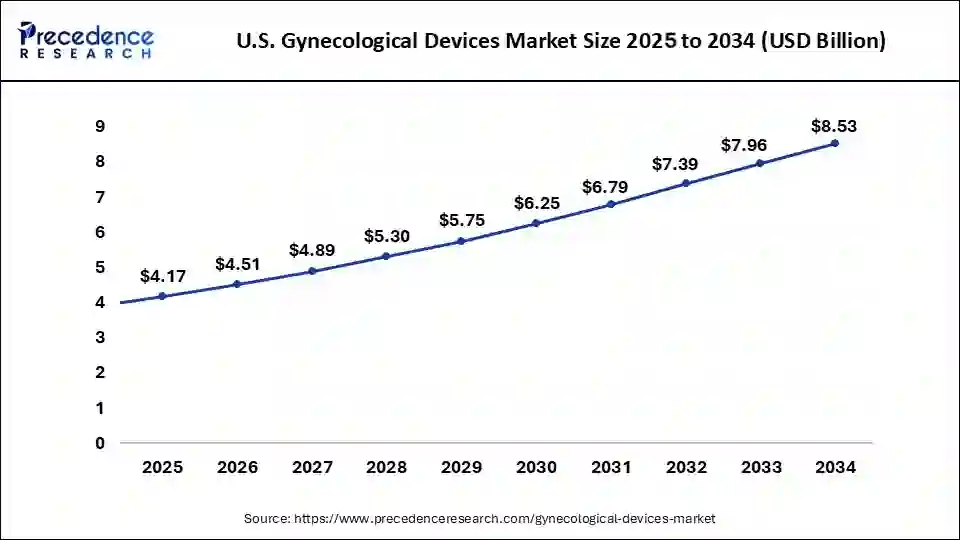
The global US gynecological devices market size accounted for USD 4.17 billion in 2025 and is predicted to increase from USD 4.51 billion in 2026 to approximately USD 9.10 billion by 2035, expanding at a CAGR of 8.12% from 2026 to 2035. The increasing adoption of minimally invasive procedures by healthcare professionals to treat women and technological advancements in hydrothermal ablation devices drive the market growth.
Key Takeaways
- By product, the surgical devices segment dominated the market in 2025.
- By product, the gynecological imaging devices segment is projected to rise with a significant CAGR during the forecast period.
- By end use, the hospitals and clinics segment held the largest market share in 2025.
- By end use, the ambulatory surgery centers (ASCs) segment is expected to grow with the highest CAGR during the forecast period.
Market Overview
The U.S. gynecological devices market is gaining traction rapidly, owing to the surging demand for birth-control devices. Healthcare providers are expanding their networks to deliver high-quality gynecological care to women in the U.S. The increasing prevalence of endometrial cancers and numerous government initiatives aimed at developing the medical devices industry contribute to the market growth.
What is the Role of AI in the U.S. Gynecological Devices Industry?
Artificial intelligence plays a crucial role in transforming the U.S. gynecological devices industry by assisting surgeons in the automated measurement of anatomical structures, analyzing pelvic masses, and detecting subtle abnormalities. AI-enabled software helps in the evaluation of histopathological and hysteroscopy images to identify malignant masses for the early diagnosis of endometrial cancers, cervical cancers, and ovarian cancers. AI systems also enable time-lapse embryo imaging to select the embryos with the highest viability for enhancing in vitro fertilization success rates.
- In September 2025, GE HealthCare launched the Voluson Performance 18 and 16 ultrasound systems. These ultrasound devices are integrated with AI to enhance gynecological surgical procedures.
What are the Trends of the U.S. Gynecological Devices Market?
- Surging Prevalence of Cervical Cancer: The growing cases of cervical cancer have increased demand for advanced surgical procedures.
- Business Expansions: Medical device companies are investing rapidly in opening new manufacturing units in different parts of the U.S.
- Partnerships: Numerous hospitals are partnering with medical instrument manufacturers to adopt high-quality surgical equipment for enhancing minimally invasive surgeries.
- Government Initiatives: The U.S. government has launched numerous policies to strengthen the healthcare infrastructure across the nation.
Market Report Coverage and Key Metrics
| Report Coverage | Details |
| Market Size in 2025 | USD 4.17 Billion |
| Market Size in 2026 | USD 4.51 Billion |
| Market Size by 2035 | USD 9.10 Billion |
| Growth Rate from 2026 to 2035 | CAGR of 8.12% |
| Base Year | 2025 |
| Forecast Period | 2026 to 2035 |
| Segments Covered | Product and End Use |
Market Dynamics
Drivers
Surging Demand for Contraceptive Devices
The demand for contraceptive devices has increased significantly to maintain the balance of the population in the U.S. Medical device companies are engaged in developing advanced contraceptive devices to enhance birth control in this region. People residing in the U.S. are widely adopting intrauterine devices (IUDs), intravaginal rings, and subdermal contraceptive implants to avoid unwanted pregnancies.
- In February 2025, Sebela Women's Health Inc announced that the FDA had approved MIUDELLA, a copper-based intrauterine system designed to prevent unwanted pregnancies in women across the U.S.
Restraint
Increasing Cost of Advanced Instruments and Strict Approval Policy
The U.S. FDA has adopted stringent policies for approving gynecological devices, resulting in delayed availability of these devices, thereby hampering industrial growth. Also, the costs of advanced medical equipment are rising significantly due to the surging cost of raw materials and supply chain issues, which in turn restrain the market expansion.
Opportunity
Portable Ultrasound Devices and Fluorescence Imaging
In recent times, robotic systems have been integrated with advanced fluorescence imaging to enable surgeons to visualize critical anatomical structures, including uterine vessels and the sentinel lymph node, to reduce the risk during endometriosis treatment. Portable 3D ultrasound devices are widely adopted by healthcare professionals as it allows them to perform accurate, real-time spatial scans for precise IUD placement and identifying displacement in the endometrial lining. Thus, technological advancements in portable ultrasound devices and the growing popularity of fluorescence imaging are expected to create several opportunities in the coming years.
Market Segmentation Analysis
Product Insights
The Surgical Devices Segment Dominated the U.S. Gynecological Devices Market in 2025
The surgical devices segment led the market in 2025. This is due to the growing investments by healthcare brands for developing a wide range of surgical devices in the U.S. The demand for gynecological endoscopy devices and handheld instruments has increased in public hospitals for delivering advanced care to women patients. The popularity of intravaginal rings has grown significantly to control the birth rate in the U.S.
The gynecological imaging devices segment is expected to grow at a considerable CAGR in the upcoming period. This is owing to the surging adoption of gynecological imaging devices to view different parts of the female reproductive system, such as the uterus, fallopian tubes, ovaries, and cervix. These imaging devices are used to detect the prevalence of various types of diseases, including tumours, fibroids, and endometriosis. Healthcare professionals are using hysteroscopes to directly visualize and treat issues inside the uterine cavity.
End Use Insights
Which End Use Segment Dominated the U.S. Gynecological Devices Market?
The hospitals and clinics segment held the largest market share in 2025. This is due to the increasing focus of hospital chains on expanding their networks across the U.S. The U.S. government is making significant investments in opening new public hospitals to deliver free treatment to women. The gynecological clinics are collaborating with medical device companies to adopt high-quality instruments for operating gynecological procedures.
The ambulatory surgical centers (ASCs) segment is expected to expand with the highest CAGR during the forecast period. This is owing to the growing preference of consumers to visit ambulatory surgical centers during emergencies. In the U.S., more than 10,000 ASCs have been established, which provide 24/7 gynecological care to patients. The deployment of advanced robotic systems in the ambulatory surgical centers enhances the newborn delivery process.
State-Wise Analysis
New Jersey Gynecological Devices Market Trends
The rising cases of polycystic ovary syndrome among women, as well as the technological advancements in the healthcare infrastructure, have driven the market expansion. The growing sales of hydrothermal ablation devices and radiofrequency ablation devices are contributing to industrial development. In addition, several gynecological centers are established to deliver high-quality treatment in this region.
Massachusetts Market Trends
The increase in medical device startups, along with the surging demand for temporary contraceptive devices, has boosted the industrial expansion. The government has opened numerous maternity hospitals to provide free childbirth services. The availability of skilled healthcare professionals, coupled with the growing adoption of advanced robotic systems in modern hospitals, accelerates the market growth.
Wisconsin Gynecological Devices Market Trends
The presence of numerous gynecology hospitals, such as UW Health, Aurora Baycare Medical Center, and St Vincent Hospital-Hospital Sisters, has driven the market growth. The public hospitals are providing affordable treatment to women suffering from cervical cancer. Medical device companies are opening new R&D centers to develop a wide range of gynecological equipment for the end-users of this region.
Utah Market Trends
The availability of 24/7 healthcare services, along with the presence of numerous medical institutions, has bolstered the market expansion. Leading surgical device manufacturers are investing rapidly in establishing new production centers to enhance their manufacturing output. Some of the leading gynecological centers of Utah include Sugar House Health Center, University of Utah Hospital, and South Jordan Health Center.
U.S. Gynecological Devices Market Value Chain Analysis
- Raw Materials Sourcing
Raw materials used in the production of gynecological devices comprise medical-grade polymers, advanced metals, and specialty materials.
Key Players: Dow Inc, Celanese Corporation, and DuPont.
- Clinical Trials and Regulatory Approval
Gynecological devices are tested through a risk-based approval process consisting of pre-clinical trials, bench testing, human clinical investigations, and regulatory review to commercialize the products in the market.
Key Players: IQVIA, ICON plc, ACL Digital, Emerald Clinical, and PPD.
- Distribution Channel
Gynecological devices are primarily distributed through a well-established supply channel that consists of direct sales and indirect channels, which cater to various end-users, including hospitals, ambulatory surgical centers, specialty clinics, and fertility centers.
Key Players: Medtronic plc, Cooper Surgical, Inc, Hologic, Inc., Boston Scientific Corp., and Stryker Corp.
Market Competitive Landscape: Leading Companies and Strategies
The U.S. gynecological devices market is highly fragmented, due to the presence of leading medical device brands and the rise of new entrants in this field. Some of the established companies operating in this sector include Boston Scientific Corporation, Medtronic plc, Johnson & Johnson Services (Ethicon, Inc.), Stryker Corporation, and Merck & Co, Inc. These brands are engaged in the research and development of advanced gynecological devices and are adopting numerous tactics, such as product launches and collaborations, to scale up their businesses in the U.S. Some emerging startups related to gynecological devices include Qvin, Materna Medical, and NextGen Jane.
Gynecological device manufacturers are collaborating with hospital chains to expand their regional businesses across the U.S. The U.S. government has launched various goals to use sustainable devices in the healthcare sector, which encourages surgical device companies to use eco-friendly materials for the production of gynecological devices. To overcome human errors, top companies are engaged in the production of surgical robots to enhance minimally invasive procedures in the future.
Top Companies in the U.S. Gynecological Devices Market
- Boston Scientific Corporation
- Medtronic plc
- Johnson & Johnson Services (Ethicon, Inc.)
- Stryker Corporation
- Richard Wolf GmbH
- Karl Storz Gmbh & Co. KG
- Olympus Corporation
- Cooper Surgical, Inc.
- Hologic, Inc.
Recent Developments U.S. Gynecological Devices Market (2025-2026)
- In June 2026, Medtronic launched the Hugo robotic-assisted surgery (RAS) system in the U.S. This robotic system finds application in gynecology surgeries across the nation.(Source: https://news.medtronic.com)
- In May 2026, GE HealthCare launched the MIM ComboTherapy GYN HDR/EBRT. This advanced solution was designed to treat gynecological cancers with superior precision in U.S. hospitals.(Source: https://www.gehealthcare.com)
- In April 2026, Utepreva announced that the FDA had approved the Utepreva Endometrial Sampler. Utepreva Endometrial Sampler is a single-use endometrial sampling device designed to enhance the early diagnosis of endometrial cancer.(Source: https://www.biospace.com)
Segments Covered in the Report
By Product
- Surgical Devices
- Gynecological Imaging Devices
- Portable Tools
By End-Use
- Hospital and Clinics
- Ambulatory Surgery Centers (ASCs)
For inquiries regarding discounts, bulk purchases, or customization requests, please contact us at sales@precedenceresearch.com
Frequently Asked Questions





Ask For Sample
No cookie-cutter, only authentic analysis – take the 1st step to become a Precedence Research client
 Get a Sample




 sales@precedenceresearch.com
 Schedule a Meeting
