



Workspace Management Software Market Trends, Companies, Revenue / Sales Performance, Subscriber Growth, Pricing Strategies, Cloud Adoption, Infrastructure Expansion, Competitive Landscape, and Industry Outlook
Workspace Management Software Market (By Component: Software Solutions, Space management tools, Implementation and integration, Support and maintenance; By Deployment Mode: Cloud-Based Solutions, On-Premise Solutions; By Function: Space and Desk Management, Facility and Maintenance Management, Asset and Resource Management, Workplace Analytics; By Industry Vertical: IT and Telecommunications, BFSI (Banking, Financial Services, Insurance), Education, Retail and E-commerce, Other Industries;) - Global Industry Analysis, Size, Trends, Leading Companies, Regional Outlook, and Forecast 2026 to 2035
Source: https://www.precedenceresearch.com/workspace-management-software-market
 Get a Sample
 Table Of Content


What is the Workspace Management Software Market Size in 2026?
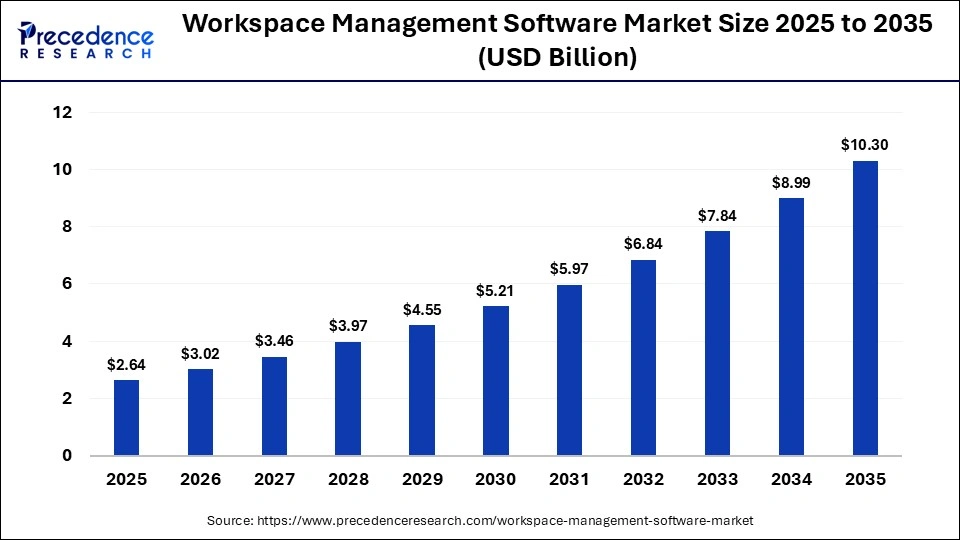
The global workspace management software market size was calculated at USD 2.64 billion in 2025 and is predicted to increase from USD 3.02 billion in 2026 to approximately USD 10.30 billion by 2035, expanding at a CAGR of 14.60% from 2026 to 2035. The market is witnessing substantial growth due to a rapid surge in hybrid work models, along with the rising adoption of AI-driven space optimization and IoT-enabled smart office solutions, which boost efficiency and employee experience.
Key Takeaways
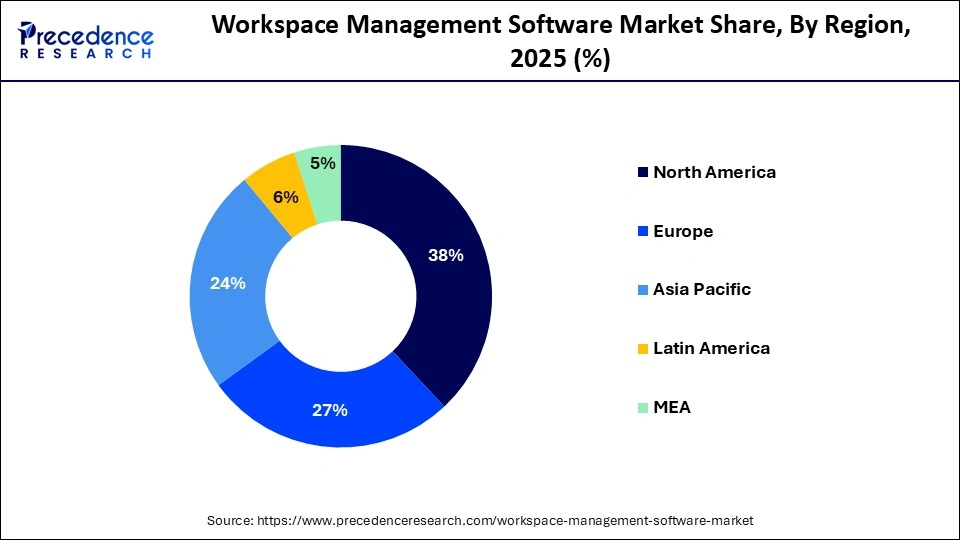
- North America dominated the market with a major share of around 38% in 2025.
- Asia Pacific is expected to grow at the fastest CAGR between 2026 and 2035.
- By component, the software solutions segment contributed the highest market share of around 61% in 2025.
- By component, the services segment is growing at a strong CAGR between 2026 and 2035.
- By deployment mode, the cloud-based solutions segment held a major market share of around 58% in 2025.
- By function, the space and desk management segment captured the highest market share of 29% in 2025.
- By function, the workplace analytics segment is poised to grow at a healthy CAGR between 2026 and 2035.
- By industry vertical, the IT and telecommunications segment generated the biggest market share of around 24% in 2025.
- By industry vertical, the healthcare segment is expanding at the fastest CAGR between 2026 and 2035.
Market Overview
The global workspace management software market comprises digital platforms that help organizations manage workplace resources, office spaces, and employee work environments. These systems support functions such as desk reservation, meeting room scheduling, space utilization analytics, facility maintenance, and workplace collaboration. Workspace management software is widely used in corporate offices, coworking spaces, universities, and government institutions to optimize workspace utilization, improve employee productivity, and enable hybrid work strategies.
How is AI Transforming the Workspace Management Software Market?
Artificial intelligence (AI) is transforming the global market from passive administration to proactive, data-driven optimization, with the market shifting toward intelligent, cloud-based systems for hybrid work. AI analyzes data from IoT sensors to optimize office layouts, reducing wasted real estate by analyzing occupancy patterns. AI-driven systems monitor equipment to predict failures before they happen, reducing downtime and operational costs. AI automates desk and meeting room booking, optimizing schedules based on real-time attendance and reducing ghost meetings.
Major Trends in the Workspace Management Software Market
- Adoption of Intelligent Automation and Agentic AI: Moving beyond simple, reactive scheduling, AI now acts autonomously to manage, predict, and optimize workspaces.
- Platform Consolidation and Unified Experiences: Companies are moving away from siloed tools toward all-in-one platforms, resulting in significantly higher employee engagement.
- Real-Time Data and IoT Integration: Sensor-based analytics are becoming standard for monitoring real-time occupancy, providing accurate, immediate data on space utilization that is crucial for reducing office footprints.
- Rise in Sustainability and ESG Reporting: Integrated Workplace Management Systems are increasingly used to track energy consumption and carbon footprints by analyzing usage to optimize lighting and HVAC, reducing waste.
- AI‑Driven Space Optimization: AI and machine learning are increasingly used to analyze workspace utilization patterns and suggest optimal space allocation, reducing real estate costs and improving efficiency.
- Cloud‑Based & SaaS Adoption: Cloud delivery models are rapidly expanding as they provide scalability, remote access, continuous updates, and lower upfront costs, ideal for distributed workplaces.
- Integration with Collaboration & HR Platforms: Workspace management solutions increasingly integrate with tools like Microsoft Teams, Slack, and HRIS systems to unify scheduling, employee profiles, and resource management.
Market Scope
| Report Coverage | Details |
| Market Size in 2025 | USD 2.64 Billion |
| Market Size in 2026 | USD 3.02 Billion |
| Market Size by 2035 | USD 10.30 Billion |
| Market Growth Rate from 2026 to 2035 | CAGR of 14.60% |
| Dominating Region | North America |
| Fastest Growing Region | Asia Pacific |
| Base Year | 2025 |
| Forecast Period | 2026 to 2035 |
| Segments Covered | Component, Deployment Mode, Function, Industry Vertical, and region |
| Regions Covered | North America, Europe, Asia-Pacific, Latin America, and Middle East & Africa |
Segment Insights
Component Insights
How did the Software Solutions Segment Lead the Workspace Management Software Market?
The software solutions segment led the market in 2025, holding approximately 61% share. This is because these solutions provide the core functionality for scheduling, resource allocation, and utilization tracking across office spaces. These solutions enable organizations to optimize desk and meeting room usage, monitor occupancy in real time, and support hybrid work models, which are increasingly in demand. Additionally, software platforms integrate with IoT sensors, collaboration tools, and analytics dashboards, offering data-driven insights that improve operational efficiency and employee experience. The scalability, flexibility, and cloud-based deployment options of software solutions further reinforce their dominant position in the market.
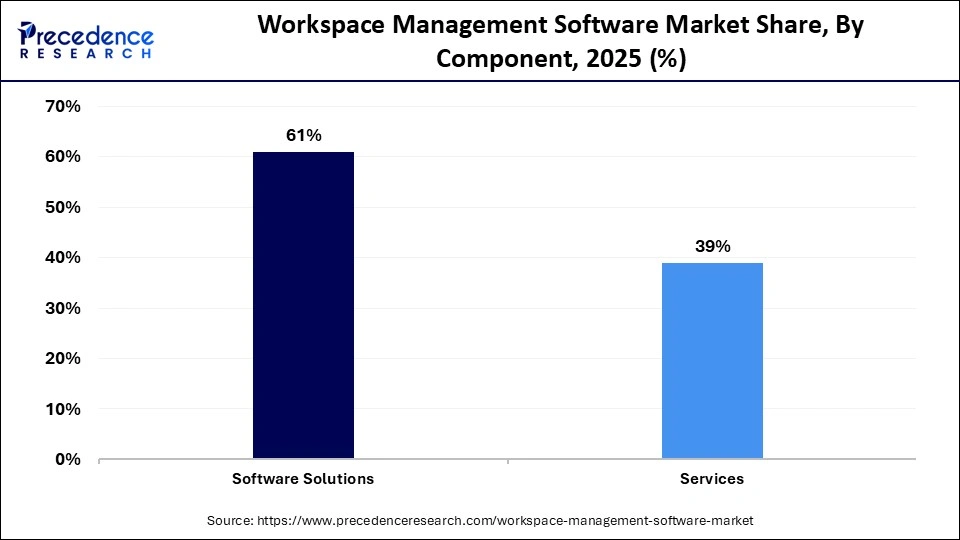
The services segment is expected to experience the fastest growth during the forecast period. This growth is primarily driven by the rising demand for implementation, customization, and managed services as enterprises transition to more complex hybrid work models. As companies adopt advanced SaaS-based platforms, they require expert assistance to integrate these tools with their existing Human Resource Information Systems (HRIS), Customer Relationship Management (CRM) systems, and building management systems. Organizations are increasingly looking to outsource the ongoing management and support of their workspace technology to ensure high availability, security, and performance.
Deployment Mode Insights
What Made Cloud-Based Solutions the Dominant Segment in the Workspace Management Software Market?
The cloud-based solutions segment dominated the market by capturing about 58% share in 2025 and is anticipated to maintain its growth during the forecast period. This is primarily due to superior scalability, lower initial costs, and real-time, mobile-first access, critical for hybrid work models. Cloud platforms are essential for managing flexible occupancy rates, enabling dynamic desks and room booking in real-time. Additionally, these solutions integrate seamlessly with other digital workplace tools and offer scalability as companies adjust their office footprints. Organizations are moving away from rigid, on-premises legacy systems toward SaaS solutions, which provide rapid deployment and reduced maintenance costs.
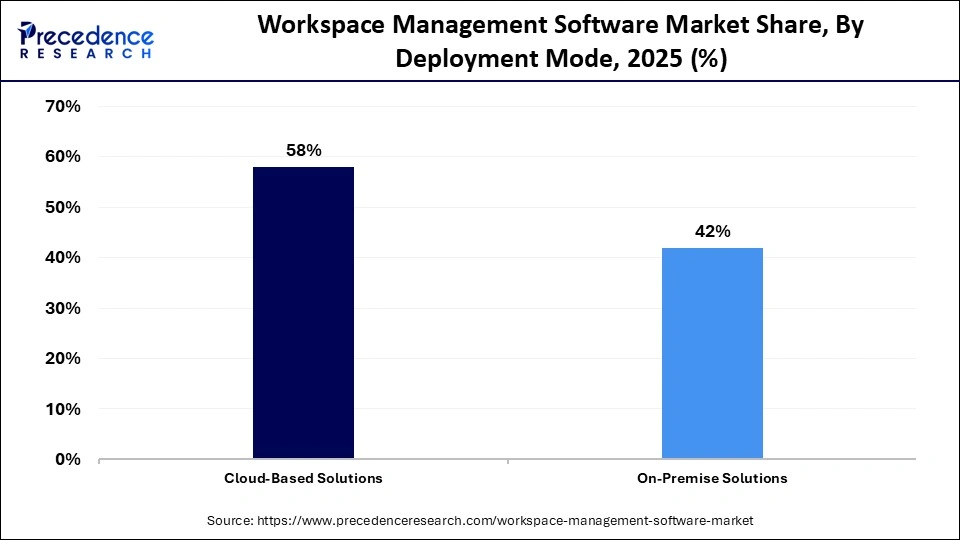
The on-premise solutions segment is expected to grow at a notable rate in the coming years because many organizations prefer full control over their data and IT infrastructure, especially in sectors with strict compliance or security requirements like finance, healthcare, and government. On-premise deployments allow for customization of features, tighter integration with legacy systems, and reduced dependency on third-party cloud providers. Companies with sensitive employee or operational data see on-premise solutions as a way to mitigate security and privacy risks while still gaining the benefits of workspace management tools.
Function Insights
Why Did the Space and Desk Management Segment Lead the Workspace Management Software Market?
The space and desk management segment led the market with approximately 29% share in 2025. This is primarily due to the urgent need to optimize real estate footprints and support hybrid work arrangements. As offices adopt flexible hot-desking strategies, companies depend on these tools to prevent congestion and minimize wasted space, with desk booking being one of the most visible and widely adopted features. Space optimization is crucial for lowering overhead costs, as these tools help firms reduce unnecessary square footage while aligning with sustainability goals by analyzing utilization. This trend drives demand for desks, rooms, and visitor management solutions.
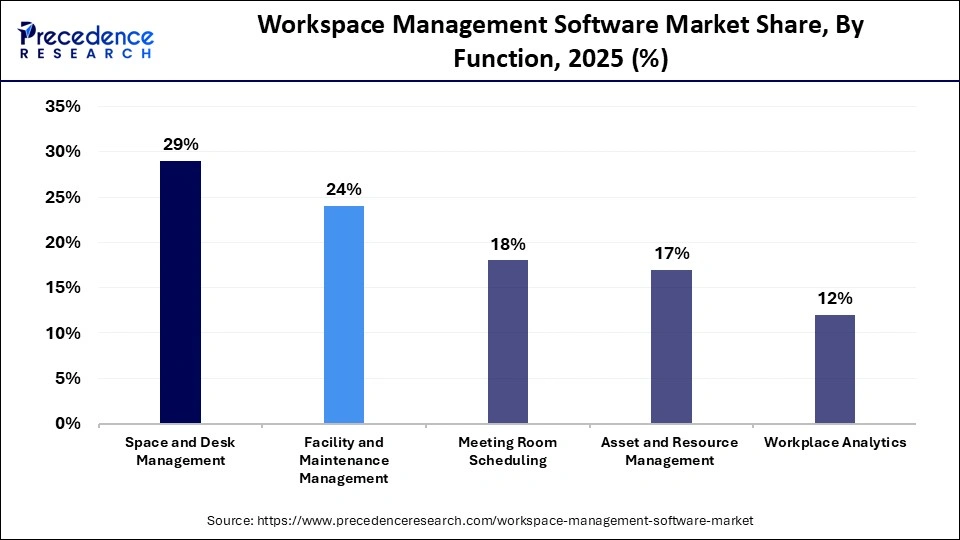
The workplace analytics segment is expected to experience the fastest growth during the forecast period. This is due to the rapid shift to hybrid work, the increasing use of AI-driven predictive insights, and the demand for data-backed space optimization. Organizations are leveraging analytics to monitor workspace utilization, ensuring that hybrid models efficiently balance remote and in-office attendance. The need for actionable insights into employee behavior, engagement, and productivity contributes to improved operational efficiency. Advanced analytics are incorporating AI and sensor technologies to provide real-time occupancy tracking, predictive maintenance, and spatial optimization.
Industry Vertical Insights
What Made IT and Telecommunications the Leading Segment in the Market?
The IT and telecommunications segment led the workspace management software market with about 24% share in 2025. The dominance of the segment is attributable to the swift adoption of hybrid work models and the extensive use of AI-driven and cloud-based space optimization tools. The rapid expansion of 5G networks demands specialized site management software for remote monitoring, predictive maintenance, and automated workflows related to distributed network assets. IT companies have been early adopters of IoT-enabled sensors for real-time occupancy tracking, which enables data-driven decisions regarding space utilization, significantly reducing real estate costs.
The healthcare segment is projected to grow at the fastest CAGR during the forecast period. This growth is largely driven by the urgent demand for digital transformation, enhanced patient care workflows, and stringent regulatory compliance. Healthcare providers are moving away from legacy systems in favor of cloud-based, scalable platforms to manage complex, multi-location, and hybrid work environments. Following the pandemic, the increase in telehealth and remote patient monitoring has created a need for robust software solutions to coordinate virtual care, manage staff, and ensure patient engagement.
Regional Insights
North America Workspace Management Software Market Size and Growth 2026 to 2035
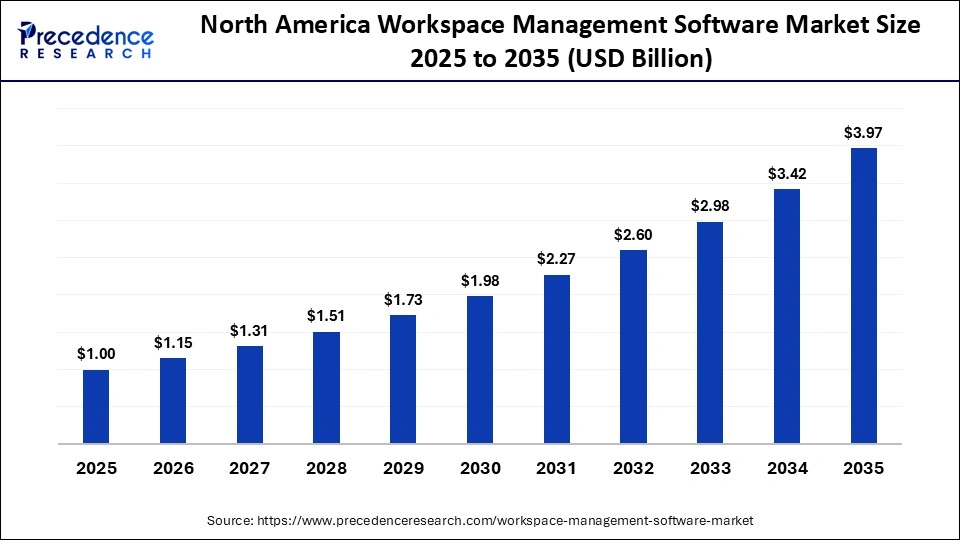
The North America workspace management software market size is estimated at USD 1.00 billion in 2025 and is projected to reach approximately USD 3.97 billion by 2035, with a 14.78% CAGR from 2026 to 2035.
How Did North America Dominate the Workspace Management Software Market?
North America dominated the global workplace management software market by holding a 38% share in 2025. This is primarily due to the rapid adoption of hybrid work models, high IT infrastructure spending, and the need for data-driven real estate consolidation. The region has widely implemented hybrid, hot-desking, and flexible work models, necessitating advanced software to manage employee scheduling and workspace effectively. This has led to a higher adoption rate of related tools compared to other regions, allowing organizations to reduce office footprints by utilizing space-utilization analytics to lower lease costs. A robust ecosystem of technology firms like IBM, Oracle, Microsoft, and high investment in AI and IoT-based smart building technologies drives innovation.
U.S. Workspace Management Software Market Size and Growth 2026 to 2035
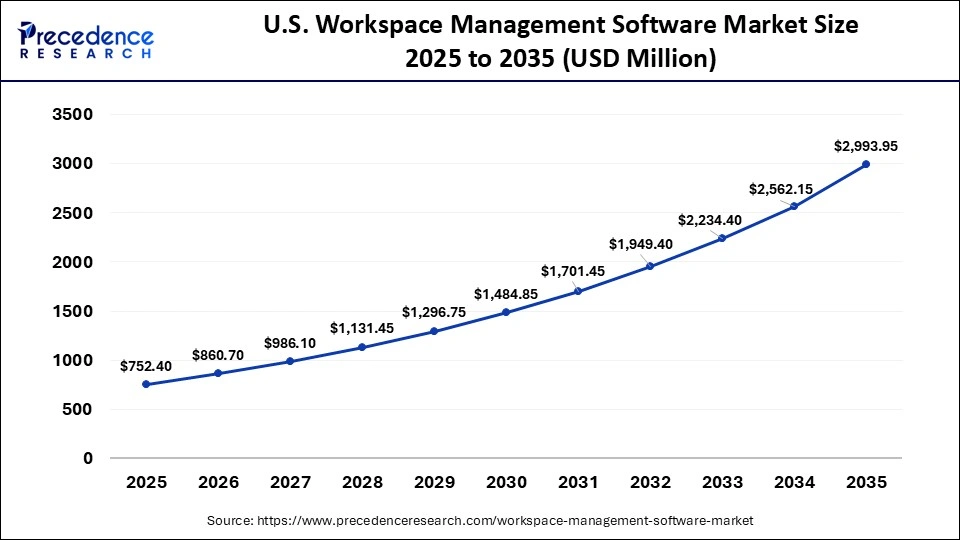
The U.S. workspace management software market size is calculated at USD 752.40 million in 2025 and is expected to reach nearly USD 2,993.95 million in 2035, accelerating at a strong CAGR of 14.81% between 2026 and 2035.
U.S. Workspace Management Software Market Trends
The U.S. plays a distinctive role within the region, mainly due to mature hybrid work strategies and high adoption of cloud-based, AI-powered tools. High adoption of hybrid work models, a focus on real estate portfolio optimization, and ESG compliance enable firms to reduce costs. Additionally, it is home to major vendors like Eptura, Envoy, Robin, Teem, and VergeSense. Heavy investment in sensor-based, real-time analytics for space utilization.
Why is Asia Pacific Considered the Fastest-Growing Region in the Workspace Management Software Market?
Asia Pacific is expected to experience the fastest growth during the forecast period. This is mainly due to rapid digital transformation, a boom in flexible, AI-powered office and coworking spaces, and high hybrid work adoption. High-speed, mobile-first adoption across emerging economies like India, Vietnam, and Indonesia is driving the shift from legacy systems to cloud-based workspace SaaS. As companies in hubs like Singapore, Tokyo, and Sydney shift to hybrid models, they require tools for hot-desking, room booking, and space optimization. Programs like India's Digital India and Malaysia's MyDIGITAL promote the use of digital tools in the private and public sectors.
India Workspace Management Software Market Trends
India is a major contributor to the market within Asia Pacific. This is mainly due to rapid urbanization and digitization, along with the rise of Global Capability Centers in India, which is driving significant demand for managed, flexible workspace solutions. There is a strong reliance on flexible, managed workspaces to provide quick, scalable infrastructure. India has recently become the largest market for Google Workspace. High demand for smart, campus-style developments that offer technology-enabled amenities.
Workspace Management Software Market Value Chain Analysis
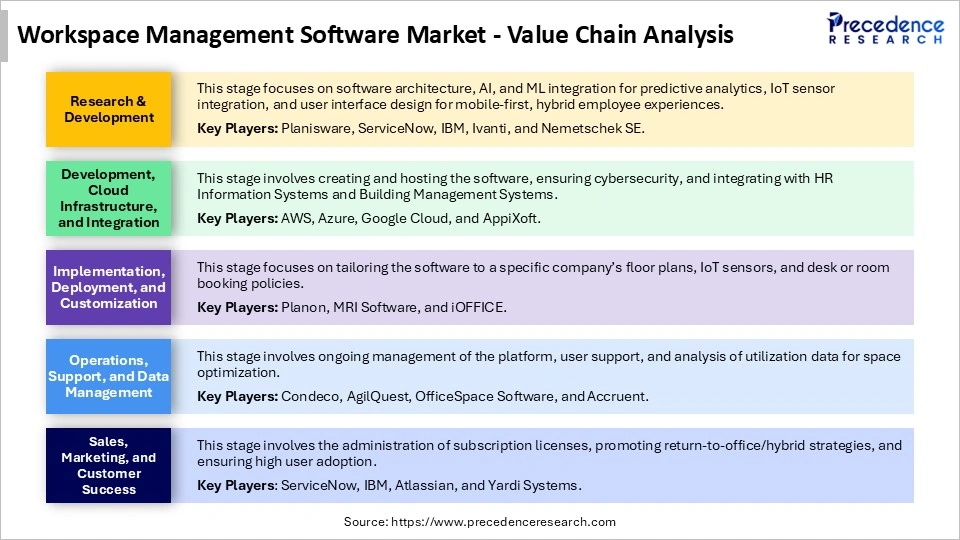
Workspace Management Software Market Companies
- Eptura
- Envoy
- Robin
- OfficeSpace Software
- Condeco
- AgilQuest
- Planon
- iOFFICE
- Yardi Systems
- Asure Software
- Nexudus
- Archie
- VergeSense
- OfficeRnD
- Skedda
Recent Developments
- In January 2026, OpenAI launched Prism, a free AI-enhanced word processor for scientific papers, integrated with GPT-5.2. It aims to accelerate research by assisting scientists with tasks like claim assessment and literature searches. Kevin Weil, VP of OpenAI for Science, stated that 2026 will be pivotal for AI in science. ChatGPT receives a high volume of scientific queries, signaling growing interest in AI-assisted research.(Source: https://techcrunch.com)
- In February 2026, the latest Workspace ONE UEM update introduced a modernized admin interface with improved navigation, automation, and device management features, enabling a more efficient experience for admins.(Source: https://www.omnissa.com)
- In December 2025, Google launched Workspace Studio, a platform allowing users to create AI agents for automating workplace tasks without coding. Powered by Gemini 3, it aims to streamline operations by integrating AI directly into Workspace apps, setting Google apart in the enterprise automation market.(Source: https://www.eweek.com)
Segments Covered in the Report
By Component
- Software Solutions
- Space management tools
- Facility management systems
- Services
- Implementation and integration
- Support and maintenance
By Deployment Mode
- Cloud-Based Solutions
- On-Premise Solutions
By Function
- Space and Desk Management
- Facility and Maintenance Management
- Meeting Room Scheduling
- Asset and Resource Management
- Workplace Analytics
By Industry Vertical
- IT and Telecommunications
- BFSI (Banking, Financial Services, Insurance)
- Healthcare
- Education
- Retail and E-commerce
- Other Industries
By Region
- North America
- Europe
- Asia-Pacific
- Latin America
- Middle East & Africa
For inquiries regarding discounts, bulk purchases, or customization requests, please contact us at sales@precedenceresearch.com
Frequently Asked Questions





Ask For Sample
No cookie-cutter, only authentic analysis – take the 1st step to become a Precedence Research client
 Get a Sample




 sales@precedenceresearch.com
 Schedule a Meeting
