



Artificial Intelligence (AI) Market Size, Key Companies, Company Market Share, User Adoption, Technology Deployment, Revenue Growth, Competitive Positioning, and Demand Forecast
The Artificial Intelligence (AI) Market is estimated at USD 900 billion in 2026 and is projected to reach USD 4,216.29 billion by 2035, registering a CAGR of 18.73%. Market expansion is being supported by continued AI adoption across industries, growing investment in AI technologies, and the wider deployment of AI-enabled applications.
Source: https://www.precedenceresearch.com/artificial-intelligence-market
 Get a Sample
 Table Of Content


Artificial Intelligence (AI) Market Size and Forecast 2026 to 2035
The global Artificial Intelligence (AI) Market size was USD 757.58 billion in 2025, is calculated at USD 900.00 billion in 2026, and is expected to reach around USD 4,216.29 billion by 2035, expanding at a CAGR of 18.73% from 2026 to 2035.

Market Highlights
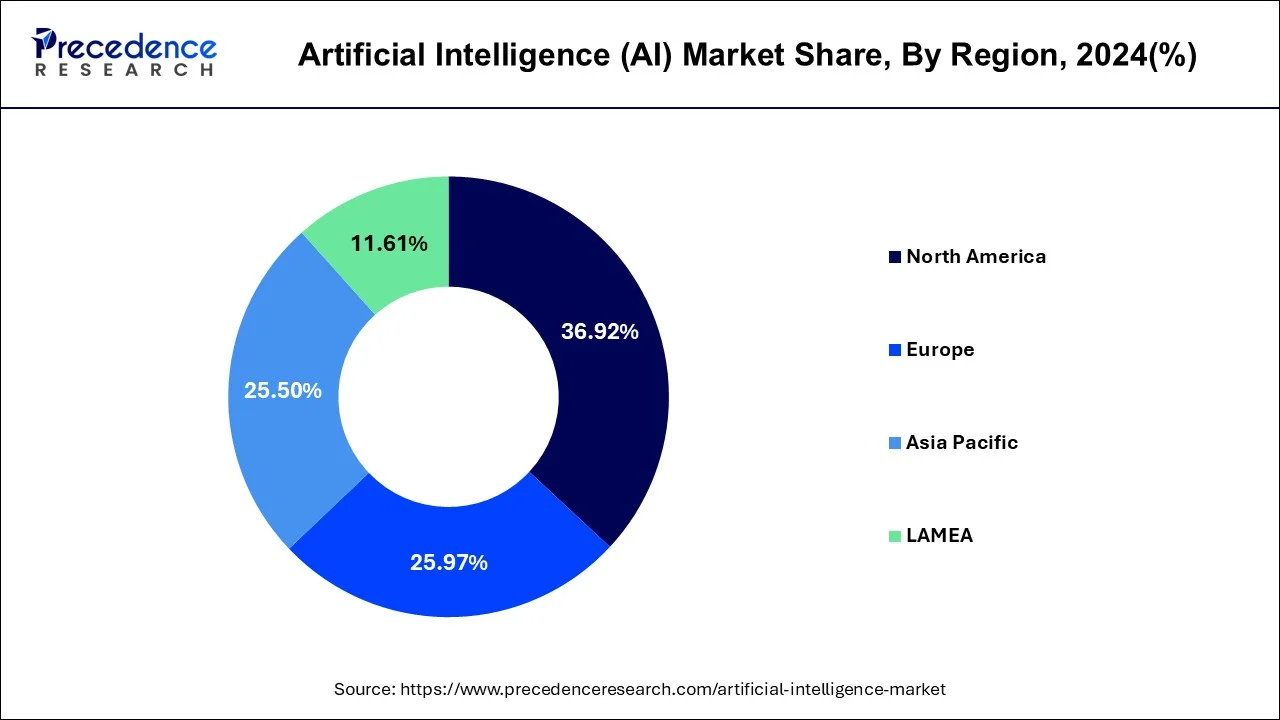
- North America accounted for the largest market share, at 36.92% in 2025.
- The Asia Pacific region is expected to grow at a notable CAGR of 19.8% from 2026 to 2035.
- By solution, the software segment held the biggest market share of 51.40% in 2025.
- By solution, the services segment is projected to expand at a CAGR of 18.30% from 2026 to 2035.
- By technology, the machine learning segment dominated the market with the largest share of 36.70% in 2025.
- By technology, the generative AI segment is expected to grow at a CAGR of 22.90% from 2026 to 2035.
- By function, the operations segment led the market with a major market share of 21.80% in 2026.
- By function, the cybersecurity segment is expected to grow at a CAGR of 20.40% over the projected period.
- By end-use, the BFSI segment led the market share of 19.60% in 2025.
- By end-use, the healthcare segment is expected to grow at a CAGR of 19.10% over the projected period.
Market Size and Forecast
- Market Size in 2025: USD 757.58 Billion
- Market Size in 2026: USD 900.00 Billion
- Forecasted Market Size by 2035: USD 4,216.29 Billion
- CAGR (2026-2035): 18.73%
- Largest Market in 2025: North America
- Fastest Growing Market: Asia Pacific
Artificial Intelligence (AI) Market Growth Factors
The rapid penetration of digital technologies has supported the growth of the global artificial intelligence market in recent years. Continued investment in research and development by major technology companies is advancing AI capabilities across industries. Demand is also increasing across end-use verticals such as automotive, healthcare, banking & finance, manufacturing, food and beverages, logistics, and retail, supporting further market expansion.
AI adoption is expanding across applications such as medical devices and self-driving features in electric vehicles, supporting demand for AI technologies. The broader shift toward digitalization is also creating additional opportunities for AI deployment. Major technology companies, including Google, Microsoft, IBM, Amazon, and Apple, continue to invest in the development and advancement of AI applications. Greater access to AI technologies and continued investment by these companies are expected to support market growth during the forecast period.
Favorable government initiatives are expected to support industry growth. The establishment of subcommittees on machine learning and AI within the federal government has increased attention toward the AI industry. In 2020, The Government of India increased the spend for Digital India to $477 million to boost AI, internet of things (IoT), big data, cybersecurity, machine learning and robotics. The artificial intelligence market is expected to witness significant growth in the BFSI sector on account of data mining applications as there is an increase in the adoption of artificial intelligence solutions in data analytics, fraud detection, cybersecurity, and database systems.
End-use industries are increasingly integrating artificial intelligence into business processes to streamline operations and improve efficiency. AI adoption is also creating opportunities for new entrants that offer application-specific products and solutions. At the same time, established companies are pursuing strategic initiatives and industry consolidation to strengthen their competitive positions.
Economical parallel processing set-up
The artificial intelligence industry has been primarily software led, while relatively few companies manufacture hardware components such as CPU, ASIC, FPGA, and GPU. Advances in design tools have made FPGAs more compatible with complex software practices and more accessible to organizations that develop algorithm models. Hardware-based artificial intelligence solutions are being introduced to address power consumption, processing speed, and efficiency requirements. As the market matures, these developments are also supporting business models built around predictive capabilities, automation, and scalable parallel processing.
The need for hardware-based artificial intelligence products has increased as end-use applications demand lower power consumption and higher performance. Over the past few years, relatively few companies have entered the development of these components. However, vendors such as IBM Corporation and Intel Corporation have started manufacturing artificial intelligence chipsets to support high performance and scalable parallel processing.
Technology Trends
- Machine learning and deep learning are being applied to healthcare detection systems. For instance, IBM's machine learning technology advances the early detection of diabetic eye disease using deep learning.
- Applications of deep neural networks for speech identification have contributed to improvements in speech and voice recognition.
- Developments in natural language processing (NLP), machine learning algorithms, automated reasoning, and integrated cloud platforms have supported the development of artificial intelligence.
Supplier Trends
- Several vendors are entering into partnerships with end-user industries to expand their reach. For instance, Microsoft's intelligent network is partnering with LV Prasad Eye Institute in Hyderabad. This partnership is aimed at incorporating machine learning to bring data-driven eye care services in India.
- Several AI startups are developing new deep learning software and hardware applications across e-commerce, cyber security, and retail.
Regulatory Trends
- Machine learning and deep learning are being applied to healthcare detection systems. For instance, IBM's machine learning technology advances the early detection of diabetic eye disease using deep learning.
- Applications of deep neural networks for speech identification have contributed to improvements in speech and voice recognition.
- Developments in natural language processing (NLP), machine learning algorithms, automated reasoning, and integrated cloud platforms have supported the development of artificial intelligence.
- Several vendors are entering into partnerships with end-user industries to expand their reach. For instance, Microsoft's intelligent network is partnering with LV Prasad Eye Institute in Hyderabad. This partnership is aimed at incorporating machine learning to bring data-driven eye care services in India.
- Several AI startups are developing new deep learning software and hardware applications across e-commerce, cyber security, and retail.
- For healthcare applications, deep learning and AI solutions may require Food and Drug Administration (FDA) approval.
- The European Union's new general data protection regulation restricts automated individual decision-making and includes the ‘right of explanation' to clarify certain algorithmic decisions.
- According to EU, any algorithmic decisions based on user-level predictors is slated to be regulated from April 2018.
Supplier Trends
- Several vendors are entering into partnership with end- user industries to enhance their reach. For instance, Microsoft's intelligent network is partnering with LV Prasad Eye Institute in Hyderabad. This partnership is aimed at incorporating machine learning to bring data- driven eye care services in India.
- Several AI startups are coming up with innovations and latest technologies in deep learning software & hardware across e-commerce, cyber security and retail industry.
- For healthcare applications, deep learning and AI solutions are required to get Food and Drug Administration (FDA) approval.
- The European Union's new general data protection regulation restricts automated individual decision making and includes the ‘right of explanation' to clarify any algorithmic decision that are taken.
- According to EU, any algorithmic decisions based on user-level predictors is slated to be regulated from April 2018.
Market Scope
| Report Coverage | Details |
| Market Size in 2025 | USD 757.58 Billion |
| Market Size in 2026 | USD 900.00 Billion |
| Market Size by 2035 | USD 4,216.29 Billion |
| Growth Rate from 2026 to 2035 | CAGR of 18.73% |
| Base Year | 2025 |
| Forecast Period | 2026 to 2035 |
| Segments Covered | Technology, Solution, End Use, and Regions |
| Regions Covered | North America, Asia Pacific, Europe, Latin America, Middle East and Africa |
Market Dynamics
Driver
Rising implementation from the finance sector
The finance sector is increasing its use of artificial intelligence across applications such as algorithmic trading, fraud detection, and credit risk assessment. AI can process large amounts of data and identify patterns that may support investment decisions and risk management. These applications can also contribute to operational efficiency, cost management, and customer experience in the finance sector.
Restraint
Transparency in decision making
Artificial intelligence models and algorithms can be complex, making their decision-making processes difficult to interpret. AI-based solutions may therefore produce outcomes that are difficult to explain, creating concerns around trust and accountability. This is particularly relevant in critical areas such as finance and healthcare, where transparency is important. As a result, explainability and transparency in decision-making can influence the adoption of AI solutions.
Opportunity
Rising acceptance from research scientists
Research scientists are increasingly using artificial intelligence to support data analysis, pattern identification, prediction, and experiment optimization. This trend is expected to continue in the coming years and create additional opportunities for the artificial intelligence market. AI-powered tools can automate repetitive tasks, allowing researchers to focus on analysis and innovation. Across fields, researchers are also using AI to predict outcomes, identify patterns, and optimize experiments, supporting broader applications of AI within research environments.
Challenge
Lack of skilled professionals
AI systems require skilled professionals, while shortages of qualified talent can create a challenge for market development. Artificial intelligence technologies require specialized expertise in areas such as machine learning, data science, and software engineering. When demand for these professionals exceeds supply, talent shortages can slow AI development, implementation, and innovation. The shortage can also limit the scalability and effectiveness of AI solutions across industries.
Artificial Intelligence Market Segmentation Insight
Technology Insights
The machine learning segment led the market in 2024. Its position reflects the broad use of machine learning for task automation, pattern recognition, data analysis, and decision support across industries. By automating repetitive activities and processing large datasets, machine learning can improve analytical speed and support operational efficiency. Supervised machine learning has also been widely used in initial AI deployments because its applications can be comparatively straightforward to implement and validate. Early business applications that delivered measurable automation and efficiency gains further demonstrated the commercial value of machine learning.
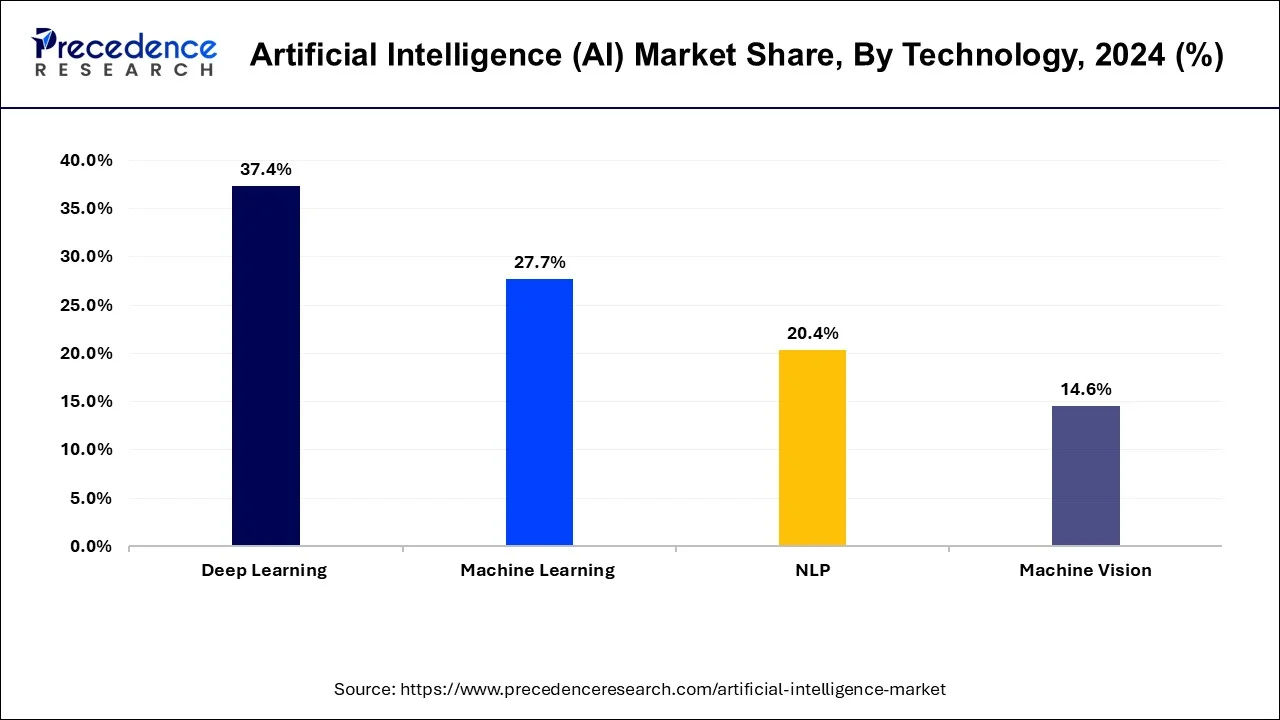
The generative AI segment is expected to register rapid growth during the forecast period. Its expansion is supported by applications that generate text, images, code, and other forms of content, as well as use cases involving task automation and workflow support. These capabilities are being applied across marketing, design, software development, customer service, drug discovery, materials science, and scientific research. The expanding range of applications is creating additional opportunities for generative AI across industry verticals.
Global Artificial Intelligence (AI) Market Revenue, By Technology, 2022-2024 (USD Billion)
| Technology | 2022 | 2023 | 2024 |
| Deep Learning | 165.98 | 196.83 | 233.69 |
| Machine Learning | 122.59 | 145.43 | 172.72 |
| NLP | 91.33 | 108.31 | 128.50 |
| Machine Vision | 74.22 | 87.57 | 103.33 |
Function Insights
The operations segment led the market in 2024, supported using AI for process automation, workflow optimization, and data-driven decision-making. AI can handle repetitive activities and provide analytical insights, allowing employees to focus on higher-value tasks while supporting productivity and cost efficiency. Applications such as chatbots and personalized recommendations also extend AI use into customer-facing processes, where they can support service delivery, engagement, and overall operational performance.
The cybersecurity segment is expected to be the fastest-growing area of the market. Increasingly sophisticated cyber threats are creating demand for technologies that can strengthen threat detection and response. AI can analyze large volumes of security data, identify anomalies, support incident response, and help security teams prioritize potential threats. These capabilities can reduce response times and support more proactive security measures.
Solution Insights
The services segment held a 39.2% share of the market while being the dominating segment in 2024. Its position is supported by the convenience and scalability offered by artificial intelligence (AI) as a service. AI projects are often complex and require multidisciplinary expertise across areas including computer vision, natural language processing, and machine learning. Services can bring together these skills and resources, helping organizations address the requirements of complex AI projects.
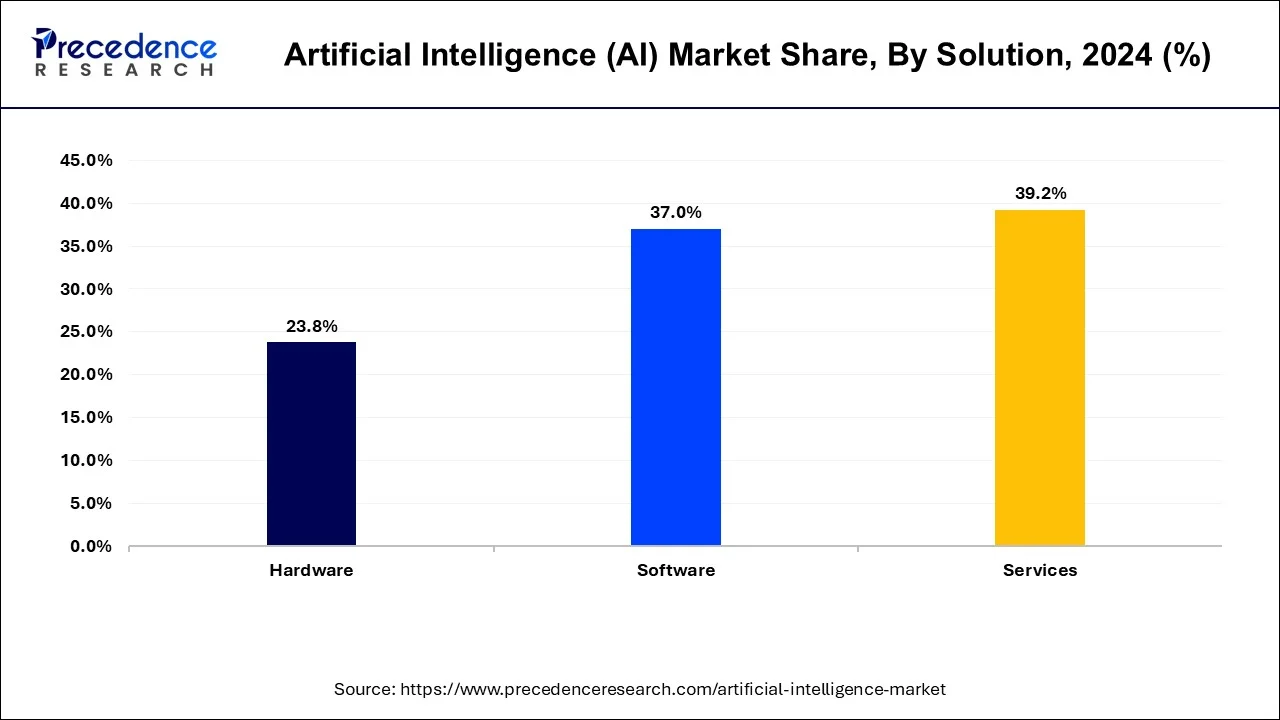
AI service providers often offer tailored or customized solutions together with implementation expertise. This can make it easier for businesses to adopt artificial intelligence technology without developing all of the required capabilities internally.
Global Artificial Intelligence (AI) Market Revenue, By Solution, 2022-2024 (USD Billion)
| Solution | 2022 | 2023 | 2024 |
| Hardware | 109.20 | 129.66 | 154.22 |
| Software | 168.85 | 200.24 | 237.86 |
| Services | 176.08 | 208.23 | 246.14 |
End User Insights
The BFSI (banking, financial services, and insurance) segment emerged as a dominant force in the market in 2024. Adoption is supported by the sector's focus on automation, customer experience, fraud detection, risk assessment, and regulatory compliance. AI applications can support credit-risk evaluation, analysis of regulatory requirements, and other decision-making processes. Chatbots and virtual assistants also enable continuous customer support, helping financial institutions improve engagement while managing operational and financial risks.
The healthcare segment is witnessing rapid growth as AI applications expand across clinical, operational, and administrative use cases. AI can assist with the analysis of medical images such as X-rays and MRIs, as well as patient data, supporting faster diagnosis and identification of relevant patterns. Applications are also being explored for treatment-response prediction, personalized therapies, drug development, and clinical-trial optimization, creating a broader role for AI across the healthcare value chain.
Global Artificial Intelligence (AI) Market Revenue, By End User, 2022-2024 (USD Billion)
| End User | 2022 | 2023 | 2024 |
| Healthcare | 64.33 | 76.35 | 90.48 |
| BFSI | 72.59 | 86.13 | 102.26 |
| Law | 15.96 | 19.02 | 22.67 |
| Retail | 43.83 | 52.13 | 62.06 |
| Advertising & Media | 63.19 | 74.97 | 88.96 |
| Automotive & Transportation | 45.41 | 53.84 | 63.87 |
| Agriculture | 29.26 | 34.78 | 41.39 |
| Manufacturing | 43.44 | 51.58 | 61.49 |
| Others | 76.11 | 89.34 | 105.04 |
Regional Insights
Why Does North America Dominate the Global Artificial Intelligence Market?
North America has garnered the largest market share in 2025. Higher demand for automated and technologically advanced hardware and software products across various end-use verticals, together with favorable government policies encouraging industries in North America to adopt artificial intelligence, has contributed to the growth of the artificial intelligence market. In 2019, the American president launched an American initiative to promote US as leader in the artificial intelligence technology. This initiative focused on adoption of AI based systems by providing guidelines for the real life application of artificial intelligence technology in various industries and sectors. North America is the home to the leading tech giants such as Facebook, Amazon, Google, IBM, Microsoft, and Apple, which have significant contributions in the development of the AI market in North America.
North America remains a leading region in the artificial intelligence market, supported by government initiatives that encourage AI adoption across multiple industries.
Investments in AI research and development have supported the establishment of specialized research institutes and centers focused on advancing AI technologies. These governmental efforts address areas such as safety and innovation and also extend into critical sectors such as healthcare, where AI is being applied across diagnostics and treatment-related activities.
U.S. Artificial Intelligence (AI) Market Size and Growth 2026 to 2035
The U.S. artificial intelligence (AI) market size was estimated at USD 173.56 billion in 2025 and is predicted to be worth around USD 976.23 billion by 2035, at a CAGR of 18.85% from 2026 to 2035.
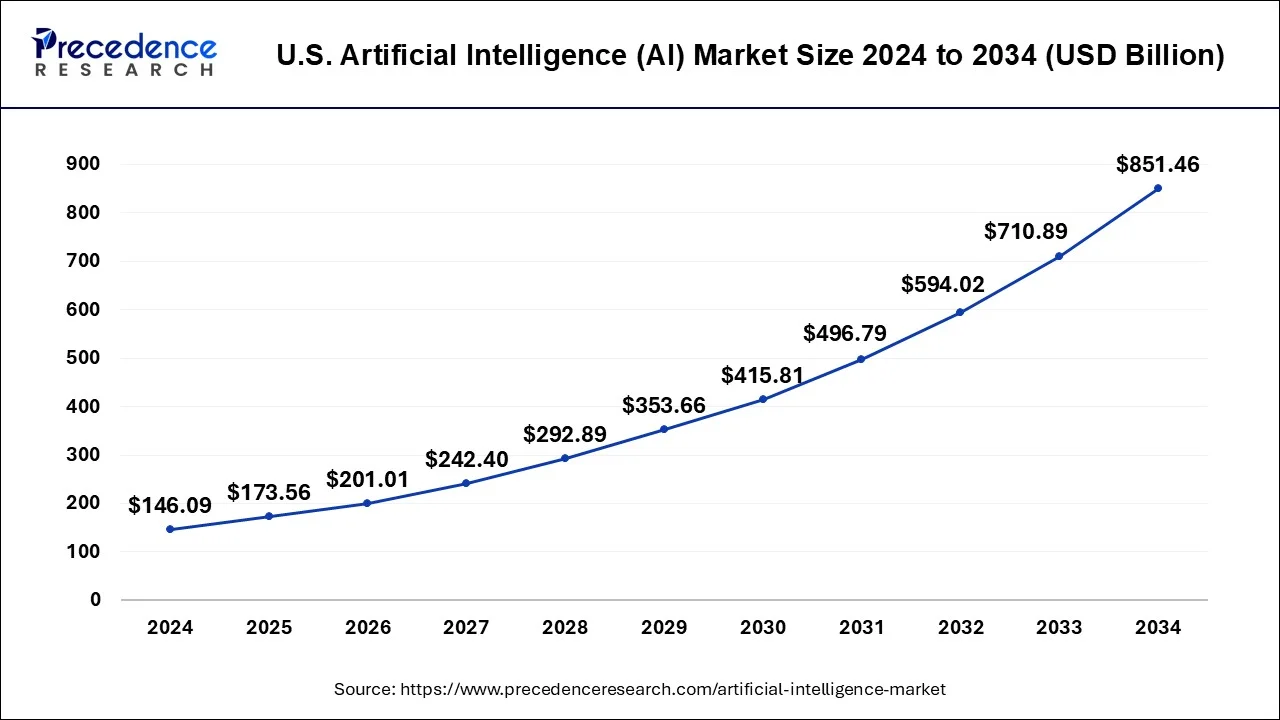
U.S. Artificial Intelligence Market Trends:
Companies and research institutions in the U.S. are advancing robotic technologies that use AI across applications ranging from industrial manufacturing to everyday household tasks.
Continued AI innovation, together with collaboration between public and private sector organizations, is reinforcing North America's position in the global AI landscape and supporting further technology development
What Factors Are Driving the Growth of the Artificial Intelligence Market in Asia Pacific?
Asia-Pacific is the fastest-growing segment in the artificial intelligence market. Government support is helping create an environment for startups and AI-focused applications, including AI-driven healthcare systems. Rapid digitalization is increasing demand for AI-enabled software, while adoption across healthcare, manufacturing, retail, finance, and transportation is expanding the regional opportunity.
- Canada artificial intelligence (AI) market was valued at USD 61.69 billion in 2024 and it is expected to reach 360.57 billion in 2034, at a CAGR of 19.31% from 2025 to 2034.
- Germany artificial intelligence (AI) market was valued at USD 37.96 billion in 2024 and it is projected to grow at a CAGR of 20.46% from 2025 to 2034.
- South Korea artificial intelligence (AI) market was valued at USD 24.74 billion in 20234 and it is expanding at a CAGR of 20.64% from 2025 to 2034.
- Japan artificial intelligence (AI) market was valued at USD 30.52 billion in 2024 and is projected to grow at a CAGR of 20.5% from 2025 to 2034.
How is AI Adoption Across Transportation and Research Driving Market Growth in Europe?
Europe is expected to record continued growth in the artificial intelligence market during the forecast period. AI adoption is expanding across sectors, with transportation and research among the areas highlighted for increasing use. Regulatory measures are also being introduced by governments and regulatory bodies, shaping how AI technologies are developed and deployed across the region.
AI adoption is increasing in the UK research sector, where the technology is being applied across development and production activities. These applications are supporting research workflows and contributing to the development of new innovations.
Companies in Germany are adapting to the use of AI in transportation as well as other sectors. AI-enabled safety features, along with related developments, are supporting the use of the technology across applications. This expansion can increase the role of AI across different sectors.
Competitive Landscape
The artificial intelligence market is evolving across a wide range of industries as organizations integrate AI into products, services, and business processes. AI as a service and supporting infrastructure are expanding the ways organizations can deploy AI capabilities without building every component internally. Major companies active in the market include Microsoft, OpenAI, Google (Alphabet), Meta Platforms, and AWS, among others.
Company Profiles
Microsoft
- HQ: Redmond, Washington.
- Founded: 1975
- Ownership: Software Maker.
- Business Overview: Microsoft provides software and cloud infrastructure capabilities, while hardware manufacturing alliances represent an opportunity to further strengthen the company profile. Its clients include businesses across digital and logistics industries.
- Products: Microsoft Azure, Game Pass and Microsoft 365, etc.
- Geographic Presence: It manages contracts across industries worldwide as a service provider and integrator.
- Revenue: The confirmed revenue for 2025 was $281.7 billion, and to date it has reached $331.8 billion.
- Recent Development: In August 2026, Microsoft opened its gates for students to exceed their educational perfection with the sound of clarity. Company members claimed that AI is commendable at producing code. Though the debate between the market leaders is introducing massive exposure of AI potential in the long run,
- Key Strategies: Building on its technical expertise, the company continues to expand its AI capabilities, with a focus on delivering real-time suggestions and learning-oriented experiences.
OpenAI
- HQ: San Francisco
- Founded: December 2015
- Ownership: Nonprofit research lab that later included AI research and deployment.
- Business Overview: OpenAI operates across AI research and deployment, providing models and tools for individuals and organizations seeking to apply AI capabilities to learning, development, and decision-making.
- Products: Omni Series, developer tools, ChatGPT, etc.
- Geographic Presence: The company operates as an AI research and development company across its hubs in Asia, North America and Europe.
- Revenue: The revenue of $40 billion in 2025 is exceeding with great speed, with the noted profit to date of $6.7 billion.
- Recent Development: In August 2026, OpenAI announced a new important member to its AI team to support the company's revenue, expertise and commercialization strategies. The new Chief Revenue Officer, Dali Rajic, will be managing the revenue process as the business expansion is skyrocketing.
- Key Strategies: OpenAI's strategy centers on communicating and deploying AI capabilities for users and organizations across learning, development, and practical application use cases.
Google (Alphabet)
- HQ: California, USA.
- Founded: 2015
- Ownership: Parent Holding Company by Google.
- Business Overview: The business motive is to help and guide independent and small industries to have a mature overview of the current trends and policies. The business circle continues with magnifying Gmail, Maps, YouTube, Ads and Android.
- Products: AI, cloud and Google services.
- Geographic Presence: The company's data centers and offices operate in 60 countries.
- Revenue: In 2025, the company earned up to $402.8 billion and has increased by 15%, with an expected $119.8 billion profit in 2026.
- Recent Development: In August 2026, Marvell's $12.2 billion warrant of 7% to Google confirmed that it can turn into a business profit for Alphabet. This warrant fist in Google's equity profit along with Marvell's spectacular custom-silicon revenue.
- Key Strategies: The strategy focuses on expanding engagement with businesses through Google's digital, cloud, AI, and advertising capabilities.
Meta Platforms
- HQ: Menlo Park, California, 94025, USA.
- Founded: 2004
- Ownership: Technology Company
- Business Overview: The company connects people globally through digital and social platforms, supporting communication, content sharing, and community engagement. Its use of AI is also becoming an important part of its broader technology strategy.
- Products: Digital services and social apps like WhatsApp, Instagram, Messenger, Facebook and Threads.
- Geographic Presence: The company operates its business locally across APAC cities.
- Revenue: The company gained $200.97 billion in revenue in 2025 and is closely preparing for $60.8 billion by 2026 end.
- Recent Development: In August 2026, Meta Platforms announced its beneficial decision to shop for fine expertise or initiate development for bolstering its existing position. The ad and AI metrics are consistently profitable, but individuals' safety concerns regarding addiction are influencing the company to follow the AI-sponsored ad craze.
- Key Strategies: Its strategy focuses on connecting audiences through social, communication, and entertainment platforms while expanding engagement across its digital ecosystem.
AWS
- HQ: Seattle, Washington, USA.
- Founded: 2003
- Industry: Custom Tools Providers.
- Business Overview: It deploys cloud infrastructure for client industries and provides tools such as databases, servers and storage. Its pay-as-you-go model supports access to these services based on usage requirements.
- Products: Services like AWS Lambda, Amazon RDS, Amazon EC2 and Amazon S3.
Geographic Presence: The company operates across countries via its data centers and offices in APAC, EMEA and within the regional countries as well. - Revenue: The revenue is noted as $42.2 billion from the 2026 net sales, with the confirmed operating income of $16.6 billion.
- Recent Development: In August 2026, AWS introduced its alliance with the government's new global launch of AI and cloud skilling programme. This smart initiative will deliver cloud and AI awareness to almost 1.5 lakh learners via AWS digital training content, with the promise of job-ready training to 10,000 registrants via the AWS re/Start program.
- Key Strategies: The strategy focuses on expanding cloud and AI capabilities while supporting professional, educational, and business use cases.
Artificial Intelligence (AI) Market Companies
- Intel Corporation
- Microsoft
- IBM
- Amazon Web Services
- Baidu, Inc.
- NVIDIA Corporation
- H2O.ai.
- Lifegraph
- Sensely, Inc.
- Enlitic, Inc.
- AiCure
- HyperVerge, Inc.
- Arm Limited
- Clarifai, Inc.
Recent Developments
- In May 2025, to support AI and the 5G network in the state, new infrastructure is being developed as per the announcement made by Manik Saha, Tripura's chief minister. The announcement highlighted the role of AI in improving efficiency, speed, and cost savings while 5G can support faster information transfer.
- In May 2025, in targeted government projects and the detection of IAS officers for domain-specific postings, the use of AI was suggested by Union Minister Jitendra Singh. During the launch event of an e-book that is, electronic civil list, which is a digital compendium of serving Indian Administrative Service (IAS) officers throughout the country, the suggestion of the minister for the use of AI was highlighted.
- In February 2025, OpenAI launched a new AI tool called Deep Research. The tool is designed to conduct multi-step research on the internet for complex tasks. The tool was described as being in its early stages, with limitations including difficulty distinguishing authoritative information from rumors.
- In September 2024, Bharti Airtel launched an artificial intelligence enabled technology that is integrated with its network to track down spam calls and messages.
In September 2024, the European Union (EU) initiated a call for incorporating artificial intelligence factories to fuel the creation of AI technology. - In December 2024, the Puma designers created an AI, a combination of feasibility, functionality, and reality, to enhance performance models. The creative campaign also incorporates 3D and generative AI.
- In December 2024, Google introduced Gemini 2.0. This next-generation AI is designed to support a broader range of tasks and AI-agent applications, including image interpretation and online search assistance.
Market Segmentation
By Solution
- Hardware
- Accelerators
- Processors
- Memory
- Network
- Software
- Services
- Professional
- Managed
By Technology
- Deep Learning
- Machine Learning
- Natural Language Processing (NLP)
- Machine Vision
- Generative?AI
By Function
- Cybersecurity
- Finance and Accounting
- Human Resource Management
- Legal and Compliance
- Operations
- Sales and Marketing
- Supply Chain Management
By End-use
- Healthcare
- BFSI
- Law
- Retail
- Advertising & Media
- Automotive & Transportation
- Agriculture
- Manufacturing
- Others
By Region
- North America
- Europe
- Asia-Pacific
- Latin America
- The Middle East and Africa
For inquiries regarding discounts, bulk purchases, or customization requests, please contact us at sales@precedenceresearch.com
Frequently Asked Questions





Ask For Sample
No cookie-cutter, only authentic analysis – take the 1st step to become a Precedence Research client
 Get a Sample




 sales@precedenceresearch.com
 Schedule a Meeting
