



Medical Devices Market Size, Key Companies, Company Product Portfolio, Hospital Procurement Trends, Manufacturing Capacity, Sales Performance, Regulatory Approvals, Company Market Share, and Forecast
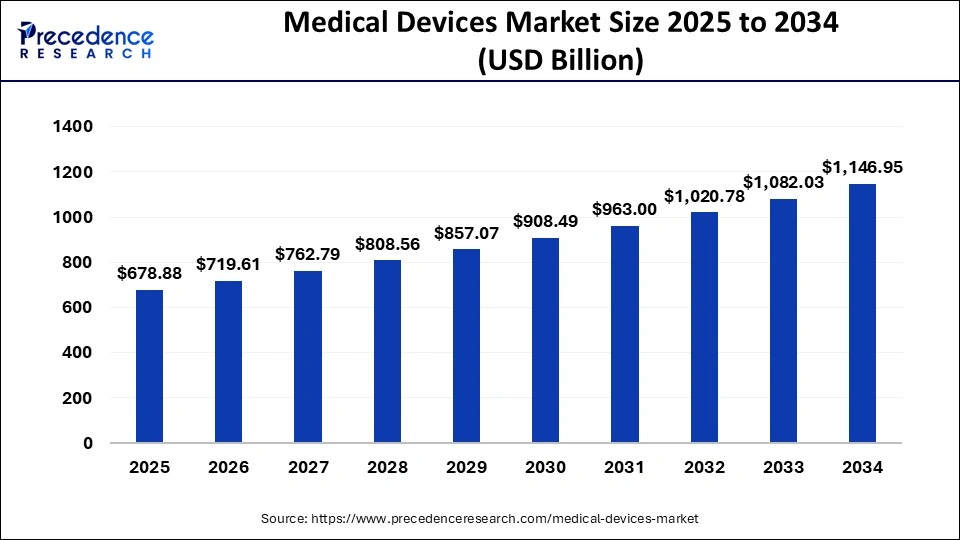
The global medical devices market was valued at USD 719.61 billion in 2026 and is projected to reach USD 1,209.42 billion by 2035, expanding at a CAGR of 5.94% from 2026 to 2035. Market growth is driven by the rising prevalence of chronic diseases, an aging population, increasing adoption of AI-enabled medical technologies, and growing demand for minimally invasive procedures and home healthcare devices. Advances in diagnostic imaging, wearable health technologies, robotics, IoT-enabled monitoring systems, and supportive government initiatives are further accelerating market expansion. North America dominated the market in 2025, while Asia Pacific is expected to witness the fastest growth during the forecast period due to expanding healthcare infrastructure and increasing investments in medical technology.
Source: https://www.precedenceresearch.com/medical-devices-market
 Get a Sample
 Table Of Content


What is the Medical Devices Market Size?
The global medical devices market was valued at USD 719.61 billion in 2026 and is projected to reach USD 1,209.42 billion by 2035, expanding at a CAGR of 5.94% from 2026 to 2035. Demographic demand, high rate of chronic disease, adoption of advanced medical technologies, the increasing delivery of healthcare outside traditional hospital environments is fueling the growth of this market. Developments in diagnostic imaging, connected monitoring, robotics, and home healthcare is also increasing the demand. North America dominated the market in 2025, while Asia Pacific is expected to record the fastest growth during the forecast period, subject to the regional assumptions used in the underlying market model.
Key Takeaways
- By Region, North America accounted for the largest revenue share of the medical devices market in 2025.
- By Region, Asia Pacific is expected to grow at the fastest CAGR in the market during the forecast period.
- By product type, the therapeutic devices segment held a dominant position in the market in 2025.
- By product type, the assistive and rehabilitation devices segment is expected to grow at the fastest CAGR of the market between 2026 and 2035.
- By end user, the hospitals segment accounted for a considerable revenue share of XX% in the market in 2025.
- By end user, the home healthcare settings segment is expected to grow with the highest CAGR of the market during the studied years.
- By sales channel, the direct sales segment led the global market in 2025.
- By sales channel, the online sales segment is expected to record the fastest growth during the forecast period.
Market Overview
As mentioned above, the market expansion is heavily being supported by demographic and clinical demand, alongside continued investment in diagnostic, therapeutic, monitoring, connected, and minimally invasive technologies.
What is the Role of AI in the Growth of the Medical Devices Market?
AI is increasingly being incorporated into medical devices and connected-care workflows, particularly in imaging, monitoring, decision support, and robotic-assisted procedures. Its commercial relevance extends beyond automation: AI can help convert device-generated data into risk signals, support interpretation of complex images, and improve workflow efficiency. The strength of these applications, however, depends on the device's intended use, clinical validation, data quality, and regulatory requirements.
Medical Devices Market Growth Factors
- Rising chronic health conditions, including cardiovascular disease, diabetes, and neurological disorders need diagnosis, monitoring, treatment, and long-term disease management.
- The growing geriatric population is increasing demand for continuous monitoring, surgical care, rehabilitation, and mobility-support technologies.
- Integration of AI, robotics, and IoT is enhancing the capabilities of medical devices, particularly in diagnostics, monitoring, surgical assistance, and personalised care.
- Growing adoption of connected and wearable devices is expanding the demand for technologies that support continuous monitoring outside conventional clinical settings.
- Government healthcare policies, domestic manufacturing incentives, and infrastructure programmes can support medical-device investment by improving production capacity, procurement, and access to healthcare technologies.
Market Scope
| Report Highlights | Details |
| Market Size in 2025 | USD 678.88 Billion |
| Market Size in 2026 | USD 719.61 Billion |
| Market Size by 2035 | USD 1,209.42 Billion |
| Growth Rate from 2026 to 2035 | CAGR of 5.94% |
| Largest Market | Asia Pacific |
| Dominated Region | North America |
| Base Year | 2025 |
| Forecast Period | 2026 to 2035 |
| Segments Covered | Product, Therapeutic Application, End User, and Region |
| Regional Scope | Asia Pacific, North America, Europe, Latin America, Middle East and Africa |
Market Dynamics
Driver
Increasing Adoption of 3D Printing of Medical Devices
3D printing is being applied to surgical instruments, dental restorations, and selected orthopaedic and cranial implant applications. Its value is particularly relevant where patient-specific geometry or procedure-specific components can provide a practical advantage over conventional manufacturing.
Patient-specific 3D-printed guides, instruments, and implants have applications in orthopaedic procedures, including selected knee and joint interventions. The technology may support procedure planning and customised device design, although the clinical and operational benefits vary by application.
Restraint
Intricate Regulatory Requirements
Regulatory requirements can increase development costs, documentation requirements, and the time required to bring certain devices to market. Requirements relating to clinical evidence, quality systems, data protection, and post-market oversight can also affect product-development planning and commercial timelines.
Opportunity
Technological Transformation in the Devices by the Companies
Medical-device manufacturers are increasingly embedding software, connectivity, analytics, and AI capabilities into established hardware portfolios. This shift is expanding the value proposition from the device itself toward connected services, workflow integration, remote monitoring, and data-enabled clinical support. Partnerships between device manufacturers, technology companies, and healthcare providers are also becoming more relevant as products become more software-intensive.
Segment Insights
Product Type Insights
Diagnostic devices are positioned for continued demand as chronic disease management and preventive care increase the need for timely testing and monitoring. Innovation across imaging, in-vitro diagnostics, molecular diagnostics, and patient-monitoring technologies is also expanding the range of diagnostic information available to clinicians.
End-User Insights
Ambulatory surgical centers are supported by demand for minimally invasive and same-day procedures. Their operating model can reduce the need for overnight hospital stays, supporting the demand for compact, efficient, and procedure-specific medical equipment. The growing adoption of outpatient procedures is also encouraging investment in medical equipment designed for same-day and short-stay care.
Diagnostic centers are benefitted due to high demand for timely testing, preventive screening, and disease monitoring. Investment in imaging systems and laboratory technologies can improve testing capacity and workflow efficiency, while the need to manage chronic and infectious diseases supports demand for specialised diagnostic capabilities.
Sales Channel Insights
Indirect sales channels remain important where manufacturers rely on distributors, dealers, and third-party suppliers to extend geographic reach and provide local logistics and support. Their relevance is particularly strong in fragmented or emerging healthcare markets, where established distribution networks can improve access to hospitals and other care settings.
Regional Insights
Why did North America Dominate the Market in 2025?
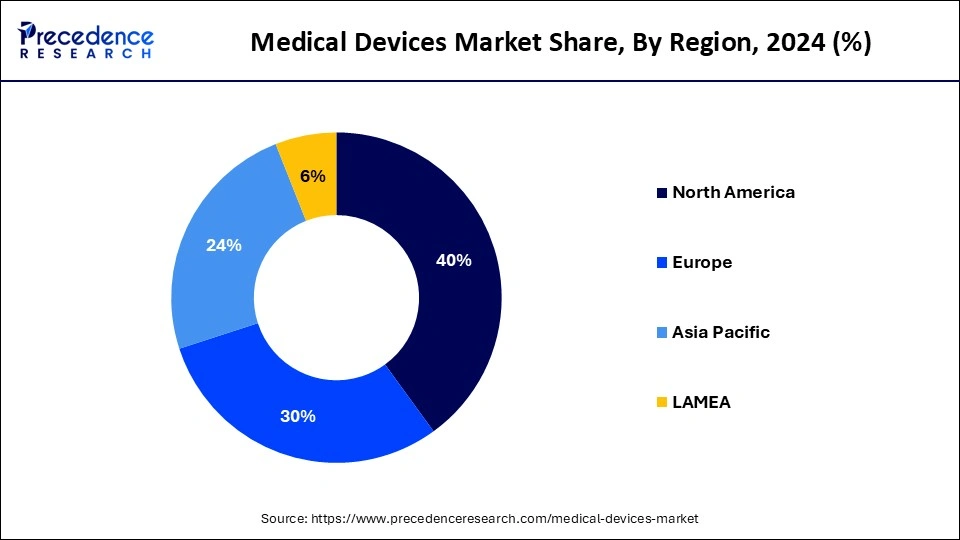
North America led the global medical devices market in 2025, according to the report's current regional assessment. Demand for the market is supported by the region's established healthcare infrastructure, high adoption of advanced medical technologies, and need for chronic-disease management and home-based care.
What is the U.S. Medical Devices Market Size?
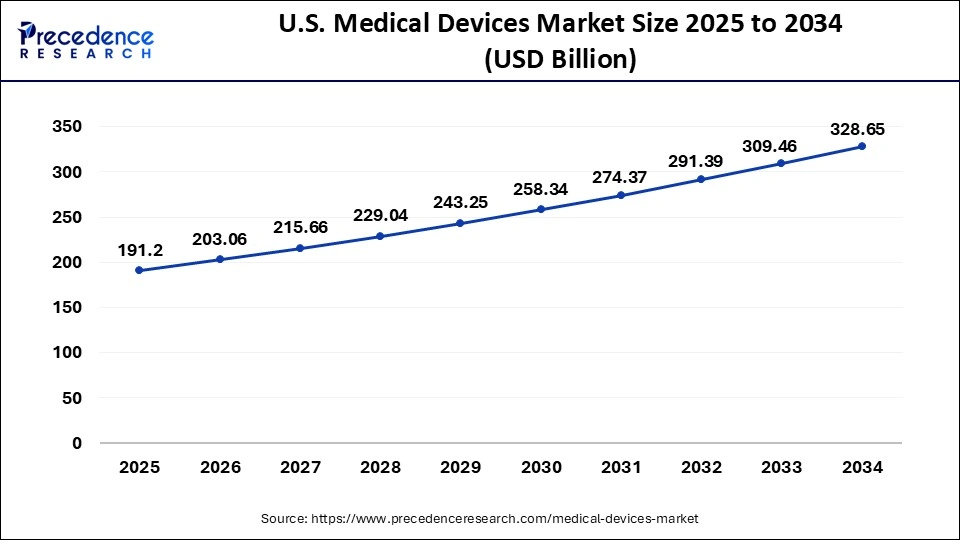
The U.S. medical devices market size is calculated at USD 191.20 billion in 2025 and is expected to be worth around USD 346.19 billion by 2035, at a CAGR of 6.2% from 2026 to 2035.
U.S. Market Trends
Demand in the U.S. is supported by the prevalence of chronic-diseases, population ageing, continued use of minimally invasive procedures, and investment in digital health and medical technologies. The country's regulatory environment also shapes the pace at which new devices reach the market.
Canada Market Trends
Canada's medical-device market is supported by healthcare investment, digital-health adoption, and efforts to modernise healthcare delivery. Demand for home-care equipment, diagnostic technologies, and remote monitoring may provide additional opportunities as care shifts towards more connected and distributed settings.
Robust Government Support & AI Integration is Driving the Asia Pacific
Asia Pacific is considered as the fastest-growing regional market. Its expansion is supported by investment made in healthcare-infrastructures, rising demand for advanced diagnosis and treatment, demographic changes, and broader adoption of connected and minimally invasive technologies. The pace of growth is likely to vary substantially across all Asian countries.
China Market Trends
China's market is supported by population ageing, demands associated with chronic diseases, continued healthcare-infrastructure investment, and expansion of digital and surgical technologies. Domestic manufacturing policy and technology development are additional factors that can influence market dynamics.
India Market Trends
India's medical-device market is being supported by healthcare-infrastructure investments, expansion of private healthcare capacities, domestic manufacturing initiatives, and growing inclination towards digital health platforms. Demand for cost-sensitive technologies is also relevant to the market, while policy support and new manufacturing capacities could shape medium- to long-term prospects.
Rising Healthcare Spending is Fueling Europe
Europe's medical-device market is supported by population ageing, chronic-disease management, demand for minimally invasive procedures, and the continued shift toward home and community-based care. Adoption of connected and AI-enabled technologies is also expanding in areas such as monitoring, diagnostics, and workflow support.
Germany Market Trends
Germany's market is supported by an ageing population, demand for chronic-disease management, and new initiatives digital healthcare. Telehealth, remote monitoring, and wearable technologies are relevant areas of development as care delivery becomes more connected.
Key Trends in the Medical Devices Market in Latin America
Latin America's medical-device market is supported by healthcare investments, broader access to medical services, and demand associated with chronic diseases. Infrastructure development and wider use of diagnostic, therapeutic, and minimally invasive technologies can create additional opportunities across the region.
Brazil Market Trends
Brazil's market is supported by investments in healthcare-infrastructures, technology modernization, and demand across hospitals, diagnostic centers, and specialty clinics. Imaging, surgical, monitoring, digital-health, and AI-enabled technologies represent areas of opportunity as providers expand capacity.
Government-Powered Initiatives are Propelling the Middle East & Africa
The Middle East and Africa are expected to show continued demand as healthcare spendings, chronic-disease management, and healthcare-infrastructures progress. AI-enabled diagnostics, telemedicine, and connected monitoring technologies may provide additional opportunities, although market conditions differ considerably across countries.
Saudi Arabia Market Trends
Saudi Arabia's market is supported by healthcare-infrastructure developments digital-health initiatives, and investment s in connected and remote-care capabilities. Smart-hospital projects and demand for home-based care can further support adoption of advanced medical technologies.
UAE Market Trends
The UAE market is supported by healthcare digitalisation, medical-tourism activities, smart-hospital investments, and private-sector spendings on advanced healthcare technologies. Government initiatives focused on innovation and healthcare development may contribute to the growth of the market.
Government Initiative
- In 2026, the Government of India continued to support domestic medical device manufacturing through the ₹3,420 crore Production Linked Incentive (PLI) Scheme and a ₹500 crore Scheme for Strengthening the Medical Device Industry. The programmes support domestic capacity and industry development.(Source: https://www.pib.gov.in)
- On February 2, 2026, the U.S. FDA's Quality Management System Regulation (QMSR) came into effective. The rule amends the current good manufacturing practice requirements in 21 CFR Part 820 and incorporates ISO 13485:2016 by reference.(Source: https://www.fda.gov)
- In 2026, the European Union moved into the mandatory-use phase for the first four EUDAMED modules, covering actor registration, UDI/device registration, notified bodies and certificates, and market surveillance. The system is intended to strengthen transparency and regulatory oversight under the EU medical-device framework.(Source: https://www.eclevarmedtech.com)
- In 2026, Japan implemented compliance with the new JIS T 0601-1-2:2023 on electromagnetic compatibility (EMC) for medical devices. Manufacturers are required to produce the documentation proving compliance before they can get approval from the regulators for the new products. The revised requirements enhance the safety of the devices, minimize the electromagnetic interference risks, and bring Japan's regulatory framework in line with the latest international technical standards.
(Source: https://mymedicallab.net) - In 2026, Mexico's COFEPRIS introduced an abbreviated reliance pathway for medicines and medical devices that can consider prior decisions by recognised reference regulatory authorities. The pathway is intended to streamline sanitary registration while maintaining requirements for quality, safety, and efficacy.
(Source: https://www.mavenrs.com)
Supply Chain Analysis-Medical Devices Market
- R&D: Research and development covers device design, engineering changes, digital integration, safety and performance testing, and development activities aligned with clinical and healthcare requirements.
Key Players: Medtronic plc, GE HealthCare, Siemens Healthineers - Clinical Trials and Regulatory Approvals: Depending on the device and jurisdiction, manufacturers generate clinical, performance, quality, and regulatory evidence required for market authorisation and ongoing compliance.
Key Players: IQVIA, ICON plc, Parexel International, Medpace Holdings - Patient Support and Services: Post-sale activities can include installation, maintenance, technical support, training, remote monitoring, warranty services, and post-market surveillance, depending on the device and service model.
Key Players: Abbott Laboratories, Baxter International Inc., Stryker Corporation
Competitive Landscape
The medical devices market remains highly competitive, with demand shaped by chronic-disease management, population ageing, minimally invasive procedures, and the high demand for home-based care. Competition also increasingly depends on product differentiation, regulatory capability, technology integration, and distribution reach.
Major companies identified in the report include Medtronic, Johnson & Johnson, Abbott Laboratories, Siemens Healthineers, GE HealthCare, Koninklijke Philips N.V., and Stryker. Competitive positioning varies across imaging, monitoring, surgery, orthopaedics, cardiovascular care, digital health, and other device categories.
Medical Devices Market Companies
- Philips Healthcare: Philips provides medical technologies spanning imaging, patient monitoring, therapy, connected care, and informatics. Its portfolio includes imaging and monitoring systems as well as solutions designed to support clinical workflows.
- Ethicon LLC: Ethicon develops surgical products for wound closure, tissue repair, and related surgical procedures. Its portfolio supports both open and minimally invasive surgeries across multiple clinical specialties.
- Siemens Healthineers: Siemens Healthineers operates across diagnostic imaging, laboratory diagnostics, minimally invasive therapies, and healthcare services. Its portfolio also includes digital and AI-enabled solutions intended to support clinical decision-making and operational workflows.
- Stryker: Stryker's portfolio spans orthopaedics, MedSurg, and neurotechnology, with technologies including surgical systems, navigation, and other digital and procedural solutions.
Other Major Key Players
- DePuy Synthes
- Medtronics Plc
- Fesenius Medical Care
- GE Healthcare
- Cardinal Health
- Baxter International Inc.
- BD
Companies Share Insights
The market is characterized by a broad mix of multinational manufacturers and regional companies across device categories. Medtronic is identified for holding the largest market share; this position should be retained only if supported by the underlying market-share analysis. R&D investment, portfolio expansion, and distribution development remain important.
Recent Developments
- In December 2025, Eurofins announced a GMP PFAS testing solution for medical devices, positioning the offering around manufacturers' need to address evolving PFAS-related testing and compliance requirements.
- In September 2025, Tata Elxsi announced the launch of the Bayer Development Center in Radiology, intended to support co-development and engineering work related to radiology technologies.
- In March 2025, the University of Birmingham and Imperial College London announced a 4D medical-device manufacturing project focused on advanced materials and device applications. The project was supported by UK Research and Innovation's Engineering and Physical Sciences Research Council.
Segments Covered in the Report
By Product Type
- Diagnostic Devices
- Imaging Devices
- X-ray
- MRI (Magnetic Resonance Imaging)
- CT (Computed Tomography)
- Ultrasound
- Nuclear Imaging (PET/SPECT)
- In-vitro Diagnostic (IVD) Devices
- Immunoassay Analyzers
- Clinical Chemistry Analyzers
- Hematology Analyzers
- Molecular Diagnostics
- Coagulation Analyzers
- Endoscopy Devices
- ECG/EKG Machines
- Patient Monitoring Devices
- Others
- Imaging Devices
- Therapeutic Devices
- Surgical Devices
- Electrosurgical Devices
- Powered Surgical Instruments
- Minimally Invasive Surgical Instruments
- Cardiovascular Devices
- Pacemakers
- Defibrillators
- Stents
- Catheters
- Orthopedic Devices
- Joint Reconstruction
- Trauma Fixation Devices
- Arthroscopy Devices
- Spinal Devices
- Respiratory Devices
- Ventilators
- Nebulizers
- CPAP/BiPAP Devices
- Dialysis Equipment
- Infusion Pumps
- Insulin Delivery Devices
- Others
- Surgical Devices
- Assistive and Rehabilitation Devices
- Hearing Aids
- Mobility Aids (Wheelchairs, Walkers, Prosthetics)
- Exoskeletons
- Robotic Rehabilitation Devices
- Others
- Others
- Disposable Medical Supplies (Syringes, Gloves, Bandages)
- Wearable Devices
- Smart Health Devices (IoT-enabled devices)
- Implantable Devices (Cochlear implants, Neurostimulators)
By End-User
- Hospitals
- Ambulatory Surgical Centers (ASCs)
- Diagnostic Centers
- Home Healthcare Settings
- Clinics
- Long-term Care Facilities
- Research and Academic Institutes
By Sales Channel
- Direct Sales (Distributors & Dealers)
- Indirect Sales
- Third Party Distributors
- Retail Pharmacies
- Online Sales
- Direct to Consumer Sales
- B2B E-commerce Platforms
- Others
By Region
- North America
- Asia Pacific
- Latin America
- Europe
- Middle East and Africa (MEA)
For inquiries regarding discounts, bulk purchases, or customization requests, please contact us at sales@precedenceresearch.com
Frequently Asked Questions
Tags





Ask For Sample
No cookie-cutter, only authentic analysis – take the 1st step to become a Precedence Research client
 Get a Sample
.webp)



 sales@precedenceresearch.com
 Schedule a Meeting
