



3D Neuroscience Market Size, Key Companies, Company Market Share, Technology Adoption, AI Integration, Product Innovation, Competitive Positioning, and Demand Forecast
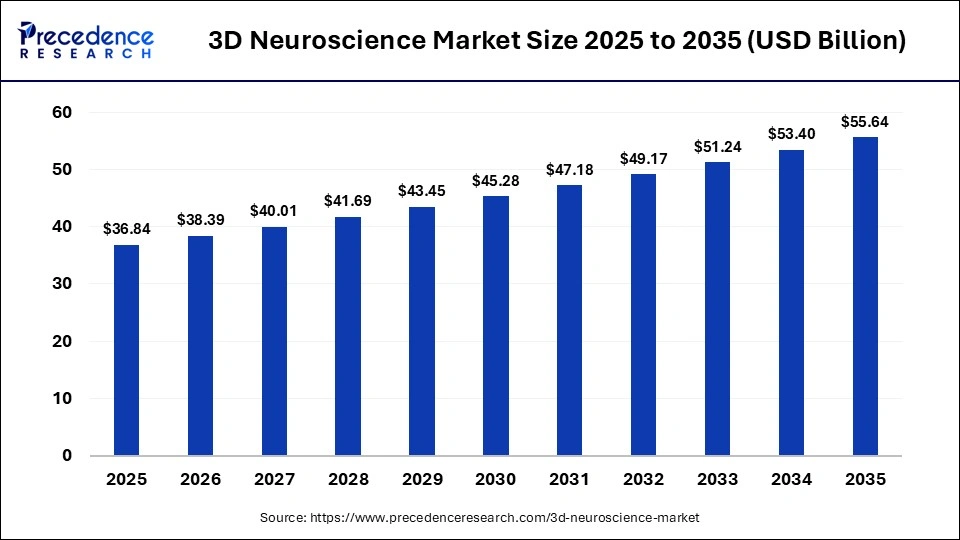
Deepa Pandey, a Healthcare Industry Expert, highlights that the 3D neuroscience market has reached USD 38.39 billion in 2026 and is on track to reach USD 55.64 billion by 2035, advancing at a CAGR of 4.21%. Key 3D neuroscience market companies shaping the market include GE HealthCare, Siemens Healthineers, Bruker Corporation, while major growth segments span by technology, by component, by end user.
Source: https://www.precedenceresearch.com/3d-neuroscience-market
 Get a Sample
 Table Of Content


What is the 3D Neuroscience Market Size?
The global 3D neuroscience market size was calculated at USD 36.84 billion in 2025 and is predicted to increase from USD 38.39 billion in 2026 to approximately USD 55.64 billion by 2035, expanding at a CAGR of 4.21% from 2026 to 2035. The market is witnessing substantial growth driven by the increasing burden of neurological disorders such as Alzheimer's and Parkinson's diseases. This expansion is further supported by the growing demand for physiologically relevant human-specific models, with rapid advancements in novel technologies spurring significant R&D investments and expanding clinical pipelines across various therapeutic areas.
Market Highlights
- North America dominated the 3D neuroscience market in 2025.
- The Asia Pacific is expected to grow at the fastest CAGR between 2026 and 2035.
- By technology, the brain imaging segment captured the highest market share in 2025.
- By technology, the electrophysiology segment is poised to grow at a healthy CAGR between 2026 and 2035.
- By component, the software and services segment generated the biggest market share in 2025.
- By component, the instruments & consumables segment is expanding at the fastest CAGR between 2026 and 2035.
- By end-user, the hospitals segment accounted for the largest market share in 2025.
- By end-user, the diagnostic laboratories segment is projected to grow at a solid CAGR between 2026 and 2035.
What is the 3D Neuroscience Market?
The 3D neuroscience market leverages advanced imaging, microscopy, software, and brain-on-chip technologies to create 3D models of the brain, improving understanding, diagnosis, and treatment of neurological disorders and replacing limited 2D methods. The market is rapidly growing due to rising neurological disease prevalence, AI and VR integration, and demand for high-resolution insights, with brain imaging, research facilities, and hospitals leading the way and showing strong investment and innovation in personalized medicine.
How Did AI Transform the 3D Neuroscience Market?
Artificial intelligence (AI) is transforming the global market by analyzing complex brain data for faster, more accurate diagnosis, personalizing treatments, mapping neural pathways, and accelerating drug discovery. AI optimizes neuroimaging like fMRI and DTI for better visualization of brain structures and pathways, aiding diagnostics and understanding of complex neural networks. AI helps create tailored treatment plans, predict patient responses to therapies, and guide precision medicine by integrating genomic and clinical data, identifying potential drug targets, and improving efficiency in drug development.
3D Neuroscience Market Outlook
- Industry Growth Overview: The market is poised for explosive growth from 2026 to 2035, primarily driven by the increasing burden of neurological diseases like Alzheimer's, Parkinson's, depression, and epilepsy and growing awareness, driving demand for sophisticated diagnostic and therapeutic tools.
- Integration of AI and ML with Advanced 3D Technologies: This trend includes brain imaging and sophisticated in vitro models. This synergy is driven by the need for more accurate, human-relevant data in drug discovery, disease modeling, and clinical diagnostics, aiming to provide more predictive preclinical data and reduce the reliance on animal testing.
- Global Expansion: The worldwide market is expanding rapidly, with North America dominating the market and Asia-Pacific and Europe showing accelerated growth due to rising healthcare spending, aging populations, and increased screen time impacting mental health. Latin America, the Middle East, and Africa are also playing a distinctive role in market expansion.
- Major Investors: Many tech giants, including Google, Meta, and Microsoft, are investing heavily in AI and VR/AR for brain research and mental health. Also, many companies like Biogen, Roche, & Novartis are exploring digital biomarkers and neurotherapeutics.
- Startup Ecosystem: Various startups focus on personalized neurofeedback, AI-driven diagnostics for mental health, and VR for cognitive rehabilitation. Startups like Kernel, NextMind, Emotiv, and various digital therapeutics firms are creating novel solutions.
Market Scope
| Report Coverage | Details |
| Market Size in 2025 | USD 36.84 Billion |
| Market Size in 2026 | USD 38.39 Billion |
| Market Size by 2035 | USD 55.64 Billion |
| Market Growth Rate from 2026 to 2035 | CAGR of 4.21% |
| Dominating Region | North America |
| Fastest Growing Region | Asia Pacific |
| Base Year | 2025 |
| Forecast Period | 2026 to 2035 |
| Segments Covered | Technology, Component, End-user, and Region |
| Regions Covered | North America, Europe, Asia-Pacific, Latin America, and Middle East & Africa |
Segments Insights
Technology Insights
How Did the Brain Imaging Segment Dominate the 3D Neuroscience Market in 2025?
The brain imaging segment dominated the market in 2025. This dominance is driven by high-resolution, detailed 3D visualization of brain structures and activity, which is essential for diagnosing and treating neurological conditions such as Alzheimer's, Parkinson's, and tumors. Advanced technologies further improve accuracy for surgical planning, research, and personalized medicine by helping neurosurgeons plan complex procedures and improve outcomes. MRI and CT are gold standards, integrated into clinical practice with established reimbursement, ensuring widespread adoption.
The electrophysiology segment is expected to grow the fastest. This is mainly due to increasing neurological disease prevalence, a shift to minimally invasive procedures, and demand for more accurate, less animal-reliant models for drug development, making EP crucial for understanding complex brain functions. Rapid technological advancements enable unprecedented real-time visualization and precise targeting of neural activity, supporting the analysis of vast EP datasets, identifying patterns for personalized medicine, and enabling faster diagnostics and treatment for neurological disorders.
Component Insights
What Made the Software and Services Segment Lead the 3D Neuroscience Market in 2025?
The software and services segment led the market in 2025. This is primarily due to the increasing integration of AI, machine learning, and advanced analytics for interpreting complex brain data. These tools allow researchers to process and analyze massive amounts of complex 3D brain data generated by imaging and electrophysiology instruments. Advanced software, including integration with Virtual Reality and Augmented Reality, provides detailed 3D visualization of brain structures, assisting in research, surgical planning, and personalized medicine development.
The instruments & consumables segment is anticipated to experience the fastest growth during the forecast period. This is mainly because of increased demand for better disease-specific models and technological advancements that improve throughput and data analysis. The growing demand for advanced tools like 3D microscopes, imaging systems, and electrophysiology devices is driven by the shift toward 3D cell cultures and organoids, which require specialized instruments and consumables such as growth media, reagents, and assay kits for better disease modeling.
End-user Insights
How Will the Hospital Segment Lead the 3D Neuroscience Market in 2025?
The hospitals segment led the market in 2025. This is mainly due to established infrastructure, specialized staff, high surgical volumes, and funding for advanced tech like 3D imaging and printing, making them crucial for complex surgical planning, patient education, and managing acute neurological cases. Additionally, increasing demand for accurate visualization and treatment solutions, along with early adoption of cutting-edge tools like 3D printing for surgical prep, patient education, and preoperative simulation, improves accuracy.
The diagnostic laboratories segment is expected to experience the fastest growth during the foreseeable period. This is mainly due to increased outsourcing, demand for cost-effective outpatient services, and specialized testing like EEG and EMG. This growth is further fostered by a shift to specialized, standalone centers; technological advancements like AI, 3D imaging, and better awareness of early diagnosis; and the offering of specialized services like ambulatory EEG, evoked potentials, and advanced neuroimaging for early and accurate diagnosis.
Regional Insights
How Did North America Dominate the 3D Neuroscience Market in 2025?
North America dominated the market in 2025. This dominance is mainly driven by its advanced healthcare infrastructure, significant R&D investment, prominent presence of key market players, and high prevalence of neurological disorders. The region boasts a well-developed healthcare system and world-class academic and research institutions like Harvard, MIT, and Stanford, at the forefront of neuroscience innovation and applications. It is also home to many companies involved in the research, production, and marketing of advanced neuroscience devices and software, such as GE Healthcare, Siemens Healthineers, and Thermo Fisher Scientific.
U.S. 3D Neuroscience Market Trends
The U.S. is the dominant market leader within North America, as it has a well-established healthcare system and early adoption of cutting-edge 3D technologies, including advanced imaging, neuro microscopy, and electrophysiology, along with high levels of funding for neuroscience research initiatives. The presence of numerous major market players like Thermo Fisher Scientific, Corning Incorporated, and GE HealthCare drives innovation and product development.
Why is Asia Pacific Considered the Fastest-Growing Region in the 3D Neuroscience Market in 2025?
Asia Pacific region is projected to experience the fastest growth during the forecast period. This is attributed to the high prevalence of neurological disorders in its large and aging population, increased investments in healthcare and research, and supportive government initiatives that promote technological advancements. Countries like China, India, and South Korea are rapidly expanding their healthcare infrastructure and increasing per capita income and insurance coverage, which enhances access to advanced neurodiagnostic services and treatments with a high adoption rate of advanced imaging techniques and relevant research platforms.
India 3D Neuroscience Market Trends
India is emerging as a high-growth market within the region, driven by increasing healthcare spending, a large population, and growing awareness of neurological disorders. There is also a rising interest in leveraging machine learning, and digital technologies for improved data analysis and user experience in neuromarketing and diagnostics. Research conducted in India often occurs at a fraction of the cost compared to Western countries, indicating strong potential for developing affordable solutions.
Why did Europe consider a Notable Region in the 3D Neuroscience Market in 2025?
Europe is also expected to grow notably in the foreseeable future. This growth is primarily due to substantial investment in research, a strong healthcare infrastructure, and collaborative initiatives. Europe boasts numerous world-class neuroscience institutes and cutting-edge research facilities, such as the Max Planck Institute for Brain Research in Germany. The presence of major market players like Merck KGaA in Germany and InSphero in Switzerland, who emphasize incorporating technologies like AI and machine learning into 3D analysis tools, contributes to market growth.
Germany 3D Neuroscience Market Trends
Germany plays a pivotal role within Europe, being home to top-tier research institutes like the Max Planck Institute for Brain Research and the German Center for Neurodegenerative Diseases. The country hosts a significant concentration of major medtech companies, including Siemens Healthineers and Merck KGaA. Active participation in large-scale EU research efforts fosters data sharing and innovation across research centers and hospitals.
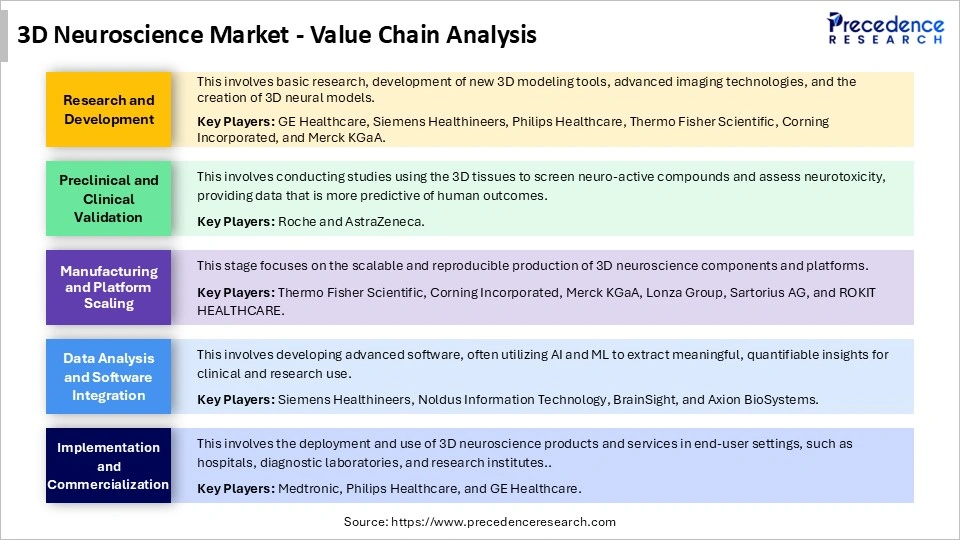
3D Neuroscience Market Value Chain Analysis
Who are the Major Players in the Global 3D Neuroscience Market?
The major players in the 3D neuroscience market include GE HealthCare, Siemens Healthineers, Bruker Corporation, Koninklijke Philips N.V., Carl Zeiss AG, Thermo Fisher Scientific, Corning Incorporated, STEMCELL Technologies, BICO, Medtronic plc, Stryker Corporation, Blackrock Neurotech, BrainSight, and Argus AI.
Leaders Announcement
- In May 2025, Sanofi acquired Vigil Neuroscience, enhancing its neurology pipeline and focusing on VG-3927, an oral TREM2 agonist for Alzheimer's disease, which aims to boost the neuroprotective function of microglia. Dr. Houman Ashrafian highlighted the strategic importance of this acquisition in addressing unmet needs in neurodegenerative diseases. (Source: https://www.sanofi.com)
Recent Developments
- In June 2025, Royal Philips announced CE Mark approval for its SmartCT image reconstruction solution, aimed at improving decision-making in stroke treatment and other neurovascular conditions. SmartCT integrates with the Philips Azurion neuro biplane system to provide real-time 3D imaging, streamlining workflows and supporting timely interventions for procedures. Dr. Shuta Aketa and Dr. Junji Fukumori from Osaka International Medical & Science Center commented on its impact.(Source: https://evtoday.com)
- In February 2025, Medtronic received FDA approval for its BrainSense Adaptive deep brain stimulation technology, enhancing its Percept DBS neurostimulators for Parkinson's care. This personalization feature adapts therapy in real time, improving symptom control without manual adjustments. This represents a new era in personalized neuromodulation, remarked Brett Wall, Medtronic's executive vice president. (Source: https://news.medtronic.com)
Segment Covered in the Report
By Technology
- Brain imaging
- Neuro-Microscopy
- Electrophysiology
- Neuroproteomic Analysis
By Component
- Instruments and consumables
- Software and services
By End-user
- Hospitals
- Diagnostic Laboratories
- Research and Academic institutes
By Region
- North America
- Europe
- Asia-Pacific
- Latin America
- Middle East & Africa
For inquiries regarding discounts, bulk purchases, or customization requests, please contact us at sales@precedenceresearch.com
Frequently Asked Questions
Tags





Ask For Sample
No cookie-cutter, only authentic analysis – take the 1st step to become a Precedence Research client
 Get a Sample
.webp)



 sales@precedenceresearch.com
 Schedule a Meeting
