



North America Bioprocess Analyzers Market Trends, Leading Companies, Company Revenue / Sales Performance, Procedure Volume, Healthcare Spending, Technology Adoption, Reimbursement Analysis, Competitive Landscape, and Growth Outlook
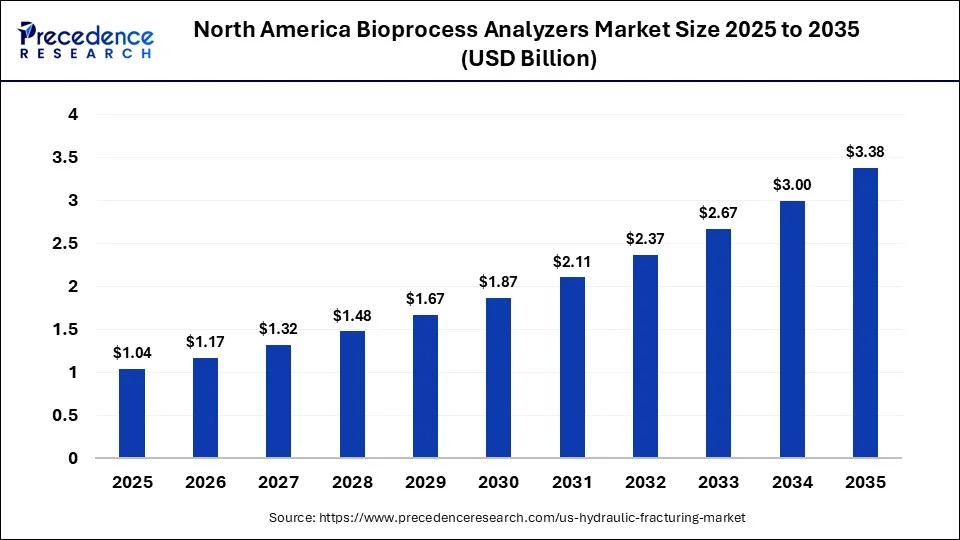
The North America bioprocess analyzers market was valued at USD 1.17 billion in 2026, expanding at a CAGR of 12.5% during the forecast period from 2026 to 2035. The driving factor for the market is the increased need for recombinant proteins, monoclonal antibodies, and personalized therapeutics to treat chronic diseases, and the adoption of automated sample systems, real-time analyzers, and advanced sensors that minimize contamination and shorten batch-release cycles. Our healthcare research analyst, Deepa Pandey, analysed this value. She researched material types, clinical applications, regional growth drivers, and competitive landscapes. Her research is useful for medical product producers, healthcare providers, biotechnology firms, and even investors for competitive benchmarking and strategic decision-making.
Source: https://www.precedenceresearch.com/north-america-bioprocess-analyzers-market
 Get a Sample
 Table Of Content


North America Bioprocess Analyzers Market Size, Demand, and Trends Analysis 2035
A strong strategic change toward targeted gene therapies and mRNA-based vaccines demands sophisticated, rapid analytical tools and the increasing prevalence of chronic diseases has surged the production of recombinant proteins, monoclonal antibodies, and biosimilars. The North America bioprocess analyzers market is forecasted to expand from USD 1.17 billion in 2026 to USD 3.38 billion by 2035 growing at a CAGR of 12.5% from 2026 to 2035. The market is driven by rising production of biologics and heavy investments in research and development.
Key Takeaways
- North America bioprocess analyzers market reaches approximately USD 1.3 billion in 2025, growing toward USD 2.1 billion by 2033.
- The market expands at approximately 8.5-9.0% CAGR, creating a substantial incremental revenue opportunity through 2033.
- Consumables represent the largest recurring-revenue pool, supported by increasing analytical frequency, sensors, reagents, and calibration requirements.
- Biopharmaceutical manufacturers are the largest customer group, while recombinant proteins remain a major application segment.
- PAT, Raman spectroscopy, real-time monitoring, multi-parameter analysis, automated sampling, and digital connectivity are reshaping analytical workflows.
- Competition is shifting from standalone instruments toward integrated ecosystems combining analyzers, sensors, consumables, software, automation, and services.
- U.S. demand dominates, while cell and gene therapy, CDMO expansion, automation, and advanced biomanufacturing create new analytical opportunities.
Introduction
North America is Becoming the Analytical Control Layer for Next-Generation Biomanufacturing
The North America bioprocess analyzers market is estimated at approximately USD 1.04 billion in 2025, with publicly available market estimates placing the region at roughly 37-40% of global demand. A base-case model indicates the market can approach USD 1.5 billion by 2033, implying approximately 8.5-9.0% CAGR and an incremental revenue opportunity of roughly USD 2.1 billion over the period.
North America's structural advantage is not simply the size of its pharmaceutical industry. The region combines a large installed base of biologics manufacturing, sophisticated cell-culture and fermentation operations, extensive CDMO capacity, high regulatory requirements, and comparatively rapid adoption of process analytical technology (PAT), automated sampling, spectroscopy, cell-culture analytics, and digital process monitoring.
Consumables represent the largest product pool, while substrate and metabolite analysis remain fundamental analytical categories. Biopharmaceutical manufacturers constitute the largest end-user group, accounting for approximately 46% of global market demand in 2025 in available market estimates. Recombinant-protein manufacturing is also among the largest application pools, reflecting the scale and maturity of antibody and protein therapeutics production.
The competitive structure is therefore shifting from standalone laboratory instruments toward integrated analytical ecosystems combining sensors, analyzers, consumables, software, automation, data integrity and technical services.
Key Coverage
- 2025 North America market estimated at approximately USD 1.3 billion
- 2033 base-case opportunity approaching USD 2.1 billion
- Approximately 8.5-9.0% CAGR
- Consumables remain the largest recurring-revenue pool
- Biopharmaceutical companies represent the largest customer group
- Recombinant proteins remain a major application segment
- PAT, real-time monitoring and automation are major technology accelerators
- U.S. demand substantially outweighs Canadian demand, while Canada remains strategically relevant for biomanufacturing and analytical technology development
Market Size & Forecast - An Approximately USD 3.38 Billion Incremental Opportunity is Emerging by 2035
The North American market is estimated at approximately USD 0.85-0.95 billion in 2025, with a modeled midpoint of roughly USD 1.3 billion. Available estimates place 2025 revenue at USD 851.7 million and forecast approximately USD 2.1 billion by 2033, corresponding to an 8.9% CAGR from 2026-2033. The principal expansion mechanism is not merely increasing instrument purchases. A greater proportion of bioprocesses are incorporating multiple analytical checkpoints, increasing the number of measurements, sensors, disposable analytical components, calibration materials, and software connections associated with each manufacturing line.
Under the base case, the market could add approximately USD 750-850 million between 2025 and 2035. An upside scenario based on faster PAT adoption, accelerated cell-and-gene-therapy manufacturing and greater automation could push annual growth above 10%, while a downside case of approximately 6-7% CAGR would emerge from prolonged biopharma capital-expenditure constraints and slower technology qualification.
Key Coverage
- 2021-2025 historical market reconstruction
- 2025 base-year revenue
- 2026-2033 annual forecasts
- Base/upside/downside scenarios
- Revenue by product, analytical type, application, and end user
- U.S. versus Canada opportunity
- Incremental revenue pools and growth contribution
Segmentation Analysis - Consumables and Multi-Parameter Cell-Culture Analytics Capture the Recurring Value Pool
The market divides principally into instruments and consumables, with analytical applications spanning substrate, metabolite, concentration, cell-density, viability, gas, pH, osmolality, and other process parameters. Consumables currently represent the largest revenue segment, creating an economically important recurring component alongside higher-value instrument placements.
Within analytical applications, substrate and metabolite measurements remain core requirements because glucose, lactate, glutamine, and related parameters directly influence cell growth, productivity, and process control. However, the fastest value creation is increasingly associated with multi-parameter and automated systems capable of measuring several critical variables from very small sample volumes.
For example, modern automated cell-culture analyzers can measure up to 16 parameters from approximately 275 µL of sample, demonstrating how automation and sample minimization are changing the economics of process monitoring.
Key Coverage
- Instruments versus consumables
- Substrate, metabolite and concentration analysis
- Cell density and viability
- pH, dissolved oxygen and gas analysis
- Osmolality
- Offline, at-line, online and in-line monitoring
- Recombinant proteins, vaccines, cell therapy, gene therapy and biosimilars
- Biopharma, CDMO, CRO and academic or research customers
Which Technology and Innovation Trends Will Most Redefine the North America Bioprocess Analyzers Market Over the Next Five Years?
The North America bioprocess analyzers market generated approximately USD 851.8 million in 2025 and is projected to reach USD 1.6 billion by 2033, representing a 9% CAGR. The technology shift is increasingly moving beyond conventional offline measurement toward real-time, at-line, and inline analytics, driven by the need to monitor substrates, metabolites, cell growth, and product-quality attributes with greater frequency and less manual intervention.
Within the broader North American bioprocess automation market, estimated at USD 4.32 billion in 2025 and growing at 14.1% CAGR through 2033, software and control systems are identified as the fastest-growing component, reinforcing the increasing linkage between analytical instruments, automation, and process-control infrastructure.
Our analysis indicates that the most commercially significant technology transition is from standalone analyzers toward integrated PAT-enabled analytical platforms. Raman and other spectroscopic technologies are gaining importance because they can support non-invasive, real-time monitoring of multiple process parameters, while automation and digital connectivity increasingly allow analytical outputs to feed directly into process-control workflows. North America accounted for roughly 38.7% of the global bioprocess analyzers market in 2024, while the region also represented more than 40% of the global bioprocess automation market, indicating an installed manufacturing ecosystem capable of adopting increasingly sophisticated analytical technologies.
In our view, this convergence is likely to shift competitive differentiation away from measurement accuracy alone toward measurement speed, number of parameters monitored, automation compatibility, software intelligence, data connectivity, and ability to support closed-loop process control.
In our view, AI/ML-enabled analytics, multi-parameter measurement, low-volume analysis, single-use compatibility, and automated sampling represent the next layer of differentiation, but their commercial impact will depend on integration with validated manufacturing workflows rather than technology novelty alone. The North American real-time bioprocess Raman analyzer market, for example, was estimated at USD 153.4 million in 2023 and is projected to reach USD 283.6 million by 2032, illustrating the commercial expansion of real-time spectroscopic monitoring.
FDA's PAT framework also provides an established regulatory foundation for innovative process monitoring and control. From our assessment, this creates opportunities for suppliers that can combine analyzers, sensors, consumables, software, automation, and services into validated analytical ecosystems, while creating a potential competitive risk for suppliers whose offerings remain predominantly hardware-centric.
How is the Competitive Landscape Evolving as Bioprocess Analyzers Shift from Standalone Instruments to Integrated Process-Analytics Platforms?
The North America bioprocess analyzers market was valued at approximately USD 851.7 million in 2025 and is projected to reach USD 1.66 billion by 2033, expanding at an 8.9% CAGR. The market is characterized by a relatively concentrated group of global analytical and bioprocess technology providers alongside specialized instrument and process-analytics companies. At the same time, the adjacent North American bioprocess automation market is considerably larger at USD 3.68 billion in 2025 and is forecast to grow at 11.7% CAGR through 2033, with software and control systems identified as its fastest-growing component.
Our analysis indicates that competitive advantage is increasingly shifting from analyzer functionality alone toward the ability to integrate analytics with automation, software, PAT, and broader bioprocess workflows. The competitive landscape therefore extends beyond traditional analyzer manufacturers to companies with capabilities spanning upstream and downstream processing, process control, digital connectivity, and recurring consumables. The increasing importance of software is particularly relevant: U.S. bioprocess automation software generated approximately USD 487.4 million in 2024, with PAT representing 33.5% of the segment, indicating that analytical intelligence is becoming increasingly embedded within automated manufacturing environments. Our assessment is that this convergence will make installed base, interoperability, application breadth, and recurring revenue increasingly important competitive variables alongside instrument performance.
In our view, the most significant competitive implication is the emergence of an ecosystem-based market structure in which suppliers compete for a larger share of the customer's analytical workflow rather than for individual analyzer purchases. Companies with broad bioprocess portfolios can potentially cross-sell analyzers, sensors, consumables, automation, and software, while specialized players can differentiate through superior measurement technologies, faster analysis, niche applications, or advanced PAT capabilities.
Recent portfolio expansion and technology transactions, including the acquisition of 908 Devices' desktop bioprocessing PAT portfolio by Repligen in 2025, also indicate that access to differentiated process-analytics technology is becoming a strategic competitive lever. From our assessment, this creates opportunities for both integrated platforms and focused specialists, but the basis of competition is likely to move increasingly toward technology depth, workflow integration, application expertise, and recurring customer engagement.
How is Product Portfolio Depth Becoming a Key Differentiator in the North America Bioprocess Analyzers Market?
The North America bioprocess analyzers market is evolving from a relatively instrument-centric market toward a broader portfolio spanning analyzers, consumables, sensors, sampling systems, software, and process-analytics solutions. Across the broader market, instruments and consumables remain the core product categories, while demand is increasingly influenced by real-time monitoring, automation, and continuous bioprocessing. Concentration detection, substrate analysis, and metabolite analysis represent major analytical requirements, reflecting the need to monitor both process performance and product formation across biopharmaceutical manufacturing.
Our analysis indicates that portfolio breadth alone is becoming less important than the ability to address multiple analytical requirements within the same workflow. Products capable of measuring multiple parameters, supporting automated or inline or at-line sampling, integrating with process-control systems, and generating actionable process data are positioned to capture greater value than single-purpose instruments.
Raman spectroscopy is particularly relevant to this transition, with one recent market assessment estimating it represented 42.02% of global bioprocess-analyzer revenue in 2025, while mass spectrometry was identified as a faster-growing technology. Our assessment is that product differentiation will increasingly depend on the combination of measurement capability, automation compatibility, software intelligence, connectivity, and recurring consumables rather than instrument specifications in isolation.
In our view, the strategic implication is a widening competitive gap between suppliers offering individual analytical products and those able to build integrated product ecosystems. The recurring component of the portfolio is particularly important: consumables and accessories-including sensors, sample tubes, calibration kits, and analytical reagents-can create repeat purchasing opportunities after the initial analyzer installation, while automation and continuous processing can increase utilization of analyzer-compatible consumables. This creates an opportunity for suppliers to increase customer lifetime value through analyzer, consumables, software, and service models, while customers increasingly gain value from standardized platforms that can be deployed across multiple process stages and facilities.
Which Technology Capabilities Are Creating Sustainable Competitive Differentiation in North American Bioprocess Analyzers?
The North America bioprocess analyzers market is increasingly being shaped by the convergence of process analytical technology (PAT), spectroscopy, multi-parameter measurement, automation, software, and real-time process monitoring. The market is estimated at approximately USD 851.7 million in 2025 and projected to reach USD 1.66 billion by 2033, reflecting an 8.9% CAGR. Within the broader North American bioprocess automation market, valued at approximately USD 3.68 billion in 2025, the software and control-system layer is expanding faster than the overall automation market, highlighting the increasing importance of digital and analytical integration.
Our analysis indicates that technology leadership is increasingly determined by how effectively an analyzer converts measurement into actionable process intelligence. Benchmarking therefore extends beyond the underlying measurement technology to parameters measured, analysis time, sample volume, inline, online or at-line capability, PAT compatibility, automation integration, software functionality and connectivity with manufacturing-control environments.
Raman-based technologies remain particularly significant for real-time monitoring, while multi-parameter and automated analytical platforms are increasingly relevant as manufacturers seek to reduce manual sampling and improve process visibility. Our assessment is that suppliers combining high-quality measurement with automation and digital integration are better positioned to capture the expanding value pool created by increasingly data-intensive biomanufacturing.
In our view, the key competitive divide will increasingly be between technologies that merely generate analytical data and platforms capable of supporting faster process decisions. This makes AI/ML-enabled interpretation, chemometrics, predictive analytics, automated sampling and interoperability important emerging benchmarking dimensions, although their commercial value depends on validation, reliability and integration into existing workflows. From our assessment, this creates an opportunity for suppliers to differentiate through end-to-end analytical capability rather than individual instrument specifications, while customers gain greater value when multiple measurements can be standardized, automated and connected across development and manufacturing environments.
Which Applications and Geographic Markets Will Shape Competitive Growth in North America's Bioprocess Analyzers Market?
The North America bioprocess analyzers market was estimated at approximately USD 851.7 million in 2025 and is projected to reach USD 1.66 billion by 2033, representing an 8.9% CAGR. Demand is concentrated in the United States, supported by its large biopharmaceutical manufacturing base, while applications span biopharmaceutical production, cell culture, fermentation, vaccines, recombinant proteins, biosimilars, cell and gene therapy, and research activities. The adjacent North American cell and gene therapy CDMO market was approximately USD 1.76 billion in 2024 and is projected to reach nearly USD 10.98 billion by 2033, indicating a rapidly expanding manufacturing environment in which low-volume, high-sensitivity and real-time analytical capabilities can become increasingly important.
Our analysis indicates that competitive intensity is likely to be determined less by geographic presence alone and more by the ability to align analyzer capabilities with application-specific process requirements. Conventional biopharmaceutical manufacturing creates sustained demand for monitoring cell density, viability, glucose, lactate, metabolites, and other process parameters, while cell and gene therapy manufacturing places greater emphasis on rapid, flexible, and low-volume analytics.
The United States therefore represents not only the largest geographic demand pool but also a key testing ground for advanced PAT, automation, and digitally connected analytics. Our assessment is that suppliers with broad application coverage and the ability to adapt their platforms across development, scale-up and commercial manufacturing environments can address a wider portion of the emerging demand opportunity.
In our view, the most significant competitive implication is the increasing overlap between application specialization and geographic expansion. Suppliers targeting high-growth applications such as cell and gene therapy, advanced biologics, and CDMO manufacturing can potentially gain access to faster-expanding analytical requirements, while suppliers focused on established biopharmaceutical processes can benefit from the much larger installed manufacturing base. This creates differentiated opportunities across large pharmaceutical manufacturers, CDMOs, emerging therapy developers, research organizations and manufacturing facilities, with purchasing priorities varying by throughput, validation requirements, automation level, analytical complexity and total cost of ownership. From our assessment, competitive expansion strategies will increasingly depend on identifying application, customer, geography combinations where analytical intensity is rising faster than existing analyzer penetration.
Expert Insights
The North America bioprocess analyzers market is the regional segment for specialized instruments and consumables used to monitor and measure biological, chemical, and physical parameters during the manufacturing of biopharmaceuticals. Moreover, strict guidelines from agencies such as the U.S. FDA enforce Process Analytical Technology (PAT) and Quality by Design (QbD), forcing firms to adopt real-time monitoring tools. I believe that surging global production of monoclonal antibodies and vaccines impact the market for the long run.
Our Experts
- The primary market research process was carried out by Deepa Pandey, Senior Research Associate, who also designed the methodology and conducted market segmentation, regional trend analysis, competitive analysis, recycling technologies, and forecasts, laying the foundation for the analytical part of the report.
- Aman Singh, Head of Research, has gathered and checked regulatory policies, information on recycling capacity, company financial information, production information, commodity price information, and numerous other quantitative information sources, which are obtained independently, thereby increasing the quality of evidence supporting calculations of the market values.
- Aditi Shivarkar, VP Research, has validated and refined the research material, verified facts, corrected inconsistencies, and completed the research document, making it accurate and to the point.
North America Bioprocess Analyzers Market Segments Covered in This Report
By Product
- Instruments
- Consumables
By Analytical Type
- Substrate Analysis
- Metabolite Analysis
- Concentration Analysis
- Cell Density Analysis
- Cell Viability Analysis
- Gas Analysis
- pH Analysis
- Osmolality
- Other Process Parameters
By Monitoring Mode
- Offline Monitoring
- At-line Monitoring
- Online Monitoring
- In-line Monitoring
By Application
- Recombinant Proteins
- Vaccines
- Cell Therapy
- Gene Therapy
- Biosimilars
By End User
- Biopharmaceutical Companies
- Contract Development & Manufacturing Organizations (CDMOs)
- Contract Research Organizations (CROs)
- Academic & Research Organizations
- By Geography
- United States
- Canada
For inquiries regarding discounts, bulk purchases, or customization requests, please contact us at sales@precedenceresearch.com
Frequently Asked Questions
Tags





Ask For Sample
No cookie-cutter, only authentic analysis – take the 1st step to become a Precedence Research client
 Get a Sample
.webp)



 sales@precedenceresearch.com
 Schedule a Meeting
