



Automotive Biometrics Market Size, Companies, Trends, Competitive Landscape, and Industry Outlook
Automotive Biometrics Market (By Offering: Hardware, Software, Service; By Technology: Fingerprint Recognition, Facial Recognition, Voice Recognition, Iris Recognition; By Application: Vehicle Access Control, Driver Identification & Personalization, Driver Monitoring Systems (DMS), Infotainment & HMI Control, In-Car Payment Authentication; By Vehicle Type: Passenger Cars, Commercial Vehicles) - Global Industry Analysis, Size, Trends, Leading Companies, Regional Outlook, and Forecast 2026 to 2035
Source: https://www.precedenceresearch.com/automotive-biometrics-market
 Get a Sample
 Table Of Content


What is the Automotive Biometrics Market Size?
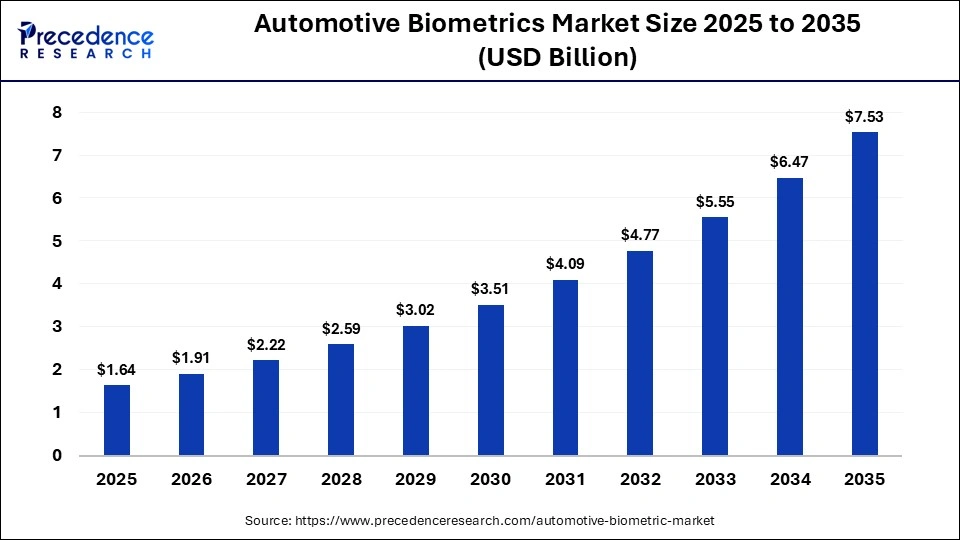
The global automotive biometrics market size is predicted to increase from USD 1.91 billion in 2026 to approximately USD 7.53 billion by 2035, expanding at a CAGR of 16.47% from 2026 to 2035. The market is driven by the growing use of advanced biometric solutions in modern cars, along with technological advancements in the automotive sector. Moreover, the rapid investment by the automotive companies in opening new research centers and the surging demand for autonomous vehicles are contributing to the market.
Market Highlights
- Asia Pacific led the automotive biometrics market with the largest share of 38% in 2026.
- North America is expected to grow at a significant CAGR from 2026 to 2035.
- By offering, the hardware segment held the largest share of the market in 2026.
- By offering, the software segment is expected to grow at the fastest CAGR between 2026 and 2035.
- By technology, the fingerprint recognition segment dominated the market in 2026.
- By technology, the iris recognition segment is expected to expand at the highest CAGR from 2026 to 2035.
- By application, the vehicle access control segment held the largest share of the market in 2026.
- By application, the driver monitoring systems (DMS) segment is expected to expand at a notable CAGR from 2026 to 2035.
- By vehicle type, the passenger cars segment held the highest share of the market in 2026.
- By vehicle type, the commercial vehicles segment is expected to grow at a significant CAGR from 2026 to 2035.
Market Overview
The automotive biometrics industry is a prominent segment of the automotive sector. This industry deals with the development and distribution of biometrics solutions for automotive companies across the globe. These biometric solutions are composed of high-quality hardware components and advanced software to operate according to the requirements of the vehicle owners. The integration of advanced voice recognition solutions in modern cars to enable infotainment & HMI control is driving the market expansion. Additionally, the rise of connected and autonomous vehicles is driving the integration of biometric systems for safer and more seamless human-vehicle interaction, further fueling market growth.
How is AI Influencing the Automotive Biometrics Market?
AI is significantly changing the landscape of the automotive sector. In recent times, automakers have been integrating AI into the production facilities to enhance efficiency, optimize performance, improve quality control, and enable defect detection. The biometrics brands are developing advanced AI-enabled biometrics platforms for vehicles to enhance security and improve fraud detection capabilities. Additionally, AI allows vehicles to learn driver preferences, detect unusual activity for security, and integrate biometrics with advanced driver-assistance systems (ADAS) for safer, more personalized, and seamless in-car experiences, driving adoption across connected and autonomous vehicles.
- In May 2024, Precise Biometrics launched an AI-based anti-tampering and liveness solution. This solution is designed to enhance security in modern vehicles.
Automotive Biometrics Market Trends
- Increasing Sales of PHEVs: The sales of plug-in-hybrid vehicles have increased rapidly in several countries, including China, the U.S., Germany, and Sweden, which increases the demand for advanced biometrics solutions. According to the International Energy Agency, around 4.9 million PHEVs were sold in China in 2024.
- Inauguration of Biometric Testing Centers: Several automotive companies are investing rapidly in opening new testing centers to check the efficacy of biometric solutions. For instance, in October 2025, BixeLab opened a biometric testing center in Canberra, Australia. This testing center is inaugurated to check the quality of several biometric systems.
- Partnerships: Numerous software companies are partnering with automotive technology suppliers to develop advanced biometric solutions for the automobile industry. For instance, in April 2025, Forvia partnered with Smart Eye. This partnership aims at developing biometric authentication technology for the automotive industry.
Segment Insights
Offering Insights
Why Did the Hardware Segment Dominate the Automotive Biometrics Market?
The hardware segment dominated the market with the largest share in 2026. This is mainly due to the increased application of ultrasonic sensors in modern cars for enhancing vehicle access capabilities. There is a strong focus of the semiconductor companies on developing a wide range of biometric hardware components to cater to the needs of the automotive industry, which also contributed to the segment's dominance. Moreover, the rapid investment by the automotive brands in opening new hardware manufacturing centers is expected to ensure the long-term growth of the segment.
The software segment is expected to grow at a considerable CAGR over the forecast period because advanced biometric systems rely heavily on sophisticated algorithms to capture, analyze, and authenticate user data accurately and securely. Software enables features such as facial recognition, voice authentication, fingerprint scanning, and behavioral analysis, while also integrating with vehicle systems for personalization, security, and access control. With the rise of connected and autonomous vehicles, demand for AI-powered, adaptive, and cloud-enabled biometric software is increasing, driving growth in this segment.
Technology Insights
What Made Fingerprint Recognition the Leading Segment in the Automotive Biometrics Market?
The fingerprint recognition segment led the automotive biometrics market while holding the largest share in 2026. This is primarily due to the increased use of fingerprint recognition technology in modern vehicles. The rapid investment by market players in developing advanced automotive fingerprint recognition solutions also supported segmental dominance. Numerous advantages of this technology, including keyless convenience, superior security, enabling in-car payments, and enhancing personalization, are expected to propel segmental growth.
The iris recognition segment is expected to grow at the highest CAGR from 2026 to 2035. The growth of the segment is driven by the increasing application of iris recognition technology in autonomous vehicles to verify the identity of the car owner. Rising partnerships among automakers and biometrics providers to develop high-quality iris sensors are positively contributing to the market. Moreover, several benefits of iris recognition technology, such as forgery resistance, liveness detection, drowsiness detection, and integrated security, are boosting the adoption of this technology. Rising concerns over vehicle safety is significantly driving the market.
Application Insights
Why Did the Vehicle Access Control Segment Dominate the Automotive Biometrics Market?
The vehicle access control segment dominated the market in 2026 by holding a major revenue share. This is because secure and convenient access is one of the most immediate and valuable applications of biometric technology in vehicles. The increased use of facial recognition systems in autonomous trucks to manage access control in specific areas also supported segmental growth.
The surging integration of advanced biometrics solutions in modern cars to replace the use of physical keys for accessing is positively influencing segmental growth. Numerous advantages of vehicle access control solutions, including enhanced security, driver authentication, and superior accessibility, are expected to foster the segment's growth.
The driver monitoring systems (DMS) segment is expected to grow at a notable CAGR from 2026 to 2035. This is because of the rising adoption of eye-tracking technology and head-pose analysis technology by automakers to enhance the capabilities of driver monitoring systems (DMS) in passenger cars. The integration of driver monitoring systems by the fleet operators to monitor the activities of the drivers is positively contributing to the segmental growth. Moreover, several benefits of driver monitoring systems (DMS), such as accident prevention, personalized experience, improved driver performance, and biometric integration, are boosting their adoption.
Vehicle Type Insights
What Made Passenger Cars the Dominant Segment in the Automotive Biometrics Market?
The passenger cars segment dominated the market with the largest share in 2026. This is primarily due to the increased sales and production of passenger cars in several nations, including China, the U.S., Germany, and Brazil. Also, the increasing focus of automakers to integrate advanced biometric solutions in passenger cars to enhance the comfort and safety of passengers is positively impacting the segmental growth. Collaborations among automotive brands and biometric solution providers to design AI-enabled automotive sensors are ensuring the long-term growth of the segment.
The commercial vehicles segment is expected to grow at a notable CAGR from 2026 to 2035. The growth of the segment is attributed to the increasing demand for electric trucks from the logistics industry in several countries, such as Canada, India, France, and the UAE. The integration of facial recognition systems in luxury buses to monitor the activities of the driver is boosting the segment. Moreover, the rapid investment by automotive companies in opening new commercial vehicles production centers is expected to drive segmental growth.
Regional Insights
What is the Asia Pacific Automotive Biometrics Market Size?
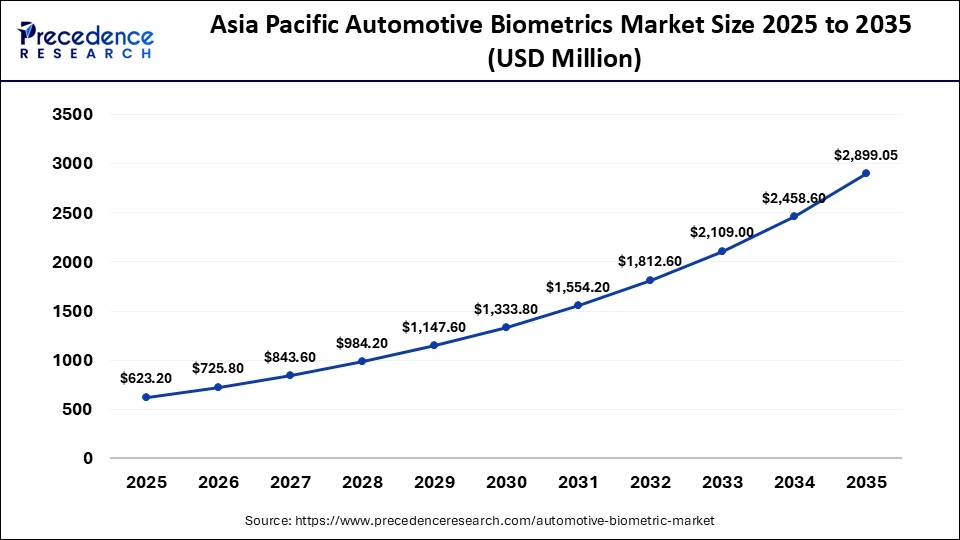
The Asia Pacific automotive biometrics market size is expected to be worth USD 2,899.05 million by 2035, increasing from USD 725.80 million by 2026, growing at a CAGR of 16.62% from 2026 to 2035.
What Made Asia Pacific the Dominant Region in the Automotive Biometrics Market?
Asia Pacific dominated the automotive biometrics market by capturing the largest share in 2026. The region's dominance in the market is attributed to the increased sales of commercial EVs in several countries, including China, Japan, India, and South Korea. Additionally, the surging popularity of software-defined vehicles and the rapid investment by biometrics companies in developing advanced safety software for vehicles are playing a crucial role in shaping the market's landscape. The presence of several market players, including Fujitsu Ltd, Shenzhen Goodix Technology Co., Ltd., and Hitachi Ltd., is expected to drive the market growth in this region.
China Automotive Biometrics Market Analysis
China is a major contributor to the market within Asia Pacific. The growing adoption of autonomous cars by the ride-hailing companies, as well as the availability of automotive hardware components at lower prices, is boosting the market in China. Also, the increasing production and sales of vehicles, coupled with the presence of numerous automotive brands, including BYD, SAIC, XPENG, and others, are positively contributing to the market. Additionally, the widespread familiarity with biometrics from mobile and digital services in China has increased consumer acceptance of in‑vehicle biometric authentication, further fueling market growth. According to the China's State Council Information Office, around 34.531 million vehicles were manufactured in China during 2026.
How is the Opportunistic Rise of North America in the Automotive Biometrics Market?
North America is expected to expand at a significant CAGR from 2026 to 2035. The increasing sales of self-driving cars in the U.S., Canada, and Mexico for lowering the dependency on manual drivers and enhancing safety is driving the market expansion. Numerous government initiatives aimed at strengthening vehicular security, as well as the surging investment by automakers for opening new production centers is positively contributing to the market. Moreover, the presence of several market players, such as Synaptics Incorporated, Aware Inc., HID Global Corporation, and Voxx International, is expected to propel the market growth in this region.
- In March 2024, VOXX International Corporation joined hands with EyeLock LLC and GalvanEyes Partners LLC. This joint venture was aimed at developing a wide range of biometric solutions for the automotive industry in the U.S.
U.S. Automotive Biometrics Market Analysis
The market in the U.S. is expanding due to the increasing adoption of electric vehicles by eco-conscious consumers and the surging cases of car thefts. The rapid investment by the automotive companies for opening research centers, as well as technological advancements in the vehicle manufacturing sector, is contributing significantly to the market expansion. Growth is also supported by increasing consumer expectations for seamless, secure, and personalized in‑vehicle experiences, which biometrics help deliver.
Who are the Major Players in the Global Automotive Biometrics Market?
The major players in the automotive biometrics market include Fujitsu Limited, Synaptics Incorporated, Methode Electronics Inc., VOXX International Corporation, Safran S.A., HID Global Corporation, BioEnable Technologies Pvt. Ltd., Continental AG, Fingerprint Cards AB, and Hitachi Ltd.
Recent Developments
- In September 2025, OCR Studio applied its computer vision and optical character recognition technology to launch a license plate and VIN recognition system for automating vehicle processing.
- In August 2025, Ituran launched Ituran KEY. Ituran KEY is a biometric vehicle security system that enables advanced biometric identification through smartphones.
- In June 2025, Trinamix launched an invisible biometric sensing display. This display is designed to enhance the comfort and safety of passengers inside the vehicle.
Automotive Biometrics Market Segments
By Offering
- Hardware
- Software
- Service
By Technology
- Fingerprint Recognition
- Facial Recognition
- Voice Recognition
- Iris Recognition
By Application
- Vehicle Access Control
- Driver Identification & Personalization
- Driver Monitoring Systems (DMS)
- Infotainment & HMI Control
- In-Car Payment Authentication
By Vehicle Type
- Passenger Cars
- Commercial Vehicles
By Region
- North America
- Europe
- Asia-Pacific
- Latin America
- Middle East & Africa
For inquiries regarding discounts, bulk purchases, or customization requests, please contact us at sales@precedenceresearch.com
Frequently Asked Questions





Ask For Sample
No cookie-cutter, only authentic analysis – take the 1st step to become a Precedence Research client
 Get a Sample




 sales@precedenceresearch.com
 Schedule a Meeting
