



Autonomous Forklift Market Size, Share and Trends 2025 to 2034
Autonomous Forklift Market (By Tonnes: Below 5 Tons, 5 to 10 Tons, Above 10 Tons; By Navigation Technology: Laser, Vision, Optical Tape, Magnetic, Inductive Guidance; By End-use: Retail and Wholesale, Logistics, Automotive, Food Industry, Others; By Application: Indoor, Outdoor) - Global Industry Analysis, Size, Trends, Leading Companies, Regional Outlook, and Forecast 2025 to 2034
Source: https://www.precedenceresearch.com/autonomous-forklift-market
 Get a Sample
 Table Of Content
What is the Autonomous Forklift Market Size?
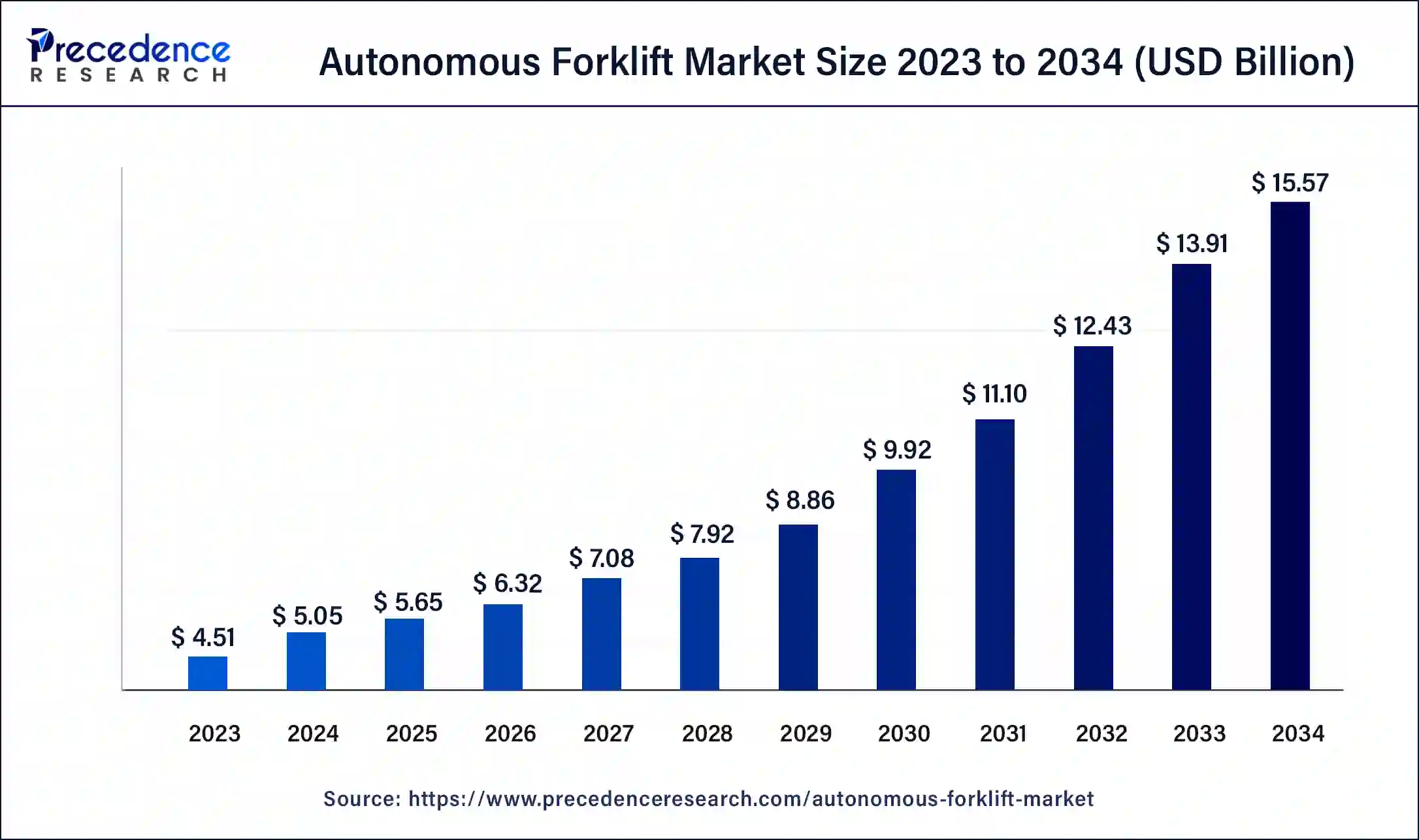
The global autonomous forklift market size is calculated at USD 5.65 billion in 2025 and is predicted to increase from USD 6.32 billion in 2026 to approximately USD 15.57 billion by 2034, expanding at a CAGR of 11.90% from 2025 to 2034. Technological advancements, along with the rising application of autonomous forklifts across several industries, including automotive, e-commerce, aviation, metals & heavy machinery, etc., are responsible for driving the growth of the autonomous forklift market.
Autonomous Forklift Market Key Takeaways
- In terms of revenue, the global autonomous forklift market was valued at USD 5.05 billion in 2024.
- It is projected to reach USD 15.57 billion by 2034.
- The market is expected to grow at a CAGR of 11.90% from 2025 to 2034.
- Asia Pacific dominated the autonomous forklift market with the largest market share of 41% in 2024.
- North America is expected to show significant growth in the market over the forecast period.
- By tonnage, the above 10 tonnes segment dominated the market in 2024.
- By tonnage, the below 5-10 segment is expected to grow at the fastest rate in the market during the forecast period.
- By navigation technology, the laser segment dominated the market in 2024.
- By navigation technology, the vision segment is expected to grow at a notable rate in the market over the forecast period.
- By end use, the retail & wholesale segments dominated the market in 2024.
- By end use, the logistics segment is expected to grow rapidly in the market over the forecast period.
- By application, the indoor segment dominated the market in 2024.
Market Overview
The autonomous forklift market focuses on developing, producing, and deploying self-driving forklifts equipped with advanced technologies. Also known as robotic forklifts or automated guided vehicles (AGVs), these forklifts perform material handling tasks without direct human intervention. They use various sensors, cameras, navigation systems, AI algorithms, and other tools to navigate and interact with their environment.
Autonomous forklifts operate in warehouses, distribution centers, manufacturing facilities, and other industrial settings, where they lift, transport, and stack pallets and goods. They can function in different modes, such as following predefined paths, navigating using sensors and markers, or dynamically adapting to their surroundings. They are adept at avoiding collisions, detecting obstacles, and optimizing routes to enhance productivity and operational efficiency. The autonomous forklift market is driven by the need for labor optimization, increased operational efficiency, reduced operational costs, and improved workplace safety.
Autonomous Forklift Market Growth Factors
- Many key players are now seeking to automate the material handling process, which can fuel the autonomous forklift market growth.
- Autonomous forklifts have a wide range of applications in different fields, which can boost market growth shortly.
- Rising utilization of innovative material handling technologies can further help in market expansion.
- The increasing use of artificial intelligence and big data is one of the key contributors to the autonomous forklift market expansion
Technological Advancements in Autonomous Forklift Industry
The expansion of autonomous forklift systems leverages modern technology which creates safety and productivity enhancements with operational efficiencies. An emerging autonomous forklift development approach utilizes machine learning through autonomous robotics technology with the help of AI machines and advanced sensor technology to facilitate complex warehouse processes with a high level of accuracy and with minimal human interaction.
The autonomous forklifts are used in industry that utilize LiDAR, GPS, vision cameras, and ultrasonic sensors to produce real-time maps that lead their smart operational decisions. The automation of the system works towards reducing risks to workers while delivering productivity and labour efficiencies and offers bottom-line sustainability.
Autonomous forklift market outlook
- Industry Growth Overview: Between 2025 and 2030, this market is expected to rise significantly due to the growing demand for advanced equipment from the heavy industries coupled with rapid investment by market players for opening new production facilities.
- Major Investors: Numerous market players are actively entering this market, drawn by product launches, R&D and joint ventures. Numerous forklift companies such as Agilox Services GMBH, Komatsu Ltd., Doosan Corporation and some others have started investing rapidly for developing high-quality autonomous forklifts to cater the needs of the end-user industries.
- Startup Ecosystem: Various startup brands are engaged in developing autonomous forklift for the end-user industries. The prominent startup brands dealing in manufacturing autonomous forklift comprises of Third Wave Automation, Gideon, Vecna Robotics and some others.
Market Scope
| Report Coverage | Details |
| Market Size in 2026 | USD 6.32 Billion |
| Market Size in 2025 | USD 5.65 Billion |
| Market Size by 2034 | USD 15.57 Billion |
| Market Growth Rate from 2025 to 2034 | CAGR of 11.90% |
| Largest Market | Asia Pacific |
| Base Year | 2024 |
| Forecast Period | 2025 to 2034 |
| Segments Covered | Tonnes, Navigation Technology, End-use, Application, and Regions |
| Regions Covered | North America, Europe, Asia-Pacific, Latin America, and the Middle East & Africa |
Market Dynamics
Driver
The innovation of new products
New product innovation is a significant trend in the autonomous forklift market as manufacturers strive to meet the evolving needs of businesses. One area of focus is developing more advanced sensor technology. Sensors, critical for providing real-time environmental information, enable safe and efficient operation. Manufacturers are investing in new sensors, such as 3D cameras and advanced radar systems, to enhance accuracy and reliability.
Another innovation area is developing more sophisticated software and algorithms. Autonomous forklifts depend on software to process sensor data and make decisions about navigation and task execution. Manufacturers are working on advanced algorithms that can analyze data more efficiently and make more accurate decisions.
- In June 2023, Cyngn Inc., a developer of AI-powered autonomous driving solutions for industrial applications, announced that they have made significant progress adapting DriveMod to enable autonomous forklifts.
Restraint
High integration cost
High integration and switching costs due to AI and warehouse management systems (WMS) pose challenges in adopting autonomous forklifts. These forklifts require significant initial investment and skilled labor to operate. Ongoing expenses for maintaining and updating various subsystems are also costly for companies. These factors, coupled with the lack of flexibility of autonomous forklifts, hinder market growth. Conversely, the growth of the e-commerce industry and the adoption of Industry 4.0 technologies are expected to create lucrative opportunities for the autonomous forklift market expansion during the forecast period.
Opportunities
Growth in the e-commerce industry
The e-commerce market is rapidly growing, leading to increased demand for consumer products and the need for warehouse space to store them. Forklifts are used in warehouses to efficiently place and arrange materials or goods, reducing time and space. These products are distributed to retail stores in bulk via pallet loads and cases, using various distribution strategies and warehouse technologies to ensure safe delivery. Depending on the usage, forklifts come in different models, such as sit-down riders, counterbalanced order pickers, and swing-reach turrets, with various power options, including gasoline, electric, diesel, natural gas, and autonomous.
- In March 2023, America's largest supermarket chain, Kroger, announced the use of self-driving trucks to transport groceries from its customer fulfillment center in Dallas to some stores in that market, taking another step to automate distribution and get online orders delivered faster.
Tonnage Insights
The above 10 tonnes segment dominated the autonomous forklift market in 2023. This indicates that forklifts with a weight capacity of 5-10 tons are the most popular and widely adopted type in the market. These findings reflect the market's preference for mid-range lifting capacities, driven by the versatility and practicality of forklifts in this weight range across various industrial and logistical applications. This contributes to the global dominance of this segment.
The below 5-10 segment is expected to grow at the fastest rate in the autonomous forklift market during the forecast period. Autonomous forklifts with a capacity of 5-10 tons are primarily used indoors. Applications for these forklifts include freight, manufacturing, warehousing, material handling, and logistics. In the confined spaces of warehouses, these compact lifts facilitate the safe and efficient transfer of goods. Furthermore, these autonomous forklifts enhance human resource safety when used to transport hazardous materials in small warehouse spaces.
Navigation Technology Insights
The laser segment dominated the autonomous forklift market in 2023. LGV navigation system, which uses laser positioning, is the most popular. The forklift is equipped with a navigation laser mounted on top of a pole, which interacts with strategically placed targets in the work area. The laser sends out rotating arrays in a 360-degree pattern.
The vision segment is expected to grow at a notable rate in the autonomous forklift market over the forecast period. This is due to the increased accuracy in route planning and navigation provided by vision-driven autonomous forklifts, which use cameras and sensors to recognize their surroundings. This technology reduces the likelihood of collisions and damage to materials and equipment.
End-use Insights
The retail & wholesale segments dominated the autonomous forklift market in 2023. Both private and public players in the ecosystem are investing substantial sums in developing and expanding retail and wholesale facilities worldwide. This investment is driving the surging demand for advanced equipment, such as autonomous forklifts, to be deployed at these sites. The rising demand for warehousing facilities and the expanding e-commerce sector will generate a massive demand for autonomous forklifts.
The logistics segment is expected to grow rapidly in the autonomous forklift market over the forecast period. The launch and growth of e-commerce in logistics and freight operations, along with the increasing need for automated systems, are the primary factors driving the segment's expansion. Additionally, the growing adoption of autonomous forklift technology in the warehouse sector is expected to promote industrial growth. This technology offers several advantages over traditional forklifts, including improved efficiency, accuracy, and precision.
- In March 2024, Pramac and BlueBotics partner, which sees BlueBotics providing ANT navigation technology and fleet management software for Pramac's new line of X-ACT mobile logistics robots. Sold by Pramac's new business unit, called Lifter Mobile Robotics, three X-ACT mobile robots are available, with several more in the pipeline.
Application Insights
The indoor segment dominated the autonomous forklift market in 2023 by application. Indoor forklifts have a lower turning radius; indoor forklifts can operate effectively even in confined spaces. The reach forklift is a warehouse truck primarily used for indoor work. Its crucial feature is extending its forks beyond the compartment, allowing it to reach into warehouse racks in ways that standard forklifts cannot. Moreover, it has an open compartment that gives the operator greater visibility.
Regional Insights
Asia Pacific Autonomous Forklift Market Size and Growth 2025 to 2034
The Asia Pacific autonomous forklift market size is estimated at USD 2.32 billion in 2025 and is predicted to be worth around USD 6.38 billion by 2034, at a CAGR of 12% from 2025 to 2034.
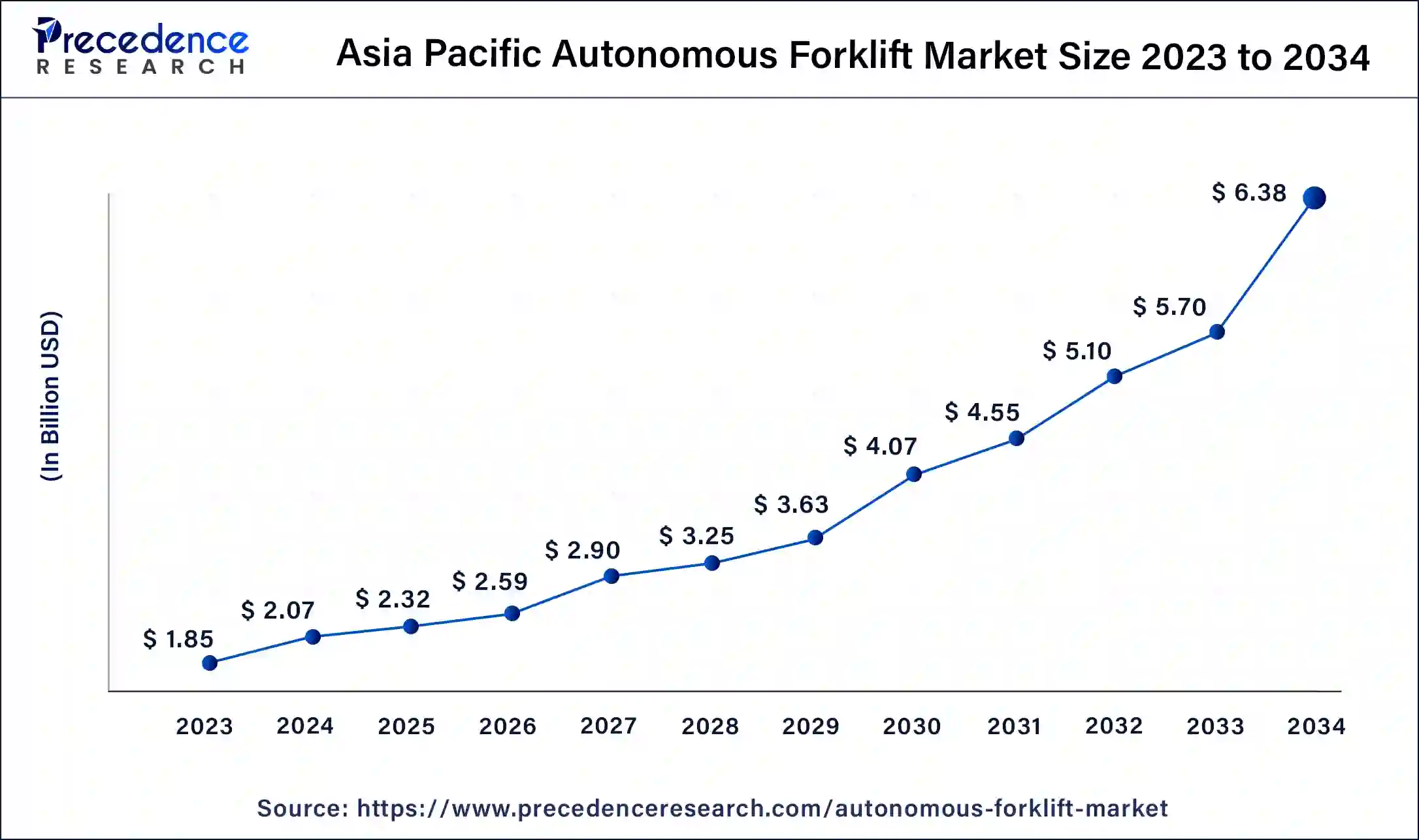
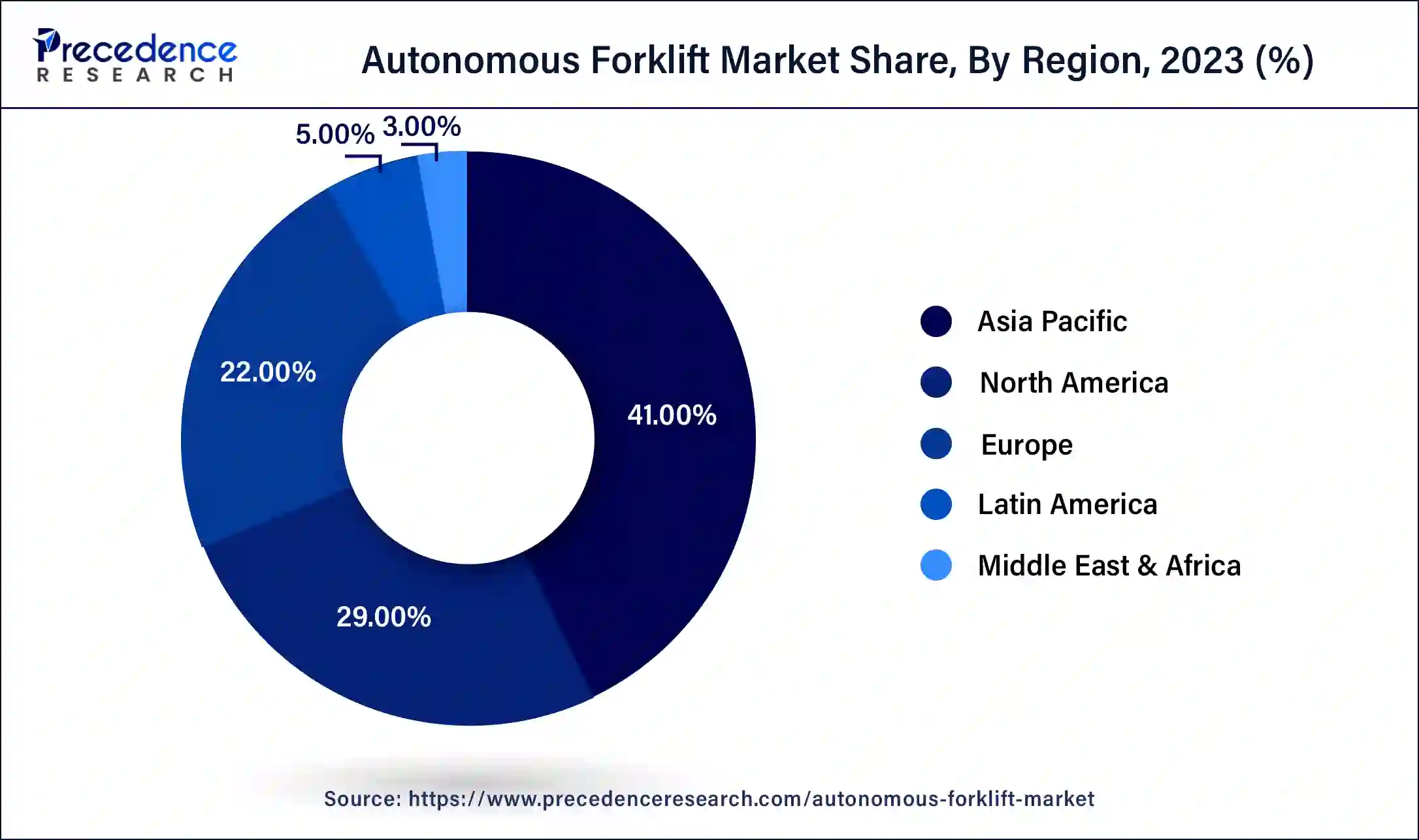
The market in 2024 was dominated by Asia Pacific. Although the deployment of autonomous forklifts across the Asia Pacific is still in its early stages, the decreasing costs and the involvement of various domestic players in the ecosystem present a massive opportunity to adopt driverless forklifts. Also, the e-commerce sector in this region is expected to experience rapid growth in the coming years. Consequently, regional operators are extensively planning to expand their fleets by incorporating advanced forklifts, which will have a positive impact on the demand for autonomous forklifts.
- In January 2024, Groundwork announced the commencement of construction of the largest Multimodal Logistics Park (MMLP) in South India on the northern outskirts of Bengaluru to provide a host of logistics, warehousing, and cold storage facilities that are aimed at reducing overall logistics costs from 13% to 9% making exports competitive.
South Korea's autonomous forklift market is expected to grow at a CAGR through 2034. In recent years, the country has seen robust growth in its manufacturing sector, particularly in industries such as automotive, electronics, and shipbuilding. These sectors have a significant demand for autonomous forklifts to enhance productivity, efficiency, and competitiveness; the South Korean government has been actively promoting the adoption of autonomous forklifts as part of its 'Smart Factory' initiative.
North America is expected to show significant growth in the autonomous forklift market over the forecast period. The use of autonomous forklifts is expected to grow significantly in the coming years as companies aim to improve efficiency, productivity, and safety in their material handling and transportation operations. The region's robust manufacturing industry is a key factor driving the demand for autonomous forklifts in North America. Automation and robotics are becoming increasingly prevalent in manufacturing, and autonomous forklifts help streamline material handling and transportation processes, reduce labor costs, and boost productivity. Also, the retail industry in North America represents a significant market for autonomous forklifts, as companies seek to enhance inventory management, product replenishment, and order fulfillment through automation.
Why Europe held a significant share of the industry?
Europe held a significant share of the market. The increasing demand for autonomous forklifts from the manufacturing sector in numerous countries such as Germany, UK, France, Italy, and some others has boosted the market expansion. Also, the presence of numerous market players coupled with rapid expansion of the food and beverage industry is expected to boost the growth of the autonomous forklift market in this region.
What made Latin America to hold a considerable share of the market?
Latin America held a considerable share of the industry. The rising adoption of autonomous forklifts in various countries such as Brazil and Argentina due to lack of manual operators has boosted the market expansion. Also, partnerships among e-commerce brands and market players to deploy autonomous forklifts in warehouses is expected to drive the growth of the autonomous forklift market in this region.
How did Middle East and Africa held a notable share of the industry?
Middle East and Africa held a notable share of the market. The growing emphasis of logistics companies to adopt autonomous forklift across numerous countries such as UAE, Saudi Arabia, South Africa and some others has boosted the market expansion. Additionally, rapid investment by automotive companies for opening new production centers to increase the production of forklifts is expected to propel the growth of the autonomous forklift market in this region.
Value-Chain Analysis
- Raw Material Procurement
The raw materials used for manufacturing autonomous forklifts consists of high-strength steel and aluminum alloys for the body and frame, along with various electronic components, sensors, along with advanced power systems.
Key Companies: ArcelorMittal, Nucor Corporation, ThyssenKrupp AG and others. - Testing and Quality Control
The testing and quality control (QC) of autonomous forklifts is a comprehensive, multi-stage process involving a combination of simulations, lab tests, and real-world pre-deployment trials to ensure safety, performance, and reliability.
Key Companies: Pro QC International, HQTS, TÜV India and others. - Distribution Channel
The distribution channels for autonomous forklifts primarily involve direct sales from manufacturers to end-users and the leasing of equipment to companies in the e-commerce, logistics, and manufacturing sectors.
Key Companies: Anhui Heli Co., Ltd., Crown Equipment Corporation, MLE B.V. and others.
Key Players: Developing self-driving forklifts for end-users
- Mitsubishi Logisnext Co Ltd: Mitsubishi Logisnext Co., Ltd. is a Japanese company formed in 2017 from a merger of Mitsubishi Nichiyu Forklift and UniCarriers Corporation, specializing in manufacturing and selling material handling and logistics equipment. The company's product line includes electric and engine-powered forklifts, automated warehouses, AGVs, and warehouse management systems (WMS).
- Jungheinrich AG: Jungheinrich AG is a global leader in intralogistics, founded in 1953 and headquartered in Hamburg, Germany. The company provides a comprehensive range of material handling equipment, warehouse automation, and logistics systems, including forklifts, reach trucks, and automated guided vehicles (AGVs).
- Hyster-Yale Materials Handling: Hyster-Yale Materials Handling, Inc. is a global company that designs, manufactures, and services a wide range of lift trucks, parts, and material handling equipment. The company provides comprehensive solutions, including attachments, hydrogen fuel cell power products, and telematics and automation systems, aimed at increasing efficiency for its customers.
- Hangcha Group Co, Ltd: Hangcha Group Co., Ltd. is a leading Chinese manufacturer of material handling equipment, including a wide range of forklifts, warehouse equipment, and industrial machinery. This company develops several products such as hydrogen fuel cell and lithium-ion forklifts.
- Agilox Services GMBH: AGILOX Services GmbH is an Austrian company founded in 2017 that develops and provides AI-driven Autonomous Mobile Robots (AMRs) for logistics and material handling.
- Komatsu Ltd.: Komatsu Ltd. is a Japanese multinational corporation headquartered in Tokyo, founded in 1921, that manufactures construction, mining, and forestry equipment, as well as industrial machinery such as presses and lasers.
Autonomous Forklift Market Companies
- Toyota Industries Corporation
- Kion Group AG
- Mitsubishi Logisnext Co Ltd
- Jungheinrich AG
- Hyster-Yale Materials Handling
- Hangcha Group Co, Ltd
- Agilox Services GMBH
- Komatsu Ltd.
- Doosan Corporation
- Anhui Yufeng Equipment Co., Ltd.
- Anhui Heli Co., Ltd.
- Crown Equipment Corporation
- MLE B.V.
Recent Developments
- In April 2024, Walmart rolled out 19 autonomous forklifts at four of its distribution centers in an effort to automate the warehouse loading dock, as part of the consumer goods giant's initiative. The autonomous forklifts from Fox Robotics are being deployed in its facilities in Florida, Texas, New York, and Alabama to enhance the overall experience and improve business operations.
- In February 2024, ArcBest launched Vaux Smart Autonomy, a series of autonomous forklifts and reach trucks controlled remotely, which encourages autonomous and manual use, with sensors and cameras that allow them to navigate warehouses for loading or stacking pallets and moving products.
- In February 2024, Seegrid Corporation announced that it was introducing an autonomous lift truck, the Palion Lift CR1 model, to a new category of autonomous material handling for warehousing, manufacturing, and logistics customers. The company also confirmed that the lift truck model has its own proprietary, best-in-class navigation technology.
- In February 2024, Seegrid Corporation announced the launch of an autonomous lift truck, the Palion Lift CR1 model, to address evolving challenges in autonomous material handling for warehousing, manufacturing, and logistics customers. The Palion Lift CR1 boasts an impressive 15' lift height and a robust 4,000lb payload capacity. Further, the company stated that the new model is equipped with its own proprietary state-of-the-art navigation technology.
- In April 2025, BlueBotics unveiled ANT locator. ANT locator is an advanced tracking solution designed for enhancing the capabilities of autonomous forklifts.
(Source: https://roboticsandautomationnews.com ) - In March 2025, Fox Robotics launched FoxBot Mk3 forklift. This forklift is designed for numerous warehouse related operations.
(Source: https://www.automatedwarehouseonline.com ) - In March 2025, AiTEN Robotics launched next-gen autonomous forklifts. These autonomous forklifts are designed for the logistics sector.
(Source: https://www.cbs42.com )
Segments Covered in the Report
By Tonnes
- Below 5 Tons
- 5 to 10 Tons
- Above 10 Tons
By Navigation Technology
- Laser
- Vision
- Optical Tape
- Magnetic
- Inductive Guidance
By End-use
- Retail and Wholesale
- Logistics
- Automotive
- Food Industry
- Others
By Application
- Indoor
- Outdoor
By Geography
- North America
- Asia Pacific
- Europe
- Latin America
- Middle East & Africa
For inquiries regarding discounts, bulk purchases, or customization requests, please contact us at sales@precedenceresearch.com
Frequently Asked Questions





Ask For Sample
No cookie-cutter, only authentic analysis – take the 1st step to become a Precedence Research client
 Get a Sample




 sales@precedenceresearch.com
 Schedule a Meeting
