


Bio-Based Construction Polymer Market Trends, Leading Companies, Company Revenue / Sales Performance, Plant Utilization, Production Volume, Pricing Dynamics, Supply Chain Performance, Competitive Landscape, and Industry Growth
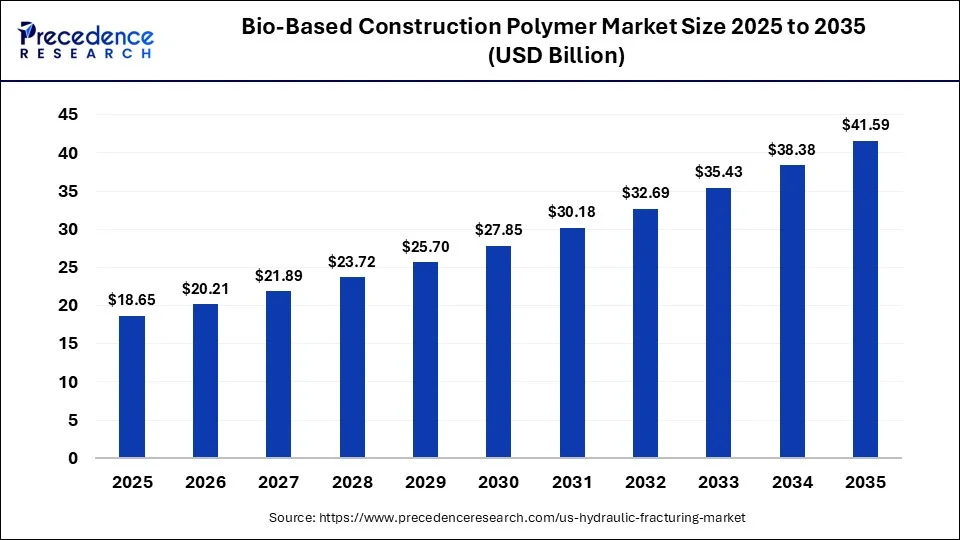
The bio-based construction polymer market reached USD 20.21 billion in 2026. This value is attributed to the increased demand for bio-polymer products and their broad uses, from insulation to pipes, profiles, flooring, paints, and adhesives. These trends were evaluated by our Senior Research Analyst, Vidyesh Swar, to curate this report. His report benefits various stakeholders, including bio-based polymer manufacturers, conventional polymer and chemical manufacturers, raw material suppliers, private equity firms, and R&D companies.
Source: https://www.precedenceresearch.com/bio-based-construction-polymer-market
 Get a Sample
 Table Of Content


Bio-Based Construction Polymer Market Trends, Growth, and Market Size Analysis 2035
The global bio-based construction polymer market is forecasted to expand from USD 20.21 billion in 2026 to USD 41.59 billion by 2035, growing at a CAGR of 8.35% from 2026 to 2035.
 Key Takeaways
- By polymer type, the polyurethane segment held the largest market share of 31.4% in 2026.
- By region, Asia Pacific held a major market share of 39.3% in 2026.
- Specialty biopolymers have high prices owing to the cost of renewable resources, their formulations, and the qualification process.
- Approximately 275,000 tons/year of bio-based ethylene capacity associated with renewable polyethylene was manufactured, following a 37% expansion from the original 200,000-ton/year configuration.
- Brazil is the largest exporter of bio-based construction polymers due to its renewable ethanol ecosystem.
- Regulatory policies in Europe target dealing with issues on standards of bio-based construction materials and their comparison to traditional building materials.
- Bulk formulators can exploit their manufacturing efficiencies, distribution systems, and connections within the construction industry, whereas specialists benefit from value-added formulations and performance in applications.
- North America's market is growing due to the development of higher-performance materials and sustainability-driven construction specifications.
How is the Bio-Based Construction Polymer Market Evolving Through 2035?
This market is not a single homogeneous polymer category, but an intersection of bio-based resins, polyols, polyester, polyolefins, epoxies, polyurethane systems, cellulose-derived polymers and other renewable polymer platforms used in insulation, pipes, profiles, flooring, coatings, adhesives, sealants, composites and construction components.
Polyurethane represents approximately 31.4% of market revenue under one market definition, while Asia Pacific accounts for approximately 39.3% of global revenue under a broader construction-polymer definition.
The key opportunity that exists now lies in making these bio-based polymers not only equivalent to their oil-based counterparts in terms of their properties but also lower in fossil carbon content.
Coverage Highlights
- Base, upside and downside scenarios
- Revenue and volume forecasts
- Regional contribution to incremental growth
- Polymer-level and application-level forecasts
Segmentation Analysis
Which Polymer Type and Application Segments Dominated the Market in 2026?
The market is segmented across polymer type, bio-content, feedstock, physical form, application, construction type, end-use sector, and geography.
Polyurethane is currently considered as the top-selling product group in several market segments due to its versatility as an insulator, floor, coating, sealant, and structural material.
The fastest growth is expected from applications where sustainability requirements coincide with a strong technical value proposition. Bio-based polyurethane systems, specialty coatings, construction adhesives, sealants, insulation foams and natural-fiber composites are particularly attractive because customers can justify premium pricing through both environmental performance and functional benefits.
Coverage Highlights
- By polymer: PU, PET, epoxies, cellulose acetate, PE, PP, PLA, PHA, PBS and others
- By application: insulation, pipes, profiles, flooring, coatings, adhesives, sealants and composites
- By end use: residential, commercial, industrial and infrastructure
- Bio-based content and feedstock segmentation
- Largest, fastest-growing and emerging segments
- Segment revenue, share, and CAGR
What are the Major Drivers and Challenges Affecting the Bio-Based Construction Polymer Market?
The strongest demand driver is the construction industry's transition toward lower embodied-carbon materials. Buildings and construction have been identified as an important contributor to the consumption of energy, emission of greenhouse gases, and waste generation, placing significant stress on materials suppliers to prove lifecycle benefits other than just operational energy savings.
Bio-based materials can reduce dependence on fossil feedstocks, while selected renewable construction materials can also contribute to lower embodied carbon and long-term biogenic carbon storage. European policy direction is increasingly focused on whole-life carbon assessment and standardization of bio-based construction products.
The overriding constraint is economics. The use of renewables, small-scale manufacturing, standards for certification, and complicated formulations may help bio-products become better than traditional polymers. Consequently, performance-adjusted cost, rather than bio-content alone, will determine adoption.
Coverage Highlights
- Renewable feedstock substitution
- Embodied-carbon reduction
- Green building certification
- Cost and performance barriers
- Feedstock volatility
- Construction-cycle sensitivity
- Bio-content requirements
- Adoption scenarios by application
What Does the Price Analysis of Bio-Based Construction Polymer Indicate?
Bio-based construction polymers do not command a uniform premium; pricing varies substantially by polymer chemistry, bio-based content, application performance, feedstock economics, certification requirements, and production scale. Bio-based polyolefins that are commodity-based are capable of attaining relatively good process compatibility with common polymers since they are produced using proven conversion technology. Bio-based specialty polyols, epoxies, and resins generally command higher premiums than other resins as a result of their costs, technical problems, performance testing, and limited quantities. The market is increasingly shifting from bio-content-based pricing toward performance-adjusted value pricing, particularly in insulation, coatings, flooring, adhesives, and sealants.
Resilient pricing is best achieved where renewable content is supported by technical or lifecycle benefits. Applications requiring thermal insulation, durability, low-VOC performance, moisture resistance, or sustainability certification can absorb higher material costs more readily than highly price-sensitive commodity applications. This creates a growing disparity between commodity bio-based polymers, which depend on strategic parity with their fossil-based counterparts, and specialty polymers which can command premium prices by virtue of their performance. Feedstock costs, polymerization and formulation expenses, freight, distributor margins, and the ability to pass cost increases through the construction value chain will therefore remain critical determinants of profitability.
The key commercial opportunity is not simply to reduce the absolute price of bio-based polymers, but to improve the cost-to-performance and lifecycle-value proposition. There is greater room to argue for premiums by suppliers that can provide higher levels of renewability content at equal processing time, lifespan, lower emissions, or less regulation.
But variation in costs of feedstock or production capacity may restrict the adoption where constructors and developers consider only initial material cost. The full analysis therefore benchmarks polymer ASP by region, bio-based versus fossil-based price differentials, feedstock and conversion-cost contributions, channel margins, premium-to-commodity spreads, price elasticity, pass-through mechanisms, and 2030 to 2035 pricing trajectories.
The pricing intelligence can also be structured as a granular pricing database, enabling users to track polymer type, formulation, bio-based content, geography, application, price/kg or price/ton, conventional-polymer benchmark, premium percentage, feedstock cost, conversion cost, distribution margin, and year. These fields can be filtered by region, application, and polymer chemistry to benchmark pricing gaps and identify applications where bio-based construction polymers have the strongest potential to sustain premium economics.
Why are Feedstock Availability and Specialty Capacity More Essential than Aggregate Polymer Capacity?
Supply is structurally fragmented between large integrated polymer producers, specialty resin manufacturers, bio-monomer suppliers, formulation companies, and regional compounders.
Capacity expansion is occurring selectively rather than uniformly. For example, bio-based ethylene capacity associated with renewable polyethylene reached approximately 275,000 tons/year, following a 37% expansion from the original 200,000-ton/year configuration.
The resulting supply picture differs sharply by chemistry. Commodity bio-based PE can benefit from larger production platforms, whereas advanced biodegradable polymers and specialized bio-based resin systems remain more capacity-constrained.
Coverage Highlights
- Global and regional production capacity
- Capacity utilization
- Feedstock availability
- Supply-demand balance
- Planned capacity additions
- Import dependency
- Lead times and inventory
- Regional supply gaps
What are the Steps Involved in the Value Chain of Bio-Based Construction Polymers?
The value chain spans the procurement of biomass, agricultural oils, sugars, starches, and bio-based intermediates, preparation of monomers/polyols/resins, polymerization, compounding/formulation, construction product manufacturing, distributors, contractors, developers, and building owners.
Profit pools increasingly concentrate at two points: feedstock-integrated polymer production and specialty formulation/application engineering. Conversion into generic format is relatively easy to emulate; however, bio-content, performance verification, and applicability are more difficult to overcome.
Coverage Highlights
- Feedstock-to-polymer mapping
- Cost contribution at each stage
- Margin pools
- Supplier concentration
- Logistics economics
- Formulation economics
- Vertical-integration opportunities
Which Trade Corridors Will Shape the Next Phase of Bio-Based Construction Polymer Supply?
International commerce in bio-based building polymers relies on raw material availability, polymer processing ability, and manufacturing systems of each region, rather than the demand for the polymers themselves. Brazil's renewable ethanol ecosystem gives the country a structurally important position in bio-based ethylene and downstream polyethylene.
Asia's large polymer-processing and construction material manufacturing base strengthens its role in downstream conversion. Specialty resins, polymer intermediates, and bio-based PE therefore exhibit different trade dynamics, with supply corridors increasingly connecting renewable-feedstock regions to major processing and construction markets.
Trade competitiveness is shifting from simple export capacity toward feedstock-to-polymer supply-chain integration. Those regions that enjoy an assured supply of renewable feedstock, an adequate conversion capacity, good trade links, and customer proximity can minimize logistics exposure and increase competitiveness.
Markets dependent on imports and lacking in any substantial bio-based polymer production capabilities offer clear-cut cases for import substitution, while those which are geared towards exports have sufficient feedstock security and scaling capacity in polymers can reap structural benefits.
Companies that are considering geographic expansion need to evaluate the entire chain of logistics from renewable feedstock to polymer intermediates, conversion, distribution tariffs, and market demand instead of simply basing their choice of manufacturing sites on labor or production costs. It could make a major difference in the economics of delivered polymer and determine whether regional production or import/export operations would be a better choice.
The report gives a complete analysis of import and export value and volume of each polymer and region, trade balance, import dependency, tariff exposure, renewable-feedstock corridors, regional localization opportunities, and import-substitution potential. Furthermore, it contrasts the flows of trade of bio-based PE, specialty resins, and their respective polymer precursors in order to determine which industries have the greatest fit between their feedstock advantages and manufacturing capability.
In addition, the underlying data for the trade intelligence can be arranged into a detailed trade flow database that will monitor the type of polymer, exporting country, importing country, trade value, trade quantity, trade balance, tariff risk, feedstock source, renewable feedstock corridor, year, and other import dependency factors.
What are the Technological Innovations of Bio-Based Construction Polymers?
Innovation is moving beyond simple renewable substitution toward bio-based polyols, partially bio-based epoxies, high-performance coatings, recyclable polymer systems, natural-fiber composites, low-VOC formulations, and advanced biodegradable polymers.
The competitive technology question is increasingly whether a material can achieve fossil-equivalent mechanical and thermal performance without compromising durability, fire resistance, moisture resistance, or processing efficiency.
Coverage Highlights
- Technology maturity
- Bio-content technologies
- Polymerization platforms
- Natural-oil and sugar-based chemistry
- Bio-based polyurethane systems
- Composite technologies
- Patent and R&D activity
- Commercialization pipeline
What are the Regulatory Landscapes of the Bio-Based Construction Polymer Market?
Regulatory focus is shifting from general sustainability goals to measurement, disclosure, standardization, and lifecycle assessment. European policy development is specifically addressing standards for bio-based construction products and comparability with conventional materials, while whole-life building emissions are receiving greater attention.
The market therefore increasingly depends on Environmental Product Declarations, lifecycle carbon data, renewable-content verification, chemical compliance, fire performance and construction-product certification.
Coverage Highlights
- Construction-product standards
- Carbon accounting
- Bio-content verification
- VOC requirements
- Fire and durability requirements
- Circularity and recyclability
- Green building procurement
- Regional regulatory comparison
Who are the Major Customers of Bio-Based Construction Polymers?
High demand is observed where the performance of polymers impacts building efficiency or durability. Insulation, protective coatings, flooring, sealants, adhesives, pipes, and profiles are therefore strategically important.
Cost/kg, lifecycle, carbon footprint, durability, certification, processability and the contracting company's track record all form part of the purchase decision. High volume in residential construction, but not in commercial and infrastructure construction, mean more premium certified material for these sectors.
Coverage Highlights
- Residential versus non-residential demand
- Application-level revenue and CAGR
- Contractor and OEM requirements
- Specification-driven purchasing
- Switching costs
- Certification barriers
- Premium application opportunities
Which Competitive Capabilities Determine Leadership as Bio-Based Construction Polymers Scale?
The competitive dynamics are fragmented for now due to the presence of a number of chemistries within the market ranging from bio-based polyurethane, PLA/PHA, polyamides, epoxies, composites, and bio-based polyolefins. In contrast to commodity polymers where scale and process efficiency play a key role in shaping company positioning, bio-based construction polymers need a wider capabilities portfolio consisting of polymer scale, access to renewable feedstock, formulation know-how, R&D, manufacturing infrastructure, and relationships with construction material manufacturers and specifiers.
The competitive advantage in this case will be created through a combination of such capabilities, not solely through scale of polymer production. Although scale will give big producers a head start in manufacturing costs, distribution, and their relationship with the wider building industry, smaller producers can gain an edge through differentiated performance and value-enhancing formulations. Bringing these capabilities together will create defensibility to deliver access to renewable feedstock, scale of production, technical performance and customer support via formulation.
Market leadership is unlikely to be concentrated but will probably stay fragmented. Commoditized business opportunities may be favorable to firms with economies of scale, integrated supply chains and efficiency. Specialty business opportunities may be favorable to firms that have unique technological solutions for problems of durability, insulation, low emissions, composites or other construction-related problems. This creates opportunities for both integrated chemical producers and specialized technology companies, but their competitive strategies will differ substantially by polymer chemistry and application.
Complete report compares the competitive environment in terms of production capacity, renewable feedstocks, polymers and formulations portfolio, R&D, manufacturing facilities, construction industry relations, applications, geography, and specialty technology differentiation. It further evaluates competitive positioning across major bio-based polymer categories to identify capability gaps, areas of strategic overlap, potential differentiation zones, and the companies best positioned to capture higher-value construction applications.
Tentative Leading Company Universe
| Company | Headquarters | Market Position | Core Strength | Major Applications/Segments |
| BASF SE | Germany | Global leader | Bio-based polyols, resins | Coatings, flooring, insulation |
| Covestro AG | Germany | Technology leader | Polyurethane/material systems | Insulation, coatings |
| Arkema S.A. | France | Specialty leader | Bio-attributed specialty polymers | Coatings, adhesives |
| Evonik Industries AG | Germany | Specialty technology | Additives, specialty chemistry | Construction formulations |
| Braskem S.A. | Brazil | Bio-polyolefin leader | Renewable ethylene/PE | Construction plastics |
| NatureWorks LLC | U.S. | Biopolymer specialist | PLA | Panels, components |
| Mitsubishi Chemical Group | Japan | Diversified materials leader | Bio-based specialty polymers | Resins, composites |
| SK Chemicals | South Korea | Sustainable-material specialist | Bio-based/recyclable polymers | Construction components |
| Kaneka Corporation | Japan | Biopolymer innovator | PHBH | Specialty plastics |
| DuPont | U.S. | Specialty-material leader | Engineering polymers | Construction systems |
| Teijin Limited | Japan | Advanced-material leader | Fibers/composites | Reinforced construction |
| Toyobo Co., Ltd. | Japan | Polymer specialist | Functional polymers | Films, composites |
| Solvay | Belgium | Specialty-material leader | High-performance polymers | Infrastructure, composites |
| Avient Corporation | U.S. | Compounder/specialty supplier | Sustainable formulations | Profiles, components |
| Corbion | Netherlands | Bio-based chemistry specialist | PLA/lactic-acid platforms | Polymer intermediates |
| Eastman Chemical Company | U.S. | Specialty-material supplier | Molecular recycling/bio-attributed materials | Construction products |
| Wacker Chemie AG | Germany | Silicone/polymer specialist | Polymer binders | Construction chemicals |
| Huntsman Corporation | U.S. | PU/epoxy specialist | Polyurethanes, epoxies | Insulation, flooring |
| Ashland Global | U.S. | Specialty-formulation supplier | Resins and additives | Coatings, construction |
| Trinseo PLC | U.S. | Polymer producer | Latex/resins | Flooring, coatings |
| DIC Corporation | Japan | Resin specialist | Coatings/resins | Construction coatings |
| Kuraray Co., Ltd. | Japan | Specialty polymer leader | Functional polymers | Interlayers, construction |
| BEWI ASA | Norway | Sustainable-material specialist | Polymer products | Insulation/building systems |
| Novamont | Italy | Bio-based polymer pioneer | Biopolymer platforms | Sustainable polymer products |
| Tate & Lyle PLC | UK | Bio-feedstock specialist | Bio-based intermediates | Polymer feedstock |
What are the Reasons Behind the Moderate Fragmentation of the Bio-Based Construction Polymer Market Across Polymer Platforms?
No single company commands a dominant share of the entire market because the competitive field spans multiple chemistries and applications. The top-tier segment includes diversified chemical companies with significant activities in construction materials, and specialists with more focus on technology portfolios.
The overall evaluation considers Top-5 and Top-10 concentrations, an estimated share of companies, a product-specific ranking per polymer, and regional dominance. The other rankings for non-comparable products are not combined into a universal ranking.
How Broad Polymer Platforms Compete with Deep Specialty Platforms?
Portfolio benchmarking includes bio-PUs, bio-PEs, bio-PETs, bio-PHAs, epoxies, bio-polyamides, specialty resins, coatings, adhesives, sealants, and composite matrices.
Portfolio diversification offers cross-selling opportunities. Niche companies could potentially leverage their specialization with more biodegradable content, improved durability and better lifecycle performance. The portfolio benchmarking identifies deficiencies, white spaces, and high-end construction applications for products.
Which Regional Advantages will Determine Competitive Leadership in Bio-Based Construction Polymers?
Asia Pacific accounted for approximately 39.3% of global market revenue in 2026 under a broad market definition, thereby making the region the largest regional demand and production pool. China, Japan, South Korea, and India have huge construction markets and the capability to produce large volumes of polymers.
But Europe is a completely different competitive landscape, with regulations and carbon accounting that could boost the demand for low-carbon materials, while North America is still focused on high-performance materials.
The competitive advantage of regions is becoming more differentiated due to the interplay of demand scale, manufacturing depth, regulatory intensity, and application sophistication. Asia Pacific has the best balance of manufacturing facilities and construction demand, which makes it cost-effective in manufacturing and processing.
In Europe, this factor plays an important role because of regulation and sustainability requirements, while North America offers strong prospects for companies that can meet strict performance requirements.
A single global expansion strategy will be less effective than region-specific positioning. Asia Pacific offers scope to leverage scale, localization, and supply-chain integration; Europe offers potential to differentiate on low-carbon and regulatory-driven formulations; and North America offers potential to leverage premium materials where performance and green-building criteria call for higher-value products. Firms with polymer offerings and production footprints aligned to these regional drivers will be well-positioned to enhance their competitiveness and access to customers.
A full comparison by region in terms of market size and growth, regional revenue contribution, polymer demand, construction activity, manufacturing capabilities, feedstocks, regulation, sustainability criteria, pricing, and competition is included in the complete report. The analysis further identifies regional growth pockets, localization opportunities, market-entry priorities, and the competitive factors most likely to influence regional share gains.
How is Scale Expansion Concentrated in Select Bio-Polymer Platforms?
Manufacturing benchmarking compares production facilities, announced capacity, utilization, vertical integration, renewable-feedstock access, and geographic localization.
One specific example of benchmarks is the 275,000 ton/year renewable ethylene platform that was developed, making possible the use of renewable sources to produce polyethylene as well as providing evidence that renewable feedstock could be a differentiator in an existing polymer process chain.
What are Strategic Developments in the Bio-Based Construction Polymer Market?
Strategic actions recently undertaken suggest that sustainability efforts have moved from pilots to commercialization. Renewable polymer capacity expansion, specialty bio-polyol introductions, and regional innovation centers demonstrate increasing investment in commercialization.
This report summarizes the newest product releases, capacity additions, deal flow, JV's, partnerships & geographical investments, including the dollar value of any investment announcements.
M&A activity will likely concentrate more on accessing:
- Bio-based feedstock technology
- Specialty resin platform technology
- Sustainable coatings technology
- Construction-chemical technology
- Composite technology
- Regional distribution capabilities
- Low-carbon material technology IP
The complete analysis assesses recent deals by deal size, geography, technology, applications, and rationale, as well as future M&A themes.
Why do Scale Leaders and Technologists Take Different Growth Tracks?
Market leaders are evaluated qualitatively as:
- Market Leaders: wide product portfolio and access to worldwide construction
- Scale Leaders: superior manufacturing and feedstock economics
- Technology Leaders: differentiated bio-polymer platforms
- Regional Leaders: superior domestic manufacturing/relationship with customers
- Application Specialists: specialized construction knowledge
- Growth Challengers: quickly growing portfolio of sustainable materials
The primary strategic issue here is whether the future winners will be integrated polymer manufacturers or specialized technology companies with better application economics.
Which are the Untapped Pools of the Bio-Based Construction Polymer Market?
The market witnesses white spaces and opportunities around bio-based insulation polymers, low-VOC coatings, renewable polyols, low-carbon infrastructure components, and high bio-content specialty polymers. Developing markets like India and Southeast Asia concentrate on domestic production of bio-based construction polymers instead of relying on imports. The most attractive white spaces combine double-digit market growth, limited qualified supply, and clear sustainability-driven purchasing criteria.
What are the Moderate-to-High Barriers to the Market?
| Force | Assessment | Strategic Interpretation |
| Supplier Power | Medium–High | Renewable feedstock availability varies by chemistry and region |
| Buyer Power | Medium–High | Large construction-material producers can negotiate aggressively |
| New Entrants | Medium | Technology development is accessible, but qualification is difficult |
| Substitutes | High | Conventional polymers remain the principal performance benchmark |
| Competitive Rivalry | High | Global chemical groups and specialty innovators compete across overlapping applications |
What Does the PESTLE Analysis of Bio-Based Construction Polymers Indicate?
- Political: renewable-material incentives and procurement policies.
- Economic: construction cycles, polymer prices and feedstock economics.
- Social: demand for healthier, lower-impact buildings.
- Technological: bio-based chemistry, composites and recyclable polymer systems.
- Legal: construction standards, chemical restrictions and certification.
- Environmental: embodied carbon, renewable feedstocks, circularity and waste reduction.
What are the Future Implications of the Bio-Based Construction Polymer Market?
The future outlook for the market is structurally positive, with growth expected to increasingly shift from sustainability-led experimentation toward commercially viable material substitution. But development will not be uniform for all polymer chemistry groups and uses, due to different economics of production, technological maturity, feedstock availability, and end-user willingness to pay.
The next wave of market expansion will be less about having a bio-based product and more about a polymer's ability to offer performance parity or superiority in addition to its sustainability characteristics. Insulation, coatings, adhesives and sealants, flooring, composites, and specialty resins are expected to stay strong growth areas because they are able to justify premium materials that offer them some combination of better thermal performance, durability, lower emissions, or compliance. Materials that do not require any significant modifications to existing production lines will have an easier path to mass-scale commercialization compared to those that do.
Firms that have access to renewable feedstock sources, conversion technologies, downstream connections, and regional manufacturing will be in a better position to reduce cost differences with fossil-based products. Asia Pacific is likely to remain a major scale and manufacturing hub, while Europe should continue to create demand through carbon-reduction and circularity requirements, and North America should provide opportunities for higher-performance sustainable construction materials.
The market is expected to move toward greater commercialization, broader customer qualification, and increasing integration into mainstream construction-material value chains. Competitive differentiation is expected to be based more and more on cost/quality performance, carbon footprint in the lifecycle, verified bio content, performance consistency, processability, and application performance than on sustainability. The most valuable areas will be those where suppliers can leverage their renewable feedstock benefits along with scale of production and economics for customers.
Bio-based construction polymers are likely to evolve from premium sustainability alternatives into a broader portfolio of commercially differentiated construction materials. Firms that focus on building scalable technology, securing feedstock, producing regionally, and developing applications will be best suited to capitalize on growth within the industry over the long term.
Key Strategic Questions Addressed
- How large is the global bio-based construction polymer market in 2026, and where will the incremental revenue pool emerge through 2035?
- Which polymer chemistries will capture the fastest growth?
- How much of demand is generated by insulation, coatings, adhesives, flooring, pipes and composites?
- What is the additional value bio-based polymers can provide compared to traditional ones?
- What are some of the most cost-effective and scalable renewable feedstocks?
- Where are supply shortages or capacity constraints emerging?
- In which areas do the highest levels of building demand and sustainability legislation intersect?
- How rapidly are bio-based polymers moving from pilot projects to qualified construction applications?
- Which companies control the strongest technology and manufacturing positions?
- How concentrated is the market across the top 5 and top 10 participants?
- Which companies possess the strongest bio-based construction product portfolios?
- Where are the largest application and geographic white spaces?
- What would be the expansion and technology changes that can affect competitiveness ranking?
- What M&A themes are likely to reshape the market?
- Which polymer technologies, applications, regions, and companies are best positioned to capture the 2030-2035 profit pools?
Bio-Based Construction Polymer Market Segments
By Polymer Type
- Bio-Based Polyethylene (PE)
- Bio-Based Polypropylene (PP)
- Bio-Based Polyurethane (PU)
- Bio-Based Polyamides
- Bio-Based Epoxy Resins
- Polylactic Acid (PLA)
- Polyhydroxyalkanoates (PHA)
- Bio-Based Acrylics
- Bio-Based Polyester
- Bio-Based Thermoplastic Elastomers
- Other Bio-Based Polymers
By Application
- Insulation
- Flooring
- Adhesives & Sealants
- Coatings
- Pipes & Fittings
- Roofing & Waterproofing
- Windows, Doors & Profiles
- Composites & Reinforced Materials
- Structural & Building Components
- Other Construction Applications
By Construction Type
- Residential Construction
- Commercial Construction
- Industrial Construction
- Infrastructure & Civil Construction
- Institutional Construction
By Feedstock
- Sugarcane & Sugar-Based Feedstock
- Corn & Starch-Based Feedstock
- Vegetable Oils
- Cellulosic & Lignocellulosic Feedstock
- Agricultural Residues
- Waste & Recycled Biomass
- Other Renewable Feedstocks
By Bio-Based Content
- Partially Bio-Based
- Predominantly Bio-Based
- Fully Bio-Based
By Form
- Pellets/Granules
- Liquid Resins
- Foams
- Films & Sheets
- Powders
- Preforms/Compounds
- Other Forms
By Technology
- Fermentation-Based Production
- Bio-Based Polymerization
- Chemical Conversion of Biomass
- Biocatalytic Processes
- Hybrid Bio-Fossil Polymer Production
- Other Production Technologies
By End User
- Building Material Manufacturers
- Construction Chemical Manufacturers
- Contractors & Builders
- Real Estate Developers
- Infrastructure Developers
- Architects & Specifiers
- Other End Users
By Distribution Channel
- Direct Sales
- Distributors & Specialty Chemical Suppliers
- Online/Digital Channels
- Other Channels
By Region
- North America
- Europe
- Asia Pacific
- Latin America
- Middle East & Africa
For inquiries regarding discounts, bulk purchases, or customization requests, please contact us at sales@precedenceresearch.com
Frequently Asked Questions





Ask For Sample
No cookie-cutter, only authentic analysis – take the 1st step to become a Precedence Research client
 Get a Sample




 sales@precedenceresearch.com
 Schedule a Meeting