



Bio-Based Chemical Market Size, Share and Trends 2026 to 2035
Bio-Based Chemical Market (By Product Category: Platform Chemicals, Polymers for Plastics, Paints, Coatings, Inks & Dyes, Surfactants, Cosmetics & Personal Care Products, Adhesives, Man-Made Fibers, Others; By Application: Industrial, Agricultural, Pharmaceutical, Others) - Global Industry Analysis, Size, Trends, Leading Companies, Regional Outlook, and Forecast 2026 to 2035
Source: https://www.precedenceresearch.com/bio-based-chemical-market
 Get a Sample
 Table Of Content


What is the Bio-Based Chemical Market Size?
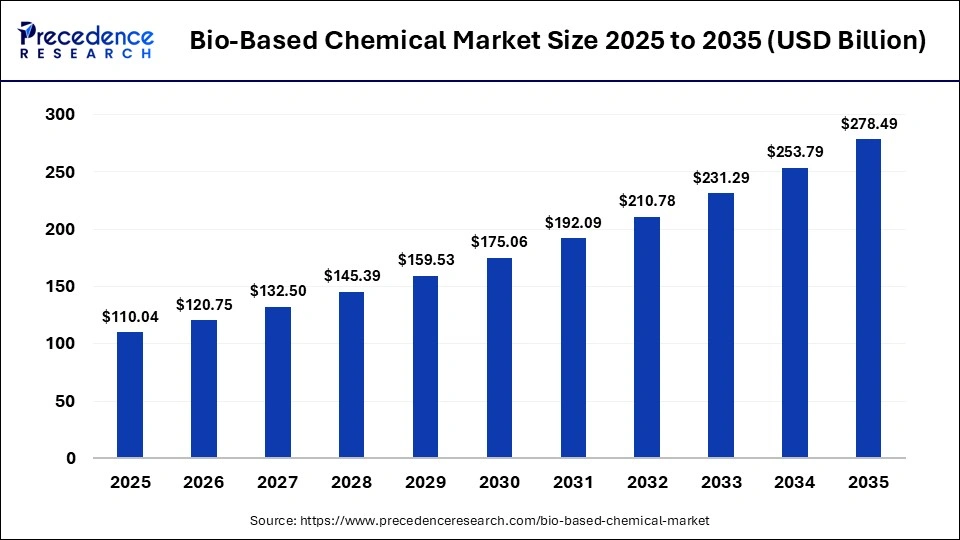
The global Bio-based chemical market size was calculated at USD 110.04 billion in 2025 and is predicted to increase from USD 120.75 billion in 2026 to approximately USD 278.49 billion by 2035, expanding at a CAGR of 9.73% from 2026 to 2035. Bio-based chemicals market involves various products in which fossil resources are completely or partially replaced by biomass, such as plant wood, plant products, and algae. The growing demand for eco-friendly and sustainable solutions in this market drives the production of chemicals from biomass.
Market Highlights
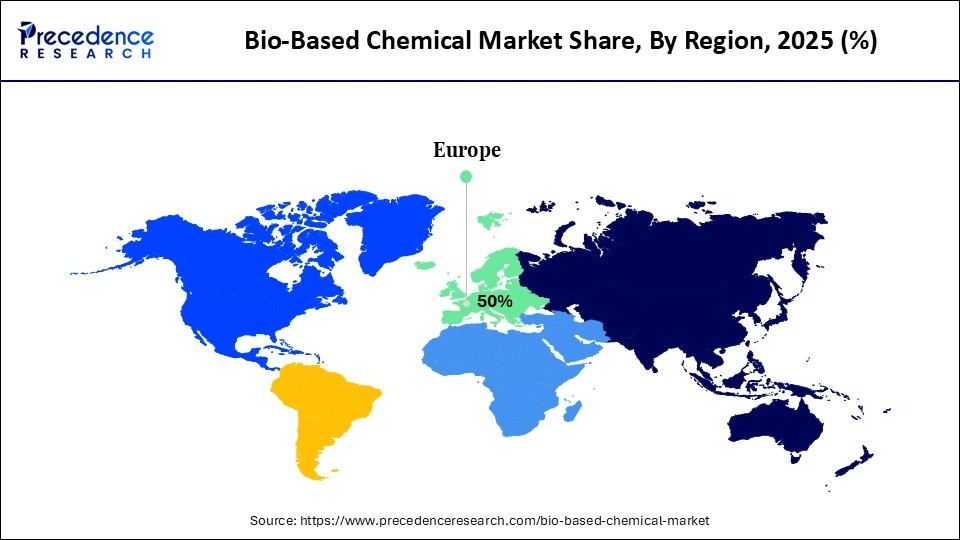
- Europe dominated the global market with the largest market share of 50% in 2025.
- Asia Pacific is expected to grow at the fastest CAGR in the market during the forecast period.
- By product category, the platform chemical segment held a dominant position in the market in 2025.
- By product category, Polymers for Plastics is expected to grow with the highest CAGR in the market between 2026 and 2035.
- By application, the agricultural segment held a dominant position in the bio-based chemical market in 2025.
- By application, the industrial segment is expected to grow at the fastest CAGR in the market between 2026 and 2035.
What is bio-based chemicals market?
As the dependence on petroleum products remains unsustainable, chemists working in bio-based industries are addressing environmental and socio-economic challenges in the chemicals market. Biobased products are derived from plants and other renewable agricultural, forestry, and marine materials. They provide an alternative to conventional petroleum-derived products. Examples are lubricants, fertilizers, bioplastics, and detergents. Biofuels are a major focus of the bio-based industry.
Developing high-value chemicals that replace petroleum products by developing chemical feedstocks from renewable sources and also using catalytic chemistry is critical to achieve sustainability. Biobased products are used in the composition of various materials in different sectors, including construction and automotive sectors, hygiene products such as cleaning products and laundry products, and also in packaging and cosmetics.
Bio based product also made it possible to reduce the carbon footprint of industry and consumers. This sector also opens up new opportunities for the farming world. This industry convert plant derived raw materials from agricultural products into products such as oil sugars, and starches, which can be used in chemical materials.
Currently, bio-based chemistry represents only 1 to 2 million tonnes out of some 400 million tonnes produced per year. But it is estimated that it will represent around 15 million tonnes by 2030.
The market is expected to rise as the industry aims to be safer and more environmentally friendly, in accordance with the principles of sustainable development, also aimed at promoting a reduction in environmental impacts, including the design of safer chemicals, waste prevention, improved energy efficiency, or the use of renewable raw materials.
What is the Role of AI in Bio-based Chemicals Market?
Artificial intelligence has emerged as an essential tool to predict chemical behavior for many recognized biomass processes relevant to biorefineries to optimize the desired product and reaction conditions. The system provides an advantage for pattern recognition when ever-changing feedstock composition influences the biomass conversion processes.
AI has been tremendously beneficial for real-time, dynamic control applications of biochemical processes for continuous parameter monitoring and regulation, such as fermentation or anaerobic digestion in the process.
This mathematical modelling can be applied to several stages of refinery, including initial proof of concept, upscaling the processes, and optimizing reactor designs. It reduces the need for expensive and time-consuming experimentations while handling the biomass feedstocks, especially on a large industrial level.
It also minimizes the purification steps while maintaining the high yields and production rates. It also consumes fewer reagents and energy, which can greatly reduce processing costs. AI enhances plant safety by predicting equipment failures and chemical risks.
Latest Trends in the Bio-based Chemicals Market
- Strong And Expanding Market Growth: The market is experiencing significant growth and demand for sustainable, eco-friendly alternatives to petroleum-based products due to strict regulations on carbon emissions, consumer demand for sustainable packaging and cosmetics, and high-yield production from renewable feedstocks like agricultural waste and plant-based raw materials, which are the key drivers for the market growth.
- Rise Of Bioplastics and Sustainable Polymers: Plastic has revolutionized manufacturing, and the durability of various products is why innovations are rapidly developing. Research shows that bioplastics can lower carbon footprint, thus manufacturers are shifting toward bioplastics in their materials to meet sustainability goals, while reducing manufacturing and disposal costs.
- Industrial Innovations and Performance: Industrial innovations and performance in the market support the urgent need for decarbonization of the chemical industry, along with demand for sustainable, biodegradable packaging and personal care products. The industry is facing scrutiny because of environmental damage and the production of toxic byproducts and waste.
- Shifting To Renewable Feedstocks: As bio-based products are environmentally friendly and often biodegradable, this prevents the accumulation of hazardous waste materials in the environment. Industry is also moving from nonrenewable and fluctuating petroleum-based to renewable feedstocks. With bio-based chemicals, the development of the circular economy will be based on recycling and efficiency in the use of resources.
Market Scope
| Report Coverage | Details |
| Market Size in 2025 | USD 110.04 Billion |
| Market Size in 2026 | USD 120.75 Billion |
| Market Size by 2035 | USD 278.49 Billion |
| Market Growth Rate from 2026 to 2035 | CAGR of 9.73% |
| Dominating Region | Europe |
| Fastest Growing Region | Asia Pacific |
| Base Year | 2025 |
| Forecast Period | 2026 to 2035 |
| Segments Covered | Product Category, Application, and Region |
| Regions Covered | North America, Europe, Asia-Pacific, Latin America, and Middle East & Africa |
Segment Insights
Product Category Insights
The platform chemical segment dominated the market in 2025. Bio-based platform chemicals are intermediate molecule compounds that are derived from renewable biological resources rather than petroleum. These molecules are fundamental building blocks in the chemical industry, converted into a wide range of commercial products such as polymers, solvents, and specialized materials. These chemicals are used in various sectors such as pharmaceutical, industrial, manufacturing, and personal care, thus raising the demand in the market.
While the Polymers for Plastics, paints segment is expected to grow rapidly in the market in the coming years due to High demand for biodegradable, non-toxic, and sustainable alternatives to Petroleum based product. To reduce carbon footprints and due to stricter environmental regulations, high demanded market is observed.
Application Insights
The agricultural type of application segment dominated the market in 2025. Bio-based chemicals, such as biopesticides and biofertilizers, are in high demand as alternative petrochemical products due to consumer awareness of health and safety. To reduce environmental damage, governments are also imposing strict regulations on pesticides, helping in the adoption of organic farming.
While the Industrial type of application segment is expected to grow rapidly in the market in the forecast period, due to its high demand for sustainable raw materials in various manufacturing products, such as lubricants, coatings, and polymers. Industries such as textile, automotive, and construction heavily use the bio-based chemicals, thus raising the demand in the market.
Regional Insights
What is the Europe Bio-based Chemicals Market Size and Growth Rate?
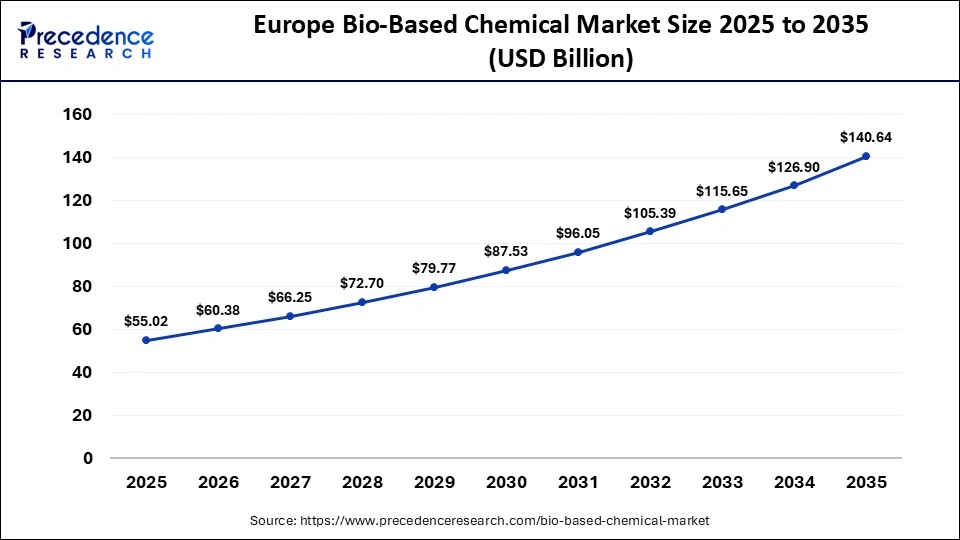
The Europe bio-based chemicalsmarket size has grown strongly in recent years. It will grow from USD 55.02 billion in 2025 to USD 140.64 billion in 2035, expanding at a compound annual growth rate (CAGR) of 9.84% between 2026 and 2035.
Europe Bio-based Chemicals Market Trends
Europe dominated the bio-based chemicals market in 2025. The bioeconomy is a vehicle for achieving the goals of the European Green Deal and the shift toward a net-zero economy. High consumer demand for sustainable products, strict environmental regulations, and the need for a reduction in fossil fuels are driving factors in the European market for bio-based chemicals. Street government policies are aiming to achieve net-zero emissions for sustainability. In addition, carbon taxes are accelerating the market opportunities for bio-based alternatives.
Germany Biobased Chemical Market Trends
In the European region, Germany dominated the market in 2025, holding the largest share in Europe due to its strong research and development, robust industry base, and active government policies to support renewable resources. Government policies are fueling the market by minimizing the use of plastic and increasing the use of biodegradable and biobased alternatives. Germany also dominates the bio-based polymer production. It is also one of the major hubs of chemical production around the world. To support the scaling up of the bio-based solutions large amount of fundings are given to various research and development, and innovation projects.
Asia Pacific Bio-based Chemicals Market Analysis
The Asia Pacific region is the fastest-growing market for bio-based chemicals, it is driven by abundant biomass feedstock, rapid industrialization, and strict government policies for the environment. To reduce the carbon emissions government is implementing strict environmental policies, boosting the demand for bio-based alternatives. Demand is also fueled by consumers' shift towards sustainable packaging, coating, and personal care products. Sectors like automotive, construction, packaging, and personal care are key sectors in the adoption of bio-based chemicals. Due to rising pollution, the adoption of bioplastics is in demand.
China Bio-based Chemicals Market Trends
China is observed to be a dominant player in the market in the Asia Pacific region in the upcoming years. Strict government policies to reduce carbon emission such as China's 2060 carbon neutrality goal is playing a critical role in boosting bio-based chemicals. Also, due to a strong industrial base and high research and development investment, the market further.
Consumers' preference towards organic products and awareness of rising environmental concerns restrict the use of petroleum-based chemicals. In China, the government penalizes and seizes properties if illegal pollution is caused. Non-degradable plastic bags are actively replaced by biodegradable plastic products, helping in the growth of the biobased market.
What are the Advancements in the Bio-Based Chemical Market in North America?
North America is considered to be a significantly growing area, as industries in the region are increasingly shifting toward sustainable manufacturing, low-carbon materials and renewable feedstocks. Growing environmental concerns, stricter carbon reduction targets, and rising demand for green consumer products are encouraging companies across packaging, automotive, agriculture, pharmaceuticals, textiles, and personal care industries to adopt bio-based chemical solutions.
U.S. Market Trends
The U.S. remains the dominant market in North America. The region has a large industrial base, an advanced biotechnology ecosystem, and strong investments in renewable chemicals research. The country generates extensive output from corn and soybean production, serving as important feedstocks for bio-based chemicals. The country has become a major hub for biorefineries and industrial biotechnology facilities.
What are the Key Trends in the Bio-Based Chemical Market in Latin America?
Latin America is expected to grow at a considerable CAGR in the upcoming period, as the region is transitioning toward sustainable industrial development and renewable resource utilization. The region possesses abundant agricultural resources, biomass availability, and favorable climatic conditions, creating strong opportunities for the production of bio-based chemicals. Growing environmental awareness, increasing demand for sustainable packaging and renewable materials, and global demand to reduce carbon emissions are encouraging industries to adopt bio-based chemicals.
Brazil Market Trends
Brazil remains the dominant market in Latin America, due to a massive agricultural economy and a well-established biofuel industry. The country is a global leader in sugarcane-based ethanol production, serving as a source for renewable chemical manufacturing. The country's focus on reducing carbon emissions and strengthening its bioeconomy is supporting long-term market growth.
How is the Middle East and Africa Region Growing in the Bio-Based Chemical Market?
The Middle East and Africa region is expected to grow at a notable CAGR in the foreseeable future, as industries across the region begin focusing more on sustainability, renewable resources, and low-carbon industrial development. Increasing global pressure to reduce carbon emissions, along with rising investments in green technologies and circular economy initiatives, is encouraging governments and manufacturers to explore bio-based chemical alternatives. In Africa, growing agricultural activity and biomass availability are creating new opportunities for renewable chemical production.
Saudi Arabia Market Trends
Saudi Arabia is witnessing growing activity in renewable chemicals. The country's large petrochemical sector is gradually integrating sustainability goals into manufacturing operations, while investments in biotechnology and renewable energy are supporting the future development of bio-based industrial materials.
Competitive Landscape
The global bio-based chemical market is highly competitive. Chemical manufacturers, biotechnology companies, and renewable material procedures are actively investing in sustainable innovation and green manufacturing technologies. Major market players are dominating through strong research capabilities, diversified product portfolios, and expanding bio-refinery operations. These players include BASF, Braskem, Cargill, Dow, and DuPont, competing on developing cost-effective bio-based polymers, renewable solvents, biodegradable plastics, and advanced industrial biotechnology solutions. Strategic collaborations, acquisitions, and capacity expansion are strengthening the market position. Growing environmental concerns, regulations, and corporate net-zero commitments are accelerating innovation. However, high production costs and feedstock price volatility remain as challenges.
Bio-Based Chemical Market Value Chain Analysis
- Feedstock Procurement
It involves the cultivation of biomass such as agricultural crops, fats and oils, and organic waste.
Key Players - Archer Daniels Midland Company (ADM), Cargill Incorporated, Stora Enso - Chemical Synthesis and Processing
It involves processes like microbial fermentation, chemical and catalytic conversion, enzymatic processing, and bio refinery integration and operations.
Key Players - BASF SE, Evonik Industries AG, Mitsubishi Chemical Group Corporation - Compound Formulation and Blending
It involves the process of transforming bio-derived chemicals into an end-use product such as bioplastic, bio-solvent, and bio-lubricants. It includes purification, separation, polymerization, and compound blending of material.
Key Players - Braskem, Corbion N.V., DuPont de Nemours, Inc. - Distribution to Industrial Users
It involves bulk transport of eco-friendly and biodegradable alternatives such as polymers and solvents. Sectors include construction, automotive, pharmaceutical, and food production.
Key Players - Brenntag SE, Univar Solutions Inc., IMCD N.V., HELM AG - Waste Management and Recycling
It includes converting organic, agricultural waste, and used biobased products into valuable chemicals, materials, and fuels. It includes organic recycling, composting, and chemical recycling. It helps with reducing waste and lower carbon footprint.
Key Players - Braskem, BASF SE, NatureWorks LLC - Regulatory Compliance and Safety Monitoring
It includes complying with legal, environmental, and health standards while managing risk throughout the life cycle of products. The product should be safe and should be eco-friendly.
Key Players - Corbion N.V., Evonik Industries AG, Clariant AG
Recent Developments
- In April 2025, Michelin announced the launch of its CERISEA project, an industrial initiative to produce the bio-sourced molecule 5-HMF (5-Hydroxymethylfurfural) at scale. This is the key molecule derived from renewable resources for green chemistry and a sustainable alternative to fossil fuel components in the industrial sector. With a production capacity of 3,000 metric tons per year, it makes it the largest HMF production site in the world.
- In October 2025, Braskem, a market leader in the production of biopolymers on an industrial scale, showcased a new generation of bio-based and circular product solutions to accelerate the transformation of the plastics industry. Under the sustainable portfolio, Braskem is revealing product launches and partnerships that bring sustainability and innovation to life across packaging, healthcare, hygiene, and consumer goods.
Who are the Major Players in the Global Bio-based Chemical Market?
The major players in the Bio-based chemical market include BASF SE, Braskem, DuPont, Cargill, Evonik Industries, Corbion, Mitsubishi Chemical, ADM, Novozymes, NatureWorks, Novamont, Total Corbion PLA, Arkema, Biome Bioplastics, DSM, PTT Global Chemical, and GFBiochemicals Ltd.
Segment Covered in The Report
By Product Category
- Platform Chemicals
- Polymers for Plastics
- Paints, Coatings, Inks & Dyes
- Surfactants
- Cosmetics & Personal Care Products
- Adhesives
- Man-Made Fibers
- Others
By Application
- Industrial
- Agricultural
- Pharmaceutical
- Others
By Region
- North America
- Europe
- Asia-Pacific
- Latin America
- Middle East & Africa
For inquiries regarding discounts, bulk purchases, or customization requests, please contact us at sales@precedenceresearch.com
Frequently Asked Questions
Tags





Ask For Sample
No cookie-cutter, only authentic analysis – take the 1st step to become a Precedence Research client
 Get a Sample




 sales@precedenceresearch.com
 Schedule a Meeting
