



Biometrics for Banking and Financial Services Market Trends, Companies, Revenue / Sales Performance, Subscriber Growth, Pricing Strategies, Cloud Adoption, Infrastructure Expansion, Competitive Landscape, and Industry Outlook
Biometrics for Banking and Financial Services Market (By Technology: Fingerprint Recognition, Facial Recognition, Voice Recognition, Iris Recognition, Vein/Biometric Others; By Component: Hardware, Software, Services; By Deployment Model: On-Premises, Cloud; By Application: Authentication & Verification, Fraud Prevention & Risk Management, Customer Onboarding, Other Banking Services; By End-User: Retail Banking, Commercial Banking, Investment Banking, FinTech/Neobanks) - Global Industry Analysis, Size, Trends, Leading Companies, Regional Outlook, and Forecast 2026 to 2035
Source: https://www.precedenceresearch.com/biometrics-for-banking-and-financial-services-market
 Get a Sample
 Table Of Content


What is the Biometrics for Banking and Financial Services Market Size in 2026?
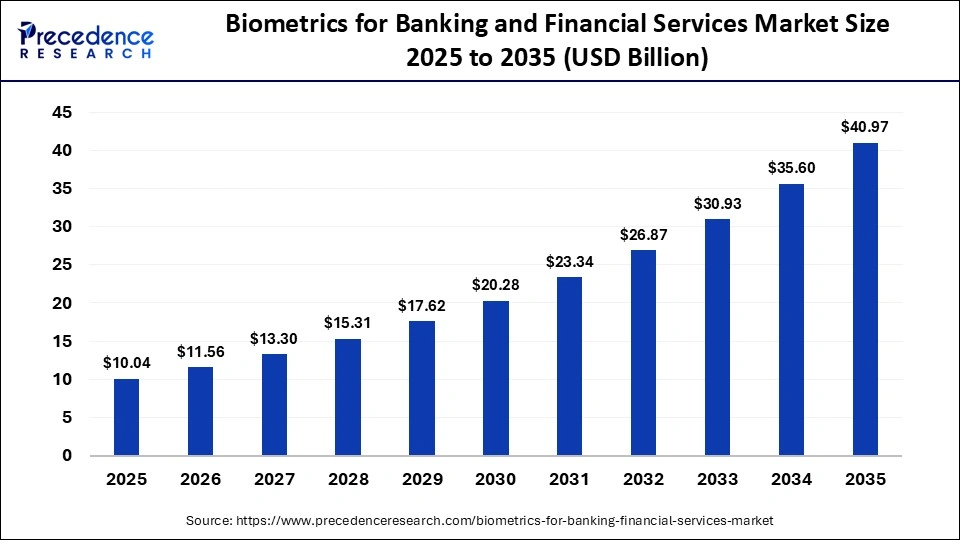
The global biometrics for banking and financial services market size was calculated at USD 10.04 billion in 2025 and is predicted to increase from USD 11.56 billion in 2026 to approximately USD 40.97 billion by 2035, expanding at a CAGR of 15.10% from 2026 to 2035. The market is driven by the rising trend of digital banking and increasing demand for secure authentication solutions.
Key Takeaways
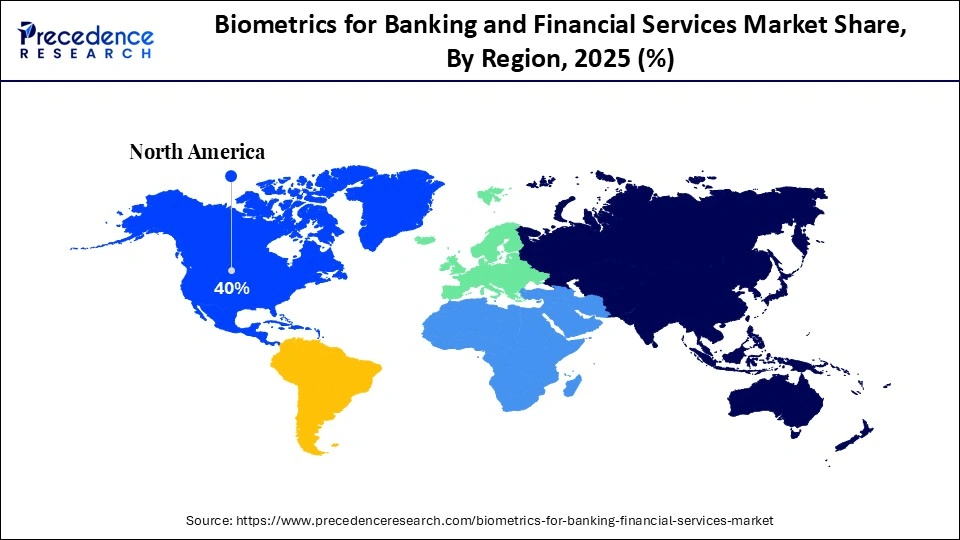
- North America dominated the biometrics for banking and financial services market with a share of 40% in 2025.
- The Asia Pacific is expected to grow at the fastest CAGR of 15.5% in the market during the forecast period.
- By technology, the fingerprint recognition segment holds a dominant position, accounting for 35% of the market share in 2025.
- By technology, the facial recognition segment is expected to grow at the fastest CAGR of 13.2% between 2026 and 2035.
- By component, the hardware segment accounted for a major share of 50% in the market in 2025.
- By component, the software segment is expected to grow at the highest CAGR of 13.5% in the market during the studied years.
- By deployment model, the on-premises segment led the global market with a share of 60% in 2025.
- By deployment model, the cloud segment is expected to expand rapidly in the market with a CAGR of 13.7% in the coming years.
- By application, the authentication & verification segment registered its dominance in the global market with a share of 45% in 2025.
- By application, the customer onboarding segment is expected to grow at the fastest CAGR of 13.9% over the forecast period.
- By end-user, the retail banking segment dominated the global market with a share of 45% in 2025.
- By end-user, the fintech/neobanks segment is expected to grow at the highest CAGR of 14.2% between 2026 and 2035.
Market Overview
The biometrics for banking and financial services market comprises biometric authentication technologies used by banks and financial institutions to verify customer identity and secure transactions. It leverages unique physiological or behavioral traits (e.g., fingerprints, face, iris, voice) to replace or complement PINs/passwords, enhance security, reduce fraud, and improve user experience across mobile banking, ATMs, online platforms, and in-branch systems.
The market is experiencing robust growth due to the rapid digitalization of the financial ecosystem. The use of mobile banking, digital payments, and online financial services is on the rise, which makes the secure, convenient, and reliable customer authentication solutions highly demanded. These solutions are more robust in the identity verification and enhance customer experience by accessing financial services without contact and with ease. The introduction of stringent regulatory requirements in the fields of data security, Know Your Customer (KYC), and anti-money laundering (AML) and compliance is also compelling financial institutions to integrate advanced biometric authentication systems.
How is AI Integration Influencing the Biometrics for Banking and Financial Services Market?
Artificial intelligence plays a critical role in improving biometric solutions. It improves the accuracy, security, and performance of banking operations. Machine learning (ML) algorithms can recognize biometric features (facial features, fingerprints, voice patterns, and behaviors) faster and more accurately. ML processes user data continuously to enhance the process of authentication by minimizing false acceptance/rejection rates and adapting to changing fraud methodologies. Behavioral biometrics can also be assisted by the AI integration to enable the financial institution to track how the user interacts with their device, including typing speed, touchscreen behavior, and navigation patterns, to keep the user constantly authenticated
Key Government Initiatives for the Biometrics for Banking and Financial Services Market
|
Initiatives |
Focus Areas |
Description |
|
Mandatory 2FA Mandate |
Digital Payment Security |
The RBI mandates two-factor authentication (2FA) for all digital payments (UPI, cards, wallets), encouraging biometric verification as a key factor to replace SMS OTPs. |
|
Aadhaar-Enabled Payments (AePS) Upgrades |
Financial Inclusion |
Expanded use of Aadhaar-based biometrics to enable secure banking services (AEPS) for rural or unbanked users, removing dependence on signatures. |
|
AI-Based Facial Recognition Integration |
ATM & Branch Security |
The RBI is piloting AI-powered facial recognition at ATMs and branches to combat sophisticated fraud and enable cardless transactions. |
Biometrics for Banking and Financial Services Market Trends
- Contactless biometric technologies, particularly facial recognition and voice verification, are gaining popularity due to their convenience and hygiene benefits. Banks are integrating these solutions into mobile apps, ATMs, and payment platforms to enable faster, frictionless, and secure customer transactions worldwide.
- Biometric usage is increasing because of the rapid development of mobile banking and digital wallet platforms. Smartphones equipped with advanced biometric scanners enable secure authentication, seamless payment authorization, and digital onboarding, enhancing user experience while reducing reliance on passwords and one-time passcodes.
- Integration of technologies like machine learning and artificial intelligence is enhancing the effectiveness of biometric systems, allowing the detection of fraud, behavioral analytics, and adaptive authentication in real time. These advancements reduce false acceptance rates, enhance security intelligence, and support continuous identity verification throughout financial transactions.
- Stringent global regulations on data protection, KYC, and anti-money laundering are driving banks to adopt biometric verification solutions. As governments and financial regulators promote secure digital identity frameworks, institutions are implementing advanced biometric authentication systems to ensure compliance and strengthen customer trust.
Market Scope
| Report Coverage | Details |
| Market Size in 2025 | USD 10.04 Billion |
| Market Size in 2026 | USD 11.56 Billion |
| Market Size by 2035 | USD 40.97 Billion |
| Market Growth Rate from 2026 to 2035 | CAGR of 15.10% |
| Dominating Region | Asia Pacific |
| Fastest Growing Region | North America |
| Base Year | 2025 |
| Forecast Period | 2026 to 2035 |
| Segments Covered | Technology, Component, Deployment Model, Application,End-User, and Region |
| Regions Covered | North America, Europe, Asia-Pacific, Latin America, and Middle East & Africa |
Segment Insights
Technology Insights
Why Did the Fingerprint Recognition Segment Lead the Biometrics for Banking and Financial Services Market?
The fingerprint recognition segment led the market while holding a dominant share of 35% in 2025, due to its high usage in mobile banking applications, automated teller machines (ATM), payment authentication systems, and access control solutions. Fingerprint recognition technology provides a good trade-off between security, cost, and convenience to the user, which has made it one of the most reliable biometric approaches for financial institutions and their customers. The rapid adoption of smartphones equipped with fingerprint sensors has accelerated digital authentication, enabling secure login, transaction authorization, and seamless customer onboarding. Moreover, fingerprint recognition requires minimal user training and delivers fast authentication speeds, supporting high transaction volumes in banking environments.
The facial recognition segment is expected to grow at the fastest CAGR of 13.2% in the market between 2026 and 2035, driven by the growing demand among banking and financial service providers to facilitate contactless, secure, and convenient authentication. Financial institutions are quickly adopting facial recognition technology as the norm for mobile banking authentication, online payments, remote identity verification, and ATM authentication, as it is highly accurate. This has been triggered by the desire for frictionless customer experiences and a shift away from traditional password- and PIN-based authentication methods.
Component Insights
What Made Hardware the Dominant Segment in the Biometrics for Banking and Financial Services Market?
The hardware segment dominated the global market with a major share of 50% in 2025 because of the heightened demand for biometric scanners, sensors, cameras, and authentication equipment that are used in ATM, bank branches, payment devices, and secure access points. Banking institutions spent a lot of money on physical biometric infrastructure to enhance the security of transactions and to meet regulatory identity verification mandates. Hardware solutions make sure that there is reliability in capturing data and high authentication rates, which are paramount in large banking operations. Banks also deployed biometric devices to boost in-branch automation and reduce operational risks associated with identity fraud.
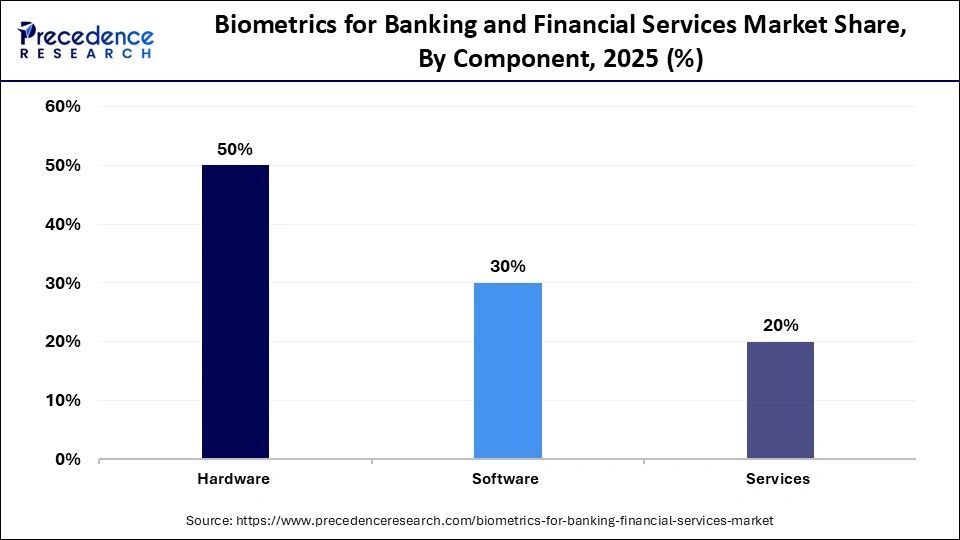
The software segment is expected to grow at the fastest CAGR of 13.5% during the forecast period, as financial institutions increasingly rely on software solutions to process biometric data, perform identity analytics, and detect fraud, as well as provide centralized authentication. These institutes are investing heavily in AI-driven software to improve the accuracy of recognition, provide adaptive authentication, and monitor user behavior in real time. Remote onboarding, mobile authentication, and cross-channel identity verification are also provided through software platforms. The increasing need to extend the digital banking service is likely to contribute to segmental growth.
Deployment Model Insights
Why Did the On-Premises Segment Lead the Market?
The on-premises segment led the biometrics for banking and financial services market with a share of 60% in 2025 because of the increased concerns over data security, privacy, and regulatory compliance. Financial institutions often favor on-premises deployments to ensure that biometric data and authentication infrastructure are directly controlled and accessed. This deployment model allows banking institutions to control encryption protocols, access controls, and internal security policies without depending on the external networks. Government-regulated financial organizations and large banks prefer on-premises solutions due to the strict laws of data sovereignty and the need to reduce the risks of cyberattack.
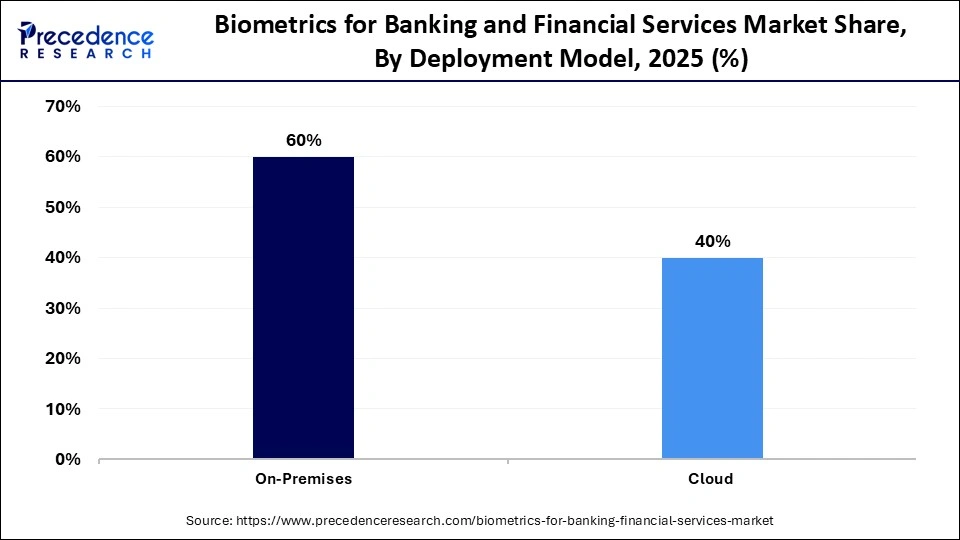
The cloud segment is expected to grow at the fastest CAGR of 13.7% over the forecast period, owing to the growing need for scalability, flexibility, and the ability to remotely access biometric solutions. Cloud-based solutions enable banks and fintech companies to install authentication systems quickly without the involvement of a set of hardware resources. This deployment facilitates real-time updates, centralized identity management, and smooth integration between mobile banking, digital payment, and online financial solutions. Also, cloud security technology and encryption standards are evolving to enhance confidence in managing biometric data in the clouds.
Application Insights
How Does the Authentication & Verification Segment Hold the Largest Share of the Market?
The authentication & verification segment held the largest share of 45% in 2025 because of the increased need for secure identity validation across digital and physical banking platforms. Financial institutions increasingly adopted biometric authentication for secure mobile banking, online payments, ATM access, and transaction approvals. The rising cases of cyber fraud, phishing, and identity theft boosted demand for real-time, effective authentication systems, while regulatory requirements for KYC compliance further encouraged the strengthening of identity verification frameworks.
The customer onboarding segment is expected to expand at a CAGR of 13.9% in the coming years, owing to the rising demand for remote and digital banking services. Financial institutions are adopting biometric solutions like facial recognition, document verification, and AI-based identity matching to securely onboard customers without requiring branch visits. This approach allows accounts to be opened quickly, even for geographically distant clients, while ensuring regulatory compliance. Additionally, biometric onboarding reduces paperwork, operational costs, and processing time, enhancing the overall customer experience and driving wider adoption.
End-User Insights
Why Did the Retail Banking Segment Lead the Biometrics for Banking and Financial Services Market?
The retail banking segment held a major revenue share of 45% in the market in 2025, driven by the large customer base and high transaction volumes that require secure authentication solutions. Biometric technologies have been widely implemented in mobile banking apps, ATMs, payment authentication, and in-branch customer identification to enhance security and convenience. These solutions help retail banks reduce fraud-related losses, improve operational efficiency, and comply with regulatory requirements for identity verification, further boosting adoption.
The fintech/neobanks segment is expected to expand at the fastest CAGR of 14.2% over the forecast period. This is because fintech companies and neobanks do not rely on conventional banks but use mobile and online channels as their primary means of communication with their customers, which is why biometric authentication is critical to ensuring the safety of communication. Biometric authentication is essential for these institutions to secure digital onboarding, enable real-time authentication, and facilitate instant payments, providing a seamless user experience. The rising consumer preference for app-based banking, contactless payments, and real-time financial services is further accelerating the integration of biometrics in fintech ecosystems.
Regional Insights
North America Biometrics for Banking and Financial Services Market Size and Growth 2026 to 2035
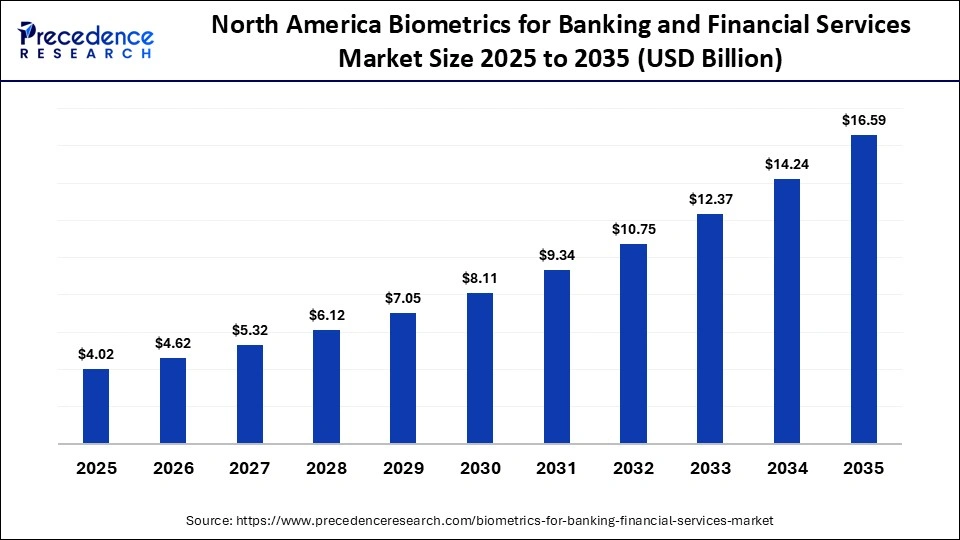
The North America biometrics for banking and financial services market size was estimated at USD 4.02 billion in 2025 and is projected to reach approximately USD 16.59 billion by 2035, with a 15.23% CAGR from 2026 to 2035.
What Made North America the Leading Region in the Biometrics for Banking and Financial Services Market?
North America led the global biometrics for banking and financial services market with a major share of 40% in 2025, owing to the early use of modern authentication tools and substantial investments in cybersecurity. Banking institutions in the region are keen on adopting biometric systems to combat increasing cybercrime and secure online transactions. Regulatory mandates requiring robust digital identity solutions further drive biometric adoption. Moreover, high usage of mobile banking and contactless payment systems by consumers stimulated the need to use secure authentication systems. Financial institutions in the region are focusing on improving customer experience by providing frictionless yet highly secure access to financial services, which ensures the long-term growth of the market in the region.
U.S. Biometrics for Banking and Financial Services Market Size and Growth 2026 to 2035
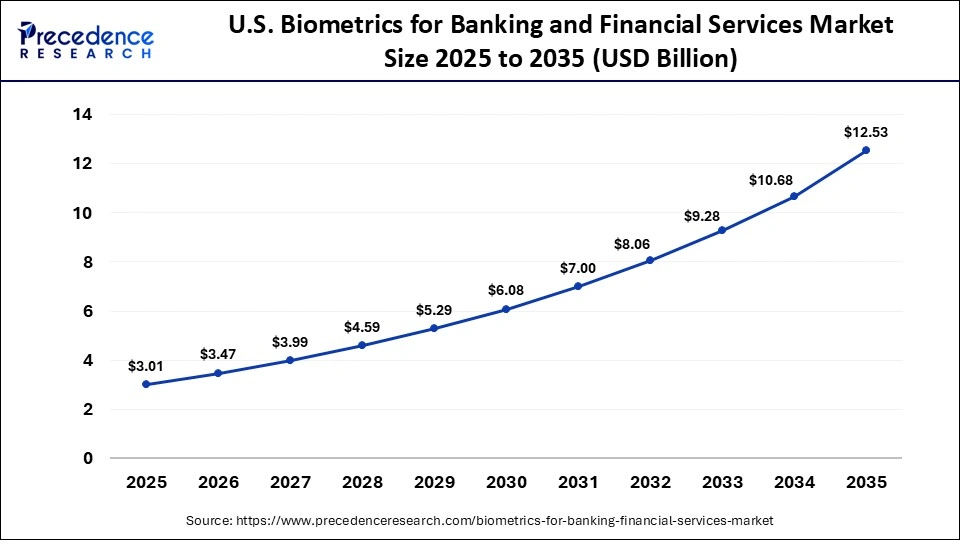
The U.S. biometrics for banking and financial services market size was calculated at USD 3.01 billion in 2025 and is expected to reach nearly USD 12.53 billion in 2035, accelerating at a strong CAGR of 15.33% between 2026 and 2035.
U.S. Market Analysis
The U.S. is the major contributor to the North American biometrics for banking and financial services market. This is due to its well-established banking sector, widespread adoption of mobile and digital banking, stringent regulatory requirements for identity verification and fraud prevention, and high consumer demand for secure, convenient, and contactless financial services. Additionally, the presence of leading fintech companies and advanced technological infrastructure accelerates the integration of biometric solutions across banking channels.
Why is Asia Pacific Experiencing the Fastest Growth in the Market?
Asia Pacific is expected to grow at the fastest CAGR of 15.5% in the biometrics for banking and financial services market during the forecast period. This is mainly due to the rapid expansion of digital banking and rising financial inclusion initiatives. High adoption of mobile payments, online banking, and digital wallets is creating a strong need for biometric authentication systems. Widespread smartphone usage and affordable internet connectivity enable the broad deployment of biometric-enabled mobile banking apps, while banks and fintech companies are investing in AI-powered authentication to prevent fraud and enhance customer convenience.
India Market Trends
India is transforming financial inclusion by utilizing its Aadhaar biometric system, positioning itself as a global leader in the integration of secure, low-cost digital identities. Through AI-enabled Aadhaar payments and the Unified Payments Interface (UPI), India has established a seamless digital ecosystem for instant Know Your Customer (KYC) verification, cardless ATM withdrawals, and secure authentication.
How will Europe Emerge in the Biometrics for Banking and Financial Services Market?
Europe is emerging as a significant player in the global market, driven by stringent security regulations, high adoption rates of digital banking, and a strong focus on fraud prevention. The emphasis on data privacy and security prompted banks to implement advanced, privacy-centric biometric solutions, thereby fostering a secure environment for adoption. Increasing concerns about fraud are leading to the adoption of advanced authentication technologies, enhancing user experiences.
Germany Market Trends
Germany is at the forefront of secure digital banking by integrating strict GDPR compliance with advanced biometric authentication, such as fingerprint and facial recognition. This approach has spurred rapid growth in fintech platforms like N26 and enhanced mainstream finance. German banks are fulfilling the requirements of the PSD2 to ensure secure, seamless, and user-friendly transactions.
How will Latin America grow in the Biometrics for Banking and Financial Services Market?
Latin America is a significantly growing region in the global market, driven by rapid growth in mobile banking, high digital fraud rates necessitating better security measures, and government-led financial inclusion initiatives. With increasing smartphone penetration and a surge in digital-first financial providers, digital wallets and instant payments are becoming standard in the region. The rise in cybercrime has led to security measures, promoting the adoption of multi-factor authentication and secure digital infrastructure.
Brazil Market Trends
Brazil is redefining financial trust by incorporating robust biometric authentication into its innovative Pix payment system, providing users with secure, instant transfers around the clock. By requiring national biometric IDs for smooth digital onboarding, Brazil is actively reducing financial fraud and establishing a new global standard for inclusive, secure, and instantaneous digital economies.
How Will the Middle East and Africa Grow in the Biometrics for Banking and Financial Services Market?
The Middle East and Africa are significantly growing regions in the global market, spurred by the increasing adoption of smartphones, high demand for financial inclusion among unbanked populations, and government-led digital transformation initiatives. This is due to demand for secure, contactless, and convenient authentication to combat rising digital fraud in mobile-first economies. Regional governments are investing in national biometric systems to enhance security and fight fraud, to adopt these technologies.
UAE Market Trends
The UAE is at the forefront of financial innovation, rapidly implementing advanced biometrics such as facial recognition and UAE Pass integration to create a secure, password-free banking experience. By mandating app-based authentication and partnering with local leaders, the UAE is setting a new global standard for secure, card-free banking in high-value transaction approvals.
Biometrics for Banking and Financial Services Market Companies
- IDEMIA
- Thales Group (Gemalto)
- NEC Corporation
- Fujitsu Limited
- Precise Biometrics AB
- Nuance Communications, Inc.
- Crossmatch Technologies, Inc.
- HID Global Corporation
- Suprema, Inc.
- 3M
- AllTrust Networks
- Digital Persona, Inc.
- Ingenico SA
- VoiceVault, Inc.
- BioID AG
Recent Developments
- In February 2026, Cashfree Payments launched Cashfree Here, a payments extension enabling UPI and passkey-based biometric card payments directly within AI chat apps like ChatGPT and Claude. Unveiled at the India AI Impact Summit 2026 in collaboration with Mastercard and Swiggy, it allows businesses to seamlessly accept payments within conversational interfaces.
(Source: https://bfsi.economictimes.indiatimes.com) - In October 2025, IDEX Biometrics released the first RuPay biometric payment card in India with Hitachi Payment Services and the Airtel Payments Bank. This was presented at the Global Fintech Fest in Mumbai as the launch of a notable development of secure and inclusive digital payment solutions throughout the country.(Source: https://live.euronext.com)
- In September 2024, PayU launched Flash Pay, a biometric authentication solution, to make the experience of card payments easier and also enhance transaction security. The solution has been announced at the Global FinTech Festival 2024 and is a combination of smooth payment systems and higher authenticity levels among banks and customers.(Source: https://ibsintelligence.com)
Segments Covered in the Report
By Technology
- Fingerprint Recognition
- Facial Recognition
- Voice Recognition
- Iris Recognition
- Vein/Biometric Others
By Component
- Hardware
- Software
- Services
By Deployment Model
- On-Premises
- Cloud
By Application
- Authentication & Verification
- Fraud Prevention & Risk Management
- Customer Onboarding
- Other Banking Services
By End-User
- Retail Banking
- Commercial Banking
- Investment Banking
- FinTech/Neobanks
By Region
- North America
- Europe
- Asia-Pacific
- Latin America
- Middle East & Africa
For inquiries regarding discounts, bulk purchases, or customization requests, please contact us at sales@precedenceresearch.com
Frequently Asked Questions





Ask For Sample
No cookie-cutter, only authentic analysis – take the 1st step to become a Precedence Research client
 Get a Sample




 sales@precedenceresearch.com
 Schedule a Meeting
