



Blind Spot Detection Adaptive Cruise Control System Market Size, Companies, Share, Vehicle Production Volume, Sales Performance, Export & Import Analysis, Technology Adoption, Competitive Positioning, and Demand Trends
Blind Spot Detection Adaptive Cruise Control System Market (By Application: SUV, Roadster, Minivan, Others; By Types: Ultrasonic Sensor, Camera, Radar Sensor) - Global Industry Analysis, Size, Trends, Leading Companies, Regional Outlook, and Forecast 2026 to 2035
Source: https://www.precedenceresearch.com/blind-spot-detection-adaptive-cruise-control-system-market
 Get a Sample
 Table Of Content


What is the Blind Spot Detection Adaptive Cruise Control System Market Size in 2026?
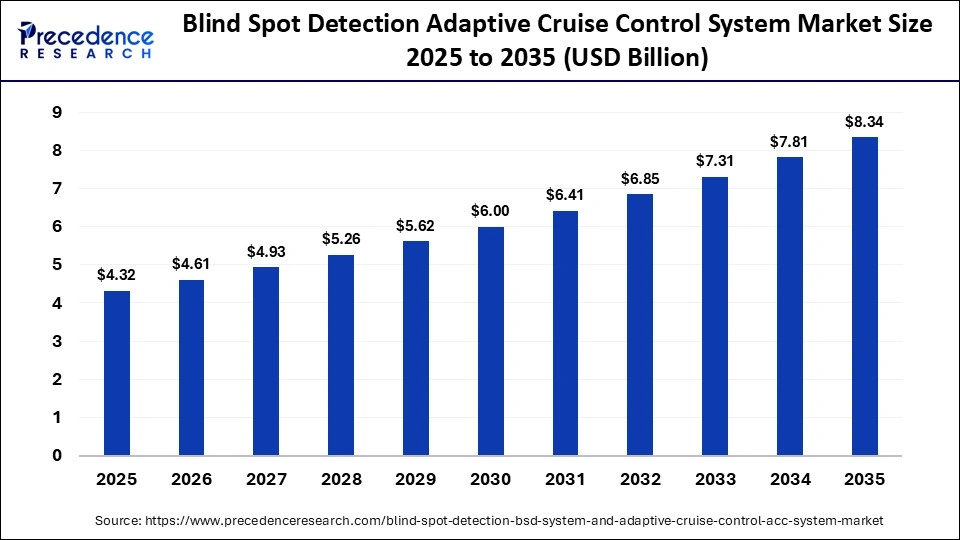
The global blind spot detection adaptive cruise control system market size was calculated at USD 4.32 billion in 2025 and is predicted to increase from USD 4.61 billion in 2026 to approximately USD 8.34 billion by 2035, expanding at a CAGR of 6.80% from 2026 to 2035.The market is growing at a very good rate, as the safety of vehicles and automation are the key focus of the automotive industry. The major growth factors include the growing road safety issues, greater mobility of advanced driver assistance systems (ADAS), the need for comfort features, and stringent international safety standards.
Key Takeaways
- North America dominated the global blind spot detection adaptive cruise control system market in 2025.
- Asia-Pacific is expected to grow at the fastest CAGR in the market during the forecast period.
- By application, the SUV segment held a dominant position in the market in 2025.
- By application, the roadster segment is expected to grow at the fastest CAGR in the market between 2026 and 2035.
- By types, the radar sensor segment dominated the global market in 2025.
- By types, the camera segment is expected to expand rapidly in the market in the coming years.
Blind Spot Detection: Smarter Mobility and Safer Driving
The blind spot detection adaptive cruise control system market is experiencing a rapid momentum due to the growing demand for ADAS technologies, which are now being adopted by all vehicle classes. To improve the safety of driving and minimize the risk of collisions, automakers are implementing radar, cameras, and ultrasonic sensors. Previously focused on premium cars, blind spot detection (BSD) and adaptive cruise control (ACC) functions are now finding their way into middle-range and entry cars. The fast process of electrification and transformation to semi-autonomous driving is also driving market growth globally.
How AI is Influencing the Blind Spot Detection Adaptive Cruise Control System?
Artificial intelligence (AI) is transforming the performance of blind spot detection and adaptive cruise control systems very significantly. AI-based algorithms enhance the accuracy of object recognition, lane following, and predictive braking. They function as an intelligent co-pilot that dramatically enhances a driver's situational awareness and actively works to prevent collisions before they occur. Software defined vehicle architectures are enabling the use of over-the-air updates to improve the system intelligence and reliability. AI and ML can enable context-aware smart filtering and significantly reduce false positives.
Blind Spot Detection Adaptive Cruise Control System Market Trends
- Rapid Adoption of ADAS: The growing adoption of ADAS systems in passenger and commercial vehicles is fuelling the demand for BSD and ACC systems. Consumers are no longer willing to be satisfied with basic safety features, but additional safety features are now the norm.
- Sensor Fusion: Automakers are integrating radar, LiDAR, cameras, and ultrasonic sensors to improve the quality of detection. Sensor fusion enhances BSD accuracy and the responsiveness of adaptive cruise control in various driving conditions.
- Advancements in AI and Software: System reliability is enhancing with the help of AI-powered perception and predictive analytics. Scalable software modifications and connection to the cloud are changing the conventional hardware-based systems into smart systems.
- Mass Market Penetration: The radar sensor and electronic control unit costs are allowing them to be deployed to small cars. Safety awareness is increasing, making emerging markets adopt more rapidly.
- Stringent Regulations: The requirement to standardize ADAS features is being imposed on OEMs by government requirements in key parts of the automotive sector. Manufacturers are also being influenced by safety assessment programs to include BSD and ACC technologies that will enable them to get high vehicle ratings.
Market Scope
| Report Coverage | Details |
| Market Size in 2025 | USD 4.32 Billion |
| Market Size in 2026 | USD 4.61 Billion |
| Market Size by 2035 | USD 8.34 Billion |
| Market Growth Rate from 2026 to 2035 | CAGR of 6.80% |
| Dominating Region | North America |
| Fastest Growing Region | Asia Pacific |
| Base Year | 2025 |
| Forecast Period | 2026 to 2035 |
| Segments Covered | Application, Types, and region |
| Regions Covered | North America, Europe, Asia-Pacific, Latin America, and Middle East & Africa |
Segmental Insights
Application Insights
Why Did the SUV Segment Dominate the Market?
The SUV segment dominated the blind spot detection adaptive cruise control system market in 2025 because of its overwhelming popularity across the world and increased safety expectations. The safety and comfort features that come with buying an SUV are usually more advanced, and therefore, the inclusion of BSD and ACC can be considered as a competitive advantage to the OEM.
The increased sensor location and detection capabilities are also advantages of the bigger vehicle size. SUVs record the highest sales as compared to other vehicle types, and this has offered economies of scale in terms of the adoption of safety systems. BSD and ACC are common standard or high-value features offered by manufacturers in mid- to high-end SUV models.
The roadster segment is expected to show the fastest growth over the forecast period, driven by the fact that luxury and performance companies have offered more advanced ADAS. Conventionally built around driving dynamics, roadster manufacturers currently incorporate BSD and ACC and do not need to sacrifice performance to attract safety-minded consumers. Sports vehicles are being customized with lightweight sensor arrays and adaptive systems based on the specifications of their driving behavior.
High performance and superior situation awareness on highways are enjoyed by enthusiasts. The increase in regulatory requirements, which affect all categories of passenger vehicles, also drives the growth of this segment. Developments are advancing faster, with feature refinement and adoption driven by close working relationships between roadster OEMs and technology suppliers.
Types Insights
Which Types Segment Led the Blind Spot Detection Adaptive Cruise Control System Market?
The radar sensor segment led the market in 2025 because of its full functionality in every weather and light environment. Radar sensors are able to offer dependable identification of moving and stationary objects, which would be essential to the ACC functionality. Car motive radar has evolved to become cost-efficient, high-resolution solutions capable of aiding both in long and short-range sensing. It can also penetrate rain, fog, and dust, which is why it is better compared with most optical systems as far as core safety is concerned. Radar also combines well with the electronic stability and collision avoidance systems. Radar is therefore still the most popular type of sensing used in blind spot and cruise control.
The camera segment is expected to expand rapidly in the market in the coming years, due to its ability to process images and recognize objects with the help of AI. Optical and infrared cameras provide a finer level of visual context that supplements radar information, and therefore, allows a more accurate identification of lane markings, pedestrians, and small objects. The development of GPU-based vision algorithms is accelerating, making it possible to have low-cost and powerful camera-based systems. Cameras integrated with sensor fusion systems improve the intelligence of the system at large. Further growth is enabled by the ability to apply to more use cases, including lane keeping and traffic sign recognition. In-car cameras are becoming more popular in mid- to entry-level cars, driving the segment's growth.
Regional Insights
Why North America Dominated the Market?
North America held the largest revenue share of the blind spot detection adaptive cruise control system market in 2025, driven by consumer demand for safety technologies. The growing awareness of collision-prevention systems and the widespread adoption in passenger vehicles and commercial vehicles contribute to regional growth. Key OEMs and suppliers in the region have maintained a heavy investment in R&D to improve performance and lower system costs.
Strict federal and state vehicle safety regulations are also an extra motivation to include BSD and ACC features. Consumers are also encouraged through insurance incentives and safety ratings. The fierce automotive innovation environment in North America has continued to support its leadership.
Country-Level Analysis
At the national level, the U.S. is a global leader in the adoption of ADAS and well-developed regulatory frameworks that facilitate the use of vehicle safety technologies. Canada is next in increasing production of automotive and consumer adoption of advanced in-car technology. American OEMs and technology providers are driving sensor development and AI-based perception systems. Exchange of technology between the U.S. and Canada is facilitated by the cross-border trade agreements. There is a rising demand among consumers in both countries for cars with adaptive safety systems.
Why is Asia Pacific the Fastest-Growing Region in the Market?
Asia-Pacific is expected to experience the fastest growth in the blind spot detection adaptive cruise control system market during the predicted timeframe. The automotive industry in China, India, and Southeast Asia is growing at a rapid pace, creating the necessity to develop high safety features. Growing consumer demand and increasing affordability are penetrating the ADAS past the high-end markets.
The governments of the area are also slowly introducing more rigid vehicle safety standards, which persuades OEMs to utilize BSD and ACC. Good relationships between local OEMs and international technology suppliers are improving market adoption. The complexity of urbanization and traffic in the region further highlights the necessity to promote driver-assist technologies.
Country-Level Analysis
China is the leading region with tremendous volumes of vehicle production and active use of smart mobility technologies. India can be quickly seen to be with growing safety consciousness and regulations, pushing the integration of BSD and ACC systems. Japan has also maintained superior automotive safety by means of innovation and strict standards for vehicles. Other countries are developing an ADAS ecosystem, including South Korea and Thailand. Growth by regional supply chains and sensor manufacturing investment enhances growth.
Blind Spot Detection Adaptive Cruise Control System Market Supply Chain Analysis
- Raw Material Sourcing
The automotive industry relies heavily on the sourcing of raw materials to ensure the production of high-quality vehicles. Key materials include steel, plastics, and electronics.
Key Players: ArcelorMittal, BASF, and Samsung SDI vehicles.
- Component Manufacturing
Component manufacturing is essential for creating intricate parts that make up a vehicle. This includes engines, transmissions, suspension systems, and more.
Key Players: Bosch, ZF Friedrichshafen AG, and Denso
- Vehicle Assembly and Integration
Once components are manufactured, they must be assembled and integrated into a complete vehicle.
Key Players: Toyota, Ford, and Volkswagen Group
- Testing and Quality Control
Testing and quality control ensure vehicles meet safety and performance standards before they reach consumers.
Key Players: SAE International, TUV SUD, and Consumer Reports
- Distribution to Dealers and OEMs
Once vehicles are manufactured, they are distributed to dealerships and original equipment manufacturers (OEMs) for retail sale.
Key Players: DHL Supply Chain, Kuehne + Nagel, and Nippon Express
- Retail Sales and Financing
The final step involves selling vehicles to consumers, which often includes financing options.
Key Players: AutoNation, CarMax, and Toyota Financial Services.
Blind Spot Detection Adaptive Cruise Control System Market Companies
- Aptiv PLC
- NXP Semiconductors N.V.
- Mobileye Global Inc.
- Magna International Inc.
- Hella KGaA Hueck & Co.
- Robert Bosch GmbH
- Continental AG
- DENSO Corporation
- ZF Friedrichshafen AG
- Valeo SA
- Continental AG
- DENSO CORPORATION
- General Motors
- GNS AUTOMOTIVE CO.LTD
- HELLA GmbH & Co. KGaA
- Hyundai
- KYOCERA Corporation
- Lear Corp.
- Magna International Inc
- Mobiley
- Phinia Inc
- Robert Bosch GmbH
- Tenneco Inc
- Valeo
- ZF Friedrichshafen AG.
Recent Developments
- In January 2026, Mercedes-Benz introduced its new MB Drive Assist Pro at CES 2026, showcasing advanced driver assistance technologies. This system enhances safety and comfort by integrating adaptive cruise control, lane-keeping assistance, and improved sensor capabilities, aiming to revolutionize the driving experience with enhanced automation and smarter vehicle navigation.(source: https://media.mbusa.com)
- In July 2025, ESCORT declared a significant firmware upgrade on its Redline 360c radar detector, which considerably improved the performance with a reduced response time of an average of 50%, making it the quickest radar detector in the market. The new version enhances radar filtering, directional warnings, a dependable POP system, and connectivity abilities, enhancing the precision of detection and assurance for the driver on the road.(source: https://www.prnewswire.com)
- In June 2025, Mahindra confirmed the launch of the Scorpio N with ADAS. The new model aims to enhance safety and driving experience, aligning with the growing trend of integrating advanced technologies into vehicles, catering to consumer demands for better safety features.(source: https://www.carlelo.com)
Segments Covered in the Report
By Application
- SUV
- Roadster
- Minivan
- Others
By Types
- Ultrasonic Sensor
- Camera
- Radar Sensor
By Region
- North America
- Asia Pacific
- Europe
- Latin America
- Middle East & Africa
For inquiries regarding discounts, bulk purchases, or customization requests, please contact us at sales@precedenceresearch.com
Frequently Asked Questions





Ask For Sample
No cookie-cutter, only authentic analysis – take the 1st step to become a Precedence Research client
 Get a Sample




 sales@precedenceresearch.com
 Schedule a Meeting
