



Cockpit Electronics for Automotive Market Size, Companies, Share, Vehicle Production Volume, Sales Performance, Export & Import Analysis, Technology Adoption, Competitive Positioning, and Demand Trends
Cockpit Electronics for Automotive Market (By Product: Head-up Display, Information Display, Infotainment and Navigation, Instrument Cluster, Telematics, Others; By Type: Advanced Cockpit Electronics, Basic Cockpit Electronics; By End Market: Economic Passenger Car, Luxury Passenger Car, Mid-Priced Passenger Car; By Fuel Type: Battery Electric Vehicle (BEV), Internal Combustion Engine (ICE), Others (Hybrid Vehicles); By Sales Channel: OEM, Aftermarket) - Global Industry Analysis, Size, Trends, Leading Companies, Regional Outlook, and Forecast 2026 to 2035
Source: https://www.precedenceresearch.com/cockpit-electronics-for-automotive-market
 Get a Sample
 Table Of Content


What is the Cockpit Electronics for Automotive Market Size in 2026?
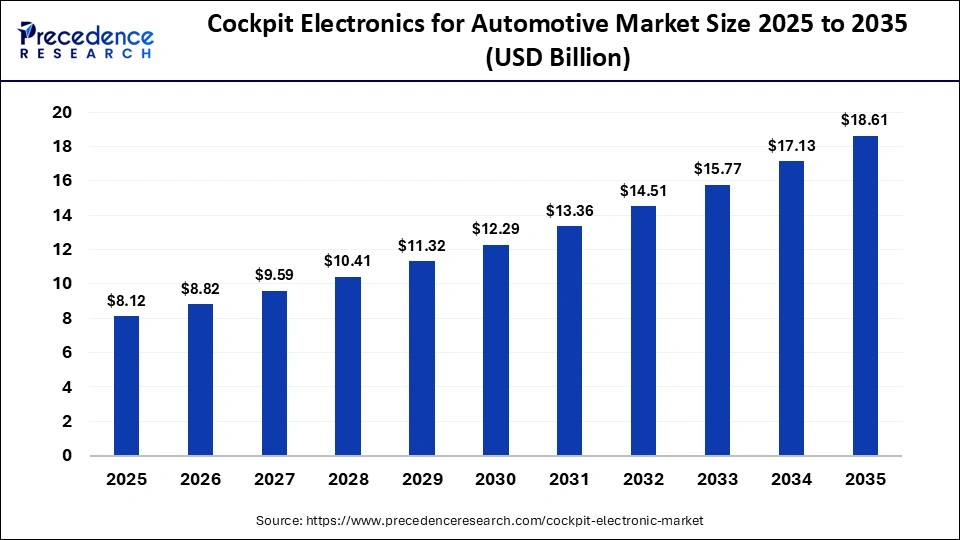
The global cockpit electronics for automotive market size accounted for USD 8.12 billion in 2025 and is predicted to increase from USD 8.82 billion in 2026 to approximately USD 18.61 billion by 2035, expanding at a CAGR of 8.65% from 2026 to 2035. The market is driven by rising demand for connected, autonomous, and software-defined vehicles. Increasing integration of digital instrument clusters, infotainment systems, head-up displays, and advanced driver interfaces enhances safety and user experience. Growing electrification, regulatory focus on safety, and rapid advancements in display, semiconductor, and connectivity technologies further support market expansion.
Key Takeaways
- Asia-Pacific led the cockpit electronics for automotive market share in 2025.
- North America is estimated to expand at the highest CAGR in the market between 2026 and 2035.
- By product, the infotainment and navigation segment held a dominant revenue share of the market in 2025.
- By product, the head-up display segment is expected to grow at the highest CAGR between 2026 and 2035.
- By type, the advanced cockpit electronics segment led the market in 2025.
- By type, the advanced telematics sub-segment is expected to expand at the fastest CAGR from 2026 to 2035.
- By end market, the economic passenger car segment held a dominant market share in 2025.
- By end market, the luxury passenger car segment is expected to grow at a solid CAGR between 2026 and 2035.
- By fuel type, the battery electric vehicle (BEV) segment held a dominant cockpit electronics for automotive market share in 2025.
- By fuel type, the internal combustion engine (ICE) segment is expected to grow at the highest CAGR between 2026 and 2035.
- By sales channel, the OEM segment held a dominant market share in 2025.
- By sales channel, the aftermarket segment is expected to grow at the highest CAGR during the forecast period.
How are Digital Cockpits Reshaping the Automotive Experience?
Digital cockpits refer to integrated, software driven in-vehicle platforms that combine digital instrument clusters, infotainment systems, head-up displays, connectivity modules, and advanced human-machine interfaces into a unified interface. Cockpit electronics for automotive encompass the hardware and software enabling these functions. By delivering real-time data, seamless connectivity, personalization, and enhanced safety features, digital cockpits are transforming vehicles into intelligent, immersive, and user-centric mobility environments.
How Can AI Integration Transform the Cockpit Electronics for Automotive Market?
Artificial intelligence integration is transforming cockpit electronics into intelligent, context-aware systems that personalize the driving experience and enhance safety. In 2026, AI-powered cockpits use natural-language assistants, driver monitoring, and multi-modal interaction to understand voice, gestures, and behavior. These systems anticipate needs, adjust cabin settings, enable over-the-air updates, and support productivity features, turning vehicles into connected, self-learning, and software-defined mobility environments. AI-based natural language processing enhances the accuracy of voice-based assistants and helps manage vehicles in real time.
Primary Trends Influencing the Cockpit Electronics for Automotive Market
- Shift Toward Fully Digital and Integrated Cockpits: Automakers are increasingly replacing analog components with fully digital instrument clusters, large infotainment displays, and integrated head-up displays. These systems combine multiple functions into a single platform, improving aesthetics, functionality, and space efficiency. Integrated cockpits also reduce wiring complexity and weight, while enabling centralized computing architectures that support advanced features, seamless updates, and improved overall vehicle performance.
- Rising Demand for Connected and Software-Defined Vehicles: Modern vehicles are evolving into software-defined platforms with continuous connectivity. Cockpit electronics now support over-the-air updates, cloud services, smartphone integration, and real-time navigation. This trend allows automakers to introduce new features after purchase, improve system performance, and enhance cybersecurity. As consumers expect smartphone-like experiences inside vehicles, connectivity-driven cockpit systems are becoming a key competitive differentiator.
- Growing Integration of Advanced Driver Assistance Systems (ADAS): Cockpit electronics are increasingly linked with ADAS technologies to provide real-time alerts, driver monitoring, and safety-related information. Digital instrument clusters and head-up displays present critical warnings and navigation cues directly in the driver's line of sight. This integration enhances situational awareness, reduces driver distraction, and supports regulatory requirements, making safety-focused cockpit solutions a major trend for the cockpit electronics for automotive market.
- Expansion of Large Displays and Advanced HMI Technologies: Automakers are adopting larger, high-resolution touchscreens, curved displays, and multi-screen layouts to enhance user interaction. Advanced human-machine interface (HMI) technologies such as voice recognition, gesture control, and haptic feedback are also gaining traction. These innovations improve usability, reduce physical buttons, and create more intuitive, premium, and customizable in-vehicle experiences for drivers and passengers.
- Rapid Electrification and Autonomous Vehicle Development: The growth of electric and autonomous vehicles is accelerating demand for advanced cockpit electronics. Electric vehicles (EVs) require new interfaces to display battery status, range, and energy management data, while autonomous vehicles shift the focus toward infotainment and passenger comfort. As vehicles become more automated, cockpit systems are evolving into digital living spaces that emphasize connectivity, entertainment, and productivity.
Market Socpe
| Report Coverage | Details |
| Market Size in 2025 | USD 8.12 Billion |
| Market Size in 2026 | USD 8.82 Billion |
| Market Size by 2035 | USD 18.61 Billion |
| Market Growth Rate from 2026 to 2035 | CAGR of 8.65% |
| Dominating Region | Asia Pacific |
| Fastest Growing Region | North America |
| Base Year | 2025 |
| Forecast Period | 2026 to 2035 |
| Segments Covered | Product, Type, End Market, End Market, Sales Channel, and Region |
| Regions Covered | North America, Europe, Asia-Pacific, Latin America, and Middle East & Africa |
Segmental Insights
Product Insights
Why Was the Infotainment and Navigation Segment Dominant?
The infotainment and navigation segment dominated the cockpit electronics for automotive market in 2025, due to rising consumer demand for connected, smartphone-like in-vehicle experiences. Integration of real-time navigation, multimedia streaming, voice assistants, and app connectivity enhances convenience and personalization. Automakers prioritize advanced infotainment systems as key differentiators, driving higher installation rates across passenger vehicles, including mid-range and premium models globally.
The head-up display segment is expected to grow at the fastest CAGR in the market between 2026 and 2035, due to rising emphasis on driver safety, reduced distraction, and enhanced real-time information visibility. Increasing integration with ADAS features, navigation prompts, and augmented reality overlays is accelerating adoption. Growing demand in mid-range vehicles and technological advancements in projection systems further support rapid segment expansion.
Type Insights
Which Type Segment Dominated the Cockpit Electronics for Automotive Market?
The advanced cockpit electronics segment held the largest revenue share of the market in 2025, due to increasing demand for integrated digital clusters, large infotainment displays, connectivity features, and intelligent HMIs. Automakers are adopting centralized computing platforms to support software-defined vehicles, personalization, and safety features, making advanced cockpit systems a standard offering across premium and mid-range vehicle segments.
The advanced telematics sub-segment is expected to expand rapidly in the coming years, driven by increasing demand for real-time vehicle diagnostics, over-the-air updates, remote monitoring, fleet management, and connected services, as automakers focus on software-defined, data-driven, and connected mobility solutions.
End Market Insights
Why Did the Economic Passenger Care Segment Dominate the Market?
The economic passenger car segment contributed the biggest revenue share of the cockpit electronics for automotive market in 2025, due to its high global production volumes and growing consumer expectations for affordable digital features. Automakers are increasingly equipping entry-level models with touchscreen infotainment, smartphone connectivity, and basic digital clusters to remain competitive, driving large-scale adoption of cost-efficient cockpit electronics across mass-market vehicles.
The luxury passenger car segment is expected to grow with the highest CAGR in the market during the studied years, due to strong demand for premium digital experiences, large curved displays, augmented reality head-up displays, advanced driver assistance integration, and AI-powered personalization. Luxury automakers rapidly adopt next-generation HMIs and software-defined architectures, accelerating innovation and higher-value cockpit electronics integration.
Fuel Type Insights
How the Battery Electric Vehicle (BEV) Segment Dominated the Market?
The battery electric vehicle (BEV) segment registered its dominance over the global cockpit electronics for automotive market in 2025, due to its strong reliance on digital interfaces for energy management, range monitoring, charging status, and connected services. EV manufacturers emphasize large touchscreens, software-defined features, and advanced user interfaces, accelerating the adoption of sophisticated cockpit electronics across both premium and mass-market EV models.
The internal combustion engine (ICE) segment is expected to witness the fastest growth in the market over the forecast period, due to its continued dominance in global vehicle production, especially across emerging economies. Automakers are upgrading ICE models with digital clusters, infotainment systems, and connectivity features to meet evolving consumer expectations, driving rapid adoption of modern cockpit electronics in existing vehicle platforms.
Sale channel Insights
Which Sales Channel Segment Led the Cockpit Electronics for Automotive Market?
The OEM segment led the market in 2025 because automakers increasingly integrated digital clusters, infotainment, head-up displays, and ADAS interfaces during vehicle production. Factory-installed systems ensure seamless hardware–software integration, cybersecurity compliance, functional safety certification, and consistent user experience. Long-term supply contracts with tier-1 suppliers, rising demand for connected and software-defined vehicles, and growing adoption of premium in-car features across mid-range models further strengthen OEM-led sales.
The aftermarket segment is expected to gain the highest market share between 2026 and 2035, due to rising demand for infotainment upgrades, digital clusters, advanced audio systems, and connectivity features in existing vehicles. Increasing vehicle lifespan, growing consumer preference for personalized in-car experiences, and the availability of cost-effective, plug-and-play solutions from third-party suppliers are driving strong adoption across both passenger and commercial vehicles.
Regional Insights
Why Asia-Pacific Dominated the Cockpit Electronics for Automotive Market?
Asia-Pacific held a major revenue share of the market in 2025, due to high vehicle production in countries such as China, Japan, South Korea, and India. Strong demand for affordable connected vehicles, rapid EV adoption, expanding middle-class populations, and the presence of major automotive and electronics manufacturers accelerate integration of digital clusters, infotainment, and advanced cockpit technologies across both mass-market and premium vehicle segments.
China Market Trends
China's cockpit electronics business is expanding rapidly due to aggressive EV commercialization, fast model refresh cycles, and intense competition among domestic OEMs. Automakers differentiate through oversized displays, AI-enabled voice systems, in-car ecosystems, and subscription-based digital services. Strong local semiconductor and display supply chains reduce costs and accelerate innovation. Strategic partnerships between automakers and technology firms further drive scalable, software-centric cockpit platforms across vehicle segments.
How is North America Growing in the Cockpit Electronics for Automotive Market?
North America is expected to witness the fastest growth during the predicted timeframe, due to strong demand for connected vehicles, high adoption of ADAS, and rapid integration of software-defined architectures. Consumers prioritize large displays, premium infotainment, and AI-enabled interfaces, encouraging automakers to accelerate the deployment of the digital cockpit. The continuous innovation, technology partnerships, and strong aftermarket digital service opportunities further support regional growth.
U.S. Market Trends
In the U.S., cockpit electronics trends are shaped by strong demand for large-format displays, AI-enabled voice assistants, and seamless smartphone integration. Automakers emphasize software-defined architectures, over-the-air updates, and subscription-based digital services to enhance recurring revenue. The growing adoption of EVs and ADAS further accelerates the integration of high-performance processors, immersive infotainment platforms, and connected cockpit ecosystems.
How Big is the Opportunity for Growth of Europe in the Global Market?
Europe is expected to grow at a notable CAGR in the cockpit electronics for automotive market in the foreseeable future, due to rising demand for premium vehicles, strict safety regulations, and rapid electrification initiatives. Automakers are investing in digital clusters, head-up displays, and advanced infotainment to meet consumer expectations and regulatory requirements. A strong presence of luxury OEMs and technology suppliers further accelerates the adoption of next-generation cockpit platforms across the region.
Cockpit Electronics for Automotive Market Value Chain Analysis
- Raw Material Sourcing
Raw material sourcing involves the procurement of semiconductor wafers, rare earth elements, copper, aluminum, specialty plastics, glass substrates, and display-grade chemicals. Suppliers ensure materials are pure, conductive, heat-resistant, and durable to meet automotive-grade standards and long vehicle lifecycles.
Key Players: Shin-Etsu Chemical Co., Ltd., Sumitomo Chemical Co., Ltd., Corning Incorporated, Dow Inc., and 3M Company.
- Component Fabrication and Machining
This stage includes semiconductor fabrication, PCB manufacturing, display panel production, sensor integration, and electronic module assembly. Precision engineering, surface-mount technology, cleanroom chip fabrication, and automated assembly lines ensure reliability, miniaturization, and high-performance cockpit modules.
Key Players: Taiwan Semiconductor Manufacturing Company, Samsung Electronics, LG Display Co., Ltd., Foxconn, and Murata Manufacturing Co., Ltd.
- System Integration and Cockpit Module Assembly
Integrated cockpit systems are developed by combining instrument clusters, infotainment units, head-up displays, connectivity modules, and HMI software into unified platforms. Hardware-software validation, thermal management optimization, and vehicle-level integration testing are conducted to ensure seamless functionality.
Key Players: Robert Bosch GmbH, Continental AG, Denso Corporation, Visteon Corporation, and Harman International.
- Testing and Certification
Cockpit electronics undergo rigorous validation, including electromagnetic compatibility testing, vibration and thermal cycling tests, cybersecurity validation, software verification, and compliance with global automotive safety standards. These tests ensure durability, performance consistency, and regulatory adherence across markets.
Key Players: TUV Rheinland, UL Solutions, SGS S.A., Bureau Veritas, and DEKRA.
- Product Lifecycle Management and Aftermarket Support
This stage includes software updates, over-the-air upgrades, diagnostics, predictive maintenance, and product obsolescence management. Continuous lifecycle support ensures cybersecurity updates, feature enhancements, and compliance with evolving automotive regulations throughout the vehicle's lifespan.
Key Players: Siemens AG, PTC Inc., Dassault Systèmes, SAP SE, and Oracle Corporation.
Cockpit Electronics for Automotive Market Companies
- Robert Bosch GmbH
- Continental AG
- Denso Corporation
- Harman International
- Visteon Corporation
- Panasonic Corporation
- Magna International
- NXP Semiconductors
- Renesas Electronics Corporation
- Qualcomm Technologies
- Texas Instruments
- Infineon Technologies AG
- Valeo S.A.
- ZF Friedrichshafen AG
- Aisin Corporation
- LG Electronics
- NVIDIA Corporation
- Sony Corporation
- Alpine Electronics
- Pioneer Corporation
Recent Developments
- In January 2026, Visteon Corporation demonstrated its production-ready high-performance compute solution built on the Snapdragon Cockpit Elite. The technology supports centralized software-defined vehicle architectures, delivering edge-based AI intelligence for responsive, personalized cockpit experiences tailored to global OEM needs. (Source: https://www.prnewswire.com)
- In January 2026, Visteon expanded its cockpit electronics reach by partnering with Mahindra & Mahindra Ltd. to integrate SmartCore Pro into the upcoming XUV7X0 lineup. The system combines surround-view cameras, advanced telematics, and triple-display cockpit functions for enhanced safety, information access, and connectivity.(Source: https://www.visteon.com)
- In December 2025, LG Electronics showcased its new AI Cabin Platform, powered by Qualcomm Snapdragon Cockpit Elite, at CES 2026, integrating generative AI into in-vehicle infotainment for context-aware driving experiences. The platform processes AI on-device for real-time personalization and enhanced safety alerts without cloud dependency.(Source: https://www.lg.com)
Segments Covered in the Report
By Product
- Head-up Display
- Information Display
- Infotainment and Navigation
- Instrument Cluster
- Telematics
- Others
By Type
- Advanced Cockpit Electronics-
- Advanced Instrument Cluster
- Advanced Telematics
- High-End Information Display
- Mid/High-end Infotainment Unit
- Windshield HUD
- Others
- Basic Cockpit Electronics
- Basic Infotainment Unit
- Basic Instrument Cluster
- Combiner HUD
- Entry Level Information Display
- Tethered Telematics
- Others
By End Market
- Economic Passenger Car
- Luxury Passenger Car
- Mid-Priced Passenger Car
By Fuel Type
- Battery Electric Vehicle (BEV)
- Internal Combustion Engine (ICE)
- Others (Hybrid Vehicles)
By Sales Channel
- OEM
- Aftermarket
By Region
- North America
- Europe
- Asia-Pacific
- Latin America
- Middle East & Africa
For inquiries regarding discounts, bulk purchases, or customization requests, please contact us at sales@precedenceresearch.com
Frequently Asked Questions





Ask For Sample
No cookie-cutter, only authentic analysis – take the 1st step to become a Precedence Research client
 Get a Sample




 sales@precedenceresearch.com
 Schedule a Meeting
