



Competent Cells Market Size, Key Companies, Company Product Portfolio, Hospital Procurement Trends, Manufacturing Capacity, Sales Performance, Regulatory Approvals, Company Market Share, and Forecast
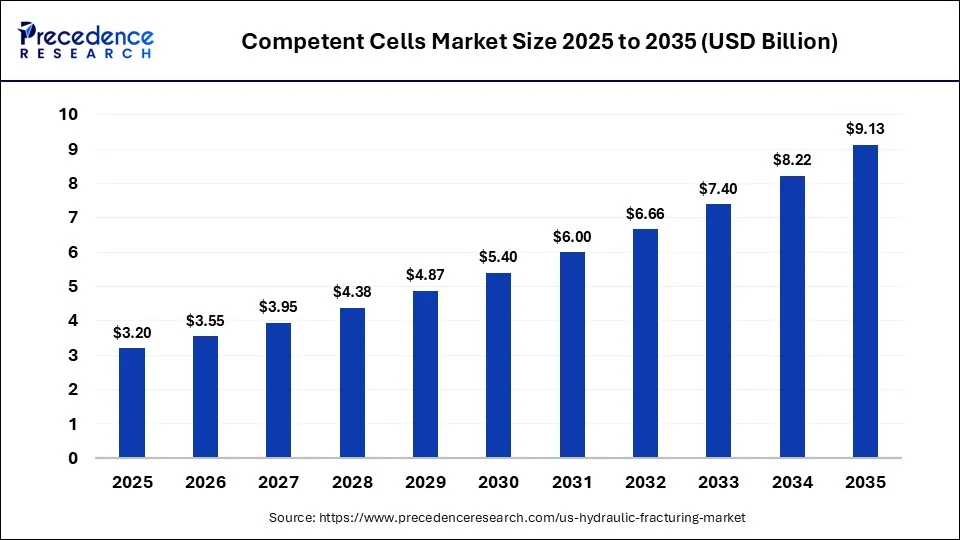
The global competent cells market is expected to achieve a value of USD 3.55 billion in 2026. The emergence of molecular biology, genetic engineering, synthetic biology, and the production of recombinant proteins provides the basis for future growth in the market. The growth of the market will be supported by the growth of research activities in molecular biology, genetic engineering, synthetic biology, and recombinant protein production. Our senior research analyst, Deepa Pandey, has done the analysis of these trends. The findings from this research can aid biotechnology companies, pharmaceutical manufacturers, contract research organizations (CROs), academic and research institutions, suppliers and distributors of laboratory reagents, and investors.
Source: https://www.precedenceresearch.com/competent-cells-market
 Get a Sample
 Table Of Content


Competent Cells Market Trends, Growth, and Market Size Analysis 2035
The competent cells market is forecasted to expand from USD 3.55 billion in 2026 to USD 9.13 billion by 2035, growing at a CAGR of 11.05% from 2026 to 2035. The global competent cells market is supported by the expanding use of molecular biology, genetic engineering, synthetic biology, recombinant DNA technology, and pharmaceutical and biotechnology research. Competent cells play an important role in plasmid propagation, molecular cloning, protein expression, library construction, mutagenesis, and other DNA transformation workflows, with chemical competence and electrocompetence representing the two primary preparation methods. Cloning remains a major application, while demand for high-efficiency and specialized strains is increasing as researchers work with complex DNA constructs and higher-throughput workflows.
Key Takeaways
- The global competent cells market is estimated at USD 3.55 billion in 2026 and is projected to grow at a CAGR of 11.05% from 2026 to 2035.
- North America accounted for a significant share of global revenue in 2025 in one market estimate, supported by established biotechnology and pharmaceutical research infrastructure.
- Chemical competence represented 46.58% of market revenue in 2024, highlighting its significant role in routine molecular biology workflows.
- Cloning accounted for approximately 49.74% of application revenue in 2024, making it the largest application segment in one market estimate.
- The market is expected to record approximately 8.6% to 10% annual growth across different published forecast scenarios through the longer-term outlook.
- Competent cells are primarily differentiated into 2 major preparation methods: chemically competent cells and electrocompetent cells.
- The market segmentation covers 8 major dimensions, including type, host organism, strain, transformation efficiency, application, end user, distribution channel, and packaging format.
- The geographic segmentation covers 5 major regions, namely North America, Europe, Asia-Pacific, Latin America, and the Middle East & Africa.
- The competitive landscape includes a 20-company working universe, spanning global life-science suppliers, molecular biology specialists, regional manufacturers, and adjacent biotechnology providers.
Overview - Molecular Biology Workflows, Recombinant Protein Production, and Synthetic Biology Shape Market Demand
The competent cells market is a specialized segment of the life sciences and biotechnology industry, supplying bacterial and other host cells engineered or prepared to accept foreign genetic material through transformation. These products are essential for plasmid propagation, molecular cloning, recombinant DNA workflows, protein expression, library construction, and synthetic biology research. Demand is linked to the expansion of academic research, pharmaceutical discovery, biopharmaceutical development, industrial biotechnology, and commercial DNA engineering.
The market has two principal commercial dimensions: chemical competence, in which cells are prepared to accept DNA through chemical treatment and heat shock, and electro competence, in which cells are optimized for DNA uptake through electroporation. Product differentiation also depends on host strain, transformation efficiency, genotype, application specificity, batch consistency, and compatibility with downstream expression systems.
A critical structural distinction is that competent cells are not a homogeneous commodity. Routine cloning strains serve high-volume research workflows, while high-efficiency strains, specialized genotypes, and application-specific preparations target workflows where transformation performance, reproducibility, and screening throughput materially influence experimental outcomes. Consequently, purchasing decisions often prioritize validated performance and experimental reliability alongside price.
The market also benefits from the growing use of plasmid DNA as a research and manufacturing input. Competent cells support plasmid construction and amplification, although they should not be confused with the broader plasmid DNA manufacturing market, which includes fermentation, purification, analytical testing, and manufacturing-grade quality requirements. Similarly, competent cells are distinct from chemically competent production hosts, mammalian cell lines, and cell-free protein synthesis systems, even where these technologies participate in overlapping research workflows.
The competitive structure combines established life-science reagent suppliers, specialist transformation technology providers, regional biotechnology manufacturers, and research-tool distributors. Product credibility, strain documentation, transformation-efficiency specifications, quality consistency, cold-chain distribution, and technical support influence customer retention. The market is also characterized by a combination of repeat purchases from established laboratories and project-driven demand from biotechnology companies developing new constructs, libraries, and engineered biological systems.
The commercial opportunity therefore extends beyond unit sales. Suppliers can differentiate through workflow-specific kits, validated strain combinations, optimized transformation protocols, ready-to-use formats, and integration with automated molecular biology platforms.
Key Coverage
- Market definition, product boundaries, and addressable applications.
- Chemical competence versus electrocompetence and their respective use cases.
- Research, pharmaceutical, industrial biotechnology, and synthetic biology demand.
- Product differentiation by strain, transformation efficiency, format, and quality.
- Customer purchasing criteria, repeat-purchase patterns, and supplier qualification.
- Competitive positioning across established suppliers and specialist manufacturers.
Market Size & Forecast - Double-Digit Growth Estimates Reflect Expanding Molecular Biology and Synthetic Biology Workflows
Published market estimates place the global competent cells market at approximately USD 3.55 billion in 2026, with two projections indicating expansion to USD 6.66 billion by 2032 at an 11.05% CAGR and USD 7.40 billion by 2033 at approximately 11.05% CAGR. These projections indicate a potential market approaching USD 5.40 billion in the early 2030 under higher-growth scenarios, although differences in market definitions and product coverage prevent their treatment as a single consensus forecast. North America accounted for a significant share of global revenue in 2025 in one estimate, while Asia-Pacific represents an emerging expansion opportunity supported by developing biotechnology research infrastructure, pharmaceutical R&D, and synthetic biology capabilities.
Our analysis indicates that sustained investment in molecular biology, increasingly complex DNA constructs, high-throughput screening, and synthetic biology workflows could support continued demand for competent cells. However, revenue growth will depend not only on the number of transformation procedures performed but also on product mix, pricing, and customer purchasing behavior. Routine cloning products may face greater price competition, whereas specialized, high-efficiency competent cells could benefit from applications requiring improved transformation performance and reproducibility. The variation between published forecasts also highlights the importance of distinguishing underlying market expansion from differences in product inclusion and estimation methodology.
In our view, the principal commercial opportunity lies in capturing value from higher-performance applications while maintaining cost competitiveness in routine research workflows. Asia-Pacific expansion could create additional opportunities for suppliers with effective distribution networks, reliable product availability, and competitive pricing, although regional growth will depend on laboratory expenditure, import dependence, and local manufacturing capabilities. We believe companies should assess market opportunities using revenue growth alongside unit demand and price realization, since improvements in DNA assembly efficiency, reduced DNA input requirements, or more economical product formats could increase workflow productivity without generating proportional growth in competent cell revenue.
The full report further examines alternative market-size scenarios, historical and forecast growth trajectories, regional revenue contribution, application-level demand, and the factors influencing adoption of standard versus high-performance products. A structured market forecast dataset can complement this analysis by tracking market value, forecast period, CAGR, geography, product type, application, and scenario assumptions, enabling users to compare estimates, benchmark regional opportunities, and evaluate how alternative market definitions affect growth expectations.
Segmentation Analysis - Routine Cloning Anchors Demand While Specialized Transformation Products Address Complex Workflows
The market is segmented by cell preparation method, transformation efficiency, strain characteristics, application, end user, delivery format, and geography. Chemical competence accounted for a reported 46.58% of market revenue in 2024 in one estimate, while cloning represented approximately 49.74% of application revenue. These figures indicate the importance of established molecular cloning workflows, although the shares are specific to that estimate and should not be assumed universal across alternative market definitions.
By cell type, chemically competent cells are widely used in routine plasmid cloning and subcloning because their workflows generally require relatively simple laboratory equipment. Electrocompetent cells are used where high transformation efficiency, difficult DNA constructs, large libraries, or particular host-strain requirements justify electroporation equipment and additional protocol control. Ultracompetent and other high-efficiency variants address workflows where low transformation success can create meaningful downstream costs.
By application, cloning and subcloning form a core demand category, followed by protein expression, mutagenesis, library construction, functional genomics, and synthetic biology. Protein expression applications require careful differentiation between cells used to construct and propagate plasmids and the expression hosts used to produce the target protein.
By end user, pharmaceutical and biotechnology companies, academic and research institutions, contract research organizations, industrial biotechnology developers, and diagnostic or life-science laboratories have different purchasing requirements. Commercial biotechnology customers may prioritize reproducibility, throughput, and workflow standardization, whereas academic laboratories frequently balance product performance against budget constraints.
By delivery format, demand includes individual tubes, multipack formats, transformation kits, specialized strain collections, and bulk or custom supply arrangements. The relative value of each format depends on laboratory throughput, cold-storage availability, and procurement practices.
The full segmentation framework quantifies revenue contribution, growth, average selling price, application-specific demand, and product penetration across these categories, while distinguishing established revenue pools from emerging opportunities.
Market Dynamics - DNA Engineering Complexity Creates Opportunities for Performance Differentiation
Growing synthetic biology research, pharmaceutical discovery, recombinant protein development, and gene-editing workflows are expanding the need for reliable DNA transformation across academic, biotechnology, and pharmaceutical laboratories. At the same time, higher-throughput experimental platforms are increasing the importance of standardized transformation performance and reproducibility. However, competent cells remain consumable research inputs whose purchasing volumes are linked to experimental activity, research budgets, and laboratory procurement practices. Performance also varies with DNA quality, construct size, host genotype, handling, and protocol conditions, meaning that nominal transformation-efficiency specifications alone may not reliably predict experimental outcomes.
Our analysis indicates that market differentiation is shifting from basic product availability toward application-specific performance, reproducibility, and workflow compatibility. High-efficiency transformation, difficult-to-transform constructs, specialized microbial hosts, and automation-compatible formulations offer opportunities for suppliers to address technically demanding applications. Conversely, academic funding constraints, laboratory consolidation, procurement standardization, and in-house cell preparation can intensify price competition in routine applications. We believe suppliers that demonstrate consistent experimental outcomes through validated protocols, technical documentation, and application-specific support can establish stronger value propositions than those competing primarily on headline performance specifications.
In our view, the principal strategic implication is that suppliers need to demonstrate lower total experimental cost rather than relying exclusively on transformation-efficiency claims. Improved reproducibility, fewer failed experiments, reduced troubleshooting requirements, and compatibility with automated workflows can strengthen customer value, particularly where DNA constructs are complex or experimental throughput is high. However, these benefits must be demonstrated under relevant application conditions, since improvements in product specifications do not automatically translate into better results across all laboratory workflows.
The full report further examines demand drivers and restraints, application-specific performance requirements, technology alternatives, customer purchasing priorities, and the competitive implications of in-house preparation and workflow optimization. Where product-level intelligence is available, a structured dataset can complement the strategic analysis by tracking competent cell type, host genotype, transformation efficiency, application, formulation, workflow compatibility, and relevant technical specifications. Filtering and benchmarking these attributes by application and product category can help identify performance gaps, differentiation opportunities, and areas where technical validation may support commercial positioning.
Pricing Analysis - Transformation Efficiency, Strain Specialization, and Workflow Reliability Determine Product Value
Competent cell pricing varies according to strain, preparation method, transformation efficiency, pack size, quality specifications, regional distribution, and application requirements. Routine chemically competent cells generally compete on convenience, consistency, and cost per transformation, while high-efficiency electrocompetent products can command a premium where difficult constructs or library-generation workflows require greater performance.
A commercially relevant pricing metric is cost per successful transformation, rather than purchase price per tube alone. A higher-priced product may offer better economics if it reduces failed experiments, repeat transformations, screening workload, or DNA consumption. Conversely, routine cloning applications may not justify premium products when standard-efficiency cells consistently deliver acceptable results.
Price differences also reflect manufacturing yield, cold-chain shipping, quality-control requirements, packaging, distributor margins, and regional import costs. Bulk procurement may lower unit costs but requires sufficient laboratory throughput and reliable storage.
The full pricing analysis evaluates product-level price bands, regional price differentials, standard versus high-efficiency formats, distributor economics, purchasing frequency, and price sensitivity by customer category. Specific price benchmarks should be validated against current product listings and comparable pack sizes rather than generalized across different strains and transformation methods.
Key Coverage
- Average selling price by cell type, strain, and efficiency class.
- Cost per transformation and cost per successful clone.
- Pack-size economics and institutional purchasing.
- Regional price differences, shipping, and distributor margins.
- Premium-product price realization and substitution risk.
- Pricing outlook under competition and increasing workflow standardization.
Demand-Supply Analysis - Cold-Chain Reliability and Consistent Batch Performance Shape Supply Economics
Competent cells are specialized biological consumables requiring controlled preparation, storage, and transportation. Unlike conventional laboratory plastics, product performance can deteriorate when temperature conditions are not maintained. Many commercial competent-cell products require storage at approximately −80°C, making cold-chain integrity an important component of distribution and inventory management.
Supply is influenced by strain availability, cell-culture preparation, batch consistency, transformation-efficiency testing, quality control, packaging, and frozen distribution. Demand is relatively recurring but uneven, reflecting laboratory purchasing cycles, research funding, seasonal budget utilization, and project-specific requirements. High-throughput screening programs and library-generation projects can generate concentrated demand, whereas routine cloning generates smaller, repeated purchases.
Supply interruptions may result from manufacturing variability, transportation delays, cold-storage failures, or limited availability of specialized strains. These constraints are particularly relevant when laboratories depend on validated products for time-sensitive experiments.
The full analysis examines production capabilities, product availability, regional import dependence, replenishment lead times, distributor inventory, and the balance between routine-product competition and specialized-product supply constraints. Publicly comparable global capacity and utilization data are limited, so precise industry-wide utilization rates or supply-demand deficits should not be inferred without additional primary research.
Value Chain & Supply Chain - Product Reliability and Technical Support Extend Beyond Cell Manufacturing
Value creation occurs at several stages. Upstream suppliers provide biological strains and consumable inputs, while manufacturers capture value through preparation expertise, product validation, process control, and differentiated strain portfolios. Distributors add value through geographic availability, consolidated procurement, inventory management, and cold-chain logistics.
The most important operational bottlenecks are consistency between batches, maintenance of transformation performance, reliable frozen shipping, and technical troubleshooting. Suppliers that combine broad strain availability with validated protocols and dependable delivery can strengthen repeat purchasing and reduce customer switching.
Technology, Regulation & Sustainability - Specialized Strains and Reproducibility Define Product Differentiation
Technology development in the competent cells market is increasingly focused on higher transformation efficiency, faster colony recovery, compatibility with complex DNA constructs, specialized host genotypes, and reproducibility in automated workflows. Strain engineering also addresses methylation sensitivity, recombination, plasmid stability, and the propagation of difficult constructs. Meanwhile, synthetic biology applications are creating potential demand for alternative microbial hosts with specific growth or metabolic characteristics. Adoption, however, depends on protocol compatibility, downstream performance, and the availability of supporting research tools. Regulatory expectations also vary by intended use: research-use-only products generally face applicable labeling, quality, transport, and workplace safety requirements, while customers using competent cells in workflows supporting regulated biomanufacturing may impose additional supplier qualification, traceability, documentation, and change-control requirements.
Our analysis indicates that competitive differentiation increasingly depends on the combination of strain characteristics, application-specific validation, and quality documentation rather than transformation efficiency alone. Specialized genotypes and improved plasmid stability can address technically demanding research workflows, while reproducibility and compatibility with established protocols influence laboratory adoption. We believe these requirements can create opportunities for suppliers that demonstrate consistent performance across relevant applications and provide robust technical documentation. However, specialized products may face narrower addressable demand where customers prioritize standardized protocols, familiar strains, and lower procurement costs.
I believe, sustainability and quality expectations represent complementary operational considerations rather than independent demand drivers. Ultra-low-temperature storage, insulated packaging, cold-chain transportation, and laboratory consumable disposal create environmental and logistical costs. Packaging optimization, shipment consolidation, and inventory management may reduce waste, although product stability requirements constrain the scope for changing storage and transport practices. Suppliers therefore need to balance operational efficiency with product integrity, quality assurance, and customer-specific compliance expectations.
The full report further examines strain innovation, identifiable patent activity, product launches, research partnerships, quality documentation, customer qualification requirements, cold-chain practices, and sustainability-related operational improvements. Where sufficiently detailed information is available, a structured product and technology dataset can complement the strategic analysis by tracking product type, host genotype, transformation-efficiency specifications, application suitability, technical characteristics, launch year, patent activity, quality documentation, storage requirements, and packaging formats. Filtering and benchmarking these attributes by supplier, application, and product category can help identify technical differentiation, potential qualification barriers, and operational improvement opportunities.
Customer & Application Analysis - Procurement Depends on Experimental Risk and Workflow Throughput
Academic laboratories, biotechnology companies, pharmaceutical R&D teams, contract research organizations, and industrial biotechnology developers purchase competent cells for different experimental priorities. Academic buyers often emphasize affordability and protocol familiarity. Commercial research organizations may place greater weight on batch consistency, reproducibility, availability, and standardized purchasing.
Switching costs are moderate in routine applications but can become more significant when a specific strain has been validated within an established workflow. Replacing the product may require protocol optimization, repeat experiments, or additional qualification. Customers working with difficult constructs or large DNA libraries may therefore prioritize performance over the lowest unit price.
Application demand also differs by experimental scale. Routine plasmid cloning tends to generate repeat purchases, while library construction and major synthetic biology projects may produce more concentrated consumption. Protein expression workflows require particular attention to the distinction between cloning hosts and expression hosts.
The customer analysis quantifies demand by end user, application, purchase frequency, product qualification, channel preferences, and performance requirements. It also identifies opportunities in technical support, custom strain selection, automated workflows, and integrated reagent kits.
Competitive Landscape - Established Life-Science Suppliers Compete Through Product Breadth, Performance, and Distribution
The competitive landscape includes global life-science reagent manufacturers, molecular biology specialists, regional suppliers, and companies offering custom DNA and synthetic biology services. Competition is shaped by transformation-efficiency specifications, strain diversity, product availability, documentation, pricing, and customer familiarity. The market cannot be assessed reliably using total corporate revenue alone because competent cells typically represent only a portion of each supplier's broader business.
Tentative Leading Company Universe
The following is a working universe of 20 relevant participants and adjacent specialists. Inclusion reflects product relevance or participation in related molecular biology workflows; it does not imply a verified ranking or equivalent exposure to the competent cells market.
Company inclusion is tentative. Product-level availability, active competent-cell offerings, commercial scale, and direct market exposure should be validated individually before treating this universe as a confirmed competitor ranking.
The full competitive assessment distinguishes direct competent-cell suppliers from broader life-science companies and adjacent technology providers. It examines product breadth, transformation efficiency, specialist applications, regional distribution, and customer overlap to identify the companies competing for specific revenue pools.
Market Share & Competitive Benchmarking - Product-Level Evidence Matters More Than Corporate Scale
Comparable market-share figures for individual competent-cell suppliers are not consistently available in public disclosures. Corporate revenue cannot be used as a proxy for competent-cell revenue, and precise top-five or top-ten market shares should not be assigned without product-level sales evidence.
The competitive analysis therefore separates confirmed product participation from estimated market position. Benchmarking dimensions include chemically competent and electrocompetent product availability, standard and high-efficiency variants, host-strain breadth, published transformation-efficiency specifications, quality documentation, geographic availability, technical support, and channel coverage.
| Company | Headquarters | Market Position | Core Strength |
| Thermo Fisher Scientific | Waltham, USA | Broad life-science supplier | Molecular biology reagents and distribution |
| New England Biolabs | Ipswich, USA | Molecular biology specialist | Cloning strains and technical resources |
| Takara Bio | Shiga, Japan | Biotechnology reagent supplier | Molecular biology and genetic engineering |
| Merck KGaA | Darmstadt, Germany | Diversified life-science supplier | Research reagents and laboratory products |
| Agilent Technologies | Santa Clara, USA | Genomics and research tools supplier | Molecular biology workflows |
| QIAGEN | Venlo, Netherlands | Sample preparation and molecular tools supplier | DNA-related research solutions |
| Bio-Rad Laboratories | Hercules, USA | Life-science research supplier | Molecular biology and laboratory systems |
| Promega Corporation | Madison, USA | Research reagent specialist | Molecular biology and assay technologies |
| Zymo Research | Irvine, USA | Molecular biology specialist | DNA preparation and research reagents |
| GenScript | Piscataway, USA | Biotechnology services and reagents | Gene synthesis and molecular biology |
| Lucigen | Middleton, USA | Molecular biology technology specialist | Transformation and cloning technologies |
| Scarab Genomics | Madison, USA | Microbial strain specialist | Engineered bacterial strains |
| OriGene Technologies | Rockville, USA | Research reagent supplier | Molecular biology and gene-related products |
| HiMedia Laboratories | Mumbai, India | Microbiology and laboratory supplier | Media, reagents, and microbiology products |
| TransGen Biotech | Beijing, China | Molecular biology supplier | Cloning and genetic engineering reagents |
| Yeastern Biotech | Taipei, Taiwan | Biotechnology reagent supplier | Molecular biology products |
| Beijing Solarbio Science & Technology | Beijing, China | Laboratory reagent supplier | Research reagents and biological products |
| Vazyme Biotech | Nanjing, China | Molecular biology reagent supplier | PCR and genetic research reagents |
| Applied Biological Materials | Richmond, Canada | Biotechnology reagent supplier | Molecular biology and gene-related tools |
| System Biosciences | Palo Alto, USA | Specialized biotechnology supplier | Genetic engineering and related research tools |
Portfolio benchmarking should distinguish established cloning products from specialized strains for difficult constructs, library construction, and other demanding applications. Technology comparisons should use comparable testing conditions wherever possible, because transformation-efficiency figures can vary with DNA type, construct size, protocol, and experimental conditions.
Strategic Developments, M&A & Company Profiles - Expansion Is Closely Linked to Molecular Biology Capabilities
Relevant strategic developments include new competent-cell formulations, engineered microbial strains, expanded reagent portfolios, improvements in transformation protocols, distribution agreements, and acquisitions involving molecular biology technologies. Transactions should be included only where the acquired capability or product portfolio has a demonstrable connection to competent cells or directly adjacent workflows.
The company-profile framework covers headquarters, ownership, overall revenue, relevant product exposure where disclosed, product portfolio, geographic footprint, research capabilities, manufacturing information, partnerships, and strategic developments. Where competent-cell-specific revenue, production capacity, or market share is not separately disclosed, the analysis distinguishes unavailable data from broader corporate metrics.
M&A analysis focuses on portfolio expansion, access to proprietary strains, molecular biology workflow integration, regional distribution, and cross-selling opportunities. Broader biotechnology acquisitions should not automatically be interpreted as competent-cell market consolidation.
Geographic Competitive Landscape & Manufacturing - Distribution Infrastructure Influences Regional Market Access
North America represents a substantial demand center, supported by biotechnology research, pharmaceutical R&D, and established laboratory procurement infrastructure. Europe contributes through academic research, industrial biotechnology, and pharmaceutical development, while Asia-Pacific presents opportunities associated with expanding research capacity, domestic reagent manufacturing, and regional biotechnology investment.
Regional competition depends on product availability, import requirements, frozen shipping infrastructure, local distributor networks, technical support, and purchasing budgets. Local manufacturing can improve delivery flexibility, but consistent biological performance and validated quality remain important considerations for customers.
Manufacturing and capacity benchmarking examines publicly identifiable production locations, product availability, manufacturing expansion, vertical integration, and cold-chain capabilities. The analysis also assesses regional partnerships and channel arrangements without treating general laboratory-reagent manufacturing capacity as equivalent to competent-cell production capacity.
Opportunity & White-Space Analysis - Specialized Workflows Create Differentiation Beyond Routine Cloning
Potential opportunities include high-efficiency products for difficult DNA constructs, specialized strains for synthetic biology, standardized solutions for high-throughput laboratories, and reliable products for customers in regions with limited access to specialized reagents.
Regional distributors and domestic suppliers may also address unmet needs involving delivery lead times, technical support, pack-size flexibility, and local procurement. For established suppliers, opportunities include product bundles, validated workflow kits, and stronger support for automated laboratory processes.
The report evaluates these opportunities against customer adoption barriers, competing technologies, technical requirements, manufacturing complexity, and achievable pricing. Financial estimates for individual white spaces require product-level demand, price, and customer data rather than extrapolation from broad biotechnology spending.
Industry Structure - Supplier Differentiation and Customer Switching Costs Shape Competitive Intensity
Porter's Five Forces highlights the following structural characteristics of the competent cells market.
| Competitive force | Indicative intensity | Market-specific rationale |
| Supplier bargaining power | Medium | Specialized strains, biological inputs, and quality requirements can constrain sourcing flexibility. |
| Buyer bargaining power | Medium to High | Large laboratories can standardize procurement, compare suppliers, and negotiate volume pricing. |
| Threat of new entrants | Medium | Basic products are technically accessible, but consistent performance, validation, distribution, and brand credibility require investment. |
| Threat of substitutes | Medium | In-house cell preparation and alternative DNA delivery technologies can replace certain applications. |
| Competitive rivalry | Medium to High | Established reagent suppliers and specialists compete through pricing, product breadth, availability, and performance. |
These ratings are qualitative structural assessments, not measured market statistics. Competitive intensity varies by product class: routine cloning products are more exposed to price competition, whereas specialized applications may place greater emphasis on validated performance and technical support.
PESTLE Analysis
- Political: Public research funding and biotechnology development programs influence laboratory investment.
- Economic: Research budgets, currency movements, logistics costs, and procurement consolidation affect demand and pricing.
- Social: Scientific workforce availability and growth in research capabilities influence laboratory adoption.
- Technological: Synthetic biology, automation, gene editing, and increasingly complex DNA constructs influence product requirements.
- Legal: Product labeling, intellectual property, transport requirements, and customer-specific quality standards shape commercialization.
- Environmental: Ultra-low-temperature storage, shipping materials, and laboratory waste create sustainability considerations.
Market Attractiveness & Future Outlook - Performance Requirements and Regional Expansion Define Growth Opportunities
The market outlook depends on the continued expansion of molecular biology workflows, pharmaceutical R&D, synthetic biology, and recombinant DNA applications. Published commercial forecasts suggest a range of growth outcomes, with estimates spanning approximately 8.6% to 10% annual growth across different forecast periods. These figures should be interpreted as alternative scenarios rather than a single verified industry consensus.
The base case assumes continued research activity, repeat demand for routine cloning products, and gradual adoption of specialized transformation solutions. The upside case assumes faster expansion in synthetic biology, library construction, high-throughput research, and biotechnology investment in Asia-Pacific. The downside case considers constrained research budgets, aggressive price competition, improved experimental efficiency that reduces consumable use, and substitution by alternative workflows.
Market attractiveness varies by segment. Routine products benefit from repeat purchases but face greater price sensitivity. Specialized products can offer differentiation but require demonstrable performance, technical validation, and sufficient application demand. Regional expansion can provide incremental opportunities where local supply, product availability, and technical support remain underdeveloped.
The full outlook examines forecast assumptions, product-level revenue opportunities, application adoption, pricing, competitive developments, and regional growth through 2030 and beyond. Company-specific growth conclusions depend on verified product exposure, technical differentiation, and distribution capabilities rather than overall corporate scale.
Key Strategic Questions Addressed
- What is the current global competent cells market size, and how do alternative forecasts differ?
- What proportion of demand comes from chemically competent versus electrocompetent cells?
- Which applications account for the largest revenue pools, and which are expanding?
- How do standard-efficiency and high-efficiency products differ in economics and use cases?
- How does transformation efficiency influence cost per successful transformation?
- Which customer segments drive repeat purchasing and premium-product adoption?
- What manufacturing, quality-control, and cold-chain constraints influence supply reliability?
- Which suppliers have the broadest relevant product portfolios and geographic reach?
- How should competent-cell-specific market share be distinguished from overall corporate revenue?
- What technical capabilities create defensible differentiation in specialized transformation workflows?
- How do regional manufacturing, imports, and distribution affect market access?
- What emerging applications could expand demand through 2030 and beyond?
- How might in-house preparation and alternative DNA delivery technologies affect commercial demand?
- Which product, application, and geographic opportunities remain underserved?
- What competitive and investment developments could reshape the market over the forecast period?
Competent Cells Market Segmentation
By Type
- Chemically Competent Cells
- Electrocompetent Cells
By Cell Type / Host Organism
- Escherichia coli (E. coli) Competent Cells
- Yeast Competent Cells
- Bacillus Competent Cells
- Other Microbial Competent Cells
By Strain
- DH5α
- TOP10
- XL1-Blue
- BL21
- JM109
- Other Specialized Strains
By Transformation Efficiency
- Standard-Efficiency Competent Cells
- High-Efficiency Competent Cells
- Ultra-High-Efficiency Competent Cells
By Application
- Cloning
- Protein Expression
- Library Construction
- Mutagenesis
- Recombinant DNA Technology
- Synthetic Biology
- Gene Editing and Genome Engineering
- Other Applications
By End User
- Academic and Research Institutions
- Pharmaceutical and Biotechnology Companies
- Contract Research Organizations (CROs)
- Contract Development and Manufacturing Organizations (CDMOs)
- Diagnostic and Testing Laboratories
- Other End Users
By Distribution Channel
- Direct Sales
- Distributors and Wholesalers
- Online Sales Platforms
By Packaging Format
- Single-Use / Small-Pack Formats
- Multi-Reaction Packs
- Bulk / Large-Pack Formats
By Region
- North America
- United States
- Canada
- Mexico
- Europe
- Germany
- United Kingdom
- France
- Italy
- Spain
- Rest of Europe
- Asia-Pacific
- China
- Japan
- India
- South Korea
- Australia
- Rest of Asia-Pacific
- Latin America
- Brazil
- Argentina
- Rest of Latin America
- Middle East & Africa
- GCC Countries
- South Africa
- Rest of Middle East & Africa
For inquiries regarding discounts, bulk purchases, or customization requests, please contact us at sales@precedenceresearch.com
Frequently Asked Questions





Ask For Sample
No cookie-cutter, only authentic analysis – take the 1st step to become a Precedence Research client
 Get a Sample
.webp)



 sales@precedenceresearch.com
 Schedule a Meeting
