



Computational Medicine and Drug Discovery Software Market Trends, Companies, Revenue / Sales Performance, Subscriber Growth, Pricing Strategies, Cloud Adoption, Infrastructure Expansion, Competitive Landscape, and Industry Outlook
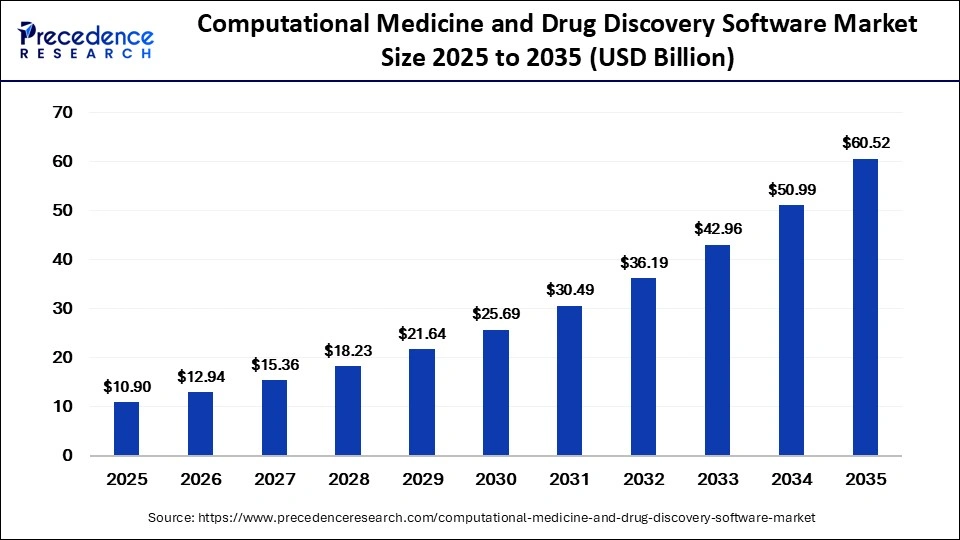
ICT industry specialist Gautam Mahajan estimates the computational medicine and drug discovery software market at USD 12.94 billion in 2026, with continued technology adoption expected to take the market to USD 60.52 billion by 2035 at a CAGR of 18.70%. Leading computational medicine and drug discovery software market providers such as Entelos Inc., Crown Bioscience Inc., Chemical Computing Group Inc., Nimbus Therapeutics Inc. are expanding their capabilities across segments including By Software Type, By Technology, By Application, By Deployment Mode, By End-Use, By Therapeutic Area.
Source: https://www.precedenceresearch.com/computational-medicine-and-drug-discovery-software-market
 Get a Sample
 Table Of Content


What is the Computational Medicine and Drug Discovery Software Market Size in 2026?
The global computational medicine and drug discovery software market size accounted for USD 10.90 billion in 2025 and is predicted to increase from USD 12.94 billion in 2026 to approximately USD 60.52 billion by 2035, expanding at a CAGR of 18.70% from 2026 to 2035. The market is growing due to rising demand for regenerative therapies, increasing clinical trial activities, and strong investments in stem cell research driven by the need to treat chronic and complex diseases.
Key Takeaways
- North America dominated the computational medicine and drug discovery software market with a 45% share in 2025.
- Asia Pacific is expected to grow at the fastest CAGR of 22.5% between 2026 and 2035.
- By software type, the molecular modeling and simulation segment held a market share of 25% in 2025.
- By software type, the AI-driven drug discovery platforms segment is expected to grow at the fastest CAGR of 23.5% between 2026 and 2035.
- By technology, the AI and machine learning segment contributed the highest market share of 35% in 2025.
- By technology, the cloud computing segment is expected to grow at a CAGR of 21% between 2026 and 2035.
- By application, the lead discovery and optimization segment dominated the market with a 28% share in 2025.
- By application, the target identification and validation segment is expected to grow at the fastest CAGR of 22.5% between 2026 and 2035.
- By deployment mode, the cloud-based segment dominated the market with a 60% share in 2025.
- By deployment mode, the hybrid segment is expected to grow at a significant CAGR of 18.5% between 2026 and 2035.
- By therapeutic area, the oncology segment contributed the highest market share of 35% in 2025.
- By therapeutic area, the neurological disorders segment is expected to expand at the fastest CAGR of 20.5% between 2026 and 2035.
- By end-use, the pharma and biotech companies segment contributed the highest market share of 55% in 2025.
- By end-use, the CROs segment is expected to grow at the fastest CAGR of 19% between 2026 and 2035.
Market Overview
The computational medicine and drug discovery software market is evolving rapidly as pharmaceutical companies increasingly rely on digital tools to accelerate research. These platforms help simulate biological processes, identify drug targets, and reduce dependency on time-consuming lab experiments. Growing demand for faster drug development, rising RandD costs, and advancements in cloud computing are driving adoption. The market is becoming essential for improving efficiency, accuracy, and innovation across the drug discovery pipeline.
Impact of AI on the Computational Medicine and Drug Discovery Software Market
Artificial intelligence is transforming how drugs are discovered by enabling faster analysis of complex biological data. AI models can predict molecular behavior, identify potential drug candidates, and optimize clinical trial design. These tools reduce the need for trial-and-error approaches, saving time and cost. As AI capabilities improve, they help researchers make better decisions and accelerate the development of innovative therapies.
Major Market Trends
- Cloud and Advanced Analytics Integration: Growing adoption of cloud platforms and analytics tools is improving scalability, data access, and overall research efficiency.
- Adoption of Simulation Technologies: Use of molecular modeling, simulation, and virtual screening is helping researchers streamline drug discovery and reduce early-stage failures.
- Rise of Collaborative Ecosystems: Increased data sharing between pharma companies, biotech firms, and research institutes is improving innovation and research outcomes.
- Use of Real-World Data and Automation: Real-world data and automation tools are enhancing decision-making, speeding workflows, and significantly reducing drug development timelines.
Market Scope
| Report Coverage | Details |
| Market Size in 2025 | USD 10.90 Billion |
| Market Size in 2026 | USD 12.94 Billion |
| Market Size by 2035 | USD 60.52 Billion |
| Market Growth Rate from 2026 to 2035 | CAGR of 18.70% |
| Dominating Region | North America |
| Fastest Growing Region | Asia Pacific |
| Base Year | 2025 |
| Forecast Period | 2026 to 2035 |
| Segments Covered | Software Type, Technology, Application, Deployment Mode, End-Use, Therapeutic Area, and Region |
| Regions Covered | North America, Europe, Asia-Pacific, Latin America, and Middle East & Africa |
Market Dynamics
Drivers
Focus on Reducing Drug Development Time
The primary driver of the computational medicine and drug discovery software market is the need to reduce drug development time and costs. Traditional methods are expensive and slow, pushing companies to adopt computational tools for efficiency. Increasing complexity of diseases, demand for personalized medicine, and growing investment in pharmaceutical RandD are also fueling growth. These solutions enable faster decision-making and improve success rates in drug discovery processes.
Restraint
High Costs
One of the key restraints is the high cost of advanced software and the need for skilled professionals to operate it. Many organizations face challenges in integrating these tools with existing systems. Data privacy concerns and regulatory complexities also limit adoption. Smaller companies may struggle with the investment required, slowing down widespread implementation despite the technology's long-term benefits.
Opportunity
Rise of AI and Use of Cloud Platforms
The market offers strong opportunities with the rise of AI, big data, and precision medicine. Increasing collaboration between technology firms and pharmaceutical companies is opening new growth avenues. Expanding use of cloud-based platforms is making these tools more accessible. Emerging markets and a growing focus on personalized therapies are expected to create significant demand, driving innovation and long-term market expansion.
Segment Insights
Software Type Insights
The Molecular Modeling and Simulation Segment Held 25% Market Share in 2025
The molecular modeling and simulation segment led the computational medicine and drug discovery software market with a share of 25% in 2025, as it remains a core tool in structure-based drug design. It helps researchers understand molecular interactions, predict drug behavior, and reduce early-stage failures. Its reliability and wide application across pharmaceutical RandD continue to support its leading position.
The AI-driven drug discovery platforms segment held a 22% market share in 2025 and is expected to expand at the fastest CAGR of 23.5% between 2026 and 2035, driven by the rise in the use of generative AI tools. These tools accelerate molecule design, improve prediction accuracy, and significantly shorten drug discovery timelines.
Computational Medicine and Drug Discovery Software Market Share, By Software Type, 2025-2035 (%)
| Software Type | 2025 | 2035 | CAGR (%) |
| Molecular Modeling and Simulation | 25.00% | 23.00% | 16.5% |
| AI-driven Drug Discovery Platforms | 22.00% | 28.00% | 23.5% |
| Bioinformatics and Genomics Software | 18.00% | 16.00% | 17.0% |
| Clinical Trial Simulation | 12.00% | 11.00% | 16.0% |
| Data Integration Platforms | 10.00% | 10.00% | 18.0% |
| Laboratory Informatics (LIMS/ELN) | 13.00% | 12.00% | 17.5% |
The bioinformatics and genomics software segment held a 18% market share in 2025 and is expected to grow at a CAGR of 17% between 2026 and 2035, supported by increasing use of omics data analysis. It plays a key role in target identification and personalized medicine research.
The clinical trial simulation segment held a 12% share of the market in 2025 and is expected to grow at a CAGR of 16% between 2026 and 2035, due to its ability to optimize trials and reduce costs. It improves trial design, minimizes risks, and enhances overall efficiency.
Technology Insights
Computational Medicine and Drug Discovery Software Market Share, By Technology, 2025-2035 (%)
| Technology | 2025 | 2035 | CAGR (%) |
| AI and Machine Learning | 35.00% | 40.00% | 24.0% |
| High-Performance Computing | 25.00% | 20.00% | 15.5% |
| Cloud Computing | 20.00% | 25.00% | 21.0% |
| Digital Twins and In Silico | 10.00% | 10.00% | 20.0% |
| Quantum Computing | 10.00% | 5.00% | 19.5% |
Why Did the AI and Machine Learning Segment Dominate the Market in 2025?
The AI and machine learning segment dominated the computational medicine and drug discovery software market with a share of 35% in 2025, driven by its ability to enable predictive modeling and generative drug design. These technologies help identify potential drug candidates faster and improve accuracy in research. Their growing role in reducing time and cost across drug discovery is strongly supporting market leadership.
The cloud computing segment held a 20% share of the market in 2025 and is expected to grow at a CAGR of 21% between 2026 and 2035, driven by its scalability and ability to support collaboration. It allows researchers to access large datasets and tools without heavy infrastructure investment.
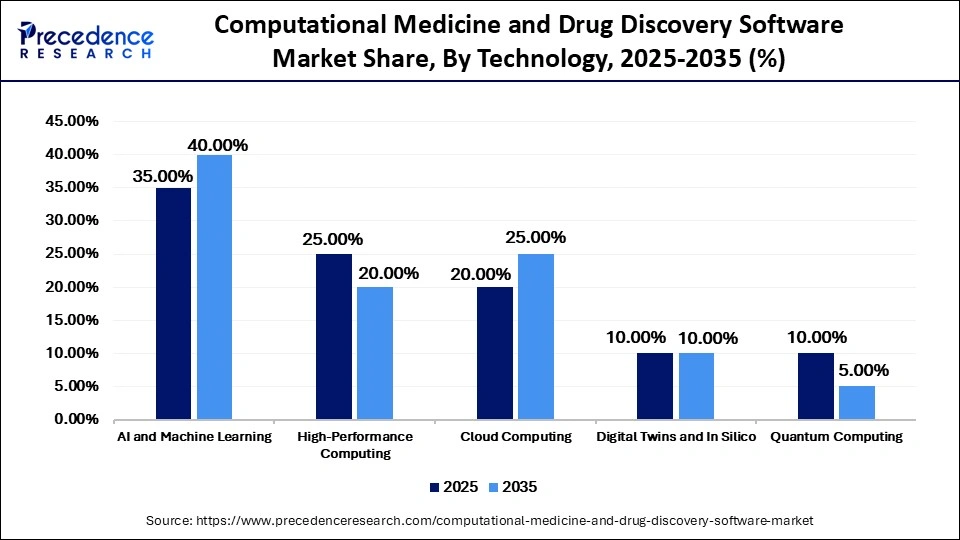
The high-performance computing segment held a 25% share of the market in 2025 and is expected to grow at a CAGR of 15.5% between 2026 and 2035, supported by its role in large-scale simulations. It enables complex calculations and faster processing for advanced drug discovery workflows.
The digital twins and in silico segment held a 10% share of the market in 2025 and is expected to grow at a CAGR of 20% between 2026 and 2035, due to the rising need for virtual simulation of biological systems. It helps test drug behavior digitally, reducing risks and development costs.
Application Insights
The Lead Discovery and Optimization Segment Dominate the Market in 2025
The lead discovery and optimization segment dominated the computational medicine and drug discovery software market with a share of 28% in 2025, driven by the growing use of AI in molecule design. These tools help identify and refine drug candidates quickly, reducing time and cost in early-stage research. Their ability to improve success rates makes them a critical part of modern drug discovery workflows.
The target identification and validation segment held a 20% share of the market in 2025 and is expected to grow at the fastest CAGR of 22.5% between 2026 and 2035, supported by advances in genomics and biomarker research. It helps identify precise drug targets, improving accuracy and efficiency in early discovery stages.
Computational Medicine and Drug Discovery Software Market Share, By Application, 2025-2035 (%)
| Application | 2025 | 2035 | CAGR (%) |
| Lead Discovery and Optimization | 28.00% | 30.00% | 20.5% |
| Target Identification and Validation | 20.00% | 22.00% | 22.5% |
| Preclinical Testing | 18.00% | 16.00% | 17.5% |
| Clinical Trial Simulation | 17.00% | 16.00% | 16.5% |
| Personalized Medicine | 17.00% | 16.00% | 19.5% |
The preclinical testing segment is expected to grow at a CAGR of 17.5% between 2026 and 2035, driven by its role in reducing failure rates before human trials. It improves safety assessment and decision-making in drug development.
The clinical trial simulation segment is expected to grow at a CAGR of 16.5% between 2026 and 2035, due to its ability to improve trial efficiency. It helps optimize study design, reduce costs, and accelerate timelines.
Deployment Mode Insights
Computational Medicine and Drug Discovery Software Market Share, By Deployment Mode, 2025-2035 (%)
| Deployment Mode | 2025 | 2035 | CAGR (%) |
| Cloud-based | 60.00% | 68.00% | 22.5% |
| On-premise | 30.00% | 22.00% | 13.5% |
| Hybrid | 10.00% | 10.00% | 18.5% |
The Cloud-based Segment Led the Market with a 60% Share in 2025
The cloud-based segment led the computational medicine and drug discovery software market with the largest share of 60% in 2025, driven by its scalability and ability to support seamless collaboration. It allows researchers to access powerful tools and large datasets without heavy infrastructure investment. Faster deployment, cost efficiency, and remote accessibility are key factors strengthening its leading position in drug discovery workflows.
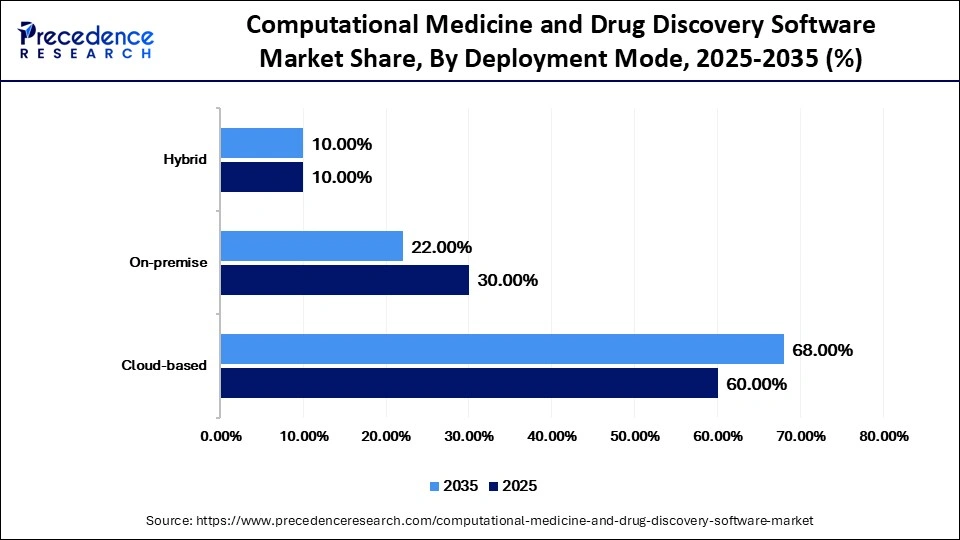
The hybrid segment held a 10% market share in 2025 and is expected to expand at the fastest CAGR of 18.5% between 2026 and 2035, as hybrid solutions offer a balance between security and flexibility. Organizations use these solutions to combine cloud benefits with control over sensitive data.
The on-premise segment held a 30% market share in 2025 and is expected to grow at a CAGR of 13.5% between 2026 and 2035, driven by strict data control and compliance requirements. It remains preferred by organizations handling highly sensitive research data.
Therapeutic Area Insights
What Made Oncology the Dominant Segment in the Market in 2025?
The oncology segment dominated the computational medicine and drug discovery software market with a 35% share in 2025, driven by high RandD focus and significant unmet medical needs. Drug discovery efforts are heavily concentrated on cancer due to its complexity and rising global burden. Advanced computational tools and AI are helping accelerate innovation, making oncology a key area for continued investment and development.
The neurological disorders segment held a 20% share of the market in 2025 and is expected to grow at the fastest CAGR of 20.5% between 2026 and 2035, supported by the complexity of CNS diseases. Growing research efforts and the need for effective treatment are driving rapid adoption.
Computational Medicine and Drug Discovery Software Market Share, By Therapeutic Area, 2025-2035 (%)
| Therapeutic Area | 2025 | 2035 | CAGR (%) |
| Oncology | 35.00% | 38.00% | 21.0% |
| Neurological Disorders | 20.00% | 22.00% | 20.5% |
| Cardiovascular Diseases | 15.00% | 14.00% | 17.0% |
| Infectious Diseases | 15.00% | 13.00% | 16.5% |
| Rare Diseases | 15.00% | 13.00% | 19.5% |
The cardiovascular diseases segment held a 15% share of the market in 2025 and is expected to grow at a CAGR of 17% between 2026 and 2035, driven by rising cases of chronic heart conditions. Focusing on long-term disease management supports demand for advanced solutions.
The infectious diseases segment held a 15% market share in 2025 and is expected to grow at a CAGR of 16.5% between 2026 and 2035, due to ongoing vaccine and antiviral development. Global health priorities and rapid response research are fueling segmental growth.
End-Use Insights
Pharmaceutical and Biotech Companies Dominated the Market in 2025
The pharmaceutical and biotech companies segment held the largest market share of 55% in 2025, driven by strong drug pipelines and continuous RandD investments. These companies rely heavily on computational tools to accelerate discovery and improve success rates. Their focus on innovation, faster development timelines, and commercialization is reinforcing their leading position in the market.
Computational Medicine and Drug Discovery Software Market Share, By End-Use, 2025-2035 (%)
| End-Use | 2025 | 2035 | CAGR (%) |
| Pharma and Biotech Companies | 55.00% | 58.00% | 20.0% |
| Academic and Research Institutes | 25.00% | 22.00% | 15.5% |
| CROs | 20.00% | 20.00% | 19.0% |
The CROs segment held a 20% share of the market in 2025 and is expected to grow at the fastest CAGR of 19% between 2026 and 2035, driven by increasing outsourcing of research and development activities. Pharma and biotech companies are leveraging CRO expertise to reduce costs, improve efficiency, and speed up drug discovery processes.
The academic and research institutes segment held a 25% share of the market in 2025 and is expected to grow at a CAGR of 15.5% between 2026 and 2035, supported by strong early-stage innovation. Rising research funding and a focus on discoveries are driving the adoption of advanced computational tools.
Regional Isnights
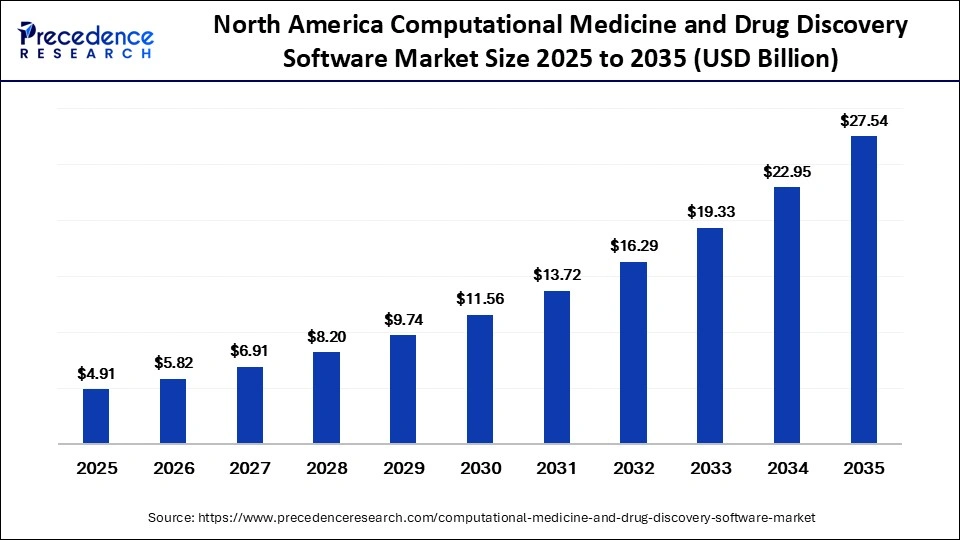
North America Computational Medicine and Drug Discovery Software Market Size and Growth 2026 to 2035
The North America computational medicine and drug discovery software market size is estimated at USD 4.91 billion in 2025 and is projected to reach approximately USD 27.54 billion by 2035, with a 18.82% CAGR from 2026 to 2035.
Why Did North America Lead the Market in 2025?
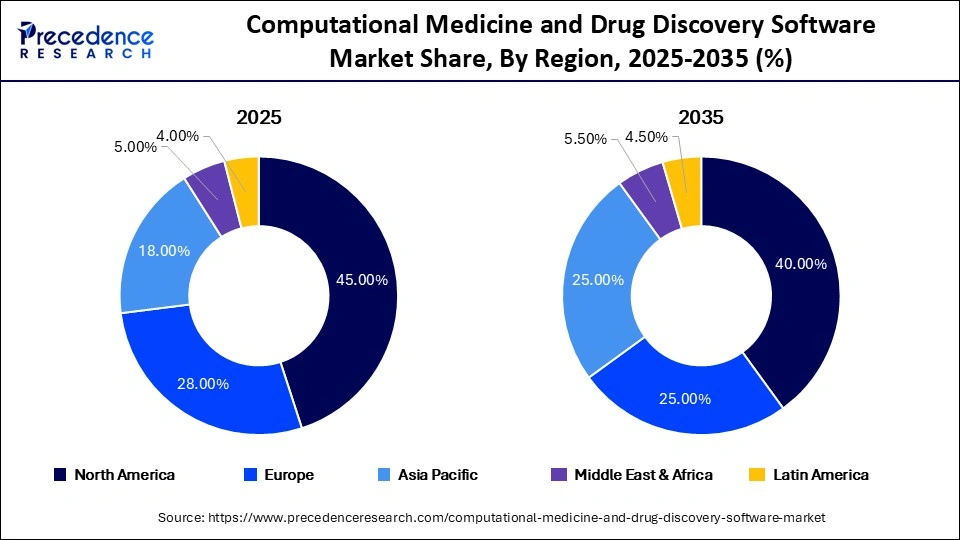
North America led the computational medicine and drug discovery software market with a 45% share in 2025, driven by a strong pharmaceutical RandD ecosystem and rapid adoption of AI technologies. The region benefits from advanced digital infrastructure, high healthcare spending, and strong collaboration between tech and biotech firms. Continuous innovation and investment are supporting leadership in computational drug discovery.
U.S. Computational Medicine and Drug Discovery Software Market Size and Growth 2026 to 2035
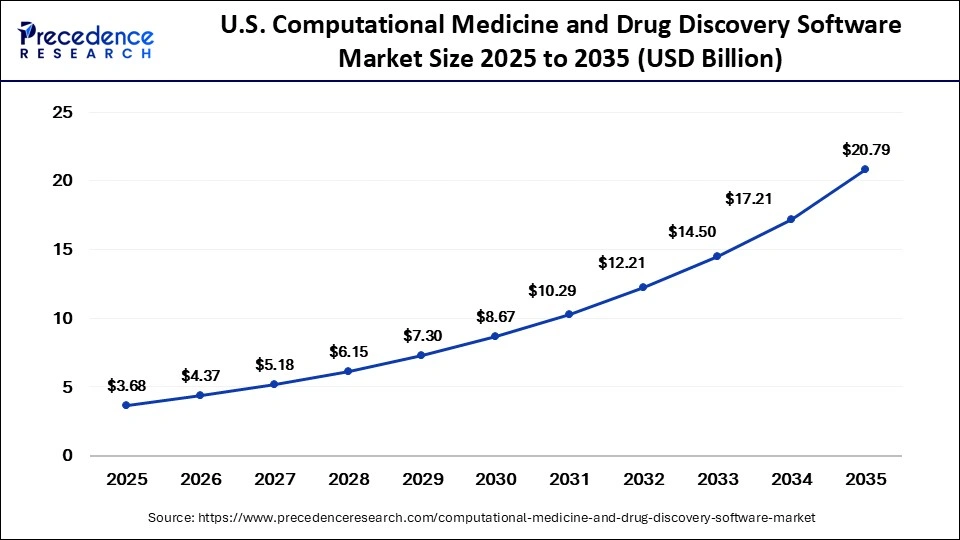
The U.S. computational medicine and drug discovery software market size is calculated at USD 3.68 billion in 2025 and is expected to reach nearly USD 20.79 billion in 2035, accelerating at a strong CAGR of 18.91% between 2026 and 2035.
U.S. Market Analysis
The U.S. remains the largest contributor within North America, supported by leading pharmaceutical companies, top research institutions, and strong venture funding. The country's early adoption of AI and cloud technologies is accelerating drug discovery processes. A well-established regulatory framework and access to large datasets further strengthen its position.
Why is Asia Pacific Undergoing the Fastest Growth in the Market?
Asia Pacific held a 18% share of the market in 2025 and is expected to grow at the fastest CAGR of 22.5% between 2026 and 2035. This growth is driven by rapid biotech expansion and rising investments. Growing digital transformation, increasing healthcare demand, and supportive government policies are encouraging the adoption of computational tools in drug discovery across the region.
China Market Analysis
China plays a major role in the market within Asia Pacific, supported by large-scale investments in AI and biotechnology. The country is rapidly expanding its data center infrastructure and research capabilities. Government initiatives promoting innovation and a strong focus on domestic pharmaceutical development are accelerating the adoption of advanced drug discovery technologies.
India Market Analysis
India is emerging as a rapidly growing market due to its expanding biotech sector and cost-effective research environment. Increasing startup activity, government support for digital health, and rising adoption of AI tools are driving growth. A large talent pool and growing collaborations with global firms are further strengthening the ecosystem.
Europe Market Analysis
Europe held a 28% share of the computational medicine and drug discovery software market in 2025 and is expected to expand at a 17% CAGR in the coming years, driven by strong collaborative research networks and regulatory support. The region emphasizes data privacy and ethical AI use, encouraging responsible innovation. Government funding programs and partnerships between academia and industry are supporting consistent growth in computational drug discovery.
Computational Medicine and Drug Discovery Software Market Companies
- Entelos Inc
- Crown Bioscience Inc
- Chemical Computing Group Inc
- Nimbus Therapeutics Inc
- Schrodinger Llc
- Dassault Systemes
- Genedata Ag
- Biognos Ab
- Leadscope Inc
- Rhenovia Pharma Limited
- Compugen
Recent Developments
- In April 2026, Amazon's cloud unit launched Amazon Bio Discovery, an artificial intelligence application designed to speed early-stage drug discovery by allowing scientists to run complex computational workflows without writing code.(Source: https://www.reuters.com)
- In January 2026, Cambridge, Massachusetts, Insilico Medicine (“Insilico”, HKEX:03696), a clinical-stage biotechnology company driven by generative artificial intelligence (AI), announced the demonstration of its Nach01 multimodal foundation model deployed on Microsoft Discovery, Microsoft's science-focused platform designed to accelerate research and development through agentic AI. (Source: https://insilico.com)
- In April 2026, Fathom Therapeutics, a drug design company aiming to solve one of biology's most complex challenges, secured an oversubscribed $47 million Series A financing round to advance its novel approach of using quantum physics and artificial intelligence to create medicines for previously untreatable diseases.(Source: https://briefglance.com)
- In December 2025, India's Ministry of Science and Technology has developed PathGennie, an open-source software that accelerates drug discovery by accurately tracking drug–protein unbinding pathways without artificial bias.(Source: https://indianmasterminds.com)
- In April 2026, Anthropic acquired Coefficient Bio, a stealth biotech AI startup founded barely eight months ago, in an all-stock deal worth just over $400 million. The acquisition brings a team of fewer than 10 people, nearly all former Genentech computational biology researchers, into Anthropic's healthcare and life sciences division.(Source: https://thenextweb.com)
Segments Covered in the Report
By Software Type
- Molecular Modeling and Simulation Software
- Bioinformatics and Genomics Software
- AI-driven Drug Discovery Platforms
- Clinical Trial Simulation Software
- Data Integration and Management Platforms
- Laboratory Informatics and Workflow Software (LIMS/ELN)
By Technology
- Artificial Intelligence and Machine Learning (AI/ML)
- High-Performance Computing (HPC)
- Cloud Computing
- Quantum Computing (Emerging)
- Digital Twins and In Silico Modeling
By Application
- Target Identification and Validation
- Lead Discovery and Optimization
- Preclinical Testing and Toxicity Prediction
- Clinical Trial Design and Simulation
- Personalized Medicine and Biomarker Discovery
By Deployment Mode
- Cloud-based Software
- On-premise Software
- Hybrid Deployment
By End-Use
- Pharmaceutical and Biotechnology Companies
- Academic and Research Institutes
- Contract Research Organizations (CROs)
By Therapeutic Area
- Oncology
- Neurological Disorders
- Cardiovascular Diseases
- Infectious Diseases
- Rare Diseases
By Region
- North America
- Europe
- Asia Pacific
- Middle East and Africa
- Latin America
For inquiries regarding discounts, bulk purchases, or customization requests, please contact us at sales@precedenceresearch.com
Frequently Asked Questions





Ask For Sample
No cookie-cutter, only authentic analysis – take the 1st step to become a Precedence Research client
 Get a Sample




 sales@precedenceresearch.com
 Schedule a Meeting
