



Data Center Liquid Cooling Manifolds Market Trends, Companies, Revenue / Sales Performance, Subscriber Growth, Pricing Strategies, Cloud Adoption, Infrastructure Expansion, Competitive Landscape, and Industry Outlook
Data Center Liquid Cooling Manifolds Market (By Manifold Type: Supply Manifolds, Return Manifolds, Integrated Supply & Return Manifolds; By Cooling Technology: Direct-to-Chip Liquid Cooling, Rear Door Heat Exchanger, Cold Plate Cooling; By Material: Stainless Steel, Aluminum, Copper, Engineering Plastics and Composites; By Number of Ports: Up to 8 Ports, 9-16 Ports, Above 16 Ports; By Mounting Type: Rack-mounted Manifolds, Cabinet-mounted Manifolds, Floor-mounted Manifolds; By Flow Rate: Below 50 LPM, 50-150 LPM, Above 150 LPM; By Data Center Type: Enterprise Data Centers, Colocation Data Centers, Edge Data Centers; By Application: Enterprise IT, Telecommunications; By End User: Cloud Service Providers, Telecom Operators; By Distribution Channel: Direct Sales, Value-Added Resellers, Industrial Distributors) - Global Industry Analysis, Size, Trends, Leading Companies, Regional Outlook, and Forecast 2026 to 2035
Source: https://www.precedenceresearch.com/data-center-liquid-cooling-manifolds-market
 Get a Sample
 Table Of Content


Data Center Liquid Cooling Manifolds Market Size and Forecast 2026 to 2035
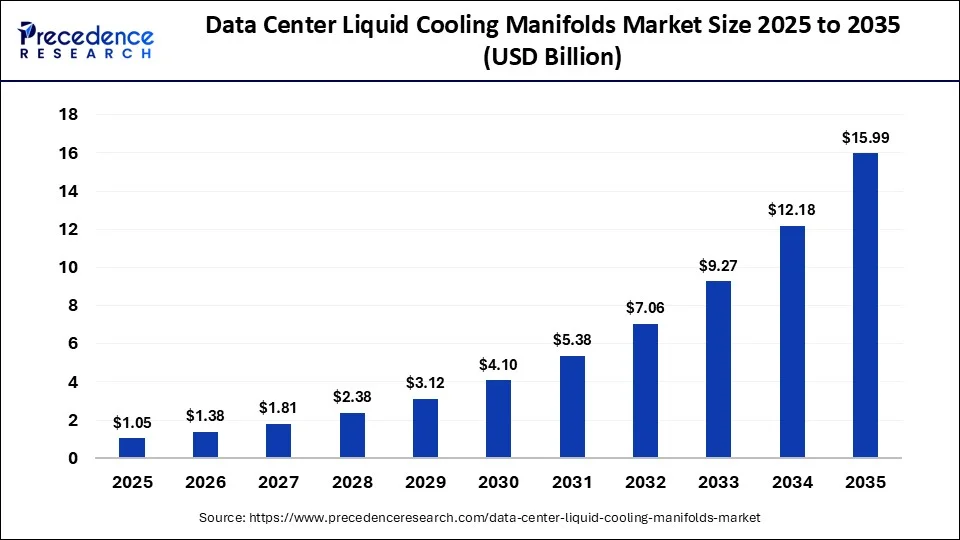
The global data center liquid cooling manifolds market size accounted for USD 1.05 billion in 2025 and is predicted to increase from USD 1.38 billion in 2026 to approximately USD 15.99 billion by 2035, expanding at a CAGR of 31.30% from 2026 to 2035. The market growth is attributed to the rising adoption of direct liquid cooling technologies and the increasing demand for energy-efficient thermal management solutions that support high-density computing infrastructure.
Key Takeaways
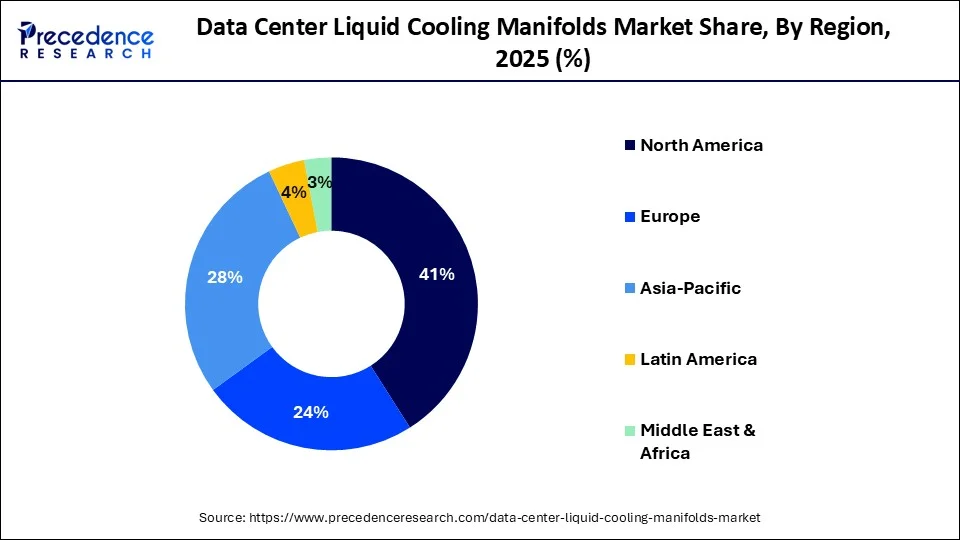
- North America dominated the data center liquid cooling manifolds market with 41% of the market share in 2025.
- Asia-Pacific is expected to register a rapid growth of 35.7% CAGR during 2026 and 2035.
- By manifold type, the supply manifolds segment contributed the highest market share of 38% in 2025.
- By manifold type, the integrated supply and return manifolds segment is expected to grow at the fastest CAGR of 34.8% between 2026 and 2035.
- By cooling technology, the direct-to-chip liquid cooling segment held a major market share of 58% in 2025.
- By cooling technology, the immersion cooling segment is expected to register the fastest growth of 39.8% CAGR during 2026 and 2035.
- By material, the stainless steel segment contributed the highest data center liquid cooling manifolds market share of 46% in 2025.
- By material, the engineering plastics and composites segment is estimated to grow at a strong CAGR of 37.2% over the projected period.
- By application, the AI and high-performance computing (HPC) segment held a 46% share of the market in 2025 and is expected to grow at a rapid CAGR of 36.8% between 2026 and 2035.
- By application, cloud computing held the second-largest market share of 28% during 2026 and 2035.
- By end user, the cloud service providers segment contributed the highest market share of 41% in 2025 and is expected to grow at the highest CAGR of 35.9% between 2026 and 2035.
- By end user, colocation operators held the second-largest market share of 26% in 2025.
Market Overview
The rapid expansion of high-performance computing (HPC) and hyperscale data centers is driving demand for advanced liquid cooling manifold solutions. The International Energy Agency (IEA) forecasts a 3.7% rise in global electricity demand in 2026. This trend toward increased energy consumption for digital infrastructure and large-scale computer systems reinforces that energy is tied to technological functions.
Data center liquid cooling manifolds precisely distribute coolant amongst cooling distribution units and high-density server racks. They provide balanced cooling flow and efficient removal of advanced processors' and accelerators' heat. Furthermore, investments in AI infrastructure and the development of energy-efficient thermal management systems are expected to bolster the market in the coming years.
Impact of Artificial Intelligence on the Data Center Liquid Cooling Manifolds Market
Artificial intelligence (AI) raises the cooling demands and power densities of racks in modern data centers. That driving the need for AI data center liquid cooling manifolds to step up the pace of innovation in hypercomputation.
AI can be used to perform smart thermal management, which involves tracking heat levels and adjusting coolant flows as needed. Furthermore, major technology players, including NVIDIA, Dell Technologies, Supermicro, Hewlett Packard Enterprise, Vertiv, and Schneider Electric, are rolling out AI-ready liquid-cooled data center server platforms to enhance cooling infrastructure solutions.
Data Center Liquid Cooling Manifolds Market Growth Factors
- Growing Deployment of Prefabricated Data Centers: Rising adoption of prefabricated and containerized data centers is accelerating the installation of standardized liquid cooling manifolds.
- Boosting Investments in Next-Generation Semiconductor Infrastructure: Expanding production of high-performance AI processors is strengthening demand for advanced liquid cooling manifold technologies across modern data centers.
Data Center Liquid Cooling Manifolds Market Trends
- Digital Twin-Based Cooling Optimization Enhancing Manifold Performance: Operators began to put into use more digital twin platforms to optimise the flow of coolants through liquid cooling networks. In real-time hydraulic simulations, small pressure imbalances were detected prior to impacting server performance. Intelligent manifold management continues improving infrastructure reliability and cooling efficiency throughout AI facilities.
- Universal Quick-Disconnect Manifold Interfaces Becoming Industry Priority: Equipment vendors made continued progress in offering standardized and multi-vendor quick-disconnect liquid cooling ecosystems. Their simplified design of the connectors and greater serviceability in dense AI server deployments. The deployment of liquid-cooled infrastructure around the globe is continuing to ramp up at a fast pace with increasing interoperability.
Market Report Coverage and Key Metrics
| Report Coverage | Details |
| Market Size in 2025 | USD 1.05 Billion |
| Market Size in 2026 | USD 1.38 Billion |
| Market Size by 2035 | USD 15.99 Billion |
| Market Growth Rate from 2026 to 2035 | CAGR of 31.30% |
| Dominating Region | North America |
| Fastest Growing Region | Asia Paicfic |
| Base Year | 2025 |
| Forecast Period | 2026 to 2035 |
| Segments Covered | Product Type, Formulation, Application, End User, Distribution Channel, and Region |
| Regions Covered | North America, Europe, Asia-Pacific, Latin America, and Middle East & Africa |
Market Dynamics
Drivers
Increasing Deployment of AI and HPC Infrastructure
Increasing deployment of AI and HPC infrastructure is expected to drive the market. Compared to traditional enterprise servers, AI clusters must run at higher thermal loads due to their high-performance GPUs.
Liquid cooling manifolds are used to distribute the coolant to direct-to-chip cooling loops. This ensures uniform cooling temperatures in the densely stacked compute racks. Furthermore, investments in hyperscale AI facilities are facilitating the long-term demand for engineered liquid cooling distribution systems, which continues to grow in the coming years.
- According to the International Data Center Authority, global AI infrastructure investments are projected to surpass USD 400 billion by 2030.
Restraint
High Installation and Infrastructure Upgrade Costs
High installation and infrastructure upgrade costs are expected to hinder large-scale deployment of liquid cooling manifold systems across existing data center facilities. Capital costs are driven up, and deployment times are lengthened for complex retrofit projects for enterprise operators. These financial and engineering challenges continue to restrain market growth in the coming years.
Opportunity
Rising Focus on Energy-Efficient Data Center Operations
Rising focus on energy-efficient data center operations is projected to create immense opportunities for liquid cooling manifold technologies. Sustainability is a business priority, and companies increasingly use liquid cooling infrastructure for better Power Usage Effectiveness (PUE) and for cost optimisation. Additionally, the increasing installation of high-density server racks is boosting precision coolant distribution system requirements.
Market Segmentation Analysis
Manifold Type Insights
The Supply Manifolds Segment Dominated the Market with 38% of Market Share in 2025
The supply manifolds segment dominated the data center liquid cooling manifolds market with a share of 38% in 2025, due to growing deployment of direct-to-chip liquid cooling across AI server infrastructure. They provide an equal flow of cool liquid from the cooling distribution units to a variety of server nodes.
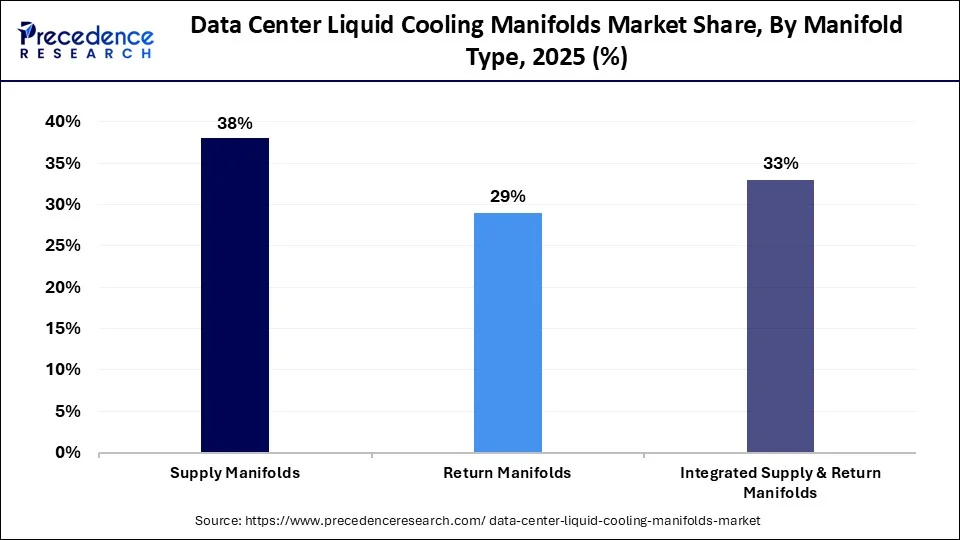
The integrated supply and return manifolds segment held 33% of the market share in 2025 and is expected to grow at the fastest CAGR of 34.8% between 2026, owing to the increasing preference for compact liquid cooling architectures. The integrated configuration minimizes piping complexity and supports installation efficiency in modern data centers.
The return manifolds segment held a 29% share in 2025, driven by its critical role in collecting and routing warmed coolant from the server racks to cooling distribution units (CDUs). They remove the heat, balance fluid velocity flow, and have secure thermal management in high-density data centers.
Cooling Technology Insights
The Direct-to-Chip Liquid Cooling Segment Dominated the Market with 58% of Market Share in 2025
The direct-to-chip liquid cooling segment dominated the data center liquid cooling manifolds market with a share of 58% in 2025, due to the growing demand for highly powerful AI servers. The method is efficient in removing heat and achieving a higher computing density within contemporary server racks. Furthermore, these operational benefits played a big part in increasing their adoption across hyperscale and enterprise data center deployments.
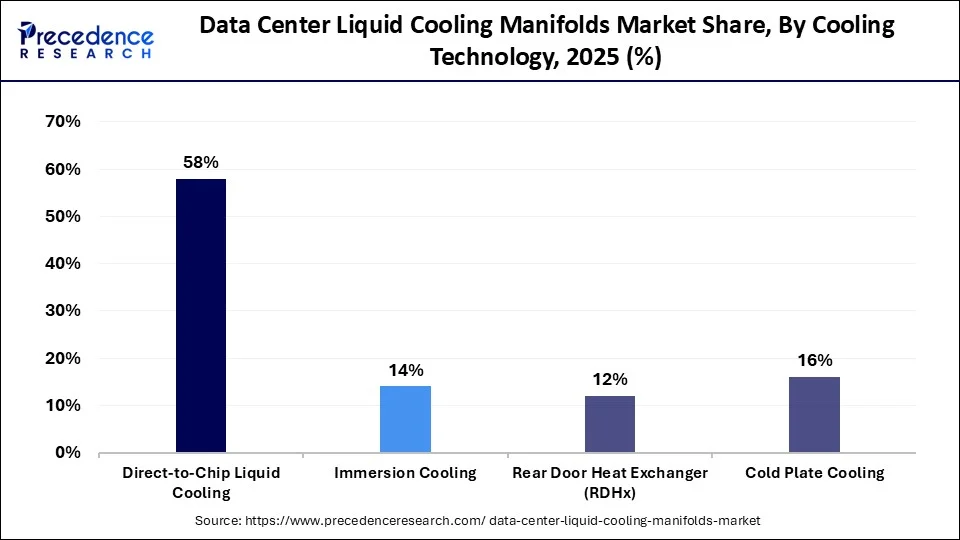
The immersion cooling segment held 14% of the market share in 2025 and is expected to grow at the highest CAGR of 39.8% between 2026 and 2035, owing to the increasing deployment of ultra-high-density AI and high-performance computing infrastructure. This setup uses the same configuration as a standard workstation setup, but eliminates the server fan and enhances cooling for extensive compute volumes.
The cold plating cooling segment held a 16% share in 2025 and is expected to grow at a CAGR of 28.9% during the forecast period, supported by its ability to greatly ease infrastructure upgrades without the need to upgrade the whole rack. The designs of the cold plates also enabled efficient thermal management for CPUs, GPUs, and advanced accelerators.
Material Insights
The Stainless Steel Segment Led the Market with 46% of Market Share in 2025
The stainless steel segment led the data center liquid cooling manifolds market with a share of 46% in 2025, as it delivers superior thermal efficiency, maximum durability, and the capability to resist high temperatures. Data center operators opted for stainless steel manifolds since they have a long service life.
The engineering plastics and composites segment held 7% of the market share in 2025 and is expected to grow at a rapid CAGR of 37.2% between 2026 and 2035, owing to the rise in demand for lightweight and corrosion-resistant cooling infrastructure. Segment growth is further bolstered by a degree of continuous innovation that is ongoing with engineered materials for next-generation data centre cooling architecture.
The aluminium segment held a 29% share in 2025 and is expected to grow at a CAGR of 32.4% during the forecast period, as it provides lightweight manifold mountings for a modern liquid cooling system. Precision machining of aluminium is driving its rising use among manufacturers for the ability to build precision coolant channels and successfully integrate connectors.
Application Insights
The AI and High-Performance Computing (HPC) Segment Held the Largest Market Share of 46% in 2025
The AI and high-performance computing (HPC) segment held the largest revenue share of 46% in the data center liquid cooling manifolds market in 2025 and is expected to grow at the highest CAGR of 36.8% between 2026 and 2035, due to the rapid deployment of power-dense computing infrastructure across hyperscale data centers. The liquid cooling manifolds ensure the accurate distribution of the coolant to the processors. This ensures stable operating temperatures during continuous AI operations. Data center operators increasingly put these systems in place in order to increase the power density of their racks.
Data Center Liquid Cooling Manifolds Market Share, By Application, 2025 (%)
| Application | 2025 | 2035 | CAGR (%) |
| AI & High-Performance Computing (HPC) | 46 | 57 | 36.80% |
| Cloud Computing | 28 | 24 | 28.70% |
| Enterprise IT | 12 | 8 | 22.10% |
| Scientific Computing | 8 | 7 | 30.50% |
| Telecommunications | 6 | 4 | 24.60% |
The cloud computing segment held a 28% share of the market in 2025 and is expected to grow at a CAGR of 28.7% during the forecast period, due to the use of high-density server architectures with global cloud providers that demand efficient and reliable liquid cooling networks. Deployment in newly built hyperscale facilities was simplified with standard EI designs of manifold systems.
The enterprise IT segment held a 12% market share in 2025 and is expected to grow at a CAGR of 22.1% during the forecast period, driven by increasing modernization of private data centers supporting business-critical digital applications. Computing centers modernized their computing facilities, enhancing both processing and electricity cost efficiencies. Liquid cooling manifolds ensured dependable cooling of enterprise servers used for virtualization, analytics, and database applications.
End User Insights
The Cloud Service Providers Segment Dominated the Market with 41% of Market Share in 2025
The cloud service providers segment dominated the data center liquid cooling manifolds market with a share of 41% in 2025 and is expected to grow at the highest CAGR of 35.9% between 2026 and 2035, due to surging AI infrastructure deployments in hyperscale computing campuses globally. Such organizations need high-end liquid cooling manifold products to provide efficient cooling for thousands of server racks.
Data Center Liquid Cooling Manifolds Market Share, By End User, 2025 (%)
| End User | 2025 | 2035 | CAGR (%) |
| Cloud Service Providers | 41 | 49 | 35.90% |
| Colocation Operators | 26 | 24 | 29.50% |
| Enterprises | 15 | 10 | 21.90% |
| Government & Defense | 8 | 7 | 27.40% |
| Research Institutions | 6 | 6 | 31.00% |
| Telecom Operators | 4 | 4 | 26.20% |
The International Energy Agency (IEA) claims it has estimated global power use in data centers at around 1.5% in 2024, showing fast-growing cooling needs. Standardized manifold systems also allow easy expansion of infrastructure in hyperscale facilities experiencing rapid growth.
The colocation operators segment held a 26% share of the market in 2025 and is expected to grow at a CAGR of 29.5% during the forecast period, due to increasing demand for AI-ready facilities supporting enterprise and hyperscale customers. Infrastructure use is optimized with precision coolant distribution, and a consistent thermal performance is ensured in multi-tenant setups. Standardized manifold systems also make server installations with liquids easier.
The enterprises segment held a 15% market share in 2025 and is expected to grow at a CAGR of 21.9% in the coming years, due to the use of AI-powered applications in private and hybrid data center infrastructure. Manifold assembly of the modern variety also made it easy to adapt to enterprise liquid cooling designs, which enabled long-term infrastructure modernization.
Market Regional Analysis: North America, Europe, Asia-Pacific
Which Factors Drive the Data Center Liquid Cooling Manifolds Market in North America?
North America held a major market share of 41% in 2025, due to its efforts toward investing in AI factories, hyperscale campuses, and high-density computing infrastructure. Liquid cooling manifolds are being deployed by regional operators to accommodate next-generation clusters of GPUs.
Amazon Web Services developed and installed a fully customized liquid cooling system in under 11 months for its next-generation AI infrastructure for 2025. Furthermore, the region's technology leadership is being further solidified with the active involvement of the hyperscalers and cooling solution providers.
U.S. Data Center Liquid Cooling Manifolds Market Size and Growth 2026 to 2035
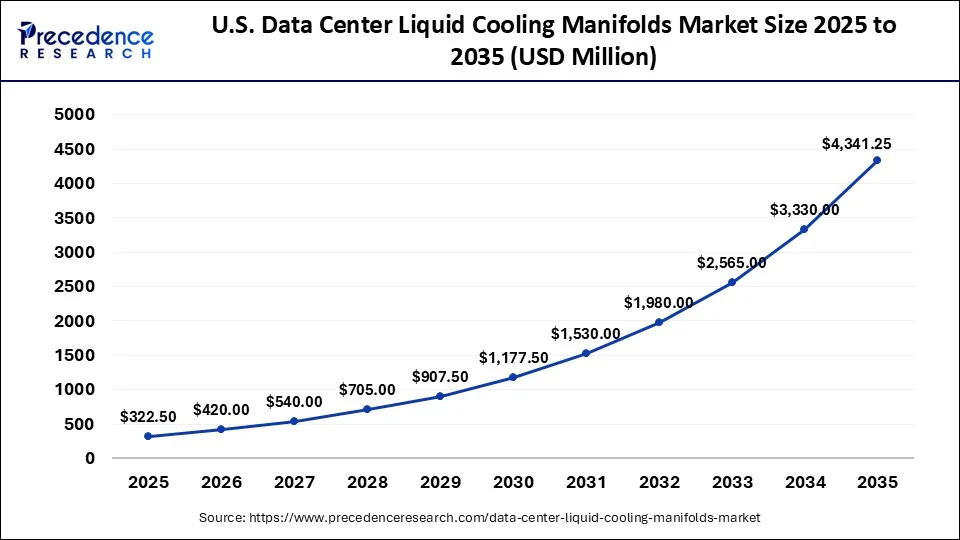
The U.S. data center liquid cooling manifolds market size was evaluated at USD 322.50 million in 2025 and is projected to reach around USD 4,341.25 million by 2035, growing at a CAGR of 29.69% from 2026 to 2035.
U.S. Driving North America's Liquid Cooling Manifolds Leadership in 2025
U.S. leads the market because its major cloud providers are continuing to build more campuses of GPUs where microgrids with advanced liquid cooling manifold systems are used. Liquid cooling industry giants also saw gains for liquid cooling products that help computing infrastructure rapidly grow, including Vertiv and Schneider Electric.
How is Asia-Pacific Growing in the Data Center Liquid Cooling Manifolds Market?
Asia-Pacific held the second-largest market share of 28% in 2025 and is expected to grow at a strong CAGR of 35.7% over the projected period, supported by the expansion of semiconductor manufacturing and investments in AI computing solutions. Liquid-cooled servers with ever more power-dense AI infrastructure keep hitting the market in the region.
Lenovo, Huawei, Inspur, and Fujitsu enhanced liquid-cooled server lines to meet growing enterprise and cloud-side needs. Furthermore, Vertiv expects the penetration and adoption of hybrid and liquid cooling technologies to increase in AI-based infrastructure moving into 2025.
China Leading Asia-Pacific's Liquid Cooling Manifolds Expansion
China is a major contributor to the market due to the presence of advanced computing infrastructure that demands precision liquid cooling technologies. AI clusters with liquid cooling for generative, cloud, and scientific research applications are becoming commonplace in domestic technology companies. In 2025, Huawei and Inspur further enhanced their AI powerhouse infrastructure with advanced liquid-cooled computing systems.
How will Europe Grow Significantly in the Data Center Liquid Cooling Manifolds Market?
Europe held a 24% share of the market in 2025 and is expected to grow at a 30.5% CAGR between 2026 and 2035, driven by digital infrastructure initiatives focused on sustainability and investment in major technology hubs. New environmental regulations promote the use of extremely effective thermal management techniques in all newly built structures. These programs drive increased market penetration of next-generation technologies in the field of liquid cooling in Europe.
Germany Powering Europe's Rapid Liquid Cooling Manifolds Growth
In Germany, the market is growing due to hyperscale infrastructure and the transition to digitalisation in manufacturing. Advanced liquid cooling technologies are becoming an important focus as more companies are implementing and adopting AI in their operations to boost productivity.
Latin America Held a Notable Market Share of 4% in 2025
Latin America held 4% of the market share in 2025 and is expected to grow at a CAGR of 29.8% between 2026 and 2035, due to its growth in cloud infrastructure, AI infrastructure, and increased demand for regional Insider digital services. High-density AI servers operating under challenging conditions necessitate effective thermal management, leading to increased focus on liquid cooling manifolds.
- During 2025, Amazon Web Services announced a USD 4 billion investment establishing its first cloud region in Chile, further boosting the demand for liquid cooling manifolds in the coming years.
Brazil Expanding Data Center Liquid Cooling Manifolds Opportunities Across Latin America
Brazil is a major player in the market, fuelled by growing cloud solutions and investments in hyperscale digital facilities. AI's regional demand is continuing to drive the growth of high-density data centers that demand efficient liquid cooling services.
Will the Middle East and Africa Grow in the Data Center Liquid Cooling Manifolds Market?
The Middle East and Africa region held 3% of the market share in 2025 and is expected to grow at a strong CAGR of 28.5% between 2026 and 2035, fueled by national AI initiatives. High ambient temperature needs highly efficient cooling, especially in these regions. Liquid cooling manifolds have the advantage of better cooling performance and can also ensure stability when used in an AI server in an extreme environment.
UAE Accelerating Data Center Liquid Cooling Manifolds Production in the Middle East and Africa
In the UAE, the market is boosted by high ambient temperatures. This boosts the requirement for accurate operation and highly efficient liquid cool manifolds systems. Direct liquid cooling for new-generation GPU clusters is being more widely adopted by data center operators in this region.
Data Center Liquid Cooling Manifolds Market Value Chain Analysis
- Material & Precision Component Sourcing
Manufacturers procure stainless steel, aluminum, engineering plastics, seals, valves, connectors, and precision tubing for manifold production.
Key Players: Parker Hannifin, Swagelok, Victaulic, Alfa Laval, Danfoss, Eaton, Legrand.
- Manifold Design, Fabrication & System Integration
Companies manufacture, machine, assemble, and test liquid cooling manifolds before integrating them with advanced cooling distribution systems.
Key Players: Vertiv, Schneider Electric, CoolIT Systems, LiquidStack, Boyd, JetCool, nVent.
- Data Center Deployment & End-User Integration
Completed manifold systems are deployed across hyperscale, colocation, and enterprise data centers supporting AI and HPC infrastructure.
Key Players: Microsoft, Amazon Web Services, Google, Meta, Equinix, Digital Realty, Dell Technologies.
Market Competitive Landscape: Leading Companies and Strategies
The data center liquid cooling manifolds market is moderately consolidated and led by the established engineering companies. Leading companies in complete liquid cooling solutions are Vertiv, Schneider Electric, CoolIT Systems, and LiquidStack. Competition is bolstered by these specialist contributors to the thermal aspects of ASUS, JetCool, Submer, ZutaCore, and Asperitas. Server makers are increasingly partnering with cooling vendors to provide an integrated AI infrastructure.
In 2025, JetCool, Flex, launches a liquid-cooled Dell PowerEdge XE7745 platform with a unified deployment and maintenance offering. In 2025, NVIDIA's Blackwell Ultra platform facilitates the trend of advanced coolant distribution technologies. Patent activity is increasing throughout the industry, and investments in continuous engineering remain unique, leading to further competition in all regions of the world for liquid cooling infrastructure.
Data Center Liquid Cooling Manifolds Market Companies
- Vertiv
- Stulz
- Schneider Electric (Motivair)
- Rittal
- LiquidStack
- Green Revolution Cooling (GRC)
- CoolIT Systems
- Boyd
- Asetek
- Alfa Laval
Recent Developments Data Center Liquid Cooling Manifolds Market (2025-2026)
- In June 2026, JetCool, a Flex company, announced a liquid-cooled version of the Dell PowerEdge XE7745 server. This integrated solution includes deployment, maintenance services, and unified warranty coverage, reducing complexity for enterprise customers. JetCool offers a streamlined approach for adopting cost-effective, high-density AI infrastructure.(Source: https://investors.flex.com)
- In June 2026, Google launched Brazos, a rack-mounted liquid cooling system that allows data centers to support high-power AI and HPC chips exceeding 1000 watts without the need for facility upgrades. Brazos enables the use of liquid-cooled equipment within existing air-cooled data centers.(Source: https://cloud.google.com)
Segments Covered in the Report
By Manifold Type
- Supply Manifolds
- Return Manifolds
- Integrated Supply & Return Manifolds
By Cooling Technology
- Direct-to-Chip Liquid Cooling
- Immersion Cooling
- Single-phase Immersion Cooling
- Two-phase Immersion Cooling
- Rear Door Heat Exchanger (RDHx)
- Cold Plate Cooling
By Material
- Stainless Steel
- Aluminum
- Copper
- Engineering Plastics and Composites
By Number of Ports
- Up to 8 Ports
- 9-16 Ports
- Above 16 Ports
By Mounting Type
- Rack-mounted Manifolds
- Cabinet-mounted Manifolds
- Floor-mounted Manifolds
By Flow Rate
- Below 50 LPM
- 50-150 LPM
- Above 150 LPM
By Data Center Type
- Enterprise Data Centers
- Colocation Data Centers
- Hyperscale Data Centers
- Edge Data Centers
By Application
- AI and High-Performance Computing (HPC)
- Cloud Computing
- Enterprise IT
- Scientific Computing
- Telecommunications
By End User
- Cloud Service Providers
- Colocation Operators
- Enterprises
- Government and Defense
- Research Institutions
- Telecom Operators
By Distribution Channel
- Direct Sales (OEM)
- System Integrators
- Value-Added Resellers (VARs)
- Industrial Distributors
By Region
- North America
- Latin America
- Europe
- Asia-pacific
- Middle and East Africa
For inquiries regarding discounts, bulk purchases, or customization requests, please contact us at sales@precedenceresearch.com
Frequently Asked Questions





Ask For Sample
No cookie-cutter, only authentic analysis – take the 1st step to become a Precedence Research client
 Get a Sample




 sales@precedenceresearch.com
 Schedule a Meeting
