



Debt Collection Software Market Trends, Companies, Revenue / Sales Performance, Subscriber Growth, Pricing Strategies, Cloud Adoption, Infrastructure Expansion, Competitive Landscape, and Industry Outlook
Debt Collection Software Market (By Component: Services, Software; By Deployment: On-premise, Cloud; By Enterprise Size: Large Enterprises, Small & Medium Enterprises; By End-User: Healthcare, Financial Institutions, Collection Agencies, Government, Telecom & Utilities, Others (Real Estate & Retail) - Global Industry Analysis, Size, Trends, Leading Companies, Regional Outlook, and Forecast 2026 to 2035
Source: https://www.precedenceresearch.com/debt-collection-software-market
 Get a Sample
 Table Of Content


What is the Debt Collection Software Market Size in 2026?
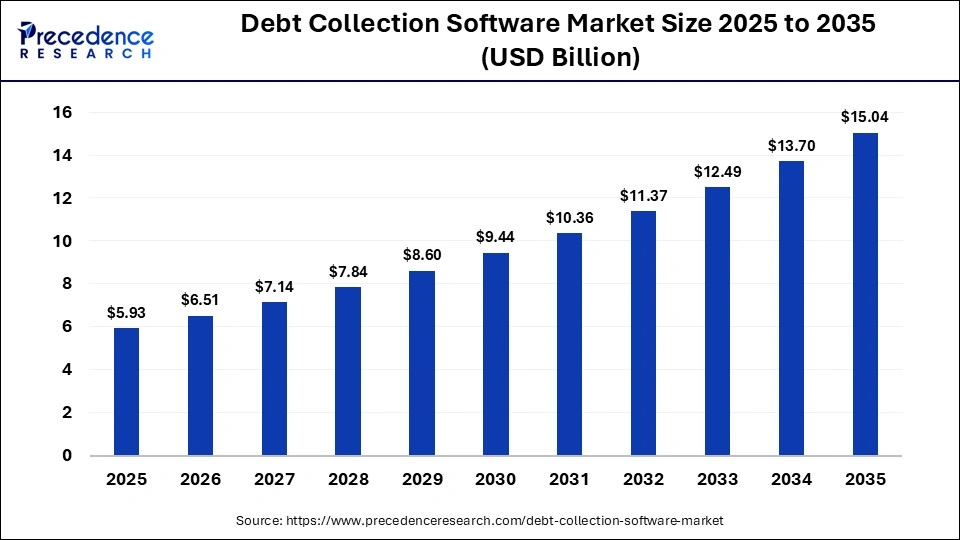
The global debt collection software market size was calculated at USD 5.93 billion in 2025 and is predicted to increase from USD 6.51 billion in 2026 to approximately USD 15.04 billion by 2035, expanding at a CAGR of 9.76% from 2026 to 2035. This market is growing due to increasing demand for automated, efficient, and compliant debt recovery solutions across financial institutions.
Key Takeaways
- North America dominated the global debt collection software market with the largest market share of 33% in 2025.
- Asia Pacific is expected to grow at the fastest CAGR between 2026 and 2035.
- By component, the software segment held the biggest market share of 68% in 2025.
- By component, the services segment is expected to expand at the fastest CAGR between 2026 and 2035.
- By deployment, the cloud segment contributed to the highest market share in 2025.
- By deployment, the on-premise segment is expected to grow at a strong CAGR between 2026 and 2035.
- By enterprise size, the large enterprises segment held a major market share in 2025.
- By enterprise size, the SME segments is expected to expand at the fastest CAGR from 2026 to 2035.
- By end user, the financial institutions segment held the biggest market share in 2025.
- By end user, the telecom & utilities segment is expected to expand at the fastest CAGR between 2026 and 2035.
What Drives the Growth of the Debt Collection Software Market?
The debt collection software market is experiencing steady growth as banks, collection agencies, and financial institutions use digital solutions more frequently to expedite recovery procedures and boost operational effectiveness. Organizations are being encouraged to switch from manual to automated debt collection systems due to the growing number of non-performing loans, requirements for regulatory compliance, and the need for customer-centric communication. Further supporting market expansion is the integration of cutting-edge technologies like artificial intelligence analytics and cloud-based platforms, which are improving collection strategies, increasing recovery rates, and lowering operating costs.
Government Initiatives Supporting the Debt Collection Software Market
| Initiative Area | Description | Impact on Market |
| Data Protection Regulations | Governments are enforcing strict data privacy laws to safeguard consumer financial data. | Increase demand for secure and compliant debt collection software. |
| Fair Debt Collection Policies | Regulations ensure ethical and transparent communication with borrowers. | Encourages adoption of software with compliance and monitoring features. |
| Digital Banking Initiatives | Promotion of digital payments and online financial services. | Drive the need for automated and integrated collection solutions. |
| Financial Inclusion Programs | Expansion of credit access to underserved populations. | Leads to higher loan volumes, increasing demand for collection systems. |
| Fintech Promotion Policies | Support for innovation in financial technologies and startups. | Boosts development and adoption of advanced debt collection platforms. |
| Cloud Adoption Support | Government-backed digital infrastructure and cloud initiatives. | Accelerates shift toward scalable, cloud-based collection software. |
How is Artificial Intelligence Transforming the Debt Collection Software Market?
The market for debt collection software is changing significantly thanks to artificial intelligence, which makes recovery procedures smarter, quicker, and more individualized. AI-powered tools can analyze large volumes of consumer data to predict repayment patterns, prioritize high-risk accounts, and recommend optimal collection strategies. Features like chatbots, automated reminders, and NLP enhance customer engagement while ensuring regulatory compliance. This not only improves recovery rates but also reduces operating costs and boosts overall efficiency for financial institutions and collection agencies.
Key Trends in the Debt Collection Software Market
- Growing Adoption of AI and Machine Learning: Organizations are increasingly using AI-driven tools to predict customer behavior, automate decision-making, and improve recovery rates.
- Shift Toward Cloud-Based Solutions: Cloud deployment is gaining traction due to its scalability, cost-effectiveness, and ease of integration across financial systems.
- Rise of Omnichannel Communication: Companies are adopting multi-channel approaches such as SMS, email, chatbots, and voice calls to improve customer engagement.
- Focus on Regulatory Compliance: Strict regulations are driving the demand for compliant software that ensures transparent and ethical debt collection practices.
- Integration of Advanced Analytics: Data analytics is being used to gain insights into customer profiles, optimize strategies, and enhance decision-making.
- Increasing Use of Automation: Automation reduces manual intervention, speeding up processes and improving operational efficiency in debt collection.
- Demand for Customer-Centric Solutions: Companies are focusing on personalized communication strategies to enhance customer experience and maintain relationships.
- Expansion in Emerging Markets: Rising financial inclusion and growing lending activities in developing regions are creating new growth opportunities for market players.
Market Scope
| Report Coverage | Details |
| Market Size in 2025 | USD 5.93 Billion |
| Market Size in 2026 | USD 6.51 Billion |
| Market Size by 2035 | USD 15.04 Billion |
| Market Growth Rate from 2026 to 2035 | CAGR of 9.76% |
| Dominating Region | North America |
| Fastest Growing Region | Asia Pacific |
| Base Year | 2025 |
| Forecast Period | 2026 to 2035 |
| Segments Covered | Component, Deployment, Enterprise Size, End-User, and Region |
| Regions Covered | North America, Europe, Asia-Pacific, Latin America, and Middle East & Africa |
Market Dynamics
Drivers
The market growth is driven by the growing need for effective recovery solutions and the growing number of non-performing loans. To increase collection efficiency and guarantee regulatory compliance, organizations are implementing automated and data-driven technologies.
Restraint
The market faces significant obstacles from stringent regulations and worries about data privacy. Adoption may also be restricted by high implementation costs and problems with integration with legacy systems. Furthermore, the necessity of maintaining compliance with evolving global financial regulations and protecting consumer data against increasing cybersecurity threats adds a layer of complexity to system deployment.
Opportunity
The increasing use of AI, machine learning, and cloud-based solutions in financial institutions creates immense opportunities in the market. The rapid shift toward digital and customer-centric collection strategies also opens up the door for market expansion. The rise of automated negotiation tools and virtual assistants is streamlining the settlement process, allowing for 24/7 debt resolution without the need for human intervention.
Segment Insights
Component Insights
Debt Collection Software Market Share, By Component, 2025 (%)
| Component | 2025 |
| Services | 32% |
| Software | 68% |
What Made Software the Dominant Segment in the Debt Collection Software Market?
The software segment dominated the market with the largest share in 2025, as businesses rely heavily on automated platforms to guarantee regulatory compliance, enhance recovery rates, and optimize collection workflows. Businesses are able to effectively handle high volumes of past-due accounts thanks to sophisticated features of software like omnichannel communication, automated reminders, predictive dialing, and AI-driven analytics. Additionally, end-to-end debt collection software solutions are becoming more widely used across industries due to the growing need to lower operating costs and improve customer engagement.
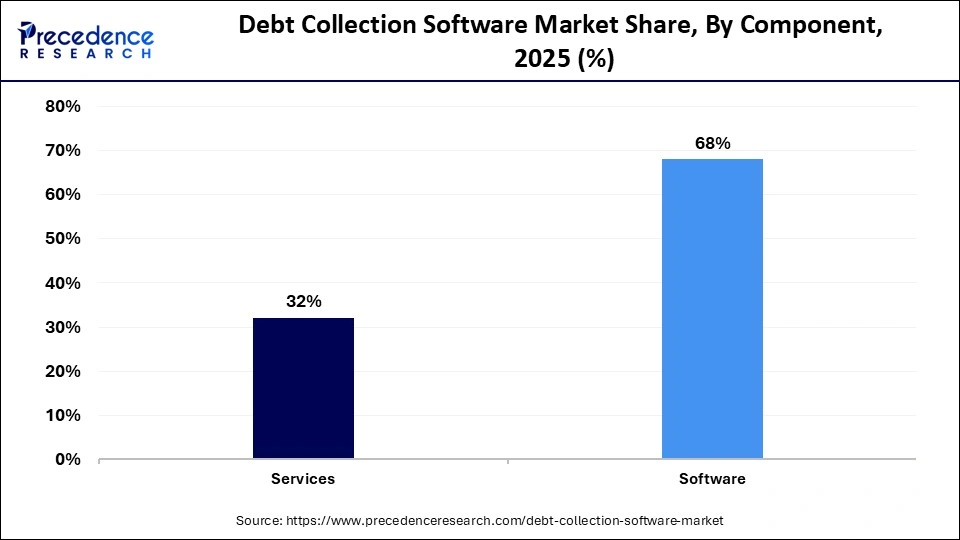
The services segment is expected to grow at the fastest CAGR in the coming years because of the growing need for training, integration, implementation, and continuing support services. Businesses need professional help as they implement sophisticated cloud-based debt collection systems to guarantee smooth deployment and customization. Additionally, companies are investing in managed and consulting services due to ongoing regulatory framework updates and the need for system optimization, which is accelerating the growth of this market.
Deployment Insights
Why Did the Cloud Segment Dominate the Debt Collection Software Market?
The cloud segment dominated the market in 2025 because of its affordability, scalability, and adaptability. With cloud-based debt collection software, businesses can easily integrate with financial and CRM systems, automate procedures, and access real-time data. Additionally, it facilitates remote operations, which are becoming more crucial in contemporary workplaces. The dominance of the segment is further reinforced by cloud solutions' quicker deployment and lower initial infrastructure investment requirements.
The on-premise segment is expected to grow at the fastest CAGR in the coming years because worries about privacy, data security, and regulatory compliance are growing. To keep complete control over their systems and data storage, financial institutions and large enterprises that handle sensitive customer data prefer on-premise deployment. On-premise solutions are also being adopted by businesses in highly regulated industries to reduce cybersecurity risks and adhere to stringent compliance requirements.
Enterprise Size Insights
Why Did the Large Enterprises Segment Dominate the Debt Collection Software Market?
The large enterprises segment dominated the market with a major share in 2025. This is because of the need to manage massive volumes of accounts receivable and complex collection processes. These organizations can invest in advanced AI-powered software with analytics and automation features to enhance efficiency. Their continued adoption is also motivated by the need to maintain regulatory compliance across multiple regions while improving overall operational performance.
The SMEs segment is expected to grow at the fastest CAGR in the coming years because they are becoming aware of the advantages of using digital debt collection services. To increase cash flow, decrease manual labor, and improve customer communication, small and medium-sized businesses are implementing inexpensive cloud-based platforms. SMEs are being encouraged to invest in debt collection software by the availability of subscription-based pricing models and simple-to-deploy solutions.
End-User Insights
Why Did the Financial Institutions Segment Dominate the Debt Collection Software Market?
The financial institutions segment dominated the market in 2025 since they handle a lot of loans, credit card payments, and other financial obligations and are the main users of debt collection software. To manage past-due accounts, guarantee regulatory compliance, and maximize recovery tactics, banks and lending organizations need sophisticated tools. The use of advanced debt collection systems in this market is further propelled by the growing complexity of financial products and the rise in non-performing assets.
The telecom & utilities segment is expected to grow at the fastest CAGR in the coming years because of the growing number of subscribers and complicated billing. Businesses in this industry deal with large amounts of recurring payments and past-due accounts, so effective debt collection systems are crucial. Utility and telecom companies are increasing recovery rates and customer retention using automated communication tools, real-time tracking, and customer-centric collection tactics.
Regional Insights
North America Debt Collection Software Market Size and Growth 2026 to 2035
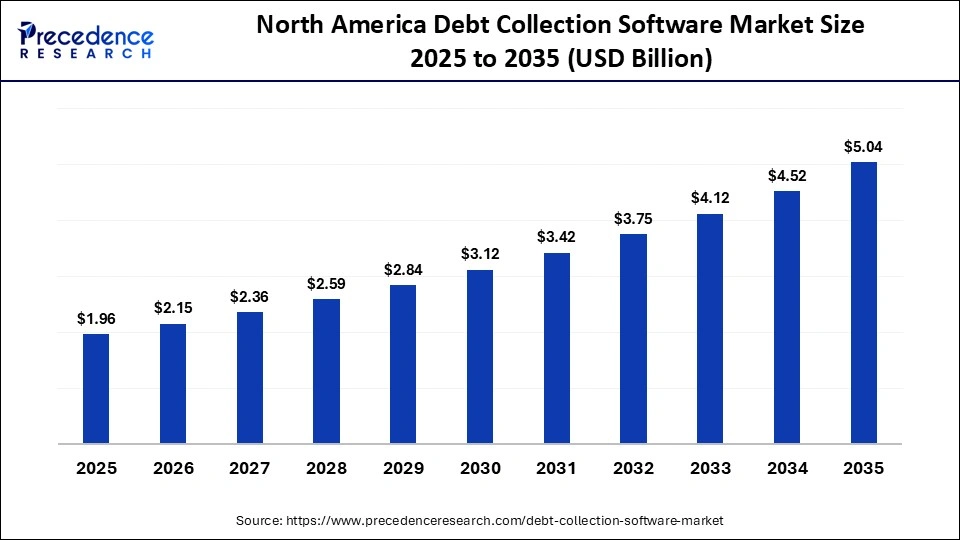
The North America debt collection software market size is estimated at USD 1.96 billion in 2025 and is projected to reach approximately USD 5.04 billion by 2035, with a 9.90% CAGR from 2026 to 2035.
What Made North America the Dominant Region in the Debt Collection Software Market?
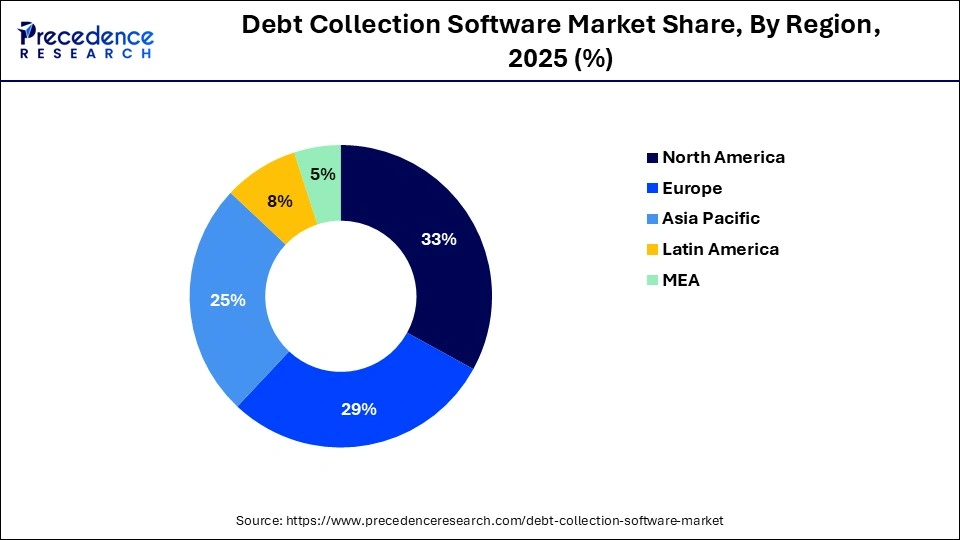
North America dominated the debt collection software market while holding the largest share of 33% in 2025. This leadership is driven by the presence of well-established financial institutions and advanced technology infrastructure, which enabled early adoption of AI-driven solutions. The region's clear regulatory framework promotes automated, compliant debt collection practices, giving companies confidence to deploy advanced software. Additionally, high digitalization levels and the presence of key market players further reinforced North America's leadership in the market.
U.S. Debt Collection Software Market Size and Growth 2026 to 2035
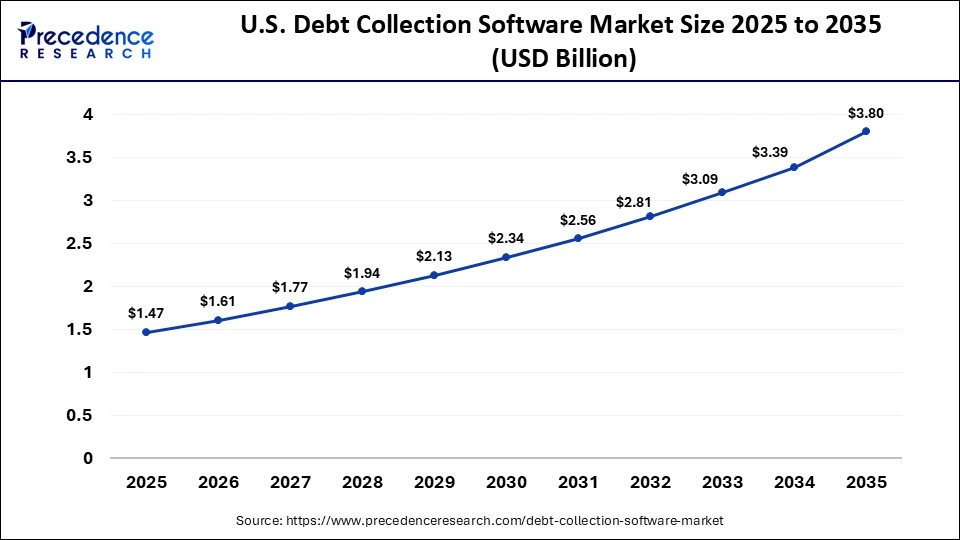
The U.S. debt collection software market size is calculated at USD 1.47 billion in 2025 and is expected to reach nearly USD 3.80 billion in 2035, accelerating at a strong CAGR of 9.96% between 2026 and 2035.
U.S. Debt Collection Software Market Analysis
The U.S. leads the market within North America due to the quick integration of data analytics, machine learning, and artificial intelligence into debt collection procedures. To increase recovery rates, businesses are concentrating on individualized and customer-centric strategies and utilizing predictive analytics. The need for transparent and compliant debt collection solutions is also being driven by growing consumer protection legislation and stringent regulatory requirements.
How is the Opportunistic Rise of Asia Pacific in the Debt Collection Software Market?
Asia Pacific is expected to grow at the fastest CAGR in the coming years, driven by the growth of the banking and telecom sectors, rapid digital transformation, and rising financial inclusion. Increasing awareness of automated debt recovery solutions and the growing number of loans and credit users are further expanding the market. Additionally, significant fintech investments in emerging economies are accelerating the adoption of debt collection software across the region.
India Debt Collection Software Market Trends
The market in India is growing due to the growth of fintech firms and digital lending platforms. Institutions are being encouraged to use automated and compliant collection solutions due to the rise in nonperforming assets and the demand for digital financial services. The nation's market expansion is also being aided by government programs that support digital payments and financial inclusion.
Debt Collection Software Market Companies
- FICO (Fair Isaac Corporation)
- Experian
- TransUnion
- Equifax
- FIS (Fidelity National Information Services)
- Oracle
- SAP
- CGI Inc.
- Pegasystems
- Temenos
- HighRadius
- Credgenics
- Spocto (Yubi Group)
- Daylit
- Gaviti
- Versapay
- Growfin
- Kolleno
Recent Developments
- In January 2026, Spocto X announced the launch of agentic AI to transform end-to-end debt collections. The platform utilizes autonomous AI agents to manage complex borrower journeys across digital and voice channels with minimal human intervention. The initiative aims to improve recovery rates and ensure regulatory compliance through empathetic, hyper-personalized engagement. (Source: https://bfsi.economictimes.indiatimes.com)
- In October, Neowise, a Decentro group subsidiary, launched two generative AI-powered solutions: NeoBot (Debt Collection VoiceBot) and NeoSight (AI Call Analytics). Developed with Bangalore-based Sarvam AI, these LLM-driven tools enhance debt recovery, boosting efficiency by ~15% and cutting costs by ~33%.(Source: https://www.expresscomputer.in)
Segments Covered in the Report
By Component
- Services
- Software
By Deployment
- On-premise
- Cloud
By Enterprise Size
- Large Enterprises
- Small & Medium Enterprises
By End-User
- Healthcare
- Financial Institutions
- Collection Agencies
- Government
- Telecom & Utilities
- Others (Real Estate & Retail)
By Region
- North America
- Latin America
- Europe
- Asia-pacific
- Middle and East Africa
For inquiries regarding discounts, bulk purchases, or customization requests, please contact us at sales@precedenceresearch.com
Frequently Asked Questions





Ask For Sample
No cookie-cutter, only authentic analysis – take the 1st step to become a Precedence Research client
 Get a Sample




 sales@precedenceresearch.com
 Schedule a Meeting
