



Delivery Drone Market Trends, Companies, Market Size, Competitive Positioning, and Growth Outlook
Delivery Drone Market (By Drone Type: Fixed-wing Delivery Drones, Rotary-wing Delivery Drones, Hybrid VTOL Delivery Drones; By Payload Capacity: Less than 2 kg, 2-5 kg, 5-10 kg, Above 10 kg; By Range: Less than 25 km, 25-100 km, Above 100 km; By Operation Mode: Fully Autonomous, Semi-autonomous, Remotely Piloted; By Application: Food Delivery, Healthcare and Medical Supply Delivery, E-commerce and Parcel Delivery, Retail Delivery, Postal Services, Industrial and Commercial Logistics, Military and Defense Logistics, Emergency and Disaster Relief, Others; By End User: Logistics and Transportation Companies, E-commerce Companies, Healthcare Organizations, Government and Defense, Food and Beverage Companies, Retail Companies, Others; By Propulsion Type: Battery-powered, Hybrid-electric, Hydrogen Fuel Cell-powered) - Global Industry Analysis, Size, Trends, Leading Companies, Regional Outlook, and Forecast 2026 to 2035
Source: https://www.precedenceresearch.com/delivery-drone-market
 Get a Sample
 Table Of Content


Delivery Drone Market Size and Forecast 2026 to 2035
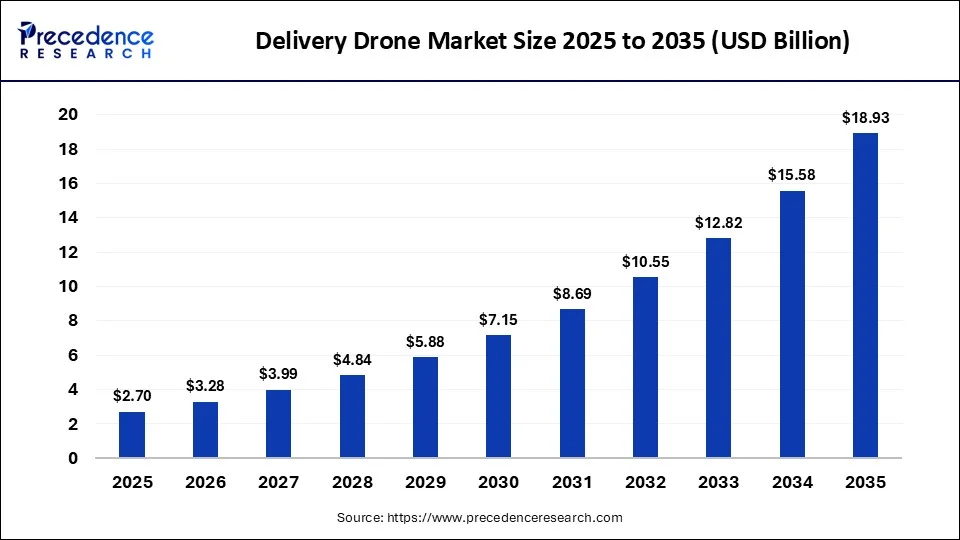
The global delivery drone market size is predicted to increase from USD 3.28 billion in 2026 to approximately USD 18.93 billion by 2035, expanding at a CAGR of 21.50% from 2026 to 2035.
Key Takeaways
- By drone type, the rotary-wing delivery drones segment captured the highest market share of 32% in 2026.
- By drone type, the hybrid VTOL delivery drones segment is poised to grow at a healthy CAGR of 8.5% between 2026 and 2035.
- By application, the e-commerce and parcel delivery segment held a major market share of 32% in 2026.
- By application, the healthcare and medical supply delivery segment is expected to expand at a notable CAGR of 24.30% from 2026 to 2035.
Executive Summary
The market is entering a new era of logistical efficiency and rapid last-mile fulfillment. Delivery by drones has moved beyond isolated, rural test sites. Consumers now associate fast, sustainable delivery with everyday convenience, and these expectations are driving traditional retail giants and quick-service restaurants to integrate autonomous drones into their core supply chains. Autonomous unmanned aerial vehicles are being developed with an emphasis on specific logistical needs, with a focus on heavy payload capacities, extended flight ranges, battery reliability, and low-altitude urban noise reduction.
The year 2026 is shaping up to be crucial for these drone delivery trends. The area is already being commercialized through strategic consolidation and infrastructure investment. The impact of these services on expedited delivery times and reduced urban carbon emissions has been validated both clinically and commercially. This demonstrates that autonomous drone technology can provide genuine efficiency improvements, rather than merely serving marketing purposes. These developments are indicating the future growth trajectory of this sector, particularly as larger companies take action.
Market Size and Growth Outlook
The global delivery drone market size was estimated at USD 3.28 billion in 2026 and is projected to reach approximately USD 18.93 billion by 2035, expanding at a CAGR of 21.50% from 2026 to 2035. The market is witnessing substantial growth driven by the intense demand for faster, more reliable medical and emergency supply logistics, which overcomes ground traffic constraints to mitigate critical transit times. This growth is further attributed to the rapid advancements in drone-in-a-box infrastructure, VTOL technologies, and BVLOS regulatory approvals, spurring significant enterprise investments across vital applications.
Executive Business Highlights
The delivery drone market is shifting toward multi-rotor, battery-electric systems driven by growth in retail, e-commerce, and healthcare logistics. North America remains a dominant region, with increasing investment potential in Drone-as-a-Service (DaaS) and AI-based BVLOS technologies. North America dominated the global market, fostered by sprawling suburbs, high demand for rapid retail and medical logistics, and FAA regulatory approvals. Meanwhile, the Asia-Pacific region is the fastest-growing market, with China and Japan leveraging aerospace expertise, which shows high growth through manufacturing incentives.
Strategic Insights for Decision Makers
To unlock the delivery drone market's potential, manufacturers and logistics providers must co-design hardware for extended payload capacity and optimal cold-chain compliance. E-commerce companies should leverage autonomous routing for 30-minute last-mile delivery, while healthcare organizations are recommended to integrate uncrewed aerial vehicle (UAV) networks directly into hospital inventories.
Aviation regulators must establish standardized, risk-based certifications, and technology providers should develop robust communication and AI-driven airspace management tools to ensure systemic safety. Finally, investors should fund scalable platforms backed by strong regulatory partnerships and clinical validations.
Market Trends Analysis
- Commercial Expansion of Autonomous Delivery Networks: The market is transforming from pilot programs to scalable, fully autonomous operations. Companies such as Zipline and Wing are rapidly scaling hub-and-spoke networks to bypass traffic and deliver retail parcels and essentials directly to consumers efficiently.
- AI and Advanced Flight Navigation Technologies: AI and ML are the structural framework for modern drone operations. AI-powered software now enables BVLOS operations through real-time route optimization, dynamic obstacle avoidance, and precise autonomous landing. AI also drives predictive maintenance and fleet management by lowering downtime and human intervention.
- Growing Adoption in Healthcare Logistics: Healthcare logistics is the highest-growth application for drones. UAVs offer a crucial, time-sensitive lifeline for transporting blood samples, vaccines, and emergency medicines to remote or traffic-congested areas. Recently, players like Matternet and Swoop Aero operate dedicated medical delivery networks that dramatically reduce transit times.
- Hybrid VTOL and Long-Range Drone Development: To balance heavy payload capacities with extended range, the industry is favoring VTOL designs. These aircraft take off and land vertically like a multirotor but fly horizontally using fixed wings, allowing for higher payloads and long-range operations without requiring runway infrastructure.
- Hydrogen and Alternative Propulsion Technologies: To meet sustainability goals and extend flight endurance, manufacturers are testing hydrogen fuel cells and hybrid-electric propulsion systems. Hydrogen power provides a significantly higher energy density than traditional lithium-ion batteries, enabling longer flight times with the mitigation of only water vapor.
- Smart City Integration: Drones are being actively integrated into smart logistics ecosystems, necessitating UTM systems and urban air mobility infrastructure to safely manage thousands of flights in dense urban airspaces simultaneously.
Delivery Drone Industry Ecosystem Analysis
Industry Ecosystem Structure
The delivery drone market ecosystem features an interdependent supply and service chain that links hardware production to end-user services. It also depends on component suppliers, battery makers, and tech developers to build and guide the aircraft by allowing logistics operators to safely execute last-mile deliveries under strict regulatory frameworks.
Hardware and software developers, which include OEM manufacturers, AI providers, and telecom companies, are combining to equip drones with the essential physical structure, navigation, and real-time cellular tracking. Overall, this network enables efficient deliveries for end users such as e-commerce consumers, healthcare facilities, and food services.
Stakeholder Mapping
The market is having a great collaborative ecosystem. OEMs build the physical aircraft, while navigation and cloud systems, including UTM, which assures safe as well as obstacle-free flights. Combined with strict regulatory bodies, these foundational stakeholders represent the safety standards required for everyday commercial operations.
Building on this infrastructure, fleet operators, logistics companies, and retailers work together to route and distribute goods. Furthermore, healthcare providers leverage this network for emergency transport, integrating rapid drone delivery directly into consumer and medical supply chains.
Strategic Partnership Landscape
Collaborations across the market are driven by public-private partnerships uniting drone manufacturers with e-commerce firms, hospitals, and telecom operators.
On May 20, 2026, Datavault AI Inc. entered into a binding term sheet with Wellgistics Health, Inc. to establish DelivMeds AI, focusing on improving healthcare outcomes. This venture includes expanding Datavault's PharmacyChain™ platform, acquiring intellectual property for biometric confirmations, and acquiring Tollo Health, expected to have a combined asset value of approximately $4 billion.
Pricing and Cost Structure Analysis
The expansion of e-commerce has strained traditional logistics, driving interest in autonomous drone technology to enhance speed and lower costs, with emphasizing economic feasibility. Additionally, Delivery drone pricing depends on hardware specifications, operational overheads, and regulatory compliance, ranging from USD 1k for basic models to USD 6k for advanced industrial units. Costs scale with payload, flight range, and software, further accelerated by pilot training, insurance, ground infrastructure, and BVLOS certification requirements.
The financial modeling suggests that a USD 2k drone, capable of 30km+ range at 100kmph, requires a USD 3 fee per delivery to achieve a 10% internal rate of return at eight deliveries daily. This study provides insights for cost-sensitive markets and requires a 14-page format (3rd-year) or 19-page format (4th-year) to evaluate drone implementation in cost-sensitive markets.
Drone Pricing by Platform Type
Delivery drone pricing spans from hundreds to thousands of dollars, depending on range and payload, but comprehensive, AI-integrated systems command steep upfront costs of USD 1k to USD 5k. Ongoing operational expenses, including insurance, maintenance, and fleet management software, typically add another USD 5k to USD 2k per year.
Delivery drone pricing also scales with capability, where fixed-wing drones (USD 20k–USD150k) deliver high speed and extensive area coverage for surveys, but necessitate launch space and higher budgets. Rotary-wing helicopters (USD20k–USD150k) support hovering and heavy payloads for supply drops but are highly expensive. Finally, multicopters (USD3k–USD50k) offer an affordable, accessible solution for photography and inspection, albeit with shorter flight times and limited capacities.
Total Cost of Ownership Analysis
The delivery drone's total cost of ownership evaluation spans high upfront hardware capital, continuous maintenance, degrading lithium-ion batteries, and specialized software. Operations demand certified pilot oversight, regulatory insurance, and automated ground infrastructure. Additionally, pilot training, regulatory BVLOS insurance compliance, and the hardware-level integration of secure no-permission, no-takeoff software frameworks substantially increase the total cost of enterprise drone operations.
Cost Comparison with Conventional Delivery
Drone delivery offers significant reductions in operational costs and delivery times compared to conventional road vehicles, yielding up to 60% savings in low-density rural areas compared to trucks. While heavy e-vans remain cheaper for large-volume, bulk goods, autonomous drones significantly lower last-mile carbon emissions and bypass traffic, providing cost advantages for small, time-critical, or difficult-to-access parcel deliveries.
Return on Investment Analysis
Delivery drone return on investment varies significantly by sector, as in healthcare, it yields high returns through faster transit and preserved cold-chains, in e-commerce and logistics, it reduces last-mile costs via models like Drone-as-a-Service, in industrial returns stem from automated facility inspections, and in government deployments yield high public value through rapid disaster response and public health interventions.
Customer Demand and Adoption Analysis
The demand for delivery drones is particularly for fast e-commerce and emergency healthcare. Adoption across industries is driven by the need for faster delivery, lower carbon footprints, and access to remote regions through urban scalability.
Healthcare and Humanitarian Operations
Drones act as an affordable, life-saving lifeline in remote or disaster-stricken regions. These are also essential in safely transporting temperature-sensitive medical supplies, vaccines, and blood components by bypassing poor road connectivity. Additionally, government evaluations show logistics firms testing drones with user-friendly interfaces to rapidly deliver critical humanitarian aid to hard-to-reach areas.
Retail, E-Commerce, and Food and Beverage
In dense urban markets, consumers demand on-demand delivery for groceries and retail goods. To bypass severe traffic congestion, the quick-commerce and food delivery sectors are adopting drones. This transition helps businesses reduce operational costs and cut travel times by up to compared to traditional bike-based delivery methods.
Adoption by the Commercial Sector
Rapidly expanding commercial drone adoption mitigates last-mile bottlenecks, advanced delivery times, and bypasses traffic, with healthcare and industrial sectors driving intense necessity for cold-chain supplies and urgent transport. Furthermore, the integration of autonomous drones in retail and food delivery is accelerating, alongside increasing utilization for secure tactical transport within defense applications.
Purchasing Decision Factors
- Purchasing decisions in the market depend on the interplay of several operational and technical factors.
- Delivery speed and flight range are governed by battery capacity and payload, with heavier weights minimizing travel distances.
- For wider adoption, companies weigh initial capital outlays against potential time savings.
- Scalability and regulatory compliance necessitate navigating stringent national airspace rules and achieving BVLOS capabilities.
- Reliability and operational costs are heavily influenced by a drone's energy efficiency and autonomous capabilities.
End-user Adoption Barriers
The delivery drone market faces various adoption barriers, including infrastructure constraints necessitating efficient capital for vertiports and charging grids, public trust hindered by privacy and noise concerns, operational complexity driven by battery limitations and weather sensitivity, and integration challenges requiring air traffic management updates. Developing a seamless delivery network requires extensive collaboration with aviation authorities and research agencies. Global acceptance also depends heavily on reducing public apprehension regarding package handling, safety protocols, and airspace regulations.
Regulatory and Airspace Management Analysis
Commercial drone delivery is strictly regulated by authorities like the U.S. FAA and India's DGCA. Operations require drone registration, pilot licensing, and adherence to airspace rules. To scale, these agencies are advancing toward BVLOS and autonomous flight certifications.
Aviation Regulations
Global delivery drone markets are governed by rigorous aviation mandates. In the U.S, the FAA oversees operations through standard Remote Pilot Certificates and strict Part 135 Air Carrier Certifications for commercial deliveries. Whereas, India's DGCA dictates compliance via the Digital Sky platform, mandating strict type certifications, remote pilot licenses, and No-Permission, No-Takeoff (NPNT) airspace protocols. These operational and safety mandates encourage line-of-sight limits and stringent collision-avoidance frameworks.
Beyond Visual Line of Sight (BVLOS) Regulations
BVLOS regulations are evolving from restrictive, case-by-case waivers into standardized frameworks such as the proposed FAA Part 108. Agencies are rapidly evolving to performance-based standards, depending on Detect-And-Avoid (DAA) technologies and new Part 146 Unmanned Traffic Management (UTM) certifications to replace traditional visual observers.
This evolution further scales commercial drone operations from isolated, exempted flights to high-density networks. Thereby, rolling performance data, major logistics operators autonomously deliver packages over populated areas by validating airspace safety without human visual intervention.
Urban Air Traffic Management
Urban Air Traffic Management offers safe routing, separating, and monitoring unpiloted aircraft in dense, low-altitude smart city environments for the market. This ecosystem also features drone corridors for structured routing, automated UTM systems for real-time deconfliction, and smart city initiatives that integrate 5G connectivity and vertiports into urban transit.
Cybersecurity and Data Privacy Regulations
Federal guidelines mandate that comprehensive risk mitigation across all system layers is enforced to secure the delivery drone. According to the National Institute of Standards and Technology and CISA UAS Cybersecurity advisories, the operators must enforce strong encryption for command-and-control links, maintain secure AI governance for autonomous flight, safeguard private customer data, and integrate real-time intrusion detection to ensure safe and hack-resistant airspace operations.
Investment and Innovation Landscape
Investments and innovation are driving market growth, Investments and innovation are driving market growth, mainly due to rapid advancements in AI and lithium-ion battery technology.
Venture Capital and Private Equity Activity
The market is witnessing significant investment with venture and private equity funding targeting startups focused on extending battery life, increasing payload capacity, and autonomous navigation. Commercialization is escalating mainly due to crucial medical supply delivery in remote regions and strong demand for e-commerce, reinforcing significant industry growth. Backed by private investment and evolving regulatory initiatives in major markets, drone-delivery networks are progressing toward commercial-scale deployment.
Mergers, Acquisitions, and Strategic Partnerships
Analyze partnerships among logistics companies, drone manufacturers, retailers, healthcare providers, and governments.
- In June 2026, XTI Aerospace, Inc. announced the addition of the Eiger long-range delivery drone to its portfolio, collaborating with Rigi Technologies SA. The Eiger is a VTOL unmanned aircraft system designed for logistics and delivery missions, capable of covering up to 62 miles BVLOS. This partnership enhances XTI's offerings in the growing drone delivery market, particularly in healthcare and logistics.
Research and Development Landscape
The market is rapidly scaling into a multi-billion-dollar industry. Backed by aviation authorities and research agencies like NASA, the sector focuses on five core technology pillars, including AI for obstacle avoidance, hybrid power and solid-state batteries for longer ranges, UTM systems for safe BVLOS navigation, specialized temperature-controlled payloads, and cloud-based fleet management to lower labor costs.
Patent and Technology Innovation Analysis
Delivery drone innovations mainly emphasize improving endurance and safety. Key breakthroughs include lightweight, solid-state batteries and hydrogen hybrid systems that boost energy density. Furthermore, AI-driven trajectory design and detect-and-avoid technologies now power autonomous flight, greatly enhancing long-range and out-of-sight capabilities.
Market Dynamics
Market Drivers
AI and Battery Technology Supporting Drone Delivery Adoption
Advancements in AI-driven autonomous flight systems, geospatial mapping, and extended-life batteries are fostering drone delivery networks. The rapid growth in e-commerce and quick-service restaurant demands is shifting logistics companies to adopt rapid, contactless last-mile delivery solutions. Additionally, the ongoing scaling of medical drone networks by transporting vaccines and emergency supplies bolsters the market expansion.
Market Restraints
The Impact of Compliance Burdens on Commercial Expansion
Despite its market potential, the market is restrained by stringent airspace regulations and complex BVLOS approvals. Although several urban delivery programs have demonstrated promising results, large-scale commercial deployment remains limited in many densely populated metropolitan areas. Operational challenges such as restricted payload capacities, limited battery range, and sensitivity to harsh weather result in the delay of global consumer adoption.
Market Opportunities
Powering Ecosystems through Strategic Investments and Partnerships
The strong opportunity of the market lies in the rigorous investments and partnerships to reinforce the innovation efforts in the drone delivery ecosystem development. Logistics giants like Amazon and Walmart are actively partnering with drone manufacturers, municipal governments, and technology experts to hasten commercialization efforts. Many stringent regulators like the FAA are working on new rules to enhance operations by efficiently feeding low-altitude airspace management and commercial product pipelines.
Market Challenges
Scaling Infrastructure while Safeguarding the Public
Public resistance to privacy intrusions and noise pollution in residential areas slows down local adoption. Developing the necessary ground infrastructure to support automated drone charging, package loading, and secure landing pads remains a major challenge. Additionally, managing insurance liabilities, complex insurance frameworks, and reliable GPS and telecommunication coverage in remote regions presents ongoing challenges that limit worldwide adoption.
Market Segmentation Analysis
Drone Type Insights
How did Rotary-Wing Delivery Drones Dominate the Delivery Drone Market in 2026?
The rotary-wing delivery drones segment dominated the market with a share of 58% in 2026, mainly stemming from its exceptional vertical take-off and urban last-mile delivery capabilities. This allows them to operate in dense urban environments as well as land in tight and confined spaces. These rotary-wing VTOLs gained massive market traction during global health emergencies, making short-distance logistical delivery highly cost-effective.
The hybrid VTOL delivery drones segment held a 20% share of the market in 2026 and is expected to grow at a significant CAGR of 28.90% between 2026 and 2035, mainly due to combined long-range efficiency with VTOL flexibility for commercial and medical logistics. These drones leverage fixed wings for forward flight for long-range deliveries, as in medical and emergency logistics, without requiring traditional runways.
Payload Capacity Insights
What made the 2-5 kg Segment Dominate the Delivery Drone Market in 2026?
The 2-5 kg segment held the market dominance with a share of 39% in 2026, mainly driven by an increasing demand for e-commerce and medical deliveries by managing payload capacity with flight efficiency. Drones in this class significantly transport blood units, vaccines, and essential diagnostic samples to traffic-congested areas. This also manages the standard weights of retail goods, groceries, and restaurant meals.
The above-10-kg delivery drone segment held an 8% share of the market in 2026 and is expected to grow at the largest CAGR of 26.10% between 2026 and 2035, due to expanding advances in heavy-payload drone technology supporting industrial use cases to improve battery energy densities and next-generation hybrid VTOL. These also connect warehouse-to-warehouse transport and supporting construction sites, as well as offshore rigs.
Range Insights
How did the Less than 25 km Segment Dominate the Delivery Drone Market in 2026?
The less than 25 km segment dominated the market with a share of 48% in 2026, mainly due to increasing demands for the urban and suburban last-mile delivery services and emergency and medical logistics. These short-range drones are highly cost-effective, which necessitates fewer regulatory constraints and reduced warehouse energy by achieving a higher volume of daily flights, making it more economically scalable.
The above-100 km segment held a 13% share of the market in 2026 and is expected to grow at a significant CAGR of 27.80% between 2026 and 2035, due to expanding commercial applications and long-range autonomous operations bringing retail and e-commerce services to underserved rural populations. Combined with AI-powered navigation and advancements in battery technology, governments are actively funding structured drone corridors.
Operation Mode Insights
Why Did the Fully Autonomous Segment Dominate the Delivery Drone Market in 2026?
The fully autonomous segment dominated the market with a 44% share in 2026 and is expected to have the fastest growth with a CAGR of 27.40% during the forecast period, due to AI navigation and BVLOS regulations accelerating autonomous operations to navigate complex environments, detect obstacles, and optimize routes without human intervention. This also provides a single human operator to oversee dozens of drones and enhances business efficiency.
The semi-autonomous segment held the second-largest market share at 34% in 2026, due to a gradual transition toward fully autonomous delivery networks, owing to the ability to monitor multiple vehicles simultaneously by reducing labor costs without abandoning direct human responsibility for safety-critical decisions. Semi-autonomous protocols also allow drones to execute pre-programmed flight paths and obstacle avoidance.
Application Insights
What made E-Commerce and Parcel Delivery Lead the Delivery Drone Market in 2026?
The e-commerce and parcel delivery segment led the market with a share of 32% in 2026, mainly stemming from the online retail drives last-mile delivery automation by emphasizing speed, affordability, and last-mile efficiency. This also allows direct, three-dimensional travel to destination points by lowering transit times. When these are scaled, their deliveries lower fuel and labor costs by replacing large delivery vehicles.
The healthcare and medical supply delivery segment held a 17% share of the market in 2026 and is expected to grow at a significant CAGR of 24.30% between 2026 and 2035, due to an increasing transport of medicines, blood, and vaccines. The drones usually bypass urban traffic and overcome geographical barriers to provide fast and on-demand last-mile logistics, enhancing emergency response and healthcare accessibility.
End User Insights
Why did Logistics and Transportation Companies dominate the Delivery Drone Market in 2026?
The logistics and transportation companies segment dominated the market with a share of 31% in 2026, mainly due to the expansion of fleet for automated parcel distribution by emphasizing last-mile optimization and time-sensitive deliveries. Logistics companies leverage drones to bypass traffic and lower expenses to support multi-copter package delivery. The drone delivers while the driver proceeds on route, accelerating deliveries.
The e-commerce companies segment held a 28% share of the market in 2026 and is expected to grow at a significant CAGR of 24.80% between 2026 and 2035, due to major investments in autonomous last-mile delivery networks because online shoppers increasingly demand same-day and instant delivery, e-commerce depends on autonomous drones to scale operations efficiently, reducing fuel costs, increasing delivery speed, and managing a competitive advantage.
Propulsion Type Insights
Why did Battery-Powered Segment Dominate the Delivery Drone Market in 2026?
The battery-powered segment dominated the market with a share of 82% in 2026, stemming from the leading commercial deployments due to mature battery technology, because of its cost-effectiveness, zero-emission profile, and minimal maintenance demands. Battery-electric multirotors reduce fuel consumption by generating no direct emissions and complying with sustainable aviation regulations.
The hydrogen fuel cell propulsion segment held a 5% share of the market in 2026 and is expected to grow at a significant CAGR of 34.10% between 2026 and 2035, due to extended endurance and rapid refueling, enabling long-distance missions. This growth is further attributed to the technology's high energy density and environmentally friendly zero-emission profile facilitate widespread implementation.
Market Regional Analysis: North America, Europe, Asia-Pacific
What Factors Are Driving the Drone Logistics and Transportation Market in North America?
North America led the market, capturing the largest revenue share in 2026, accounting for an estimated 37% market share, due to expanding e-commerce adoption, an early commercialization supported by favorable regulatory pilots, and strong investments. Drones provide a cost-effective and reliable transport mechanism for medical products, especially when traditional road and helicopter services are inaccessible.
U.S. Delivery Drone Market Size and Growth 2026 to 2035
The U.S. delivery drone market size was evaluated at USD 900 million in 2026 and is projected to reach around USD 4,600 million by 2035, growing at a CAGR of 19.89% from 2026 to 2035.
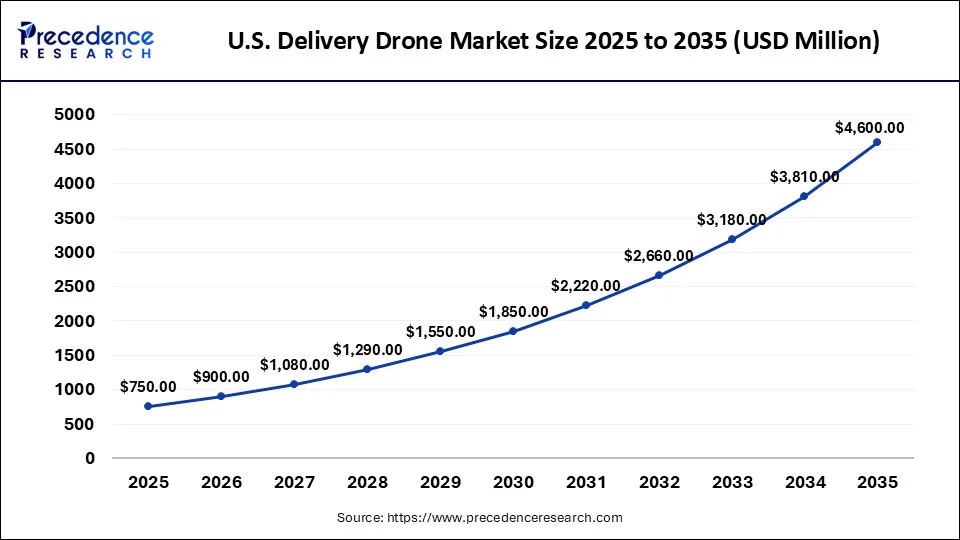
The U.S. is the dominant country in the region, mainly characterized by the favorable regulatory frameworks like the FAA's push for routine BVLOS operations. This also enables large-scale commercial deployments and improves autonomous flight capabilities.
Canada plays a distinctive role within the region, mainly characterized by its supportive infrastructure initiatives, which are increasing corporate use cases, emerging technologies, and rapid e-commerce expansion in remote areas.
What Is Driving the Growth of the Asia Pacific Drone Logistics and Transportation Market?
Asia Pacific held a 31% share of the market in 2026 and is expected to grow at the largest 25.80% CAGR between 2026 and 2035, driven by rapid expansion of e-commerce growth, smart city initiatives, and government support, which drives greater adoption. Integrating unmanned aerial vehicles into regional healthcare networks improves patient outcomes in areas where infrastructure is not developed.
China represents a dominant position within the region, due to the presence of the China Economic and Security Review Commission, by a massive manufacturing and research ecosystem for UAVs. This strong state-backed infrastructure for large-scale urban and rural logistics integration solidifies its industry scale.
India is witnessing the fastest-growing market in the region as a rapid growth leader in developing Asian technologies. This is due to government-led manufacturing incentives, localized policy reforms, and seamless commercial drone flight permission to address vast and remote delivery limitations.
Why Is Europe Emerging as a Key Market for Drone Logistics and Transportation?
Europe held 24% market share and is expected to grow at a notable CAGR of 19.40% between 2026 and 2035, due to the expansion of drone corridors and healthcare delivery networks for the increasing e-commerce logistics demands and advancement of essential healthcare transport. Stringent mandates like the European Union Aviation Safety Agency portal offer a risk-based baseline for commercial drone operations across member states.
The regional market is led by Germany through advanced industrial automation and smart city logistics innovation. It hosts designated long-range test zones supported by public funding to effectively integrate commercial drones into busy European airspace.
Norway experienced the highest growth within the region by leveraging autonomous drones for vital remote healthcare delivery and long-distance logistics. Its uniquely supportive regulatory environment also delivers medical supplies and groceries across challenging terrain and harsh winter climates.
Why Is Latin America Emerging as a High-Growth Market for Drone Logistics and Transportation?
Latin America is expected to grow at a significant CAGR of 20.70% between 2026 and 2035, primarily due to the increasing utilization of remote logistics and healthcare access, and accelerate e-commerce and medical supply delivery. The government collaborations are also fostering Latin American aviation authorities to frame stringent regulations for the BVLOS flights.
Brazil's strong position in the regional market stemmed from its stringent private sector investment and government modernization initiatives across commercial sectors. Brazil is refining its regulatory environment to improve its autonomous unmanned navigation.
Argentina experienced the highest rate of growth, due to expanding tech integrations in its vast agricultural and remote logistics sectors. Authorized trials sanctioned by Argentina's National Civil Aviation Administration are transforming air transport for rural connectivity.
Why Is the Middle East & Africa Emerging as a High-Growth Market for Drone Logistics and Transportation?
The Middle East and Africa are expected to grow at a significant CAGR of 21.20% between 2026 and 2035, due to the increasing investments in autonomous logistics and infrastructure development to bypass severe road congestion and connect crucial infrastructural gaps. The drones also resolve last-mile supply delays in both expanding smart urban centers and geographically isolated regions.
The United Arab Emirates (UAE) is the dominant GCC country advancing smart city initiatives and autonomous delivery within the region, mainly driven by high smartphone penetration, e-commerce growth, and Dubai Civil Aviation Authority regulations for commercial deliveries.
South Africa is witnessing the fastest growth within the region by leveraging drones for healthcare logistics, mining applications, and commercial ecosystem growth. Academic and governmental frameworks highlight these connections between medical samples and supply distribution in rural areas.
Supply Chain and Value Chain Analysis
- Raw Material and Component Supply
In this manufacturing, drones require advanced raw materials, computing hardware, and communication systems, including lightweight carbon fiber composites, high-capacity lithium-ion batteries, electric motors, and specialized aerospace-grade sensors.
Key Players: Boeing, Airbus, DJI, and Velodyne Lidar.
- Manufacturing and Product Development
This focuses on the assembly of airframes, integration of autonomous navigation software, obstacle-avoidance systems, and payload release mechanisms to meet aviation authority standards.
Key Players: Zipline, Matternet, Amazon Prime Air, Wing Aviation, and EHang.
- Distribution Network and Integration
This involves integration of drones into existing omnichannel retail and logistics fulfillment networks, which are stored and dispatched directly to customers as well as specialized drop-off zones.
Key Players: Amazon, Walmart, FedEx, DoorDash, United Parcel Service (UPS).
- Supply Chain Risks and Mitigation Strategies
This includes risks like battery supply bottlenecks, regulatory restrictions, and cybersecurity threats. Mitigation requires forging strategic supply partnerships, utilizing advanced AI for real-time fleet monitoring, and developing redundant hardware systems.
Key Players: DHL, UPS, Fortem Technologies, and Iris Automation.
Competitive Landscape
The market is transitioning from pilot trials to regional commercialization as competitive positioning hinges on navigating rigorous safety standards set by aviation authorities and forming strategic partnerships for healthcare and retail logistics. As technology leadership is mainly fostered by AI, payload capability, and endurance, industry leaders are only racing to scale AI-powered navigation and obtain rigorous BVLOS certifications by complying with regulatory frameworks.
Market Structure Analysis
The market features a highly competitive yet concentrated structure, mainly driven by major technology and logistics players like Zipline, which emphasizes white-label healthcare supply chains, along with Alphabet's Wing and Amazon Prime Air to integrate drone deliveries into established commercial retail networks. Because strict airspace regulations and high capital costs act as steep barriers to entry, the competitive intensity is high due to expanding technological innovations and regulatory approvals.
Strategic Developments
The market is rapidly scaling beyond pilot programs through strategic alliances, regulatory clearances like FAA BVLOS approvals, and targeted investments. For example, Walmart and Alphabet's Wing are expanding their drone delivery partnership to seven new U.S. metro areas with regulatory approvals from aviation authorities. Many leaders like Zipline and Flytrex are also advancing urban and rural logistics, leveraging strategic funding and partnerships to improve network density for food delivery services and e-commerce infrastructure development.
Competitive Benchmarking
It is important to consider several aspects in an overall assessment of the prospects for benchmarking within this industry, as leading players like Zipline and Wing boast fully autonomous flight stacks capable of dropping packages into confined spaces with minimal human oversight. Elroy Air supports payloads for medical logistics and middle-mile cargo, whereas retail drones like Amazon Prime Air handle packages for lightweight consumer goods and medical goods. These leaders are actively expanding operations internationally by scaling autonomy and fleet management software as a growing demand in complex urban environments.
Delivery Drone Market Companies
- Zipline
- Wing (Alphabet)
- Amazon Prime Air
- UPS Flight Forward
- FedEx Corporation
- DHL
- Matternet
- Flytrex
- Wingcopter
- Manna Drone Delivery
- EHang
- Swoop Aero
- Drone Delivery Canada
- Skyports Drone Services
- Meituan
Strategic Growth Opportunities
High-Growth Commercial Opportunities
Expanding drone delivery networks are transforming traditional supply chain bottlenecks across different industries. The rapid UAV expansion thrives where ground transport struggles. Key sectors include urgent medical supply logistics, direct-to-consumer parcel drops, industrial supply delivery, rural connectivity, and rapid emergency first-aid response. Major retailers like Walmart are spearheading this with massive national drone delivery continuously.
Technology Investment Opportunities
Hardware and software innovations are vital to extend flight ranges and payloads, along with considerable safety. Essential investment areas are AI Navigation for obstacle avoidance, hydrogen fuel cell Hydrogen Propulsion for improved range, and hybrid VTOL Platforms that combine vertical lift with fixed-wing efficiency. These are combined with cloud-based fleet management software for unmanned traffic management and unassisted autonomous operations.
Geographic Expansion Opportunities
Emerging markets with progressive, low-altitude airspace regulations and national infrastructure investments. Commercial drone adoption is driving in emerging markets like India, the Middle East, and Africa due to supportive regulatory environments and fewer airspace restrictions. Meanwhile, regulatory modernization programs led by the U.S. FAA, specifically regarding BVLOS rules, are opening emerging markets for commercial flight data and route approvals.
White Space Analysis
The market is targeting high-friction and untapped logistics sectors ripe for disruption. Key use cases include cross-border and offshore deliveries, temperature-controlled cold-chain logistics for sensitive medical supplies, and automated B2B transfers of industrial parts and documents between localized corporate hubs.
Future Outlook and Strategic Recommendations
Long-Term Industry Outlook
Urban drone delivery is becoming essential for quick commerce, mainly fostered by unmanned traffic management networks that lower the delivery costs. The major transformation toward advanced AI, dynamic flight routing, and hydrogen fuel cells is solving historical payload and endurance bottlenecks. Meanwhile, maturing certifications from authorities like the FAA and EASA are scaling BVLOS operations worldwide.
Emerging Business Models
The market is rapidly evolving from hardware ownership to outsourced services, mainly driven by Drone Delivery-as-a-Service (DDaaS), mitigating upfront capital and pilot training costs. Other models, such as fleet leasing, subscription platforms for guaranteed 30-minute e-commerce delivery, and integrated networks of automated drone-in-a-box hubs, are represented as micro-fulfillment nodes by supporting the overall growth of the market.
Strategic Recommendations for Stakeholders
Strategic recommendations for the drone industry emphasize adopting advanced technologies like hydrogen-powered swarms, implementing Drone-as-a-Service (DDaaS) models for logistics, and accelerating regulatory approvals for BVLOS operations, ultimately to increase payload capacities beyond standard limits. These initiatives emphasize rising payload capacities, enhancing, and ensuring safe, scalable operations across manufacturing, healthcare, and retail sectors.
Complete Market Segmentation
By Drone Type
- Fixed-wing Delivery Drones
- Rotary-wing Delivery Drones
- Hybrid VTOL Delivery Drones
By Payload Capacity
- Less than 2 kg
- 2-5 kg
- 5-10 kg
- Above 10 kg
By Range
- Less than 25 km
- 25–100 km
- Above 100 km
By Operation Mode
- Fully Autonomous
- Semi-autonomous
- Remotely Piloted
By Application
- Food Delivery
- Healthcare and Medical Supply Delivery
- E-commerce and Parcel Delivery
- Retail Delivery
- Postal Services
- Industrial and Commercial Logistics
- Military and Defense Logistics
- Emergency and Disaster Relief
- Others
By End User
- Logistics and Transportation Companies
- E-commerce Companies
- Healthcare Organizations
- Government and Defense
- Food and Beverage Companies
- Retail Companies
- Others
By Propulsion Type
- Battery-powered
- Hybrid-electric
- Hydrogen Fuel Cell-powered
By Region
- North America
- Latin America
- Europe
- Asia-Pacific
- Middle East and Africa
For inquiries regarding discounts, bulk purchases, or customization requests, please contact us at sales@precedenceresearch.com
Frequently Asked Questions
Tags





Ask For Sample
No cookie-cutter, only authentic analysis – take the 1st step to become a Precedence Research client
 Get a Sample




 sales@precedenceresearch.com
 Schedule a Meeting
