



Digital Map Market Size, Share and Trends 2026 to 2035
Digital Map Market (By Type: Software Solutions, Maps (data), Services; By Application: Indoor Navigation/Positioning, Outdoor Maps) - Global Industry Analysis, Size, Trends, Leading Companies, Regional Outlook, and Forecast 2026 to 2035
Source: https://www.precedenceresearch.com/digital-map-market
 Get a Sample
 Table Of Content


What is the Digital Map Market Size?
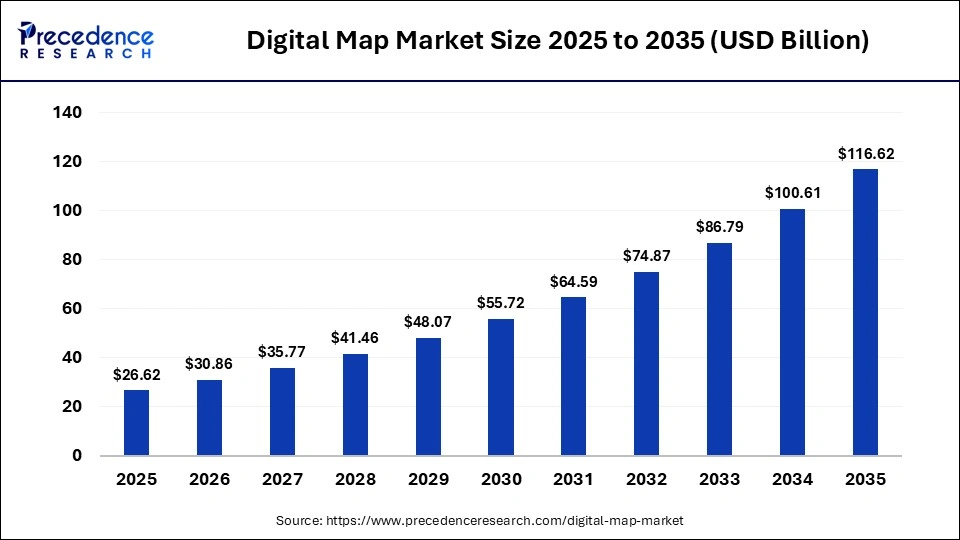
The global digital map market size accounted for USD 26.62 billion in 2025 and is predicted to increase from USD 30.86 billion in 2026 to approximately USD 116.62 billion by 2035, expanding at a CAGR of 15.92% from 2026 to 2035. The global digital map market is witnessing robust growth, driven by the growing demand for location-based services, the rapid growth of the e-commerce sector, and the increasing adoption of connected devices such as smartphones, tablets, and laptops.
Market Highlights
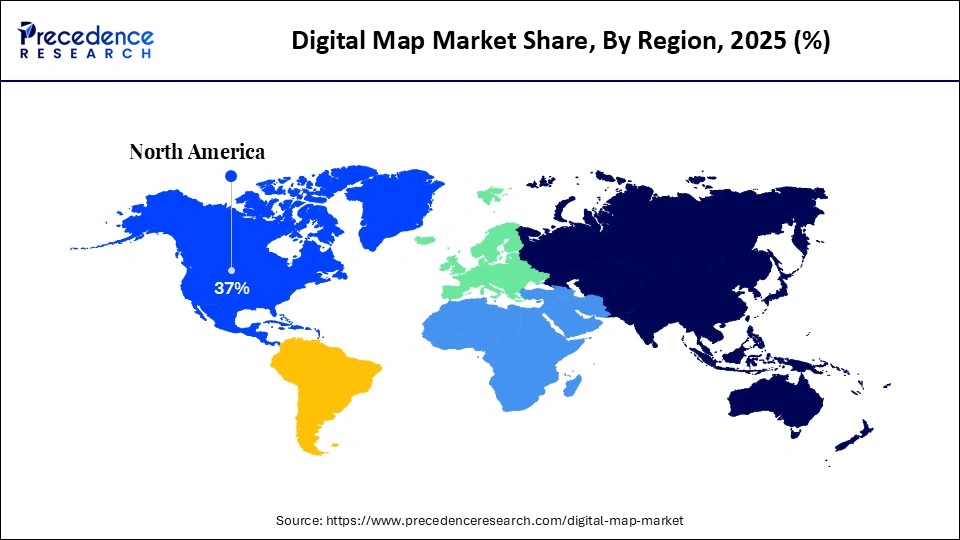
- North America dominated the global digital map market with the highest share in 2025.
- Asia Pacific is expected to grow at the fastest CAGR in the market during the forecast period.
- By type, the software solutions segment held the largest market share in 2025.
- By type, the services segment is expected to grow at a remarkable CAGR between 2026 and 2035.
- By application, the outdoor maps segment contributed the biggest market share in 2025.
- By application, the indoor maps segment is expected to grow at a significant CAGR between 2026 and 2035.
Market Overview
A digital map is a virtual representation of geographic areas that displays spatial information through data-driven visuals. Digital map offers clear directions, quick access to information, and real-time interaction features, such as interactive features such as zooming and panning. They are accessible directly from smartphones, computers/laptops, and embedded systems. Digital Maps serve both indoor and outdoor environments. Digital maps are created using satellite imagery, Global Positioning System (GPS), and Geographical Information System (GIS), providing accurate information on location, land use, topography, and infrastructure. They support advanced analysis for urban planning, agriculture, environmental monitoring, and disaster management. The key technologies that drive the digital map market include Light Detection and Ranging (LiDAR), Interferometric Synthetic Aperture Radar (InSAR), Geographic Information Systems (GIS), Global Positioning System (GPS), and other technologies.
How are AI-driven innovations reshaping the growth of the digital map market?
In the era of a rapidly evolving technological landscape, the Artificial Intelligence (AI) integration is transforming and accelerating the growth of the digital map market. The integration of AI enhances accuracy, enabling autonomous navigation and personalizing user experiences. AI efficiently analyzes historical data to forecast future trends, such as traffic congestion before its occurrence. AI algorithms process massive data from drones, satellites, and connected vehicle sensors to update maps instantly and reflect real-world changes such as road closures, construction, land use shifts, and others. An AI-powered digital map uses constantly updated data from IoT devices, connected cars, and satellites, allowing for real-time adjustments to road conditions, traffic flow, and environmental changes.
What are the emerging trends in the digital map market?
- The rising application of digital maps is anticipated to accelerate the growth of the mobile virtual network operator market during the forecast period. Digital maps are scalable and versatile solutions that are widely adopted for several applications, such as wayfinding, navigation, and visitor experience, such as events and trade shows, hospitals, shopping malls, airports, museums, and more.
- The growing demand for real-time mapping and geospatial analytics across various industries is expected to contribute to the overall growth of the digital map market.
- The rising advancements in mapping technology and supportive government-led digital initiatives are expected to create significant growth opportunities for the market during the forecast period.
- The increasing adoption of autonomous vehicles creates significant demand for highly detailed and accurate mapping data, bolstering the expansion of the market in the coming years.
- The rise in construction activities is expected to promote the growth of the digital map market during the forecast period. Digital maps play a crucial role in construction fields. Digital maps are widely used during the construction phase to monitor the progress and guide the engineers.
Market Scope
| Report Coverage | Details |
| Market Size in 2025 | USD 26.62 Billion |
| Market Size in 2026 | USD 30.86 Billion |
| Market Size by 2035 | USD 116.62 Billion |
| Market Growth Rate from 2026 to 2035 | CAGR of 15.92% |
| Dominating Region | North America |
| Fastest Growing Region | Asia Pacific |
| Base Year | 2025 |
| Forecast Period | 2026 to 2035 |
| Segments Covered | Type, Application, and Region |
| Regions Covered | North America, Europe, Asia-Pacific, Latin America, and Middle East & Africa |
Segmental Insights
Type Insights
What causes the software solutions segment to dominate the digital map market?
Software solutions
The software solutions segment held the largest market share in the digital map market. The segment includes web-based, desktop, and mobile apps. The segment's growth is primarily driven by the rising adoption of smartphones and IoT-connected devices, the increasing rollout of 5G technologies, and continuous technological advancements in mapping technology. Software solutions increasingly incorporate AI, machine learning, and big data to transform from static mapping tools into dynamic, intelligent, and predictive systems that provide real-time updates, predictive traffic forecasting, and faster route optimization. Several developers are increasingly focusing on providing more detailed and comprehensive digital maps to meet the ongoing demand of individuals and businesses. In addition, the rising use of 2-D and 3-D views of geographic locations is expected to boost the growth of the software solutions segment.
Services
The services segment is expected to grow at a remarkable CAGR between 2026 and 2035, owing to the increasing need for real-time data, advanced spatial analytics, and cloud-based solutions. The proliferation of connected devices, smartphones, and IoT enables advanced location-based services (LBS) across industries. The rising investments in infrastructure development, urban planning, and smart city projects are significantly increasing the demand for digital mapping services. Moreover, several digital mapping service providers are increasingly focusing on developing interactive and easily accessible digital maps.
Application Insights
What has led the outdoor maps segment to dominate the digital map market?
Outdoor Maps
The outdoor maps segment dominates the market, holding the highest market share in 2025. The growth of the segment is primarily driven by the increasing demand from high-growth industries like automotive (autonomous driving), logistics (last-mile delivery), construction (smart city infrastructure), agricultural, energy & mining, and others. The usage of outdoor maps assists in product marketing, disaster management, fleet management, land-based decision-making, environmental studies, risk analysis, and other surveys. Additionally, the increasing penetration of high-speed internet services & smartphones, rising demand for real-time location-based information, and advancements in GPS and GIS technology are anticipated to drive the digital map demand for outdoor applications.
Indoor maps
The indoor maps segment is the fastest-growing in the digital map market. The segment's fastest growth is supported by the increasing need for real-time navigation, asset tracking, and spatial analytics in complex environments like airports, retail stores, health care facilities, shopping malls, educational institutes, museums, manufacturing plants, and other locations. The indoor usage of digital maps assists in navigating large and complex buildings. The surge in the adoption of Technologies like Bluetooth Low Energy (BLE), Wi-Fi, and UWB, which allow for precise and real-time tracking of assets, is anticipated to fuel the segment's growth in the coming years.
Regional Insights
How Big is the North America Digital Map Market Size?
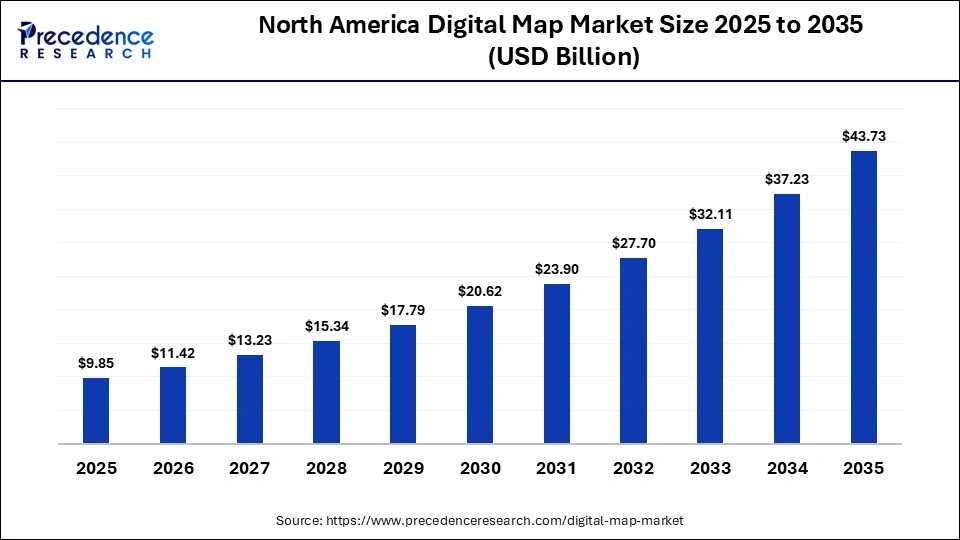
The North America digital map market size is estimated at USD 9.85 billion in 2025 and is projected to reach approximately USD 43.73 billion by 2035, with a 16.07% CAGR from 2026 to 2035.
North America Digital Map Market Analysis
North America dominates the market, holding the largest share in 2025. The region benefits from established technology-driven infrastructure and the presence of prominent market players. The growth of the region is characterized by the increasing need for precise and real-time location services, high penetration of smartphone & 5G technology, growing demand for autonomous vehicles, significant investments in smart infrastructure, and rising need for optimized logistics and delivery routes. The early adoption of advanced technologies such as Geographic Information Systems (GIS), LiDAR technology, Global Positioning System (GPS), and AI-integrated live mapping is bolstering the regional market's growth.
What is the Size of the U.S. Digital Map Market?
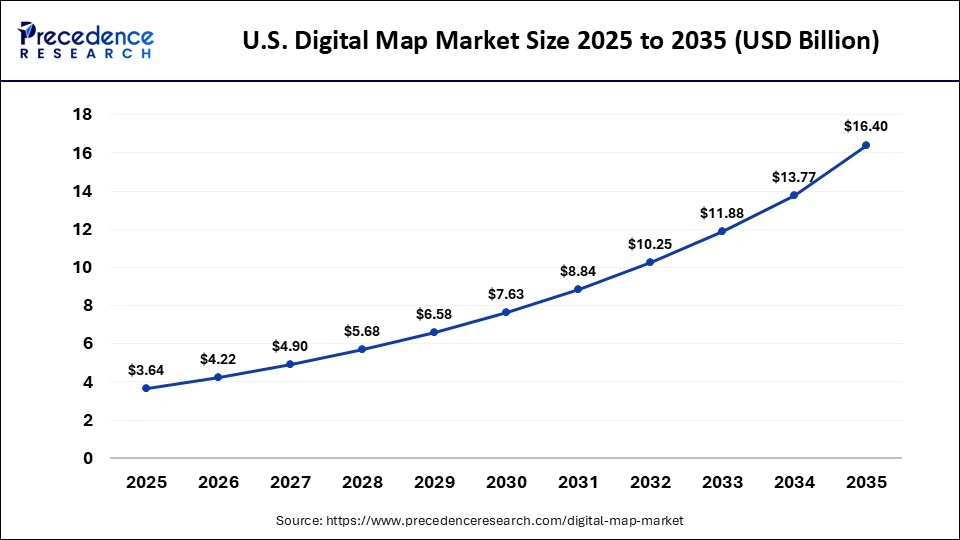
The U.S. digital map market size is calculated at USD 3.64 billion in 2025 and is expected to reach nearly USD 16.40 billion in 2035, accelerating at a strong CAGR of 16.24% between 2026 and 2035.
The U.S. Digital Map Market Analysis
The U.S. leads the market. The United States is a major contributor to the market. The country is home to the leading market players such as Apple Inc., Environmental Systems Research Institute (ESRI), Inc., Google, Intermap Technologies Corporation, INRIX Inc., MapBox Inc., and others. These major tech players are heavily investing in advancing mapping solutions, including high-definition maps for autonomous driving. The country's growth is also supported by the increasing demand for real-time & AI-driven mapping and massive investment in autonomous vehicles, logistics, and smart city infrastructure. In addition, the widespread use of smartphones has substantially increased the demand for location-based services like Google Maps, Waze, and others, ensuring the continuous growth of the market in the country.
Asia Pacific Digital Map Market Analysis
Asia Pacific is the fastest-growing region in the digital map market. The region's growth is primarily driven by rapid urbanization, growing need for digital navigation and tracking solutions, booming e-commerce sectors, rising investment in smart city projects, and extensive use of advanced technologies such as Geographic Information Systems (GIS) and Global Positioning System (GPS). The surge in connected vehicles and autonomous driving technology, particularly in China, Japan, and South Korea, requires seamless digital map integration. China is leading in HD map innovation for high-density traffic.
The rising internet penetration and an increase in connected devices, such as smartphones, tablets, and laptops has increased the adoption of map-based applications, which are expected to accelerate the regional market's growth. The region is also experiencing rapid growth, owing to the increasing demand for navigation services across various industries such as logistics, automotive, construction, and retail sectors. Several governments in the region are heavily investing in digitizing road networks. These collective factors are expected to boost the growth of the digital map market during the forecast period.
In December 2025, on the occasion of International Day of Persons with Disabilities (IDPD) 2025, Cure SMA Foundation of India, a national parent-led nonprofit working for individuals with Spinal Muscular Atrophy (SMA), unveiled the Preview and Soft Launch of “e-Swayam”, a digital accessibility map. It is designed as a community-powered, technology-enabled public platform. e-Swayam aims to transform accessibility across India by providing reliable, real-time, lived-experience–based data about the accessibility of physical infrastructure. The initiative begins with mobility accessibility in 2025 and will expand to include all disabilities by 2027.
China Digital Map Market Analysis
China's market is experiencing growth. The country's growth is supported by the strong presence of local giants, such as Baidu Maps and Alibaba's Amap, rapid digitalization, increasing adoption of navigation-enabled smartphones, rapid expansion of e-commerce industries, growing demand for 3D mapping, rising IoT integration, rising adoption of AI-driven analytics, and increasing investment in smart cities & infrastructure. The rising implementation of IoT in logistics and transportation sectors for real-time tracking, congestion management, and advanced logistics routing is propelling the country's market expansion.
The demand for geospatial analysis is increasing in the country as governments and businesses are using big data for risk assessment, urban planning, and disaster management. The emergence of autonomous vehicles is likely to drive the demand for high-precision (HD) maps that provide real-time, detailed environmental data. Moreover, the increasing need for 3D and high-definition maps to support Advanced Driver Assistance Systems (ADAS) and electric vehicle (EV) route planning.
What Are the Driving Factors of The Digital Map Market in Europe?
Europe is expected to grow at a significant CAGR during the forecast period. Europe Road safety and smart mobility are the main points of interest in the market, and it has been expanding. Smart city projects and eco-friendly transportation systems are supported by governments. There is high use of advanced driver-assistance systems in vehicles. Companies need mapping tools to track sustainability. The need for indoor mapping and real-time navigation is growing in various sectors and urban regions.
Germany Market Trends
Automotive mapping and safety systems are key topics in Germany. Advanced mapping in driver-assistance features is backed up by regulations. The trend in connected cars is towards live map updates. Companies also pay attention to safe, nearby data storage as a result of strict privacy rules, leading to more reliable mapping systems that adhere to national data safety regulations.
What Are the Driving Factors of The Digital Map Market in Latin America?
Latin America is expected to grow at a significant CAGR during the forecast period. The region is seeing fast digital growth with the rising use of mobile technology. E-commerce and logistics are growing, leading to a rise in the demand for location-based services. Cities are implementing smart planning solutions, and businesses are benefiting from the use of mapping tools in improving delivery systems. There is also a broad trend of growing agriculture mapping and connectivity, which is helping to drive the widespread use of digital maps.
Brazil Market Trends
Brazil is emerging as an important market, as the smartphone penetration rate is increasing and the demand for mobile navigation is growing. Logistics and e-commerce firms are making investments in the accuracy of maps. Real-time tracking and services are enabled by faster networks. Digital maps are also being utilized in cities for traffic management, urban planning, and governance of the infrastructure management system as a whole.
How is the Middle East and Africa Performing in The Digital Map Market?
The Middle East and Africa are expected to grow at a significant CAGR during the forecast period. Governments invest in advanced digital infrastructure and technologies. Mapping is increasingly applied in the construction, defense, and logistics sectors. Better connectivity, along with a greater emphasis on the modern transportation system, is also contributing to the demand for cutting-edge digital mapping technologies.
Saudi Arabia Market Trends
Saudi Arabia is heavily investing in digital technologies and smart cities. Planning, traffic control, and infrastructure management are aspects of digital mapping. There's also a focus on secure national mapping systems. The use of IoT devices is on the rise for real-time tracking in logistics and energy industries.
Competitive Landscape
The global digital map market is highly competitive. Technology giants, geospatial solution providers, and navigation platform companies are continuously investing in innovation to strengthen their market presence. Competition is increasingly centered around high-precision mapping, cloud-based geospatial analytics, autonomous vehicle mapping, and smart city integration. Companies such as Google, HERE Technologies, TomTom, Apple, and Mapbox are dominating through advanced mapping platforms, AI-powered location intelligence, and real-time navigation capabilities.
Companies are focusing on strategic collaborations, acquisitions, and product launches to expand their digital ecosystems and improve consumer experience. The competition is further intensified by the growing adoption of AI, IoT, and 3D mapping technologies across industries such as logistics, transportation, urban planning, and mobility services. However, high infrastructure costs, cybersecurity concerns, and strict data privacy regulations remain major challenges for market growth.
Who are the Major Players in the Global Digital Map Market?
The major players in the digital map market include Apple Inc., Maxar Technologies., Environmental Systems Research Institute (ESRI), Inc., Google, AutoNavi Holdings Ltd., Getmapping PLC., HERE Holding Corporation, Intermap Technologies Corporation, NavInfo Co., Ltd., TomTom International BV, Zenrin Co., Ltd., HERE Technologies, Navinfo Co., Ltd, INRIX Inc., Baidu, Inc., nad MapBox Inc.
Recent Developments
- In May 2026, the Grand Island Parks and Recreation Department launched a new interactive map designed to make it easier for visitors to locate their loved ones. Users can search for names and locations and view records from their devices while at the cemetery. (Source: https://www.ksnblocal4.com/)
- In February 2026, MICWARE Group announced the launch of the latest version of its 3D digital platform, “Dynamic Share Map”. The new platform aggregates, curates, and monetizes location-based multimedia content. It collects visual and spatial data from open map data, real-time edge data, and high- fidelity contents. (Source: https://www.prnewswire.com)
- In October 2025, Vietnam announced its plan to launch the National Agricultural Products Map. The Agricultural Products Map of Vietnam will feature outstanding farm products from 34 provinces and cities, offering easy access to information about products, producers, and distributors for regulators, businesses, and consumers. This initiative is being implemented by the Department of Domestic Market Management and Development under the Ministry of Industry and Trade. It aims to establish a digital database of Vietnamese agricultural products to promote trade and expand market reach.(Source: https://vietnamnet.vn)
- In February 2025, Cahaba Riverkeeper has just launched “Cahabapedia“, an interactive digital map and data repository that provides a comprehensive look at the health and history of the Cahaba watershed. Through Cahabapedia, users can view things like water quality information, hydrological + recreational data, regional areas of interest, and other continuously-updated information about the Cahaba River.(Source: https://bhamnow.com)
Segments Covered in the Report
By Type
- Software Solutions
- Web-based
- Desktop
- Mobile App
- Maps (data)
- Services
By Application
- Indoor Navigation/Positioning
- Airports
- Retail Stores
- Health Care Facilities
- Other
- Educational Institutes
- Museums
- Other Commercial Buildings
- Outdoor Maps
- Automotive
- Mobile & Internet
- Government & Utilities
- Real Estate/Construction
- Others
- Energy & Mining
- Agriculture
By Region
- North America
- Europe
- Asia-Pacific
- Latin America
- Middle East & Africa
For inquiries regarding discounts, bulk purchases, or customization requests, please contact us at sales@precedenceresearch.com
Frequently Asked Questions
Tags





Ask For Sample
No cookie-cutter, only authentic analysis – take the 1st step to become a Precedence Research client
 Get a Sample




 sales@precedenceresearch.com
 Schedule a Meeting
