



Edge Computing in Healthcare Market Trends, Companies, Revenue / Sales Performance, Subscriber Growth, Pricing Strategies, Cloud Adoption, Infrastructure Expansion, Competitive Landscape, and Industry Outlook
Edge Computing in Healthcare Market (By Component: Hardware, Software/Platforms, Services; By Application: Diagnostics and Monitoring, Telehealth and Remote Patient Monitoring, Robotic and AI-Assisted Surgery, Connected Ambulances and Emergency Services; By End User: Hospitals and Clinics, Surgical Centers, Diagnostic and Imaging Centers, Long-Term and Home-Care Providers) - Global Industry Analysis, Size, Trends, Leading Companies, Regional Outlook, and Forecast 2026 to 2035
Source: https://www.precedenceresearch.com/edge-computing-in-healthcare-market
 Get a Sample
 Table Of Content


What is the Edge Computing in Healthcare Market Size in 2026?
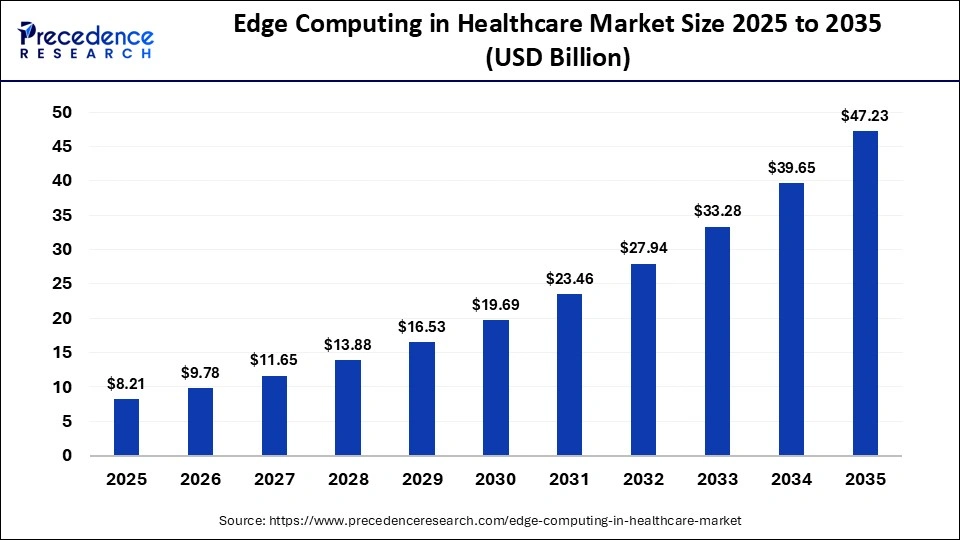
The global edge computing in healthcare market size was calculated at USD 8.21 billion in 2025 and is predicted to increase from USD 9.78 billion in 2026 to approximately USD 47.23 billion by 2035, expanding at a CAGR of USD 19.12% from 2026 to 2035. Key drivers for edge computing in healthcare include rapid adoption of IoT medical devices, urgent need for real-time data processing/lower latency, improved patient monitoring, enhanced data security/privacy, and 5G network expansion.
Key Takeaways
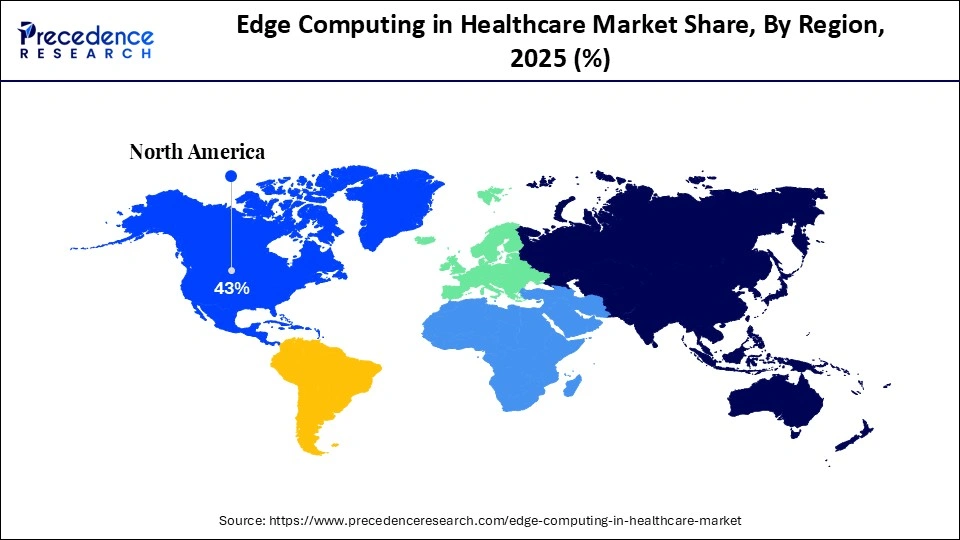
- North America dominated the market with the largest share of 43% in 2025.
- Asia Pacific is expected to grow at the fastest CAGR during the forecast period.
- By component, the hardware segment was dominant in the market in 2025.
- By component, the services segment is expected to witness rapid expansion in the studied years.
- By application, the diagnostics and monitoring segment dominated the market in 2025.
- By application, the telehealth and remote patient monitoring segment is expected to be the fastest-growing during 2026-2035.
- By end user, the hospitals and clinics segment led the market in 2025.
- By end user, the long-term and home-care providers segment is expected to witness the fastest growth in the upcoming years.
What are the Prominent Drivers of the Edge Computing in Healthcare Market?
Edge computing in healthcare processes patient data near the source, such as wearables, bedside monitors, or imaging devices, rather than in a distant cloud. This reduces latency for real-time, life-critical decisions, enhances data privacy, and improves network efficiency in hospitals and remote care, enabling faster clinical responses and better patient outcomes.
The growing need for instant data analysis (sub-millisecond), especially in critical care and emergency services, is fueling edge computing for instant, life-saving decisions. Besides this, continuous breakthroughs in connected medical devices, like wearables, sensors, and smart monitors, are demanding local processing to handle high-volume data without huge network bandwidth.
What are the Key AI Roles in the Edge Computing In Healthcare Market?
- Specifically, edge AI is assisting robotic systems, such as the da Vinci Surgical System, through processing sensor data in real-time to confirm greater precision & safety during procedures. Whereas, rigorous AI algorithms are boosting the analysis of medical images directly on the device, & also facilitating immediate insights for radiologists & minimizing the need to transmit large files to the cloud.
- Simultaneously, edge AI plays a critical role in radiology and diagnostics by analyzing high-resolution medical images directly on devices. This eliminates the need for transmitting large files to the cloud, providing immediate, actionable insights to clinicians, reducing diagnosis latency, and addressing data privacy. Furthermore, edge AI drives intelligent patient monitoring in smart ICUs and wearable devices, detecting anomalies and predicting adverse events, such as sepsis or cardiac arrest, at high speed.
Trends in the Edge Computing In Healthcare Market
- Elevating Decentralized Data Management: The market has explored approximately 72% of connected healthcare devices, which highly leverage edge processing, lower reliance on central cloud servers, reduce latency, & strengthen data privacy.
- Promoting 5G and Edge Synergy: Day by day, leaders are implementing integrated 5G Standalone (SA) networks provides secure, promising, and ultra-reliable, low-latency communication (URLLC), which is significant for remote, telerobotic surgeries.
- Spurring Smart Wearables & IoT: The latest medical wearables with embedded edge processors have expanded in two years, which offer extensive chronic disease management & rapid, actionable health insights.
Market Scope
| Report Coverage | Details |
| Market Size in 2025 | USD 8.21 Billion |
| Market Size in 2026 | USD 9.78 Billion |
| Market Size by 2035 | USD 47.23 Billion |
| Market Growth Rate from 2026 to 2035 | CAGR of 19.12% |
| Dominating Region | North America |
| Fastest Growing Region | Asia Pacific |
| Base Year | 2025 |
| Forecast Period | 2026 to 2035 |
| Segments Covered | Component, Application, End User, and region |
| Regions Covered | North America, Europe, Asia-Pacific, Latin America, and Middle East & Africa |
Segmental Insights
Component Insights
Which Component Led the Edge Computing In Healthcare Market in 2025?
In 2025, the hardware segment registered dominance in the market. This mainly covers IoT sensors, smart wearables, edge servers, and gateways. Its progression is propelled by the rising need for rapid, AI-powered diagnostics and remote patient monitoring, with localized data management. Also, companies like OnLogic & Advantech are developing ruggedized, sanitizable, and purpose-built hardware for hospital, clinic, and emergency settings.
On the other hand, the services segment is predicted to expand rapidly in the coming era. The widespread adoption of services, like remote patient monitoring, AI-driven diagnostics/imaging, robotic surgery assistance, & modern ambulance data processing are driven by the broader 5G adoption, IoT progression, & cost-effective requirements. Besides this, paramedics can simplify real-time data to hospitals & receive, or receive remote diagnostic, or diagnostic support, in transit via 5G, which accelerates patient care before admission.
Application Insights
How did the Diagnostics and Monitoring Segment Dominate the Market in 2025?
The diagnostics and monitoring segment held the biggest revenue share of the edge computing in healthcare market in 2025. Globally progressing critical care, emergency response, and remote patient monitoring require highly demanding sub-millisecond data processing to enable instantaneous clinical decisions, lowering latency. The trend is promoting multi-modal, flexible skin patches for persistent monitoring of ECG, skin temperature, & sweat biomarkers without cloud usage.
However, the telehealth and remote patient monitoring segment is estimated to show the fastest expansion. A key driver is the developing reimbursement policies & an inclination toward value-based care is impelling the need for sophisticated RPM systems to manage chronic conditions in local conditions. The market is rigorously transforming AI-enabled wearables for 99% accurate activity categorization, 5G-powered robotic surgery, & optimized data privacy by keeping sensitive data local.
End User Insights
Which End User Led the Edge Computing In Healthcare Market in 2025?
In 2025, the hospitals and clinics segment was dominant in the market. The use of edge computing in these facilities enables consistent, on-premise monitoring of crucial signs, like ECG, blood pressure, and oxygen levels, which further allows for immediate, localized AI analysis, triggering instant alerts for anomalies. Moreover, edge devices are processing high-resolution medical imaging on-site and facilitating radiologists with faster, AI-enabled insights.
However, the long-term and home-care providers segment is estimated to witness rapid expansion. A massive rise in ageing populations drives the need for decentralized, long-term care and monitoring, with emerging hospital-at-home models necessitating low-latency processing for high-quality video consultations & remote diagnostics. Alongside, several edge sensors assist in tracking medical equipment to estimate failures before they occur, enhancing safety in long-term care facilities.
Regional Insights
North America Edge Computing in Healthcare Market Size and Growth 2026 to 2035
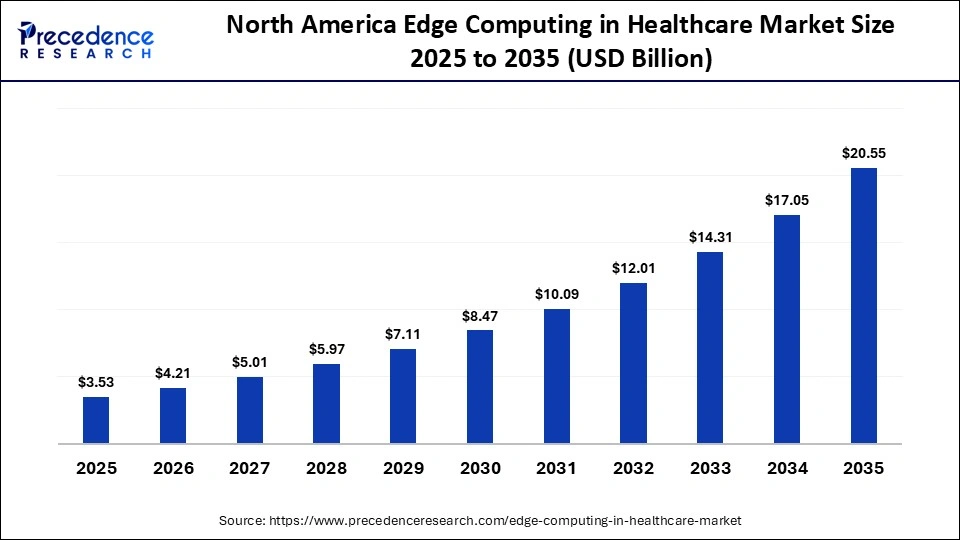
The North America edge computing in healthcare market size is estimated at USD 3.53 billion in 2025 and is projected to reach approximately USD 20.55 billion by 2035, with a 19.26% CAGR from 2026 to 2035.
How did North America Dominate the Market in 2025?
North America led the edge computing in healthcare market with a major revenue share in of 43% 2025. This dominance is primarily fueled by a rise in investments in health IT, 5G adoption, and higher demand for remote patient monitoring. The adoption of IoT-enabled medical devices, wearable monitors, and advanced, secure telemedicine platforms is transforming patient care by offering lower latency. Increased investment in 5G infrastructure supports this expansion, reducing the burden on centralized cloud systems and enhancing data privacy. Hospitals are leveraging these technologies for instantaneous clinical decision-making, significantly enhancing operational efficiency.
U.S. Edge Computing in Healthcare Market Size and Growth 2026 to 2035
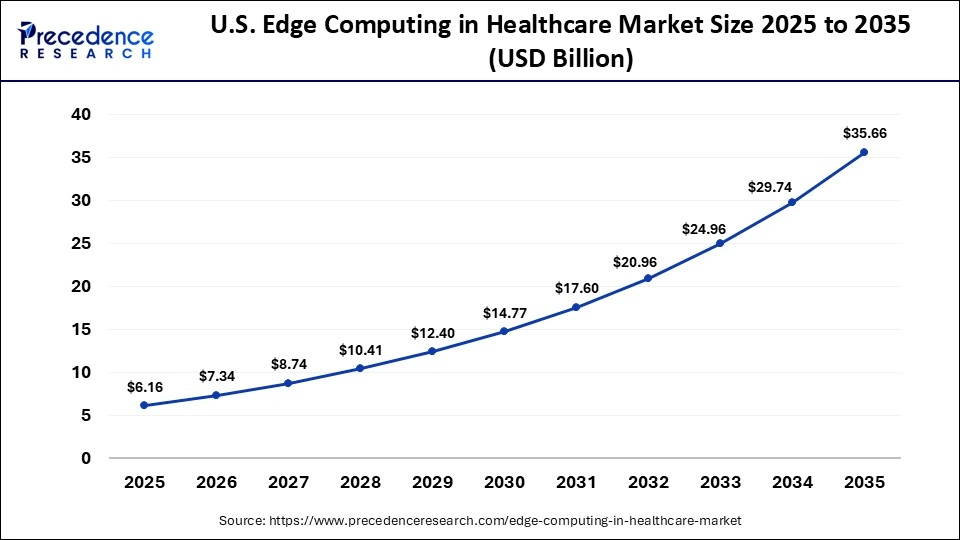
The U.S. edge computing in healthcare market size is calculated at USD 6.16 billion in 2025 and is expected to reach nearly USD 35.66 billion in 2035, accelerating at a strong CAGR of 19.20% between 2026 and 2035.
U.S. Edge Computing in Healthcare Market Trends
Whereas, the emergence of stringent Canadian data regulations is propelling the adoption of on-premise edge nodes, which keep sensitive Patient Health Information (PHI) within the facility. Edge computing in Canada's healthcare market is growing rapidly, driven by the need for real-time data processing in remote monitoring, telemedicine, and diagnostic imaging. The integration of IoT-enabled medical devices, such as wearables and smart monitors, is accelerating this trend, allowing clinicians to analyze patient vitals immediately. Furthermore, the expansion of 5G infrastructure, coupled with investments in hospital digital transformation, ensures low-latency, secure, and efficient patient care across Canadian healthcare facilities.
For instance,
- In October 2025, NVIDIA joined with the U.S. Department of Energy's national labs and the nation's major companies to establish America's AI infrastructure to assist scientific discovery, economic expansion & reinforce the next industrial transformation.
Specifically, the U.S. market has many leading firms, such as IBM, AWS, Microsoft, Cisco, Dell, & GE, that are investing heavily in hybrid edge-cloud architectures. Also, the U.S. is extensively leading in global adoption, with substantial progression in AI-enabled robotic surgery & imaging systems.
What are the Significant Drivers of the Asia Pacific Market?
In the coming era, the Asia Pacific is anticipated to register the fastest expansion in the edge computing in healthcare market. A prominent catalyst is the growing demand and adoption of IoT devices and wearable technology, including smart glucose meters & blood pressure monitors. Besides this, numerous APAC healthcare firms are implementing edge computing to manage the vast volume of data, which lowers bandwidth usage & fosters data privacy.
Edge computing in China's healthcare market is expanding rapidly, driven by 5G infrastructure, AI, and IoT adoption in hospitals. It facilitates real-time data processing for remote patient monitoring, telemedicine, and swift analysis of imaging (X-rays, MRIs). Localized data processing reduces latency and enhances security, crucial for and mandated by strict in-country data regulations. The market is accelerating to support smart city projects and decentralized patient care, allowing for faster, more efficient, and secure healthcare delivery. Moreover, Chinese surgeons have successfully operated on remote, long-distance surgeries by leveraging 5G and edge-based low-latency technology.
- For instance,In October 2025, Advantech collaborated with Edge Impulse Inc. to combine Edge Impulse's intuitive AI development tools into Advantech's edge computing platforms.
Edge computing in India's healthcare sector is expanding rapidly, driven by 5G adoption, IoT devices, and telemedicine. It enables real-time diagnostics and remote monitoring, crucial for rural areas. Major drivers include reducing data latency, enhancing privacy, and supporting AI-powered analytics, transforming patient care delivery by providing faster, localized data processing solutions.
Regulatory Compliance & Digital Strategy is Fueling Europe
Europe is experiencing a notable growth in the edge computing in healthcare market. The region highly executes stricter regulations, specifically GDPR and specific, stringent health data rules in countries such as France and Germany. This further requires maintaining sensitive data locally, which fuels on-premise edge deployments.
For instance,
- In February 2026, Cornerstone partnered with StonesThro to implement the deployment of micro-edge cloud computing across the UK.
Additionally, Germany has explored the GEMEINSAM DIGITAL 2026 strategy, which made mandatory ISiK standards for hospitals & the ePA (electronic patient record) 3.0 for real-time access. Many German researchers are emphasizing emerging AI applications at the edge for tailored healthcare, ensuring data privacy & security.
The UK edge computing in healthcare market is expanding rapidly, driven by the need for real-time patient monitoring, 5G integration, and improved data privacy. Hospitals are adopting edge nodes to process data locally, enhancing diagnostic speed, supporting robotic surgery, and reducing latency, fueled by the rising Internet of Medical Things (IoMT) adoption.
Edge Computing in Healthcare Market Companies
- NVIDIA
- Microsoft (Azure IoT)
- Cisco Systems, Inc.
- Intel Corporation
- GE HealthCare Technologies Inc.
- HPE (Hewlett Packard Enterprise)
- Google Cloud
- Siemens Healthineers
- IBM Corporation
- Dell Technologies Inc.
- Amazon Web Services (AWS), Inc.
- Koninklijke Philips NV
- Qualcomm Technologies, Inc.
- Advantech Co. Ltd.
- ZPE Systems
- Binariks
- Huawei Technologies Co., Ltd.
- Akamai Technologies
- Nokia Corporation
- Fujitsu Limited
Recent Developments
- In March 2026, Intel debuted the Intel Core™ processor Series 2 with P-cores at Embedded World 2026, presenting an industrial-grade platform built for critical edge operations. Simultaneously, the company introduced a new Edge AI suite for Health & Life Sciences, which offers validated reference pipelines and benchmarking tools to optimize AI-driven patient monitoring. (Source: https://newsroom.intel.com)
- In December 2025, Avalue Technology introduced a suite of medical-grade edge computing systems to address the growing need for real-time AI analytics in clinical settings. These platforms support the healthcare industry's digital shift by providing high-performance processing for diagnostic imaging, surgical navigation, and point-of-care services. (Source: https://www.iotinsider.com)
- In July 2025, Blue Cloud Softech Solutions Limited introduced BluHealth Platform v2.0, the latest version of its digital healthcare system using artificial intelligence tools & non-invasive diagnostic technologies.(Source- https://www.techcircle.in)
Segments Covered in the Report
By Component
- Hardware
- Software/Platforms
- Services
By Application
- Diagnostics and Monitoring
- Telehealth and Remote Patient Monitoring
- Robotic and AI-Assisted Surgery
- Connected Ambulances and Emergency Services
By End User
- Hospitals and Clinics
- Surgical Centers
- Diagnostic and Imaging Centers
- Long-Term and Home-Care Providers
By Region
- North America
- Latin America
- Europe
- Asia-pacific
- Middle and East Africa
For inquiries regarding discounts, bulk purchases, or customization requests, please contact us at sales@precedenceresearch.com
Frequently Asked Questions





Ask For Sample
No cookie-cutter, only authentic analysis – take the 1st step to become a Precedence Research client
 Get a Sample




 sales@precedenceresearch.com
 Schedule a Meeting
