


Europe Recombinant Protein Manufacturing Services Market Trends, Leading Companies, Company Revenue / Sales Performance, Procedure Volume, Healthcare Spending, Technology Adoption, Reimbursement Analysis, Competitive Landscape, and Growth Outlook
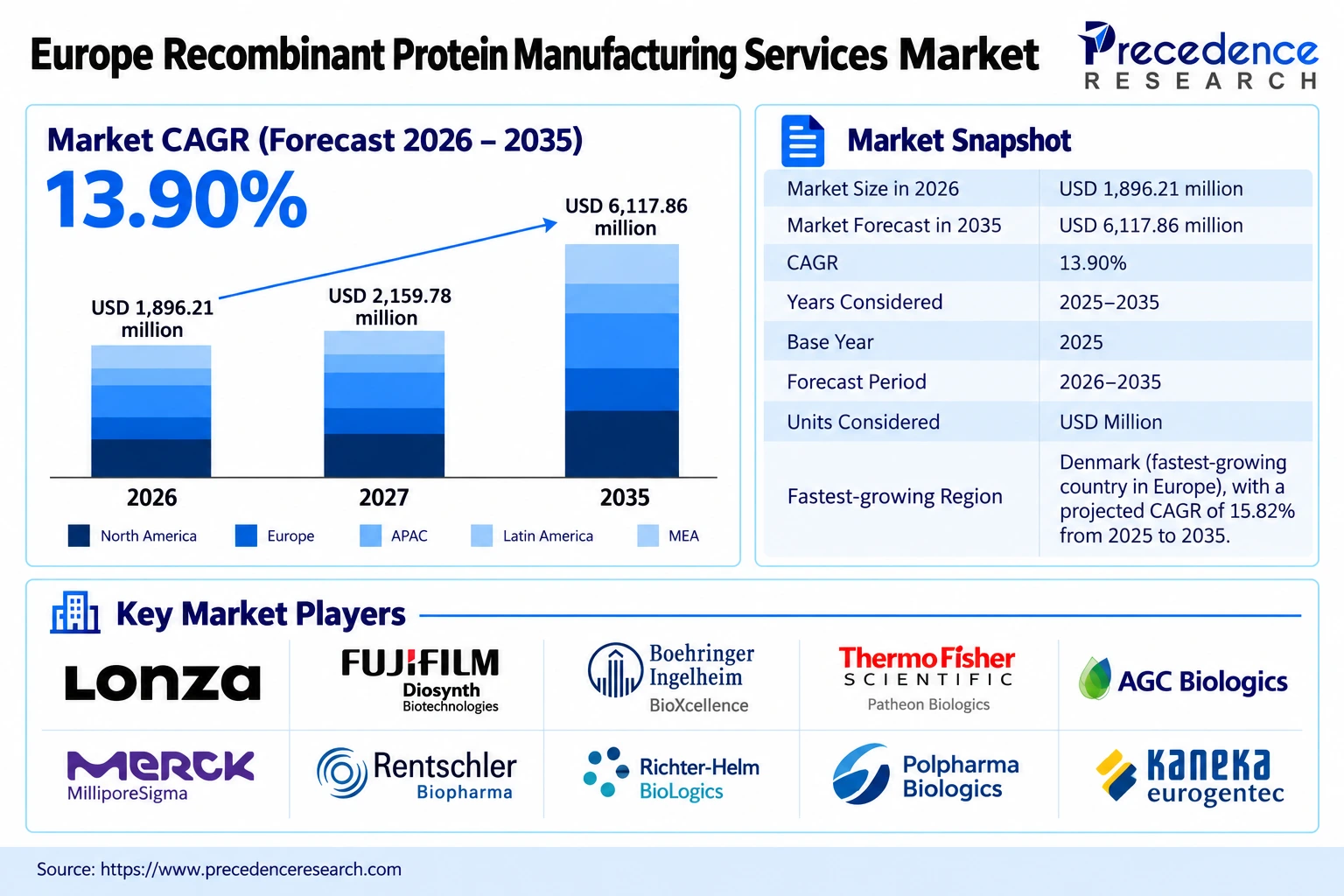
Deepa Pandey, a Healthcare Industry Expert, highlights that the Europe recombinant protein manufacturing services market has reached USD 1,896.21 million in 2026 and is on track to reach USD 6,117.86 million by 2035, advancing at a CAGR of 13.90%. Key Europe recombinant protein manufacturing services market companies shaping the market include Lonza Group AG, FUJIFILM Diosynth Biotechnologies, Boehringer Ingelheim BioXcellence, Thermo Fisher Scientific (Patheon Biologics), while major growth segments span service type, host cell, molecule type, end user.
Source: https://www.precedenceresearch.com/europe-recombinant-protein-manufacturing-services-market
 Get a Sample
 Table Of Content


Europe Recombinant Protein Manufacturing Services Market Size, Trends, Share, and Innovations 2035
The Europe recombinant protein manufacturing services market is estimated at USD 1,896.21 million in 2026 and is projected to reach USD 6,117.86 million by 2035, expanding at a CAGR of 13.9% from 2026 to 2035. The market was valued at USD 1,664.80 million in 2025, the base yearand it covers contract development and manufacturing of recombinant proteins, including antibodies, enzymes, hormones, cytokines, vaccine antigens and other therapeutic and research proteins, using mammalian, microbial, yeast and insect expression systems.
Key Takeaways
Market Size & Growth Outlook
- Market size in 2025: USD 1,664.80 million
- Estimated market size in 2026: USD 1,896.21 million
- Projected market size by 2035: USD 6,117.86 million
- CAGR (2026-2035): 13.90%
Regional Market Spotlight
- Germany led the market with a 24.6% (USD 409.54 million) share in 2025.
- Switzerland accounted for 16.8% (USD 279.69 million) of the market in 2025.
- United Kingdom accounted for 13.4% (USD 223.08 million) of the market in 2025.
- Denmark accounted for 8.2% (USD 136.51 million) in 2025 and is projected to be the fastest-growing country, at a CAGR of 15.82% from 2025 to 2035.
Segmental Spotlight
- By service type, Commercial Production accounted for 57.4% (USD 955.60 million) in 2025.
- By host cell, Mammalian Cells accounted for 56.2% (USD 935.62 million) in 2025.
- By molecule type, Monoclonal Antibodies & Fragments accounted for 48.6% (USD 809.09 million) in 2025.
- By end user, Pharmaceutical & Biotechnology Companies accounted for 79.4% (USD 1,321.85 million) in 2025.
Europe Recombinant Protein Manufacturing Services Market Size and Forecast, 2025-2035 (USD Million)
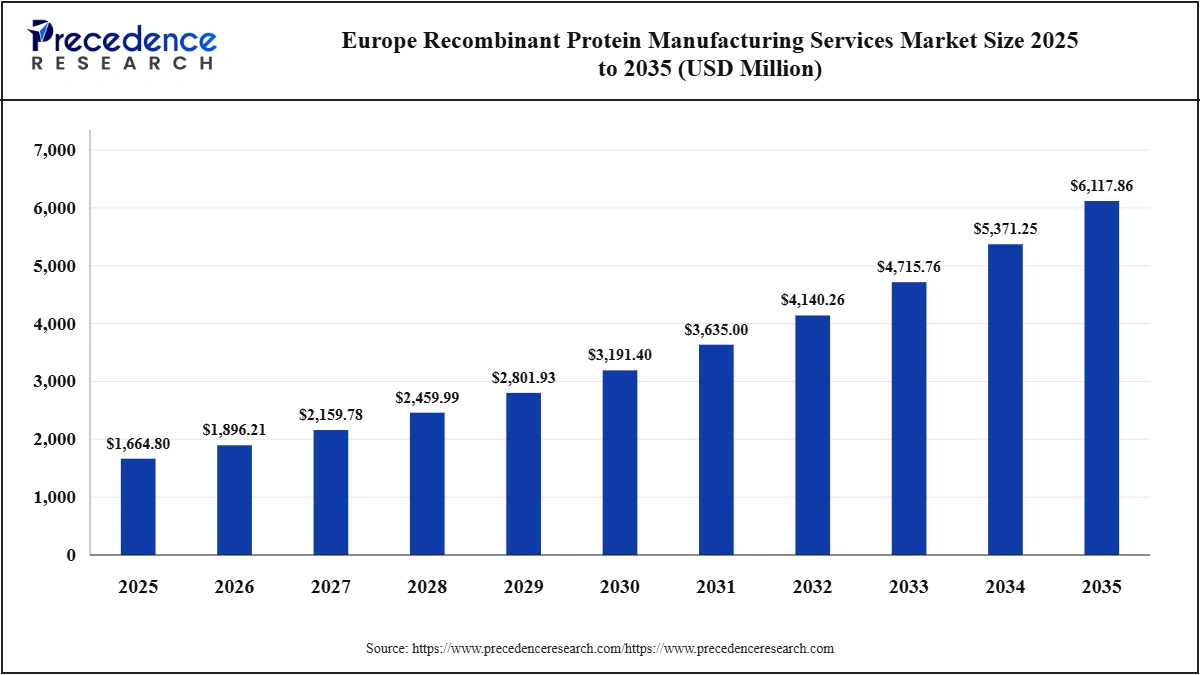
Note: 2025 is the base year; 2026-2035 values are forecasts.
Sources: Expert interviews, secondary sources, Precedence Research database and Precedence Research analysts.
The Europe recombinant protein manufacturing services market is projected to grow from USD 1,664.80 million in 2025 to USD 6,117.86 million by 2035 because biopharmaceutical companies are outsourcing more recombinant protein development and production as biologics, biosimilars and novel protein formats move through clinical pipelines. New large-scale bioreactor capacity in Europe allows CDMOs to take on more commercial programs, lifting the market to USD 3,191.40 million by 2030 and sustaining a CAGR of 13.9% from 2026 to 2035.
- Analyst View: We built the estimate from the number of recombinant protein programs in European development and commercial supply, multiplied by the share outsourced and by typical contract values for process development, clinical batches and commercial production. Commercial production values were cross-checked against installed outsourced bioreactor capacity and utilization in Europe. The total revenue was then compared with the European biologics revenues of leading CDMOs and with published estimates, which places our base year slightly above[GM1.1] the comparable figure. The growth rate reflects strong clinical pipelines and rising outsourcing, moderated by the time new capacity needs to reach full utilization.
Market Trends
- Large CDMOs are adding 20,000-litre mammalian bioreactors in Europe.
- Bioconjugation capacity is expanding for antibody-drug conjugates.
- Small and mid-sized biotech firms are outsourcing protein production earlier in development.
- Microbial expression is gaining use for antibody fragments and enzymes.
- Continuous and intensified processing is improving yields and lowering costs.
- European sponsors are seeking regional supply to reduce reliance on Asian CDMOs.
Drivers, Restraints and Opportunities
Driver
Biologics, biosimilars, and novel protein formats keep expanding in European pipelines. Many small and mid-sized biotech firms lack in-house manufacturing and depend on CDMOs from development through commercial supply. Large pharma companies also outsource to add flexible capacity without building new plants.
Restraint
Building and validating large-scale biologics capacity takes years and large capital investment. New capacity can stay underused if pipelines slip or clinical trials fail. Skilled labor shortages and long regulatory timelines also slow how quickly CDMOs can take on new programs.
Opportunity
Antibody-drug conjugates, bispecific and fusion proteins need specialized development and manufacturing expertise. European sponsors want regional supply chains, which favors CDMOs with local capacity. Integrated offerings that cover cell line development, drug substance and product can win long-term contracts.
Market Segmentation: 2025 Share and Value
Europe Recombinant Protein Manufacturing Services Market by Service Type 2025, Share & Size
| Segments | 2025 Share | 2025 Market Value |
| Commercial Production | 57.40% | USD 955.60 million |
| Clinical Production | 28.60% | USD 476.13 million |
| Preclinical & Process Development | 14.00% | USD 233.07 million |
Note: 2025 is the base year.
Sources: Expert interviews, secondary sources, Precedence Research database and Precedence Research analysts.
Commercial production accounted for 57.4% (USD 955.60 million) in 2025 because approved biologics and biosimilars need long-term, large-volume manufacturing contracts. Clinical production, at 28.6% (USD 476.13 million), grows with the number of biologics entering trials, while preclinical and process development, at 14% (USD 233.07 million), is gaining share as small biotech firms outsource early cell line and process work. Contracts that start in development often shift to commercial supply, which connects these segments together.
Europe Recombinant Protein Manufacturing Services Market by Host Cell 2025, Share & Size
| Segments | 2025 Share | 2025 Market Value |
| Mammalian Cells | 56.20% | USD 935.62 million |
| Microbial (Bacterial) | 27.40% | USD 456.16 million |
| Yeast & Fungi | 9.80% | USD 163.15 million |
| Insect & Others | 6.60% | USD 109.88 million |
Note: 2025 is the base year.
Sources: Expert interviews, secondary sources, Precedence Research database and Precedence Research analysts.
Mammalian cells accounted for 56.2% (USD 935.62 million) in 2025 because most antibodies and complex glycoproteins require mammalian expression. Microbial systems, at 27.4% (USD 456.16 million), as it requires cheaper enzymes, hormones, antibody fragments and vaccine antigens , while yeast and fungi, at 9.8% (USD 163.15 million), and insect and other systems, at 6.6% (USD 109.88 million), are used for specific proteins and vaccines.
Europe Recombinant Protein Manufacturing Services Market by Molecule Type 2025, Share & Size
| Segments | 2025 Share | 2025 Market Value |
| Monoclonal Antibodies & Fragments | 48.60% | USD 809.09 million |
| Cytokines & Other Proteins | 14.00% | USD 233.07 million |
| Enzymes | 13.20% | USD 219.75 million |
| Hormones & Growth Factors | 12.40% | USD 206.44 million |
| Vaccines & Antigens | 11.80% | USD 196.45 million |
Note: 2025 is the base year.
Sources: Expert interviews, secondary sources, Precedence Research database and Precedence Research analysts.
Monoclonal antibodies and fragments accounted for 48.6% (USD 809.09 million) in 2025. oncology, immunology, and biosimilar programs are supporting growth of the segment. Cytokines and other proteins account for 14.% (USD 233.07 million), enzymes for 13.2% (USD 219.75 million), hormones and growth factors for 12.4% (USD 206.44 million) and vaccines and antigens for 11.8% (USD 196.45 million). Antibody fragments, bispecific and fusion proteins are gaining share as pipelines move toward more complex formats.
Europe Recombinant Protein Manufacturing Services Market by End User 2025, Share & Size
| Segments | 2025 Share | 2025 Market Value |
| Pharmaceutical & Biotechnology Companies | 79.40% | USD 1,321.85 million |
| Diagnostics & Other Companies | 11.40% | USD 189.79 million |
| Academic & Research Institutes | 9.20% | USD 153.16 million |
Note: 2025 is the base year.
Sources: Expert interviews, secondary sources, Precedence Research database and Precedence Research analysts.
Pharmaceutical and biotechnology companies accounted for 79.4% (USD 1,321.85 million) in 2025 because they own most biologics pipelines and commercial products. Diagnostics and other companies, at 11.4% (USD 189.79 million), order recombinant antigens and enzymes for test kits[GM2.1], while academic and research institutes, at 9.2% (USD 153.16 million), outsource protein production for translational research.
- Analyst View: Segment values were allocated by mapping European biologics programs to their development stage, expression system and molecule type, and weighting by typical contract value. Commercial and mammalian work leads because large antibody programs generate the highest contract values. We expect clinical production, microbial systems and complex antibody formats to gain share as small biotech firms outsource more and as fragments, bispecific and fusion proteins advance in trials.
Country Analysis
Europe Recombinant Protein Manufacturing Services Market by Country 2025, Share & Size
| Country | 2025 Share | 2025 Market Value |
| Germany | 24.60% | USD 409.54 million |
| Switzerland | 16.80% | USD 279.69 million |
| United Kingdom | 13.40% | USD 223.08 million |
| France | 9.70% | USD 161.49 million |
| Denmark | 8.20% | USD 136.51 million |
| Netherlands | 6.10% | USD 101.55 million |
| Belgium | 5.30% | USD 88.23 million |
| Italy | 4.60% | USD 76.58 million |
| Spain | 3.30% | USD 54.94 million |
| Rest of Europe | 8.00% | USD 133.18 million |
Note: 2025 is the base year.
Sources: Expert interviews, secondary sources, Precedence Research database and Precedence Research analysts.
Germany accounted for 24.6% (USD 409.54 million) in 2025, its large base of biologics CDMOs and biopharma companies is favorable for the segmental growth. Switzerland, at 16.8% (USD 279.69 million), grows with large-scale mammalian and bioconjugation capacity, while the United Kingdom, at 13.4% (USD 223.08 million), expands on biotech pipelines and microbial manufacturing Denmark is at 8.2% (USD 136.51 million)with the fastest growth. France, at 9.7% (USD 161.49 million), the Netherlands, at 6.1% (USD 101.55 million), and Belgium, at 5.3% (USD 88.23 million), are established biologics hubs, while Italy and Spain together account for 7.9% of demand.
Germany accounted for 24.6% (USD 409.54 million) in 2025. Large CDMO sites and biopharma companies across the region support mammalian and microbial protein production.
Switzerland accounted for 16.8% (USD 279.69 million) in 2025. Large-scale biologics and bioconjugation capacity in Visp and Basel drives demand for recombinant proteins.
The United Kingdom accounted for 13.4% (USD 223.08 million) in 2025. Biotech pipelines and microbial manufacturing across the country expertise support growth.
France accounted for 9.7% (USD 161.49 million) in 2025. Vaccine and biologics manufacturing sites in region support demand.
Denmark accounted for 8.2% (USD 136.51 million) in 2025 and is the fastest-growing country. Large mammalian capacity additions at Hillerød are expanding outsourced production of recombinant proteins in the country.
The Netherlands accounted for 6.1% (USD 101.55 million) in 2025. Biologics CDMO sites and biotech clusters support demand.
Belgium accounted for 5.3% (USD 88.23 million) in 2025. Vaccine and protein manufacturing expertise drives growth of the regional market.
Italy accounted for 4.6% (USD 76.58 million) in 2025. Biosimilar and biotech companies outsource production.
Spain accounted for 3.3% (USD 54.94 million) in 2025. A growing reional biotech sector supports the demand.
The Rest of Europe accounted for 8.0% (USD 133.18 million) in 2025. Ireland, Poland, Sweden and other countries add biologics capacity.
- Analyst View: Country shares were built from the location of outsourced biologics capacity, weighted by utilization and contract value, and from the location of biopharma sponsors. Germany and Switzerland lead because they host the largest CDMO sites and biopharma companies. Denmark is at the highest growth premium due to upcoming online large new mammalian bioreactor capacity at Hillerød through 2026. This will raise its share of outsourced production.
Top 10 Companies in the Europe Recombinant Protein Manufacturing Services Market
| Rank | Company Name | Market-Specific Revenue (USD Million) | 2025 Share | Key Products / Business | Headquarters |
| 1 | Lonza Group AG | 368.4 | 22.13% | Mammalian and microbial biologics manufacturing and bioconjugation | Switzerland |
| 2 | FUJIFILM Diosynth Biotechnologies | 214.6 | 12.89% | Large-scale mammalian and microbial manufacturing | Denmark |
| 3 | Boehringer Ingelheim BioXcellence | 176.2 | 10.58% | Contract biologics manufacturing | Germany |
| 4 | Thermo Fisher Scientific (Patheon Biologics) | 98.4 | 5.91% | Biologics development and manufacturing | United States |
| 5 | AGC Biologics | 74.8 | 4.49% | Mammalian and microbial protein manufacturing | Denmark |
| 6 | Merck KGaA (MilliporeSigma) | 62.3 | 3.74% | Biologics process development and manufacturing services | Germany |
| 7 | Rentschler Biopharma SE | 58.4 | 3.51% | Mammalian biologics development and manufacturing | Germany |
| 8 | Richter-Helm BioLogics | 38.6 | 2.32% | Microbial recombinant protein manufacturing | Germany |
| 9 | Polpharma Biologics | 34.2 | 2.05% | Biologics development and manufacturing | Poland |
| 10 | Kaneka Eurogentec S.A. | 31.8 | 1.91% | Microbial protein and vaccine antigen manufacturing | Belgium |
Note: Company revenues and shares are 2025 estimates.
Sources: Company press releases, expert interviews, secondary sources, Precedence Research database and Precedence Research analysts.
Lonza led the Europe recombinant protein manufacturing services market with an estimated 22.13% (USD 368.40 million) of 2025 revenue, followed by FUJIFILM Diosynth Biotechnologies at 12.89% (USD 214.60 million) and Boehringer Ingelheim BioXcellence at 10.58% (USD 176.20 million). Lonza leads through its large mammalian, microbial and bioconjugation sites in Switzerland, Fujifilm through its expanding large-scale mammalian capacity in Denmark. Boehringer Ingelheim's contract biologics business in Germany helps the organization stand out in the market. The top 10 companies accounted for an estimated 69.54% (USD 1,157.70 million) of 2025 revenue, while the remaining 30.46% (USD 507.10 million) was shared among mid-sized and specialist CDMOs, academic manufacturing centers and smaller protein production providers. Competition focuses on available large-scale capacity, speed from development to commercial supply, and expertise in complex formats such as bispecific and antibody-drug conjugates.
Recent Developments
- January 2025: Fujifilm Diosynth Biotechnologies doubled mammalian cell culture capacity at its Hillerød, Denmark site to twelve 20,000-litre bioreactors, as part of a USD 1.6 billion programme, with further expansions due to finish in 2026.
- March 2025: Fujifilm said about USD 4 billion of its USD 8 billion global biologics manufacturing investment was expected to be operational by the end of 2025, including large-scale facilities in Europe.
Market Segments
By Service Type
- Commercial Production
- Clinical Production
- Preclinical & Process Development
By Host Cell
- Mammalian Cells
- Microbial (Bacterial)
- Yeast & Fungi
- Insect & Others
By Molecule Type
- Monoclonal Antibodies & Fragments
- Cytokines & Other Proteins
- Enzymes
- Hormones & Growth Factors
- Vaccines & Antigens
By End User
- Pharmaceutical & Biotechnology Companies
- Diagnostics & Other Companies
- Academic & Research Institutes
By Country
- Germany
- Switzerland
- United Kingdom
- France
- Denmark
- Netherlands
- Belgium
- Italy
- Spain
- Rest of Europe
Research Methodology
The Europe recombinant protein manufacturing services market was defined as contract development and manufacturing of recombinant proteins in Europe, including antibodies, enzymes, hormones, cytokines and vaccine antigens produced in mammalian, microbial, yeast and insect systems, counted at service-provider level. The 2025 base year was built bottom-up from the number of recombinant protein programs by stage, the outsourced share and typical contract values, and checked top-down against the European biologics revenues of leading CDMOs and installed outsourced capacity. Segment, country, and company values were extracted from programmed data by stage, expression system and molecule type, country capacity, and provider portfolios. Key estimates were verified by cross-checking company disclosures, regulatory and industry data and published third-party estimates, and inputs that could not be reconciled were excluded. All segment, regional and company figures were reconciled to the same 2025 base year, and the 2026-2035 forecast, which applies a constant CAGR from the 2025 base, was recalculated and validated.
Analyst View Overall Market
Outsourced recombinant protein manufacturing in Europe is growing faster than biologics production overall, because more sponsors rely on CDMOs for capacity and expertise. Our estimate links demand to the number of programs by stage, the outsourced share and contract values, cross-checked against installed outsourced capacity. The forecast depends on pipeline success and on how quickly new capacity in Denmark, Switzerland and Germany fills. The main risks are clinical setbacks: capacity overbuild, and biotech funding cycles.
Sources and References
- Pharma Manufacturing. "Fujifilm Diosynth Biotechnologies expands production at Denmark facility". 2025-01-10. Hillerød expansion to twelve 20,000-litre bioreactors and USD 1.6 billion programme. (Source: https://pharmamanufacturing.com)
- Pharma Manufacturing. "Lonza, Thermo Fisher, Fujifilm lay out expansion plans at DCAT Week 2025". 2025-03. Fujifilm global investment and European capacity. (Source: https://www.pharmamanufacturing.com)
- blue News (Keystone-SDA). "Lonza expands production capacity in Visp". 2024-11-12. Bioconjugate lines in Visp and Swissmedic approval of multi-product facility. (Source: https://www.bluewin.ch)
- BioProcess International. "Fujifilm latest USD 1.6bn spend to help quadruple CDMO's mammalian capacity". Undated. Fujifilm mammalian capacity expansion. (Source:https://www.bioprocessintl.com)
For inquiries regarding discounts, bulk purchases, or customization requests, please contact us at sales@precedenceresearch.com
Frequently Asked Questions





Ask For Sample
No cookie-cutter, only authentic analysis – take the 1st step to become a Precedence Research client
 Get a Sample
.webp)



 sales@precedenceresearch.com
 Schedule a Meeting