



Food Processing and Handling Equipment Market Size, Food Processing Capacity, Sales Performance, Export Analysis, Consumer Preferences, and Market Positioning
Food Processing And Handling Equipment Market (By Equipment Type: Food Processing Equipment, Food Service Equipment, Food Packaging Equipment; By End-Product Form: Solid, Liquid, Semi-solid; By Application: Bakery & Confectionery, Meat & Poultry, Fish & Seafood, Dairy Products, Alcoholic Beverages, Non-alcoholic Beverages, Other) - Global Industry Analysis, Size, Trends, Leading Companies, Regional Outlook, and Forecast 2026 to 2035
Source: https://www.precedenceresearch.com/food-processing-and-handling-equipment-market
 Get a Sample
 Table Of Content


What is the Food Processing and Handling Equipment Market Size?
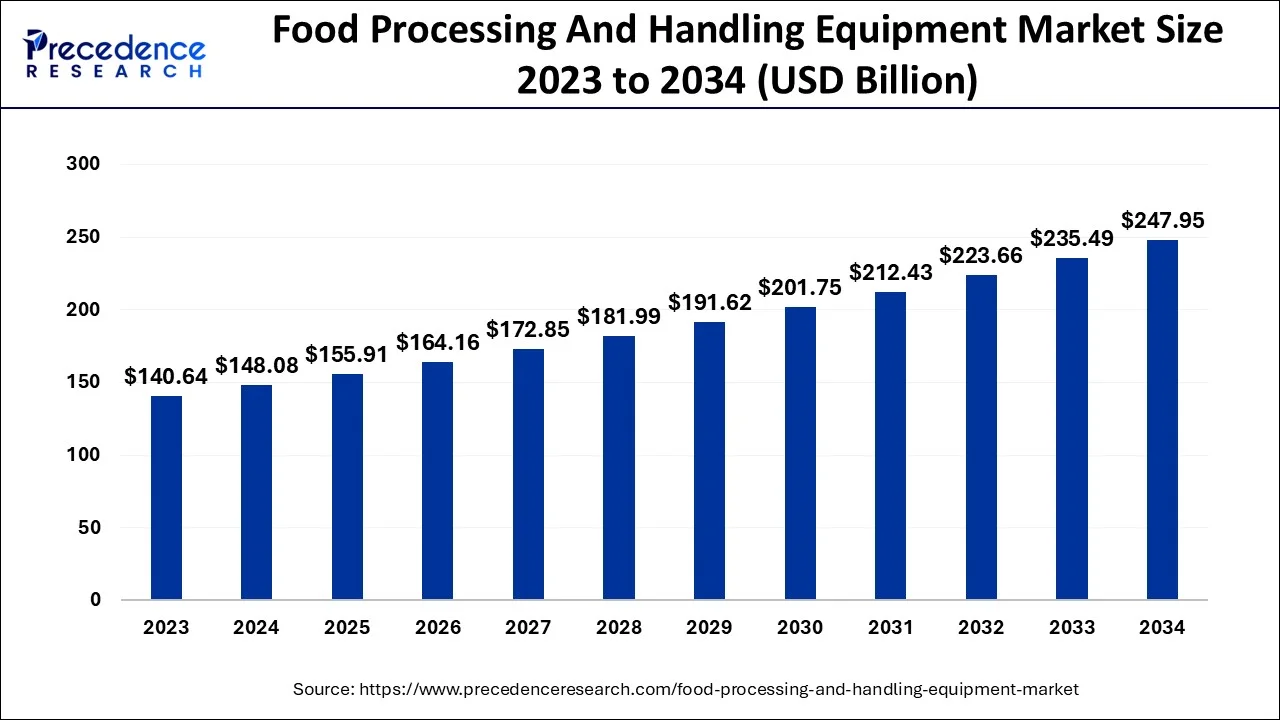
The global food processing and handling equipment market size is calculated at USD 155.91 billion in 2025 and is predicted to increase from USD 164.16 billion in 2026 to approximately USD 259.99 billion by 2035, expanding at a CAGR of 5.25% from 2026 to 2035. The burgeoning food processing industry, the shifting trend towards processed foods, and rapid urbanization drive the market.
Food Processing and Handling Equipment Market Key Takeaways
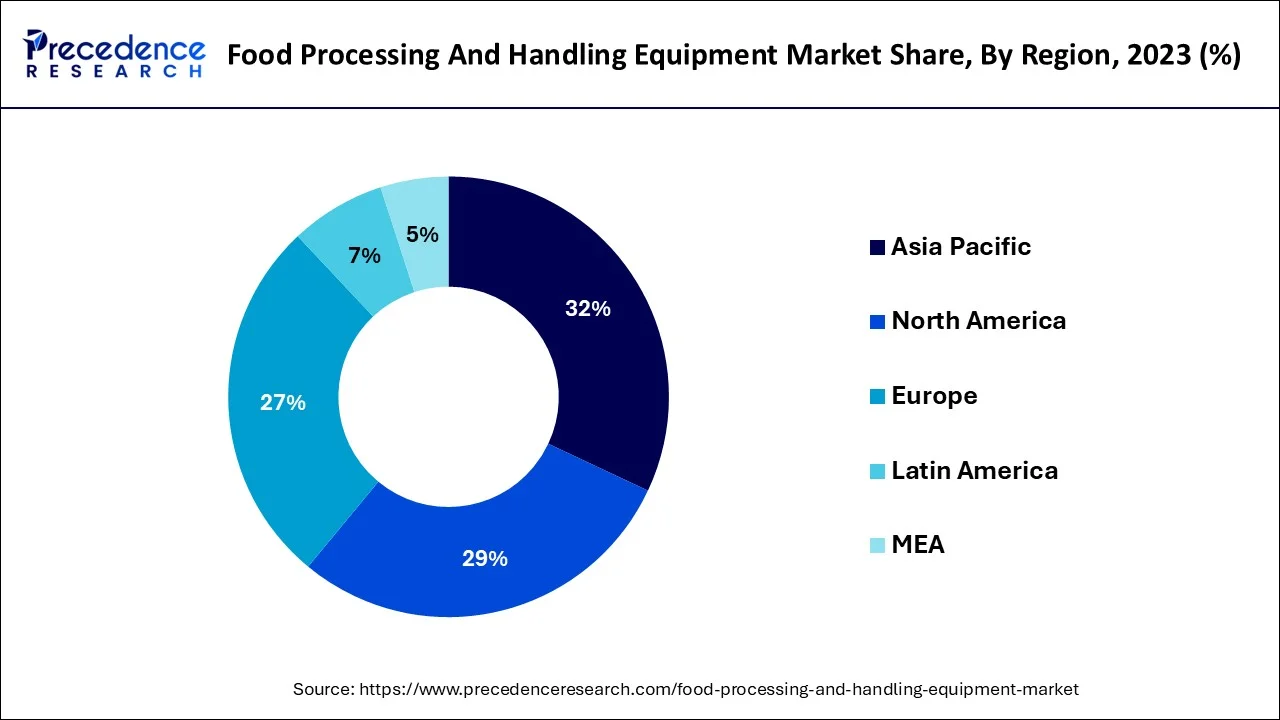
- Asia Pacific dominated the global market with the highest market share of 32% in 2025.
- By Equipment Type, the food processing equipment segment held the largest market share in 2025.
- By Application, the bakery and confectionary segment captured the biggest revenue share in 2025.
Market Overview
The food processing and equipment market encompasses the development and deployment of a diverse array of machinery, parts, and systems for the preparation, processing, storage, and packaging of food items. Some common equipment includes injectors, tumblers, mixers, bowl cutters/emulsifiers, and grinders. They are used for multiple purposes, such as mixing, grinding, blending, slicing, and cutting. These types of equipment possess safety, durability, and resistance to scratching and decomposition.
How is AI contributing to the Food Processing and Handling Equipment Industry?
The adoption of artificial intelligence in the food industry is marked by the introduction of computer vision, robots, and predictive analytics throughout the food processing and handling process chain. It renders the quality inspection, sorting, hygiene inspection, and maintenance cleaning-up processes intelligent and all automated by AI machines. Besides this, AI is also used in the processing environments to optimize the parameters, enhance safety, throughput, minimize waste, and minimize manual intervention.
Major Trends in The Food Processing and Handling Equipment Market
- Increasing numbers of businesses are resorting to AI in automatic quality control and safety controls.
- Robotics is being incorporated so that the most accurate sorting, cutting, and packaging will occur.
- Predictive maintenance through sensor IoT is becoming a standard tool in ensuring that the equipment has minimal downtimes.
- The parameters of processing are also being optimized to enhance yield, nutrition, and consistency.
- Supply chain management is getting intelligent through AI that performs demand forecasting and route optimization.
- Hygiene and compliance (both workers and equipment) have reached an advanced level of monitoring, and thus, monitoring and tracking are now simultaneous for both areas.
- Energy-efficient and sustainable food processing technologies are becoming of interest.
Market Outlook
- Industry Growth Overview: The market is poised for robust growth over the next several years, as food brands around the world invest in automating their facilities to improve safety and efficiency.
- Sustainability Trends: As manufacturers strive to reduce their carbon footprint, they are increasingly investing in eco-friendly machines, energy-efficient electric motors, water-saving cleaning equipment, and recyclable materials.
- Global Expansion: Expanding food exports from the Asia-Pacific, Latin America and Middle East regions have prompted producers to expand their production capabilities.
- Start-Up Ecosystem: Emerging agri-tech and food machinery start-ups are now introducing new products, including smart sensors, AI-based quality checks, compact processing units, and automated sanitation equipment.
Market Scope
| Report Coverage | Details |
| Market Size in 2025 | USD 155.91 Billion |
| Market Size in 2026 | USD 164.16 Billion |
| Market Size by 2035 | USD 259.99 Billion |
| Growth Rate from 2026 to 2035 | CAGR of 5.25% |
| Base Year | 2025 |
| Forecast Period | 2026 to 2035 |
| Segments Covered | Equipment Type, End-Product Form, Application, and Region |
| Regions Covered | Regions Covered North America, Europe, Asia-Pacific, Latin America and Middle East & Africa |
Market Dynamics
Driver
What is the Importance of the Food Processing and Handling Equipment Market?
The market is driven by the increased focus on efficiency, safety, and quality in the food production sector. Food processing equipment is one of the key components that help manufacturers meet these goals. These machines are brought to the market to complete several tasks in the production process. They help ensure that food products are produced safely, consistently, and quickly.
Restraint
What are the Challenges in Food Processing Manufacturing?
It is tedious to maintain food safety and quality because contamination can occur at many stages, from raw material sourcing to final packaging. The supply chain complexity in food processing is faced by many stakeholders, like suppliers, farmers, retailers, and distributors. A lack of modern equipment and automation creates hurdles in technological upgradation. It results in high operational costs, inefficiencies, and difficulty in meeting regulatory standards.
Opportunity
What are the Major Trends in the Food Processing Industry?
The food processing and handling equipment market revolves around the development of innovative products and continuous innovation in the food processing sector. It is driven by the development of various food products and immunity-boosting products, and the rising health awareness among consumers. Food industries are heavily using plant-based extracts such as bamboo and wheat and sustainable bioplastics.
Segments Insights
Equipment Type Insights
Which Equipment Type Segment Dominated the Food Processing and Handling Equipment Market?
The food processing equipment segment held a dominant position in the market in 2025 due to the growing demand for processed foods and the need for large-scale food manufacturing. Food processing equipment enables bulk operations and conducts entire process flows, from raw material intake to final processing. The type of equipment to be used depends on moisture content, contamination risk, and desired throughput. They play a vital role in ensuring food safety throughout processing by preventing the introduction of contaminants.
The food packaging equipment segment is expected to grow at the fastest CAGR in the market between 2026 and 2035 due to the rising preference for aesthetic packaging and longer shelf-life of food products. Different types of food packaging equipment include vacuum packaging machines, bundling packaging machines, bagging machines, closing machines, and closing machines. Using these machines, companies can create their brand value by developing unique packaging.
End-Product Form Insights
Why did the Solid Segment Dominate the Food Processing and Handling Equipment Market?
The solid segment dominated the market in 2025 due to extensive processing requirements across bakery products, confectionery, meat, poultry, and certain dairy solids. These solid foods are produced by converting agricultural raw materials into safe, stable products. Solid food products are safer, can be processed at a lower cost, and have a longer shelf life. They undergo primary and secondary processing, such as ingredient mixing, thermal treatment, fermentation, and controlled packaging.
The semi-solid segment is expected to grow with the highest CAGR in the market during the studied years due to increasing demand for ready-made sauces, spreads, fillings, creams, and pastes. Cooking sauces help consumers easily replicate and bring home the restaurant experience. Food processing equipment is used to manufacture semi-solid foods using minimal preservatives and additives. The rising preference for vegetarianism and veganism promotes the demand for eggless sauces across HoReCa and individuals.
Application Insights
Which Application Segment Led the Food Processing and Handling Equipment Market?
The bakery and confectionery segment led the market in 2025 due to the need for daily staple foods like bread. People mostly prefer bakery and confectionery food items like cookies and cakes on special occasions. Specialized food processing equipment is required for producing bakery items that undergo multiple steps, from fermentation and dough kneading to baking at high temperatures.
The fish and seafood segment is expected to expand rapidly in the market in the coming years. Fish and seafood processing requires well-thought-out sanitary processes to prevent contamination, with significant attention given to the use of water. Key steps for fish and seafood processing include washing and grading, gutting or filetting, and freezing & canning. Processing enables producers to deliver on quality, sustainability, and innovation.
Regional Insights
What is the Asia Pacific Food Processing and Handling Equipment Market Size?
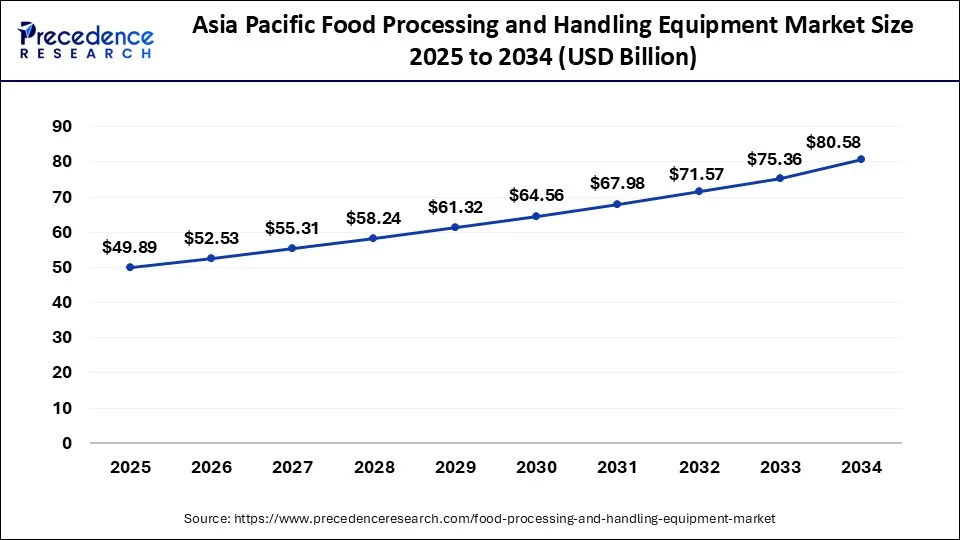
The Asia Pacific food processing and handling equipment market size is exhibited at USD 49.89 billion in 2025 and is projected to be worth around USD 84.85 billion by 2035, growing at a CAGR of 5.45% from 2026 to 2035.
Asia Pacific region has shown good growth in recent years and this region is expected to dominate the market during the forecast period. The increasing population of Indonesians like China and India is creating a great demand for food products. Increasing demand for processed food products it's leading to the growth of the equipment market. China holds the largest market share in the Asia Pacific region and it is continuously catering to the increasing demand of processed food in the nation. Followed by China India is also expected to have a good amount of market share during the forecast period. As there is a major shift of consumers towards processed foods and convenient foods the market is expected to grow in India. With the increase in disposable income, there is a growth in dual-income households and busy lifestyles, all of these factors are responsible for the growth of the food processing and handling equipment market in this region. Rapid urbanization and industrialization is supporting the market and providing better opportunities in the Asia Pacific region.
India Market Trends
The Indian market is driven by the presence of key players and favorable government support. Gansons, Pilotsmith India, and Neologic Engineers are major providers of food processing equipment in India. India's food processing industry is considered to be the 6th largest in the world, supported by an extensive agricultural sector and potential exports of processed foods.
Governments or investing in order to have advanced machinery for processing and handling of food products in this region. Increased automation and the use of robotics in this industry is expected to drive the market in the Asia Pacific region. North American region it is also expected to see growth as a result of demand for food processing and handling equipment. Consumers in this region prefer frozen food products. An increase in the number of food manufacturing plants is driving the market growth of this region. Many major market players are located in the North American region, and this also happens to be a major factor for the growth of this market. In order to expand the production facilities of the European region there is a significant amount of investment in this industry. Major market players from European nations or setting their manufacturing units across other regions. There are many food products that have a global market and this is driving through the food processing and handling equipment market.
How is North America Growing in the Food Processing and Handling Equipment Market?
North America is expected to grow at a notable CAGR in the foreseeable future due to the increasing integration of automation in food processing and the rapidly expanding manufacturing infrastructure. Government bodies launch initiatives and policies to promote the indigenous manufacturing of food products, strengthening the food processing sector. Favorable trade policies and increasing investments from government and private organizations contribute to market growth.
U.S. Market Trends
The U.S. Department of Agriculture (USDA) recently announced an investment of $840 million to fund regenerative agriculture projects and practices in FY26, increase agricultural production, and support new uses and markets of agricultural products and innovative solutions.
Europe Food Processing and Handling Equipment Market
Europe continues to maintain its position as a large player in the global market due to its established reputations for having extensive regulatory frameworks, advanced food production systems, and growing consumer demands for more sustainable technologies for food processing. Countries such as Germany, France, and Italy have significant investments in automation, robotics, and clean-label methods that create opportunities for new equipment innovations.
Furthermore, heightened requirements for efficient cold chain systems; hygienic design; and energy-efficient machinery are driving demand for the use of new equipment that can provide significant performance advantages through precision engineering. Additionally, the European Union's export-driven food industry is driving demand for premium-grade machines with exceptional levels of automation and robotics technology.
Germany Market Trends
The German market is growing due to the rising adoption of advanced technologies and stringent hygiene rules. Manufacturers prefer precision engineering and high automation levels. Germany's food processing industry is the 4th largest industrial sector in the country. Over 632,910 companies involved in food production serve around 84 million citizens in Germany with safe, high-quality food.
Which Major Growth Factors Drive the Notable Growth of the Food Processing and Handling Equipment Market in Latin America?
Latin America is expected to grow at a notable rate in the market during the predicted timeframe, driven by the region's role as a massive global agricultural and protein-processing hub and the rapid growth of packaged and processed food. Government initiatives across this region aim to enhance export competitiveness, modernize food production, and build stricter food safety frameworks. Government-backed port authority investments across this region have expanded reefer plug infrastructure, animal health certification zones, and container yards.
How can the Food Processing and Handling Equipment Market Expand in Brazil?
Brazil is transitioning toward urbanization, shifting consumer habits, sustainable packaging initiatives, government-backed financing, and expansion of the food service sector. Government incentives boost the adoption of smart sensors, Industry 4.0 automation, and advanced meat or poultry processing equipment.
Will the Middle East and Africa Grow in the Food Processing and Equipment Handling Market?
The Middle East and Africa region is considered to be a significantly growing area due to automated processing lines, food security initiatives, and rising convenience food demand. The rapidly expanding agricultural sector and the growing demand for processed foods augment the market. Major industry players and institutions conduct seminars and conferences to share the latest updates on food processing.
UAE Market Trends
Regional suppliers like Danway Group, Swedinox International, and Focus EMC Kitchens provide advanced machinery for automated production lines. The UAE is home to over 570 food and beverage processors, comprising small- and medium-sized companies, and produces 5.6 million metric tons annually.
Government Initiatives in the Food Processing and Handling Equipment Market
China
- In May 2026, China introduced the next-generation industrial policy, and state interventions are expanding foreign dependence on Chinese supply chains and boosting China's trade dominance. It has also been reported that state interventions across the economy are becoming more crucial and broader for global markets. (Source: https://rhg.com)
United States
- In October 2026, the U.S. Food and Drug Administration (FDA) introduced the ‘Human Foods Program' that plays an important role in implementing the Trump Administration's policies. The U.S. FDA has made significant efforts to protect and promote the health and well-being of all Americans. (Source: https://www.fda.gov)
Germany
- In December 2025, the Organisation for Economic Co-operation and Development (OECD) reported that private consumption will increase due to reduced uncertainty of domestic policy, low inflation, and rising nominal wages. It has also been stated that there is an urgent need for improved public spending efficiency, and efforts are being made to ensure medium-term fiscal sustainability. (Source: https://www.oecd.org)
Brazil
- In March 2026, the USDA Foreign Agricultural Service reported that the food processing sector revenue of Brazil reached about USD 248 billion in 2025, which grew 8% from the year 2024. Brazil holds a strong agricultural base that supports ongoing investments in the food processing sector. (Source: https://www.fas.usda.gov)
Saudi Arabia
- In March 2025, Saudi Arabia announced $20 billion in investments in the food industry by 2035. It has been announced that the dairy, bakery, poultry, and sweet sectors, and the beverages and juice industries will benefit from most of the new funds. (Source: https://www.thesaudifoodshow.com)
Investments in the Food Processing and Handling Equipment Market
- In April 2026, Electrolux Group and Midea Group announced a long-term strategic partnership in North America to strengthen innovation and boost profitable growth. The team expected that this partnership would have a positive impact on Electrolux Group's sales. It will also contribute to increasing cost efficiency over the next three years. (Source: https://www.prnewswire.com)
- In April 2026, Hoshizaki announced that it has begun shipments from its manufacturing facility in Vietnam. It has also been announced that Hoshizaki is focused on increasing its initial 51% stakeholding in Arico. (Source: https://www.coolingpost.com)
- In July 2026, GEA Group raised its full-year guidance and achieved a 14.2% year-over-year increase in order intake in the second quarter of 2026. The organic revenue growth was reported to be about 6 to 8%. (Source: https://www.gea.com)
Collaborations in the Food Processing and Handling Equipment Market
- In August 2025, SPX FLOW and Siemens collaborated to uphold cutting-edge digital twin technology at the Manufacturing x Digital center in Chicago. They represent a premier hub for innovation in manufacturing and is accelerating advances across industries such as chemicals, food and beverage, and batteries. (Source: https://news.siemens.com)
- In March 2026, Bosch accelerated advanced manufacturing in Mexico. Bosch is integrating AI, advanced automation, and digital twin technology to enhance productivity. It will also boost the transition toward high-value manufacturing processes. (Source: https://mexicobusiness.news)
- In July 2026, Alfa Laval strengthened its commitment to the global food industry with its pharma and food division. It will enhance customer alignment and bring R&D investment to a historic level. (Source: https://asiafoodjournal.com)
Value Chain Analysis
- Components Sourcing & Engineering Excellence: Manufacturers use high-quality materials to manufacture components of food processing and handling equipment. These materials must also comply with relevant food safety regulations for the equipment to be durable and usable.
- Technology & Manufacturing Integration: Most leading brands today employ extensive automated mechanical systems as well as AI (artificial intelligence) monitoring systems in addition to using standard monitoring equipment, which enables them to meet global processing standards.
- After-Sales Service & Distribution Optimization: Specialized dealership networks with strong service support personnel provide quick installation and training, maintenance, and lifecycle management of food processing and handling equipment to their customer base.
Competitive Landscape
The food processing and handling equipment market is accelerated by surging demand for processed and ready-to-eat foods, rapid automation, labor shortages, and stringent food safety and hygiene regulations. The top companies in this industry are Tetra Laval Group, GEA Group AG, Bühler Holding AG, JBT Corporation, The Middleby Corporation, Marel hf, Alfa Laval AB, Krones AG, and SPX FLOW, Inc. These industrial leaders offer aseptic processing and filling systems, homogenizers, heat exchangers, mixers, alternative processing lines, freezing and chilling systems, energy-efficient packing systems, etc. R&D investments focus on AI-driven sorting and automation, sustainability, and transition into digital-first enterprises.
Top Companies in the Food Processing and Handling Equipment Market & Their Offerings
- Electrolux: Electrolux offers the global markets the opportunity to experience its system of various home and professional appliances, such as integrated food processing, washing, refrigeration, and cooking.
- Hoshizaki: Hoshizaki has been known to fabricate dependable commercial kitchen devices that consume less energy, like ice machines, refrigerators, and freezers, and on the other hand has the most reputation as being reliable at the same time.
- Global Bakery Solutions: Global Bakery Solutions is engaged in the business of providing ovens, conveyors, tumbler mixers, and other machinery that are essential in operating industrial bakery businesses and protein processing.
Food Processing and Handling Equipment Market Players
- Electrolux (Sweden)
- Hoshizaki (Japan)
- Global Bakery Solutions (UK)
- Sealtech Engineers (India)
- GEA Group (Germany)
- SPX Flow (US)
- Robert Bosch (Germany)
- IMA Group (Italy) ALFA LAVAL (Sweden)
- Bühler Holding AG (Switzerland)
- JBT Corporation (US)
- Multivac (Germany)
- Krones Group (Germany)
- Tetra Laval International S.A. (Switzerland)
- Middleby Corporation (US)
- Dover Corporation (US)
- Ali Group S.r.l (Italy)
- Dairy Tech India (India)
- Spheretech Packaging India Pvt Ltd (India)
- Align Industry (India)
Recent Developments
- In November 2025, FAMSUN unveiled its new premium brand FAMSCEND in Yangzhou, China, with over 160 industry leaders in attendance. The launch signifies the company's foray into pet and healthy human food equipment, emphasizing the mission to "Innovate to nourish a better world" and a vision of trustworthiness. (Source: https://www.petfoodindustry.com)
- In May 2025, Alfa Laval, Krones, SPX FLOW, and Tetra Pak formed the Food Manufacturing Technologies Europe (FMTE) coalition to tackle key challenges in the food manufacturing sector. FMTE aims to enhance European competitiveness and invites more companies to participate in policymaking efforts. (Source: https://www.foodanddrinktechnology.com)
Segments Covered in the Report
By Equipment Type
- Food Processing Equipment
- Food Service Equipment
- Food Packaging Equipment
By End-Product Form
- Solid
- Liquid
- Semi-solid
By Application
- Bakery & Confectionery
- Meat & Poultry
- Fish & Seafood
- Dairy Products
- Alcoholic Beverages
- Non-alcoholic Beverages
- Other
By Geography
- North America
- Europe
- Asia-Pacific
- Latin America
- Middle East & Africa (MEA)
For inquiries regarding discounts, bulk purchases, or customization requests, please contact us at sales@precedenceresearch.com
Frequently Asked Questions





Ask For Sample
No cookie-cutter, only authentic analysis – take the 1st step to become a Precedence Research client
 Get a Sample




 sales@precedenceresearch.com
 Schedule a Meeting
