



Fruit and Vegetable Processing Market Size, Key Companies, Company Market Share, Production Volume, Consumption Trends, Pricing Analysis, Export & Import Dynamics, Competitive Positioning, and Demand Forecast
Fruit and Vegetable Processing Market (By Type: Fruit Products, Vegetable Products; By Product: Fresh, Canned, Frozen, Dried and Dehydrated; By Mode of Operation: Semi Automatic, Automatic; By Material: Fruits, Vegetables, Others; By Technology: High-Pressure Processing (HPP), Microwave Processing, Pulsed Electric Field Processing (PEF); By Processing Systems: Small-Scale Processing, Intermediate-Scale Processing, Large-Scale Processing; By Equipment Type: Pre-Processing Equipment, Peeling/Inspection/Slicing, Washing & Dewatering, Fillers, Seasoning, Packaging & Handling, Others) - Global Industry Analysis, Size, Trends, Leading Companies, Regional Outlook, and Forecast 2026 to 2035
Source: https://www.precedenceresearch.com/fruit-and-vegetable-processing-market
 Get a Sample
 Table Of Content


What is the Fruit and Vegetable Processing Market Size?
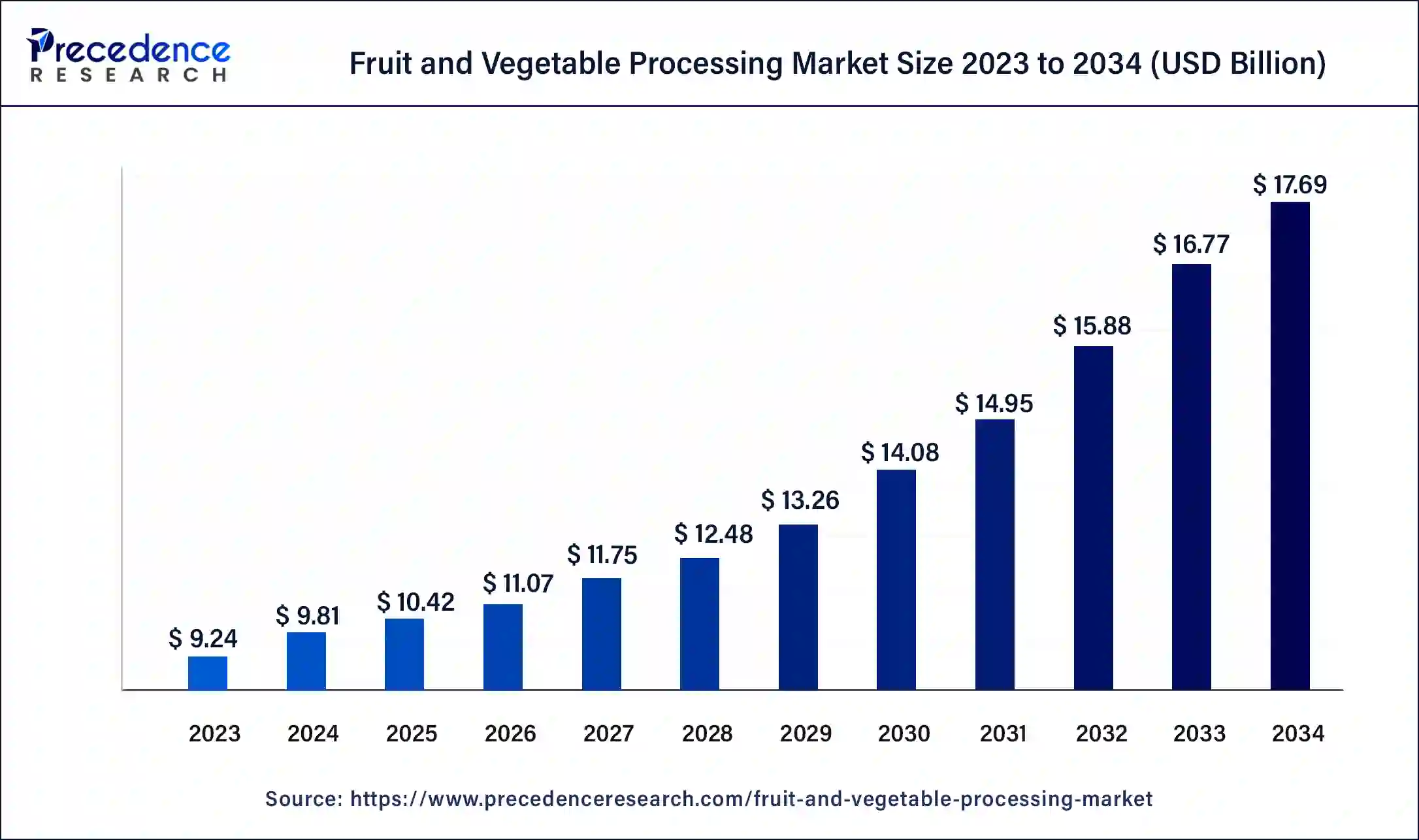
The global fruit and vegetable processing market size is accounted at USD 10.42 billion in 2025 and predicted to increase from USD 11.07 billion in 2026 to approximately USD 18.59 billion by 2035, growing at a CAGR of 5.96% from 2026 to 2035
Market Highlights
- Asia Pacific dominated the aavory snack market in 2025.
- By type, the fruit segment held the largest share of the market in 2025.
- By product type, the canned segments dominated the global market in 2025.
- By mode of operation, the automatic segment led the global market in 2025.
What is Fruit and Vegetable Processing?
Dual income households and a major change in the lifestyle of the consumers is creating a demand for a fruit and vegetable processing market. Processing of fruit and vegetables helps in improving the storage life and helps in improving the quality of these fruits and vegetables. Processing of fruits and vegetables is extremely useful in preservation of vitamins, nutrition and the flavor of the food items. The processed food items are stored in the form of pulp fruit pieces or juices in cans.
Different types of processing techniques are drying freezing and preparing jellies juices or jams. A large group of plants are consumed by humans. Vegetables are extremely perishable but they need to be preserved with the use of processing methods in order to improve their shelf life. The availability of processing techniques across many nations has aided the international trade of vegetables which is confined to the processed forms. Processing of vegetables and fruits does not involve any deterioration in terms of nutrition. In many developing nations there is a belief that the fresh vegetables are superior as compared to the processed ones.
Fresh vegetables may lose their vitamin content during transportation and the quality of fresh vegetables is also altered due to the interference of various factors during storage and transportation. But in the case of canned vegetables or frozen vegetables which are processed the nutritive value remains high. Minimally processed vegetables and fruits do not contain any preservatives.
The COVID-19 pandemic have led to a major change in the consumption patterns of the consumers. Most of the consumers across the globe are seeking fresh foods to replace the junk food. In order to boost the immunity the market for processed fruits and vegetables is growing across the globe. In the industries where the processing of fruits and vegetables is done there is an increase in the usage of automation and robotics which helps in reducing the cost and increases the output.
What are the Growth Factors in the Fruit and Vegetable Processing Market?
Consumption of different types of fruits and vegetables is extremely important for the health of a person. The diverse range of these perishable items needs special care. Fruits and vegetables undergo many processes like washing, trimming, peeling, slicing and all of these processes do not affect their quality. All of these food items are extremely nutritious. In order to cater to the busy lifestyle of consumers in the developed nations and also in the developing nations the processed fruit and vegetables market is expected to grow during the forecast period. As there is an increase in the per capita income of many households and an increase in the disposable income has provided opportunities for the growth of this market.
Most of the households demand ready to eat food items and this is expected to grow in the coming years. The demand for processed products is increasing due to its quality and nutritive value. Increase dependency on robotics and automatics in the fruit and vegetable processing industry has led to a growth in the output and it has reduced the cost of operation for these companies. There are many stringent policies led by the government and the food safety standards that ensure quality. The market for the global fruit and vegetable processing has many different market players that provide best products at competitive rates. In order to introduce more efficient systems for the growth of this market there have been many mergers and acquisitions amongst the market players. Owing to all of these factors the market for fruit and vegetable processing is expected to grow well during the forecast period.
Major Trends of the Fruit and Vegetable Processing Market
- An increasing number of AI-based grading and sorting systems are being installed, resulting in fewer human mistakes and fewer post-harvest losses during processing.
- Consumers are becoming more interested in functional processed products such as vegetable fibres, fruit concentrates, and powders from nutraceutical, sports nutrition, and fortified foods.
- An increase in contract processing (chemical short-cutting) and private label manufacturing allows retailers and foodservice companies to reduce capex and decrease time to market for new products.
- There is a growing investment in energy-efficient and water-optimised processing plants to reduce operational costs and meet sustainability requirements.
- The use of non-thermal methods of preservation, like advanced dehydration techniques and pulsed electric fields, is being adopted to maintain texture, colour, and nutritional quality.
Fruit and Vegetable Processing Market Trade Analysis
- Global trade for processed fruits and vegetables is affected by seasonality, with the exporting countries leveraging excess produce from their harvests to supply areas where production does not match demand.
- The ability of exporters to compete in the marketplace for processed fruits and vegetables is increasingly dependent upon meeting food safety requirements and maintaining cold chain integrity, resulting in fewer rejected shipments and more efficient cross-border transportation of fruits and vegetables.
Market Outlook
- Industry Growth Overview: From 2025 to 2030, the fruit and vegetable processing industry will continue to grow around the world due to an increasing global demand for processed, ready-to-eat, minimally processed, and added-value items. Future growth is attributable to several new urban-dwellers in the Asia-Pacific region and North America, along with advancements in cold-chain infrastructure.
- Sustainability Trends: Sustainability is driving many processors to seek out eco-friendly packaging; adopt waste-reduction technologies; construct renewable-energy-powered processing facilities; and develop clean-label products. In addition, many firms are investing in equipment to support pulp recovery, water recycling, and reduced carbon footprints as regulatory agencies raise the bar on food waste and emissions.
- Global Expansion: Large processing companies are creating processing plants and supply chains in Southeast Asia, Eastern Europe, and Latin America, primarily to secure access to raw materials, but also to meet the growing demand for processed food in these regions. By establishing local processing operations and building supply chains that are regionally adapted, companies are able to reduce logistics expenses and create products tailored to local tastes.
- Key Investors: Investment Groups with Private Equity have become increasingly interested in the Food Processing Sector because it has both stable and consistent demand as well as high-profit margins with Frozen and Canned Products. Investors are supporting businesses that are modernizing their processing facilities, automating their operations, and improving their cold storage capabilities, particularly in emerging markets.
- Startup Ecosystem: Startups are growing in popularity due to the development of new technologies for dehydrating fruits and vegetables, utilizing high-pressure processing techniques, producing fermented products from plants, and producing Zero-Waste extracts. Some of the most promising startups in this market include those based in India, Europe, and the U.S., which have been able to attract large amounts of venture capital.
Market Scope
| Report Coverage | Details |
| Market Size in 2025 | USD 10.42 Billion |
| Market Size in 2026 | USD 11.07 Billion |
| Market Size by 2035 | USD 18.59 Billion |
| Market Growth Rate from 2026 to 2035 | CAGR of 5.96% |
| Largest Market | Asia Pacific |
| Base Year | 2025 |
| Forecast Period | 2026 to 2035 |
| Segments Covered | Type, Product, Mode of Operation, Material, Technology, Processing Systems, Equipment, and Regions |
| Regions Covered | North America, Europe, Asia-Pacific, Latin America, and Middle East & Africa |
Segments Insights
Type Insights
The fruit segment had the largest market share in the past and it is expected to dominate the market in the coming years. Different types of products derived after the processing of fruits are jam, fruit jellies, fruit cheese, fruit pulp, fruit syrup, dried fruit and others. There is an increase in the demand for all of these fruit products in various industries. Various juice outlets, beverage stores, restaurants have the largest demand for these products. All of these products are used in many different types of food preparations. Most of the fruit products can be used as supplementary items in combination with other food products.
The vegetable segment we'll have good revenue during the future. Different types of processed vegetable products offered in the market are concentrated vegetable juice pasteurized vegetables, vegetable sauce marinated vegetables and other vegetable products. The frozen form of vegetables has a good demand in developed nations. The revenue generated from the fruit products will be more as compared to the vegetable products.
Product Insights
The canned segment will have the largest market share in the coming years. In the developing as well as the developed nations there is a great demand for canned vegetables and fruits. In the developing nations the canned fruits and vegetables head great demand even in the past. Maximum revenue will be generated through this segment. Different types of products that are canned or beet, spinach, apples, tomatoes, cranberries, apricots etc the nutritional content of these food items is preserved to the maximum when they are canned. The amount of nutrition in terms of minerals, proteins, fats and carbohydrates do not change in the process of canning. Pineapple chunks or Mandarin oranges are best canned fruits.
The fruits and vegetables in this technique are processed in immediately after a few hours of harvesting which helps in minimum loss of nutrients as well as flavor. Most of the canned vegetables which are inexpensive and healthy or corn, pumpkin, tomatoes, beans etc. The frozen segment will also have a great demand in the future. Fruits and vegetables provide many advantages in the frozen form. Fruits and vegetables at an optimum temperature helps in increasing their shelf life. Increased shelf life of these fruits and vegetables reduces the wastage in this industry.
Mode of Operation Insights
Depending upon the mode of operation, the automatic segment accounted largest market share in 2025. Automation in this industry has come in the recent years but it has helped in increasing the output of these industries with lower costs. The automatic mode of operation helps in reducing the human intervention which thereby helps in maintaining the nutritive value of the food and does not contaminate the contents of different fruits and vegetables. Reduced intervention of humans in this industry due to the use of robots and automation has helped in generating more output in order to meet the growing demand in developed nations.
Automation has also helped in reducing the cost of operations in this industry as the cost of Labor is high in the developed nations. Due to the increased use of robotics and automation in this industry the demands of the online platform are also met which requires great output. The quality of the products is not affected even during these bulk productions. The automatic segment will lead the market in terms of revenue as compared to the semi automatic segment.
Geography Insights
During the forecast period the Asia Pacific region is expected to have the largest growth in terms of revenue. The growth of this market in the Asia Pacific region is boosted due to various government initiatives that facilitate technological advancements in this region. At least in the countries like Japan China and India the production of fruits and vegetables is high as compared to other crops. That European markets shall have a stable growth in the coming years due to the presence of major market players in this region. The European market is seeing saturation in the demand for processed fruits and vegetables. The developing nations of the Asia Pacific region our exploring the industry. This region is providing many growth opportunities for the fruit and vegetable processing market. Even though the cultivation of fruits and vegetables is high in many nations like India still there is a growing demand for processed fruits and vegetables due to an improved lifestyle of many consumers and high disposable income.
Rapid urbanization and increased per capita income is another reason for the growth of the processed fruit and vegetables market in the Asia Pacific region. Dual income households and hectic lifestyles or other factors that are helping in the growth of the market. In the developing economies the adoption of processed food products is increasing as it happens to be a time saving option and it is extremely convenient for the working class people. The presence of many local and international market players in the industry in the North American region is leading to a growth of the market. In the countries like Canada a change in the lifestyle of consumers is creating greater demand for these products.
Regional Insights
Why did North America experience the fastest growth in the Fruit and Vegetable Processing Market?
North America has been the fastest-growing region in the fruit and vegetable processing industry due to the growing consumer demand for healthy, clean, and easily accessible food options. There are many fast-growing segments within this region, including frozen, dried, and minimally processed fruits/vegetables. In addition, North America provides substantial investment opportunities in sustainable packaging solutions, automation, and plant-based food products. As a result, companies have invested heavily in waste/reduction technology as well as premium product lines, thus accelerating the market's growth.
U.S. Fruit and Vegetable Processing Market Trends
The U.S. has been the largest market in North America for food and beverage processors due to the abundance of processing technologies available and the growing need for consumer convenience while maintaining high food safety standards. As a response to this need, many processors are investing heavily in automated plants used for processing various food products and deploying sustainable packaging materials.
Currently, there is significant growth potential for frozen and dehydrated produce in the United States, and as such, the continued growth of North America's retail and e-commerce grocery sectors has been a catalyst for this growth.
What are the Advancements in the Fruit and Vegetable Processing Industry in Europe?
Europe is expected to witness significant growth in the market. This growth is driven by changing consumer lifestyles, favoring convenient and healthy food options as well as advances in food processing technologies that enhance product shelf life and quality. Rising urbanization and busy lifestyles are driving the demand for convenient, ready-to-eat processed fruit and vegetable products. Countries such as Germany, the U.K., France, etc., are leading players.
Germany Fruit and Vegetable Processing Market Trends: The country benefits from a robust export network and strong domestic consumption driven by its culinary culture and demand for convenient, ready-to-use ingredients. Government support, adherence to strict EU food safety standards, and innovation in value-added products further strengthen the region's market presence.
What are the Key Trends in the Fruit and Vegetable Processing Industry in Latin America?
Latin America is expected to witness substantial growth in the market, driven by an escalating consumer demand for convenience foods and health-oriented products. This growth and development are mainly fueled by increased processing capacities, technological innovations, and strategic investments that are aimed at optimizing yield and reducing waste. Shifting consumer preferences towards healthier, convenient, and sustainably produced foods also continue to propel market demand.
Brazil Fruit and Vegetable Processing Market Trends: The country is witnessing an increasing adoption of automation and digitalization, which is helping in enhancing operational efficiency and product consistency, thus fostering innovation and propelling market growth. Trends like organic produce, e-commerce, and direct-to-consumer channels are changing market dynamics, while major firms pursue vertical integration.
How is the Fruit and Vegetable Processing Industry Growing in the Middle East and Africa?
The Middle East and Africa are expected to witness steady growth throughout the forecast years. Growing urbanization efforts, an increased adoption of healthy lifestyles, growing demand for organic vegetables and fruits, and increasing consumption of canned and frozen food are expected to drive the market's growth in the upcoming years. Supportive policies, subsidies, and investments in infrastructure are also gaining traction, encouraging local production and distribution of vegetables and fruits.
Saudi Arabia Fruit and Vegetable Processing Market Trends: Rapid urbanization efforts in the region are driving demand for convenient and readily available food options. As more and more people move to cities and adopt busy lifestyles, there is a growing preference for fresh, pre-packaged, and ready-to-eat fruits and vegetables.
Fruit and Vegetable Processing Market Companies
- GEA Group AG (Germany)
- Bühler (Switzerland)
- Krones AG (Germany)
- Heat and Control, Inc. (Sweden)
- Finis (Netherlands)
- Conagra Brands (US)
- Greencore Group (Ireland)
- Nestlé S.A (Switzerland)
- Olam International (Singapore)
- Marel (Iceland)
- Bigtem Makine A.S.(Turkey)
- FENCO Food Machinery S.R. L.(Italy)
- ANKO FOOD MACHINE CO.LTD (Taiwan)
- The Kraft Heinz Company (US)
- PepsiCo Inc. (US)
- AGRANA Group (Austria)
- Bonduelle (France)
- Dole Food (US)
- SVZ International B.V. (US)
- Sahyadri Farms (India)
- Alfa Laval (Sweden)
- JBT Corporation (US)
- Syntegon Technology GmbH(Germany)
- Diana Group S.A.S.(France)
- RAJE AGRO FOODS PRIVET LIMITED (India)
Recent Developments
- The Kraft Heinz Company acquired Hemmer which is brazilian company. This company produces sauces and condiments. In order to introduce new taste options in Brazil this acquisition was made in September 2021.
- Agrana is an Austrian food company, it acquired Taiyo Kagaku Co which is involved in fruit preparations. The acquisition of this Japanese company has helped in capturing the Asian market. Yokkaichi, southern Japan plant was also acquired by Agrana in the same year in order to expand its territorial presence.
- In order to meet the increasing demand for organic and chemical free products Olam international had acquired Dangote Flour mills in 2019.
- Primal nutrition was acquired by the Kraft Heinz company in January 2019 in order to capture a larger market and to offer varied products in the market. This acquisition has helped in capturing a larger market.
Segments covered in the Report
By Type
- Fruit Products
- Vegetable Products
By Product
- Fresh
- Canned
- Frozen
- Dried and Dehydrated
- By Mode of Operation
- Semi Automatic
- Automatic
By Material
- Fruits
- Vegetables
- Others
By Technology
- High-Pressure Processing (HPP)
- Microwave Processing
- Pulsed Electric Field Processing (PEF)
By Processing Systems
- Small-Scale Processing
- Intermediate-Scale Processing
- Large-Scale Processing
By Equipment Type
- Pre-Processing Equipment
- Peeling/Inspection/Slicing
- Washing & Dewatering
- Fillers
- Seasoning
- Packaging & Handling
- Others
By Geography
- North America
- U.S.
- Canada
- Europe
- U.K.
- Germany
- France
- Asia-Pacific
- China
- India
- Japan
- South Korea
- Malaysia
- Philippines
- Latin America
- Brazil
- Rest of Latin America
- Middle East & Africa (MEA)
- GCC
- North Africa
- South Africa
- Rest of the Middle East & Africa
For inquiries regarding discounts, bulk purchases, or customization requests, please contact us at sales@precedenceresearch.com
Frequently Asked Questions





Ask For Sample
No cookie-cutter, only authentic analysis – take the 1st step to become a Precedence Research client
 Get a Sample




 sales@precedenceresearch.com
 Schedule a Meeting
