



Glass Filled Nylon Market Trends, Leading Companies, Company Revenue / Sales Performance, Plant Utilization, Production Volume, Pricing Dynamics, Supply Chain Performance, Competitive Landscape, and Industry Growth
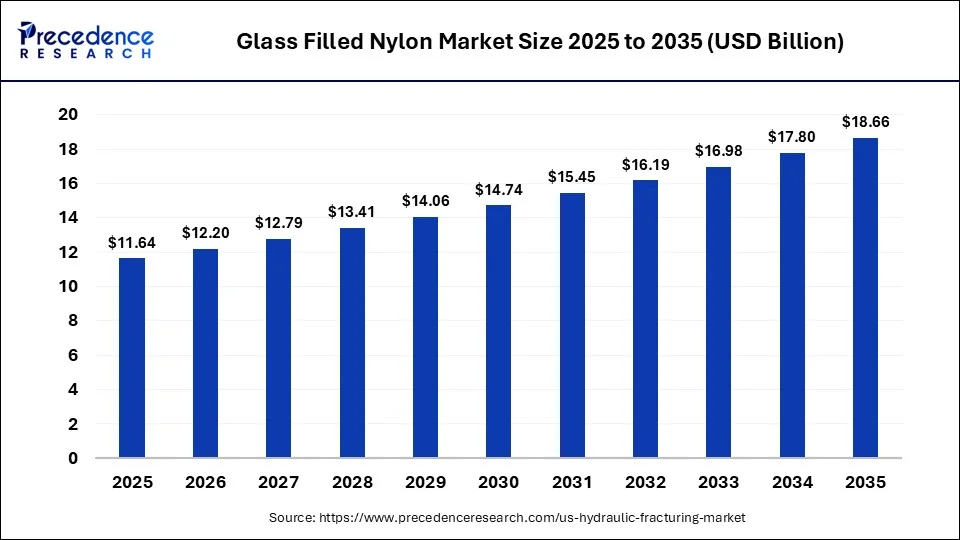
The global glassfilled nylon market was valued at about USD 12.20 billion in 2026, driven by manufacturers’ adoption of reinforced nylon for its strength, stiffness, dimensional stability, heat resistance, and light weight. Demand for lightweight automotive components, electrical and electronic applications, industrial equipment, and consumer products also supports growth. Senior Research Analyst Vidyesh Swar analyzed these trends for this report, which serves polymer manufacturers, compounders, automotive and electronics companies, industrial equipment producers, distributors, and technology providers. Â
Source: https://www.precedenceresearch.com/glass-filled-nylon-market
 Get a Sample
 Table Of Content


Glass Filled Nylon Market Analysis, Demand, and Growth Rate Forecast 2035
The glass filled nylon market is forecasted to expand from USD 12.20 billion in 2026 to USD 18.66 billion by 2035, growing at a CAGR of 4.83% from 2026 to 2035. The glassfilled nylon market is expanding as demand for highperformance plastics rises across the automotive, electronics, industrial, and consumer sectors. Vidyesh Swar noted that glass fiber offers nylon's strength, toughness, dimensional stability, and thermal performance, supporting durable, lightweight applications. The growing focus on vehicle lightweighting, fuel efficiency, electrification, and demand for advanced components further drives adoption.
Our Senior Research Analyst noted that companies are developing grades with improved mechanical properties, chemical resistance, flame retardancy, and processability. These advances create opportunities in automotive, electronics, industrial machinery, consumer goods, and diversified infrastructure. Substantial investments in formulations, sustainable feedstocks, recycled content, and applicationspecific grades address evolving performance and environmental issues.
Key Takeaways
- The global glassfilled nylon market was valued at approximately USD 9.8 billion in 2025 and is projected to reach USD 14.5 billion by 2030, representing a 6.6% CAGR.
- Market volume is predictable at 1.8 million tons in 2025, with approximately 650 kilotons of incremental volume opportunity through 2030
- By polyamide type, PA66 accounts for approximately 54.85% of market revenue, while PA6 is expected to contribute roughly 35%. Both represent smaller but fastergrowing specialty segments.
- By enduse applications, automotive and E&E are leading, driven by the need for lightweighting, metaltoplastic conversion, thermal management, electrification, insulation, and improved mechanical performance.
- The market is moving from volumedriven demand to highperformance, applicationspecific compounds for EV components, battery housings, connectors, and thermal management.
- Asia Pacific accounts for approximately 42% of global volume.
- Pricing varies broadly by grade and application. Highcontent, flameretardant PA66 grades for E&E applications reportedly command a 25%-40% premium over lowervalue commodity formulations.
- Growth is driven by lightweighting, EV implementation, and metaltoplastic substitution. Key constraints include volatile caprolactam and adipic acid prices, supplychain disruptions, and competitive edge from PBT and PPS.
Which Market Forces Will Most Influence GlassFilled Nylon Adoption and Value Creation?
Drivers
- Lightweighting and EV Adoption: Glassfilled nylon is increasingly used in automotive and EV components, offering strength and stiffness at lower weight. Automakers are evaluating lightweight materials to improve efficiency, simplify design, and meet electrification demands. The electrification initiative replacing metal with plastic supports structural, underthehood, electrical, and battery applications.
- HighPerformance Material Demand: The performance requirements in automotive, electronics, industrial, and consumer markets are boosting glassfilled nylon adoption. Compared with unreinforced nylon, glass fibers improve strength and heat resistance, making the material suitable for durable, lightweight components requiring flexible processing and reliable performance.
Restraints
- RawMaterial Price Volatility: Fluctuations in caprolactam, adipic acid, energy prices, transportation costs, and material availability can raise manufacturing costs and destabilize nylon pricing. These pressures may minimize margins, especially in pricesensitive applications where customers cannot absorb increases.
- AlternativePolymer Competition: Engineering polymers such as PBT and PPS may outperform glassfilled nylon in specialized thermal, electrical, chemical, and dimensional applications. Betterperforming or more economical alternatives can limit adoption and drive substitution in specific applications. Selection depends on component requirements, operating conditions, processing, durability, and costefficiency.
Opportunities
- Recycled and BioBased Grades: Growing sustainability goals are driving demand for recycled and biobased glassfilled nylon. Automotive, electronics, and industrial manufacturers are exploring lowerimpact materials with recycled content. Better recycling technologies and consistent formulations can broaden adoption by maintaining mechanical and thermal performance, creating opportunities for suppliers serving sustainabilityfocused infrastructure.
- HighPerformance Specialty Grades: Demand for glassfilled nylon that delivers heat performance, strength, flame resistance, and low warpage is creating opportunities for specialized formulations. By adjusting formulations and glassfiber content to component needs, suppliers can create highervalue products and expand these materials' applications. As automotive electrification and electronics and industrial applications advance, products need tailored stiffness, heat resistance, dimensional stability, and processability.
Segmental Analysis
Which Nylon Grades and Reinforcement Levels Are Capturing the Greatest Growth and Value Across EndUse Applications?
The glassfilled nylon market can be segmented by nylon grade, glassfiber reinforcement level, application, enduse industry, and geography.
By polyamide Type, PA6 and PA66 are the main product categories, with PA66 generating about 54.85%of market revenue through established automotive, E&E, consumer, and industrial demand. Hightemperature grades are gaining traction where thermal stability and mechanical performance are crucial. The need for recycled and biobased grades offers emerging sustainable alternatives.
By glassfiber reinforcement level, the market includes 10%–20%, 30%-40%, and >50% glassfiber content. Manufacturers use lower reinforcement levels when they need to balance strength, stiffness, weight, and processability. The 30%-40% range provides greater strength and dimensional stability; >50% suits demanding applications requiring stiffness, structural performance, and thermal resistance.
By application, Glassfilled nylon is used in automotive, electrical and electronic (E&E) components, industrial, consumer, and other engineered applications. It offers automotive components a strong strengthtoweight ratio and resistance to heat, chemicals, and wear. Additionally, E&E components benefit from its electrical performance, dimensional stability, and robustness.
By enduse industry, Automotive and electrical & electronics drive demand for highperformance engineering plastics through lightweighting and component miniaturization. Machinery and equipment add industrial demand, while consumers increasingly use these plastics in durable, performanceoriented products.
By geography, AsiaPacific leads in production and consumption of glassfilled nylon. Demand depends on automotive and electronics manufacturing, industrial activity, polymerprocessing capacity, and adoption of lightweight materials. North America and Europe remain key markets for advanced engineering plastics and specialized glassfilled nylon.
Which Polyamide Type Will Define the Growth and Profit Pools in GlassFilled Nylon?
PA 66 leads the glassfilled nylon market, accounting for about 54.85%of revenue, supported by its thermal resistance, mechanical strength, chemical stability, and established utilization in enginecompartment components and highvoltage connectors. PA 6 holds roughly 35%, competing in costsensitive automotive, consumer, and industrial uses where processing efficiency and adequate performance outweigh maximum heat resistance. Additionally, specialty formulations expand at approximately 8.2% annually, versus an estimated 6.6% CAGR for the overall market.
Our analysis suggests that polyamide type competition is transitioning toward PA 6 for costperformance, PA 66 for reliability, and specialty grades for premium growth. PA 6 may gain in applications prioritizing weight reduction and part economics, while PA 66 remains strong where thermal aging, dimensional stability, and chemical exposure matter. Momentum is moving toward hightemperature and circularcontent formulations, driven by electrification, flameretardancy requirements, and sustainability targets.
In our view, the main opportunity for compounders is to move beyond resin supply with applicationspecific formulations featuring validated recycled or biobased content, stable fiber dispersion, low warpage, controlled moisture uptake, and reliable thermalcycle performance. The main risk is that sustainabilityled grades require development and qualification investment before scaling. Additionally, companies with broad PA 6/PA 66 portfolios and specialtyengineering capabilities are best positioned to protect margins and win longterm OEM programs.
Which EndUse Applications Are Driving the Strongest Demand for Nylon Materials?
Automotive, electrical and electronics (E&E), consumer, and industrial applications differ in demand, performance, and material priorities. Automotive and E&E typically require superior strength, heat resistance, dimensional stability, flame retardancy, and durability. This diversity leads to meaningful differences in grade selection, reinforcement needs, and the value each segment contributes to the market.
Our analysis indicates that demand increasingly reflects componentspecific needs, not nylon consumption alone. Automotive demand is driven by lightweighting and metal replacement requirements. E&E applications are driven by insulation, thermal performance, and safety approach, and consumer by product economics and design. Therefore, application mix shapes growth potential and product value positioning.
In our view, the key takeaway is that suppliers developing applicationspecific compounds can capture more value than those focused on standard resin volumes, especially when customers need tailored strength, reinforcement, and electrical performance. Accordingly, shifts in automotive and E&E applications can significantly affect demand for highperformance nylon grades and reinforced formulations.
Value Chain Analysis
Where Are the Most Concentrated Margin Pools Across the Nylon Value Chain?
The nylon value chain starts with petrochemical feedstocks, including caprolactam and adipic acid, which are polymerized into resin. The resin is compounded with glass fiber and performance additives before reaching OEMs. Evidence suggests margins concentrate in applicationspecific compounding, where formulation complexity, performance requirements, qualification standards, and customerspecific requirements offer new opportunities to stand out compared with upstream resin manufacturing.
Our analysis suggests that polymerization remains structurally important but relatively concentrated, giving upstream suppliers greater influence over resin availability, costs, and supply continuity. Compounding is more fragmented, with global integrated producers competing alongside regional specialists. Yet specialized compounds for highend automotive and electronics applications can earn stronger margins because customers prioritize performance, customization, and qualification history over resin price.
In our view, the key strategic takeaway is that value capture increasingly depends on formulation expertise and close OEM relationships, not just scale. Upstream players may pursue vertical integration to protect feedstocktoresin economics. Compounders can differentiate through proprietary formulations, glassfiber reinforcement, additive packages, application engineering, and codevelopment. Logistics and inventory strategies affect compounding and OEM production schedules.
Regional Analysis
How Do Several Regions Contribute to the GlassFilled Nylon Market?
Asia Pacific dominates the glassfilled nylon market, accounting for about 42% of global volume. The regional move towards electrification, consumer electronics, and polymerprocessing industries drives demand, particularly in China, Japan, South Korea, and India, across automotive, industrial, electrical, and consumer applications.
North America represents a fastgrowing region, supported by automotive, industrial, electronics, and consumer manufacturing. Lightweighting, metaltoplastic conversion, EV development, and demand for strong, stable, heatresistant, durable engineering plastics underpin domestic expansion.
Europe's strong automotive and industrial sectors, especially in Germany, promote domestic expansion. Vehicle electrification, lightweighting, resource efficiency, and sustainable plastics are driving interest in advanced, recycledcontent, and highperformance grades.
Asia Pacific growth potential is rising as automotive, EV, electronics, and industrial production expand. Metal replacement with lightweight reinforced polymers is creating new applications. The global market is projected to grow from USD 9.8 billion in 2025 to USD 14.5 billion by 2030, at a 6.6% CAGR, with demand increasingly linked to manufacturing growth and material substitution.
How Are RawMaterial Costs, Performance Specifications, and Contract Structures Shaping GlassFilled Nylon Pricing?
Glassfilled nylon prices, typically quoted in USD/kg, vary by polyamide grade, reinforcement, additives, and application. This distinction shows that ASP depends not only on polymer costs but also on the performance requirements and formulation complexity built into the finished compound. Commodity PA6 is usually cheaper, and highglass, flameretardant PA66 grades used in E&E applications can command a reported 25%–40% premium.
Our analysis indicates that raw materials and additives, including caprolactam, adipic acid, glass fiber, flame retardants, and thermal stabilizers, drive costs. The specialtygrade premium suggests complex formulations and application qualification that lift profit over commoditygrade materials. Passthrough clauses in large automotive agreements help offset feedstock and energy volatility.
In our view, commodity grades face rawmaterial swings and price competition, while specialty grades meeting demanding thermal, flameretardant, or mechanical requirements can capture more value. Logistics also affects delivered prices, especially across dispersed supply chains. Suppliers with differentiated formulations and effective passthrough terms are better positioned to protect profitability amid cost fluctuations.
Competitive Intelligence
Which Competitive Capabilities Are Shaping Leadership in the Global GlassFilled Nylon Market?
The competitive landscape features globally integrated producers, engineeredmaterial specialists, and highperformance compounders. They compete through capacity, application breadth, R&D, and formulation expertise. Major players are based in Germany, the U.S., Switzerland, and Belgium, and operate globally. Their offerings range from integrated production and broad engineeringmaterial portfolios to specialized hightemperature and specialty polymers.
Our analysis observed that competitive positioning increasingly pairs scale with applicationspecific expertise. Integrated manufacturers and specialists stand out in hightemperature performance, advanced compounding, and custom formulations. We can provide a structured company database covering corporate details, headquarters, facilities and capacity, product portfolios, specialties, applications, technology, markets, and strategic activity.
In our view, the key implication is that production scale alone does not determine competitive advantage. Future positioning will depend on balancing capacity, innovation, specialtygrade development, application engineering, and geographic reach. Researchers in highperformance polyamides and engineered compounds can target highervalue applications, while those with integrated production and broad application coverage can leverage scale, portfolio breadth, and customer relationships.
| Company | Headquarters | Market Position | Core Strength |
| BASF | Germany | Global materials leader | PA6/PA66, reinforced grades, automotive |
| Envalior | Netherlands | Engineering-material specialist | PA6/PA66, sustainable grades |
| Celanese | U.S. | Global engineered-material supplier | PA6/PA66, specialty compounds |
| Syensqo | Belgium | Global polymer producer | Advanced polyamides and specialty polymers |
| Toray Industries | Japan | Specialty materials supplier | Reinforced nylon and advanced materials |
| UBE Corporation | Japan | Integrated chemical/material supplier | Polyamide and automotive materials |
| Kuraray | Japan | Specialty polymer supplier | High-performance materials |
| Avient | U.S. | Specialty compounder | Customized reinforced formulations |
| Mitsubishi Chemical Group | Japan | Diversified materials producer | Engineering plastics |
| Asahi Kasei | Japan | Advanced materials | Engineering-plastics spec supplier and automotive manufacturers |
| SABIC | Saudi Arabia | Global engineering-plastics producer | High-performance compounds |
| DuPont | U.S. | Specialty engineering-material supplier | Zytel and high-performance nylon |
What is the Future Outlook of the GlassFilled Nylon Market?
The next phase of the glassfilled nylon industry is set to go beyond simply boosting mechanical strength, with a greater focus on lightweight performance, dimensional stability, durability, efficient processing, and material solutions tailored to specific applications.
Stakeholders are exploring a range of technology and materials development themes, including:
- Highglasscontent nylon formulations
- Lightweight and highstrength grades
- Improved thermal and chemical resistance
- Flameretardant formulations
- Recycled and sustainable glassfilled nylon
- Biobased nylon composites
- Enhanced impact and fatigue resistance
- Lowwarpage and dimensionalstability grades
- Electric vehicle and batterycomponent applications
- Advanced injectionmolding technologies
- Customized grades for automotive and industrial applications
- Improved surface finish and processability
The market's future growth opportunities are likely to arise at the intersection of material innovation, lightweight engineering, sustainable formulations, advanced processing technologies, and applicationspecific performance requirements.
Key Strategic Questions Addressed
- What is the current market size and projected growth of the global glassfilled nylon market?
- Which nylon grades are generating the highest revenue and growth?
- How are leading companies using new product launches and advanced glassfilled nylon grades to address automotive, EV, E&E, and industrial applications?
- What partnerships, collaborations, and strategic alliances are companies pursuing to strengthen technology, application development, and market access?
- Which enduse industries are driving demand for glassfilled nylon?
- How are automotive lightweighting and EV adoption influencing market growth?
- What role is metaltoplastic conversion playing in expanding application opportunities?
- How are rawmaterial price fluctuations affecting production costs and supplier margins?
- What impact do competing materials such as PBT and PPS have on market opportunities?
- How is demand for recycled and biobased glassfilled nylon shaping product development?
- Which regions represent the largest consumption and future growth opportunities?
- What strategies are major market participants using to strengthen their competitive positions?
- Which emerging applications and highperformance grades could create new revenue opportunities through 2030?
Experts Insights
Our Senior Researcher says the glassfilled nylon market is shifting from conventional engineering plastics to highperformance, applicationspecific compounds, accelerated by lightweighting, metaltoplastic conversion, and vehicle electrification. Automotive and electronics manufacturers prefer these materials for toughness, dimensional stability, heat resistance, insulation, and lower weight. In response, producers are developing advanced resins, higher glassfiber content, specialty formulations, recycled and biobased materials, and applicationspecific compounds.
A key market performance indicator is application penetration across automotive, electrical and electronics, industrial, and consumer markets not market revenue alone. Considering resingrade adoption, application mix, replacement and qualification cycles, pricing premiums, and demand from EV and metalreplacement applications offers a clearer picture of the market's fundamental growth potential.
Our Experts
- Vidyesh Swar, Senior Research Analyst, led the primary research, designing the methodology and conducting market segmentation and regional analysis for the glassfilled nylon market, covering nylon grades, glassfiber reinforcement levels, applications, enduse industries, and key geographic markets.
- Aman Singh, Head of Research, gathered and independently validated data on rawmaterial trends, competition, industry dynamics, company strategies, and financials, strengthening support for market sizing, forecasts, and competitive assessments.
- Aditi Shivarkar, VP Research, reviewed and refined the research materials, verified key market facts, resolved inconsistencies, and completed the research document to provide an accurate, wellorganized analysis of the glassfilled nylon market, with a clear focus on relevant developments.
Glass Filled Nylon Market Segments Covered in the Report
By Polyamide Type
- PA6
- PA66
- Other Polyamides
By Glass Fiber Content
- Below 20%
- 20%–30%
- 31%–40%
- Above 40%
By Processing Technology
- Injection Molding
- Extrusion
- Other Processing Technologies
By Product Type
- Short Glass Fiber Reinforced Nylon
- Long Glass Fiber Reinforced Nylon
- Glass Fiber Reinforced Specialty Nylon
By Application
- Automotive Components
- Electrical & Electronics Components
- Industrial Components
- Consumer Appliances
- Power Tools & Equipment
- Others
By EndUse Industry
- Automotive & Transportation
- Electrical & Electronics
- Industrial Machinery
- Consumer Goods & Appliances
- Energy & Power
- Others
By Region
- North America
- U.S.
- Canada
- Mexico
- Europe
- Germany
- France
- Italy
- U.K.
- Spain
- Rest of Europe
- Asia Pacific
- China
- Japan
- India
- South Korea
- Southeast Asia
- Rest of Asia Pacific
- Latin America
- Brazil
- Mexico
- Rest of Latin America
- Middle East & Africa
- GCC
- South Africa
- Rest of Middle East & Africa
For inquiries regarding discounts, bulk purchases, or customization requests, please contact us at sales@precedenceresearch.com
Frequently Asked Questions





Ask For Sample
No cookie-cutter, only authentic analysis – take the 1st step to become a Precedence Research client
 Get a Sample




 sales@precedenceresearch.com
 Schedule a Meeting
