



Hydrogel Dressing Market Size, Companies, Share, Patient Volume, Treatment Adoption Rates, Pricing Analysis, Regulatory Landscape, Competitive Positioning, and Demand Forecast
Hydrogel Dressing Market (By Raw Material: Synthetic Hydrogels, Natural Hydrogels, Semi-synthetic / Hybrid Hydrogels; By Product: Amorphous hydrogel, Sheet hydrogel, Impregnated hydrogel; By Application: Acute Wounds, Chronic Wounds; By End-use: Hospitals & Clinics, Home Healthcare) - Global Industry Analysis, Size, Trends, Leading Companies, Regional Outlook, and Forecast 2026 to 2035
Source: https://www.precedenceresearch.com/hydrogel-dressing-market
 Get a Sample
 Table Of Content


What is Hydrogel Dressing Market Size in 2026?
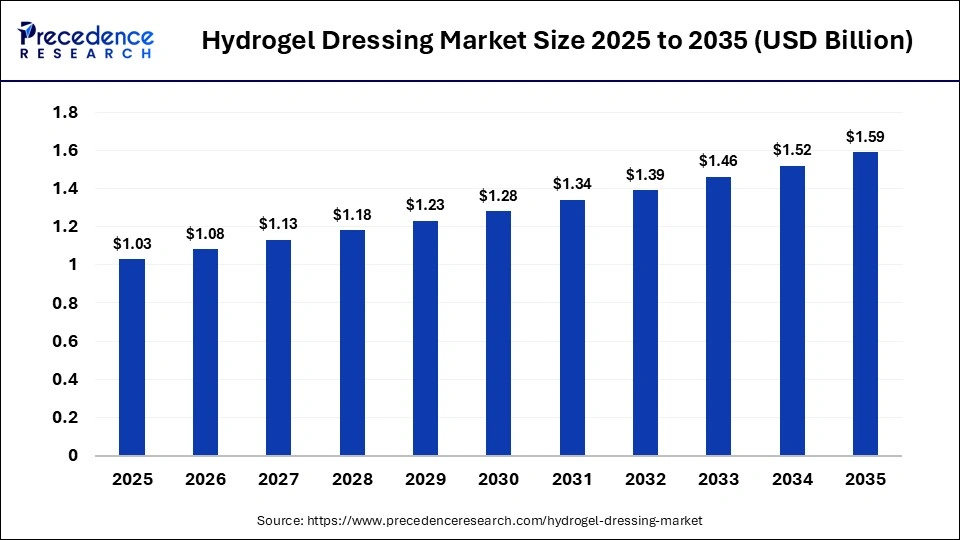
The global hydrogel dressing market size was calculated at USD 1.03 billion in 2025 and is predicted to increase from USD 1.08 billion in 2026 to approximately USD 1.59 billion by 2035, expanding at a CAGR of 4.36% from 2026 to 2035. A rising prevalence of chronic wounds, diabetic foot ulcers, and pressure ulcers results in growing demand for hydrogel dressings. Healthcare providers also increasingly focus on a patient's comfort in their dressing regimen and on applying cost-effective methods of dressing the wound. This should only increase the share of the hydrogel dressing market.
Key Takeaways
- North America is leading the hydrogel dressing market dominance in 2025.
- Asia-Pacific hydrogel dressing market is growing rapidly in the forecast period of 2026 to 2035.
- By raw material, the synthetic hydrogel dressing dominated the market in 2025.
- By raw material, the natural hydrogel segment is expected to grow rapidly in the forecast period.
- By product, amorphous hydrogel has held dominance in the hydrogel dressing market in 2025.
- By product, the sheet hydrogel segment is growing fast in the hydrogel dressing market in the forecast period.
- By application, the chronic wound segment is showing dominance in the hydrogel dressing market in 2025.
- By application, the acute wound segment is growing rapidly in the forecast period.
- By end-user, the hospitals and clinics segment dominated in 2025.
- By end-user, the home care segment is expected to grow rapidly in the forecast period of 2026 to 2035.
What is the Hydrogel Dressing Market?
Hydrogel dressings are a type of wound care product made of polymers derived from water or glycerin. These dressings mostly consist of 80–99% water and have a cooling, gel-like texture. The moisture they provide helps to promote the wound's hydration necessary for wound healing, alleviating pain, and facilitating the removal of necrotic tissue (debridement). Hydrogel dressings are beneficial, especially in cases of dry, painful, or necrotic wounds such as burns, pressure ulcers, surgical incisions, and skin tears.
Some hydrogel formulations are amorphous and can be spread with ease, while others, like sheets or gauze impregnated with the gel, are available as a more structured alternative. Their ability to maintain an ideal healing environment is one of the great factors behind their rising popularity. Moreover, with technological improvement, more versatile hydrogel products were developed, featuring both antimicrobial properties and also more convenient applications.
Market Trends of the Hydrogel Dressing Market
- Demographic Pressure from the Older Age Group
Older adults have a higher prevalence of chronic diseases like diabetes, which leads to more cases of diabetic ulcers and pressure sores and drives demand for wound care products. - Antimicrobial and Silver-Infused Innovations
Infection control has become one of the non-negotiable areas of chronic wound treatment. Manufacturers like Smith & Nephew plc (UK) and 3M Company (US) continue to expand antimicrobial hydrogel portfolios through silver-based solutions and PHMB-enhanced alternatives. These formulations are a mix of retaining moisture and suppressing microbes that appeal heavily to hospital procurement teams focused on reducing readmissions. - Emerging Smart & Sensor-Integrated Hydrogels
Hydrogel dressing is quietly transitioning into smart wound platforms. Incorporation of embedded moisture and pH sensors is a field of interest that is emerging to complement the already existing polymer matrices in real medical environments on wound surfaces, which makes it possible to monitor the wound environment without damaging the healing tissue. The change is part of a larger shift toward data-driven wound care rather than visual guesswork that relies on what you see. - Sustainability & Biocompatible Materials
Environmental scrutiny is pushing manufacturers toward biodegradable polymers and eco-conscious packaging. Procurement officers measure lifecycle impact and clinical efficacy. Sourcing suppliers on plant-based polymers and less plastic are moving to place themselves as long-term partners in sustainable healthcare supply chains.
Impact of AI in the Hydrogel Dressing Market
Conductive hydrogel dressing using AI research has been developed by researchers to tackle chronic wounds, including diabetic ulcers and pressure sores. Research has increasingly applied machine learning (ML) techniques, allowing for the processing of large-scale datasets, correlation between structure and properties of the hydrogels, and prediction of their behavior. These integrated AI-driven dressings can continuously track multiple wound parameters, including temperature, pH, glucose concentration, pressure, and pain signals. ML algorithms can also predict the healing stage and detect early signs of infection with an accuracy of up to 96%.
Alongside this, hydrogels have also been shown to support healing by being characterized by electroactive properties, antibacterial activity, and controlled release of medicines. While challenges such as signal stability and translating this technology into practice are encountered, emerging technologies pave the way for personalized, remote, and data-driven wound care solutions. Furthermore, AI-driven materials design can be used to predict the necessary combinations of polymers, crosslinkers, and additives for individualizing hydrogels in terms of mechanical, thermal, and chemical properties. So, this period marks a significant transition from traditional empirical methods to ones that are strictly data oriented. The outcome in hydrogel development is faster, more thorough decision-making.
Market Scope
| Report Coverage | Details |
| Market Size in 2025 | USD 1.03 Billion |
| Market Size in 2026 | USD 1.08 Billion |
| Market Size by 2035 | USD 1.59 Billion |
| Market Growth Rate from 2026 to 2035 | CAGR of 4.36% |
| Dominating Region | North America |
| Fastest Growing Region | Asia Pacific |
| Base Year | 2025 |
| Forecast Period | 2026 to 2035 |
| Segments Covered | Raw Material, Product, Application, End-User, and region |
| Regions Covered | North America, Europe, Asia-Pacific, Latin America, and Middle East & Africa |
Segment Insights
Raw Material Insights
Synthetic Hydrogels
The synthetic hydrogel dressing dominated the market in 2025. These dressings have particular advantages, now known as advanced wound treatment techniques. Derived from widely used polymers, synthetic hydrogels are heavily depended upon in commercial wound care products owing to their reliable structure and consistent performance. Such materials are preferred by manufacturers for their scalability as well as for their ability to regulate absorption effectively. Their mechanical strength also makes them the perfect choice for treating wounds with moderate to significant exudate, allowing for structural integrity and moisture regulation without compromising the durability of the dressing.
Natural Hydrogels
The natural hydrogel segment is expected to grow rapidly in the forecast period. This expansion can be traced to the increasing popularity of naturally derived hydrogel dressings, which are regarded as the most effective dressing for the healing of wounds in patients. Many of the natural hydrogels, consisting of alginate, collagen, chitosan, and so on, are preferred by clinicians who prefer their biocompatibility and bioactivity. It has been shown that these materials interact more harmoniously with wound beds; as a result, in some cases, stimulating cellular responses and even tissue regeneration.
Product Insights
Amorphous hydrogel
Amorphous hydrogel has held dominance in the hydrogel dressing market in 2025. This position can be attributed to their flexibility, ease of use, and suitability for moist wound healing environments. Usually obtained in tubes or sachets, such hydrogels are tailored for non-standard wound cavities and to mimic the appearance of dry necrotic tissue or to be used in irregular areas. This makes it easy to apply and rehydrate non-viable tissue with their fluid-like texture.
Sheet hydrogel
The sheet hydrogel segment is growing fast in the hydrogel dressing market. Their user-friendliness has propelled their growth rate for homecare needs. Designed to be standardized and easy to adhere, these dressings give consistent thickness and hydration throughout the wound area. They also deliver a cooling sensation that helps to dull pain so that burns and tenderness don't hurt. Sheet formats are preferred by hospitals as part of standardized programs, which demand reliable coverings and easy dressing changes
Application Insights
Chronic Wounds
The chronic wound segment is showed dominance in the hydrogel dressing market in 2025. This dominance is due to the increasing occurrence of diseases like diabetic foot ulcers, venous leg ulcers, and pressure ulcers. These diseases require constant moisture control over the time required for healing. The hydrogels are critical softening agents of the necrotic tissue while ensuring optimal hydration, and hence have been considered essential components of long-term wound healing methods in hospitals and community health programs.
Acute Wounds
The acute wound segment is growing rapidly in the forecast period. This growth is primarily attributed to the increase in the number of surgical procedures and increasing burn injuries globally. Hydrogel dressings are utilized as temporary moisture-retaining solutions aimed at promoting rapid epithelial healing without causing maceration. The implementation of these dressings in this industry is driven by their comfort and removal ability, which is particularly important for post-operative conditions where the trauma to tissue may be significant at dressing changes.
End-User Insights
Hospitals & Clinics
The hospitals and clinics segment led the market in 2025. The vast coverage of many patients with chronic and acute wounds means hydrogel dressings form the basis of a very strong position. In fact, decisions regarding product choice are heavily influenced by bulk purchase agreements and adherence to clinical protocols. In these contexts, hydrogel dressings are integrated into the care pathways of multidisciplinary health care, frequently integrated with new practices like negative pressure wound therapy.
Home Healthcare
The home care segment is expected to grow rapidly in the forecast period of 2026 to 2035. This growth is driven by the convenience of hydrogel dressing and the rising interest from an aging population needing home wound care services. In the context of the growing tendency towards patient- and decentralized approaches to wound care, hydrogel products made particularly for easy application and long-lasting use are becoming commonly available.
Regional Insights
North America Hydrogel Dressing Market Trends
North America is leading the hydrogel dressing market dominance in 2025. Some of the reasons are a mature healthcare system, the increasing frequency of diabetes, leading to diabetic foot ulcers, and a rise in burn cases, as well as traumatic or surgical wounds. Technical development of moisture-retentive dressings is backed by evidence-based clinical practices.
U.S. Hydrogel Dressing Market Trends
The United States market for Hydrogel Wound Dressings is rapidly expanding, this is due to an aging population, technology, and a rise in chronic wound rates. The rise of the big guns in the industry, along with a strong health system are enabling swift launches of newer products. This growth is associated with an overall awareness about effective wound care in addition to appropriate compensation models.
Asia-Pacific Hydrogel Dressing Market Trends
The Asia-Pacific hydrogel dressing market is growing rapidly in the forecast period of 2026 to 2035. The growth lies in this higher degree of acceptance of hydrogel dressings for wound care, increased health expenditure trends, and the targeted effort to improve health care infrastructure. Furthermore, the growing number of diabetic patients in countries like India and China also means steady demand for advanced wound care products. A good demand for quality healing (high-quality) services is encouraging the growth of high-grade products, though still under pressure because of price sensitivity.
China Hydrogel Dressing Market Trends
The Chinese market for hydrogel wound dressings is experiencing rapid growth in this region, as more money is now going into healthcare facilities, the patient population is increasing, and the consumer market in global Chinese hydrogel wound management is moving quickly. These factors support the market development of the pharmaceutical and medical device sectors, and government initiatives to build healthcare infrastructure. As these new technologies and transformations are built into the healthcare system, robust growth should also persist.
Hydrogel Dressing Market Companies
- Coloplast A/S
- DeRoyal Industries
- 3M Company
- Smith & Nephew
- Laboratoires Urgo (Urgo Medical / Urgo Group)
- Lohmann & Rauscher GmbH & Co. KG
- Essity AB (BSN Medical)
- Integra LifeScience Corporation
- B. Braun Melsungen AG
- Scapa Healthcare
- ConvaTec Group PLC
- Mölnlycke Health Care AB
Recent Developments
- In October 2024, Kerala University (India) patented a novel, patient-specific, wound-healing hydrogel dressing for diabetic patients developed from ferulic acid with alginate dialdehyde gelatin, which allowed for quicker tissue regeneration in chronic immune-compromised wounds. This milestone brings attention to the impact of academic innovation on dressing design and suggests potential clinical application globally.
- In February 2026, scientists at the University of Warwick (UK) reported that stiff and less hydrated hydrogels can slow bacterial replication - a key insight for the development of hydrogels for use in dressing. This discovery steers material design toward formulations that do more than just heal — they also inherently resist harmful microbes without relying too much on antibiotics.
Segment Covered in the Report
By Raw Material
- Synthetic Hydrogels
- Natural Hydrogels
- Semi-synthetic / Hybrid Hydrogels
By Product
- Amorphous hydrogel
- Sheet hydrogel
- Impregnated hydrogel
By Application
- Acute Wounds
- Chronic Wounds
By End-use
- Hospitals & Clinics
- Home Healthcare
By Region
- North America
- Europe
- Asia-Pacific
- Latin America
- Middle East & Africa
For inquiries regarding discounts, bulk purchases, or customization requests, please contact us at sales@precedenceresearch.com
Frequently Asked Questions
Tags





Ask For Sample
No cookie-cutter, only authentic analysis – take the 1st step to become a Precedence Research client
 Get a Sample
.webp)



 sales@precedenceresearch.com
 Schedule a Meeting
