



Hyperspectral Imaging Systems Market Trends, Companies, Revenue / Sales Performance, Subscriber Growth, Pricing Strategies, Cloud Adoption, Infrastructure Expansion, Competitive Landscape, and Industry Outlook
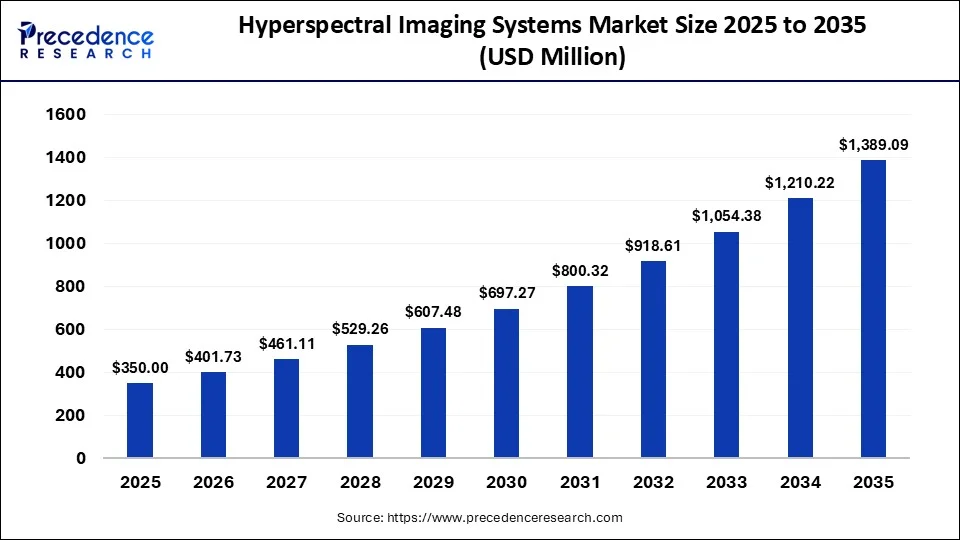
ICT industry specialist Gautam Mahajan estimates the Hyperspectral Imaging Systems Market at USD 401.73 million in 2026, with continued technology adoption expected to take the market to USD 1,389.09 million by 2035 at a CAGR of 14.78%. Leading Hyperspectral Imaging Systems Market providers such as BaySpec, Inc., Corning Inc., HAIP Solutions GmbH are expanding their capabilities across segments including technology type, spectral range, system component, application, platform, end user, distribution channel, region.
Source: https://www.precedenceresearch.com/hyperspectral-imaging-systems-market
 Get a Sample
 Table Of Content


Hyperspectral Imaging Systems Market Size and Forecast 2026 to 2035
The global hyperspectral imaging systems market size is predicted to increase from USD 401.73 million in 2026 to approximately USD 1,389.09 million by 2035, expanding at a CAGR of 14.78% from 2026 to 2035.
Key Takeaways
- By technology type, the push broom hyperspectral imaging segment contributed the highest market share of 38% in 2025.
- By technology type, the snapshot hyperspectral imaging segment held a 24% share of the market in 2025 and is expected to grow at a significant CAGR of 17.2% between 2026 and 2035.
- By application, the agriculture & precision farming segment held a major market share of 36% in 2025.
- By application, the healthcare & life sciences segment held a 18% share in 2025 and is expected to register significant growth of 17.8% CAGR during 2026 and 2035.
- The Gigapixel facility of Pixxel was built in 2026 to scale up the satellite production from 25 to 100, thereby expanding the manufacturing base in the hyperspectral imaging industry.
- The deal between Hexagon and ITRES for 2026 reflects consolidation that is changing the competitive landscape for the hyperspectral imaging market.
- In April 2026, Hypervision Surgical raised USD 23 million in Series A funding, which further propels the HealthCare segment in the hyperspectral imaging industry.
- The silicon spectrometer chip developed at UC Davis will allow for more affordable manufacturing and mass production within the hyperspectral imaging sector, reducing barriers to entry.
- Advanced Micro Foundry is part of GlobalFoundries' acquisition of the company, helping to bolster the semiconductor supply chain supporting the hyperspectral imaging ecosystem.
Market Size Description
In 2026, the global hyperspectral imaging systems market was estimated at USD 401.73 million. Analysts project a CAGR of 14.78% between 2026 and 2035. Hyperspectral imaging systems penetration in various fields. They are rapidly increasing in the agriculture, healthcare, defense, inspection, environmental monitoring, and remote sensing sectors worldwide. These systems can now be used by farmers to monitor crop stress even before symptoms can be observed.
Hyperspectral scanning is used by healthcare providers for non-invasive imaging and early health tissue diagnostics. The technology is used in defence to monitor, detect targets, and analyse terrain. Spectral information is used by industrial inspection teams to detect defects in the material which would be undetectable by the use of standard cameras. These sensors are used to monitor water quality, soil contamination, and pollution in the environment.
Satellite constellations are growing in the sky, and the applications of remote sensing are scaling up as well. Pixxel launched and commissioned all six Firefly satellites to provide high resolution hyperspectral data from orbit in 2025. Firefly is Pixxel's maiden constellation designed to support high-resolution hyperspectral imaging with high frequencies across the globe. This expanding satellite tempo is transforming the way governments and companies use spectroscopic data.
This continues to be promoted by regular environmental monitoring efforts on board the EnMAP mission operated by Germany. EnMAP is a German hyperspectral satellite mission. This monitors and characterises global environmental data in terms of geochemical, biochemical, and biophysical parameters.
India also had a dedicated hyperspectral defense and civilian satellite which was launched on January 12, 2026, aboard PSLV-C62, but the mission failed to place the satellite into its intended orbit. EOS-N1, "Anvesha," developed by DRDO. This has been constructed for strategic defense and for various civilian applications like agriculture, urban mapping, and environmental assessment. The national security group continues to share its vision for how it intends to further develop its Earth observation capability with commercial partners. Commercial Earth-observation companies such as Pixxel are also expanding next-generation Earth-observation capabilities.
Market Growth Highlights
Hyperspectral imaging systems are coming out of the laboratory into widespread commercial use. Small operators are reducing the cost of miniaturizing sensors. Driving increasing system volumes. Older pushbroom scanners are now stiff competition for snapshot cameras, as they are fast and portable. Innovating camera technology is still a heavyweight competition. Companies such as Konica Minolta Sensing Americas and BaySpec are still in the lead heading into 2026.
This price change is opening up the market for smaller agricultural co-operatives and mid sized industrial customers. Food sorting and snapshot technologies are the two largest growth markets. Demand for agriculture and defense applications continues to dominate. Further facilitated by environmental monitoring. The biggest regional growth opportunities are in North America and Asia Pacific for 2025 and 2026. IMEC's technology for on-chip filters is also driving advancements in developing more compact, scalable, and real-time hyperspectral sensors.
Dominant and Emerging Market Segments
In terms of segment dominance, hardware still holds the top spot, especially when it comes to cameras, sensors, and optical filters. The hyperspectral camera and software are a major strength of Specim. That allows object identification with a reliable chemical composition analysis. The visible-to-near-infrared spectral range is the most favored as a compromise between cost and accuracy. Airborne and satellite platforms keep growing rapidly. Attributable to agriculture and defence continue to be the biggest end-user sectors for deployment.
The feasibility of industrial inspection and sorting of food products is turning into fast growing application area. Telops is also improving its standing with the Hyper-Cam & HC Airborne Mini system. They are valued for their outstanding gas and mineral detection accuracy. The volume of raw imagery has been trending upwards at a rapid pace. Software and Analytics have also increased their share. Europe and North America combine for the biggest share of installed base. On the other hand, the Asia-Pacific region is fuelled by domestic manufacturing.
Strategic Insights for Stakeholders
There is a clear need for miniaturization of sensors for manufacturers to remain competitive as new players emerge quickly into the market. Satellite constellation operators are currently attracting investors' interest. They continue to go forward with their growing earth-observation contracts until 2025 and 2026. Technology developers are seeing a benefit from real-time processing as a differentiator.
Because with it, the buyer decision making process is in real-time. Research organizations are key for cross-industry standardization and validation of spectral libraries. Industry product roadmaps are taking on a new look as end users continue to ask for field-ready systems, and not vying for the next lab gadget.
Market Overview
Understanding Hyperspectral Imaging Systems
Hyperspectral imaging systems typically see the reflected light in hundreds of narrow, contiguous spectra. They go beyond red, green, blue images, like standard cameras. The width of each pixel represents an uninterrupted spectral signature. Also describes the chemical and physical composition of a material. This sophisticated signature enables substances to be identified. By the device's previous generation optical sensors, which do not detect the presence of the substances. This approach creates different spectral fingerprints for various types of vegetation, minerals, plastics, and even human tissue.
Hyperspectral systems are used to detect changes in plants. At an early stage of plant stress, mineralization, or contamination, before plants are visually affected. This was validated in the studies of researchers employing UAV based platforms for hyperspectral acquisition for fungal stress and soil variations. Unlike driving a tractor into a field. The study showed that these UAV systems with AI algorithms had a substantial improvement in crop stressor precision monitoring. It is this precision that has enabled the technology to continue to grow far beyond its original roots in the laboratory.
Evolution of Hyperspectral Imaging Technology
Hyperspectral imaging emerged more than 20 years ago as an analytical technique. It could be done in the laboratory, but was too large to be readily used in the field. Early systems were light-controlled, set up systems and required technically trained operators. This was all changed by the introduction of portability. Manufacturers miniaturized sensors to fit a rugged, field-ready camera body. Handheld and benchtop units made it to food processors, pharmaceutical labs, and recycling facilities. This change propelled the use of hyperspectral analysis from the research lab to routine industrial use. This constant evolution takes the technology ever to more demanding applications, from the lab bench to orbit.
Market Scope and Coverage
This market encompasses hardware, software, and services related to spectral imaging technology. The essential elements are camera, spectrometer, optical filters, illumination systems, and software for data processing. These platforms include handheld devices, benchtop devices, UAVs, aircraft and satellites in orbit. The range of applications includes agriculture, healthcare, defense, inspection industry, environmental monitoring, and food safety inspection. Geographies include North America, Europe, Asia-Pacific and emerging markets both within Latin America and in the Middle East.
Role of Hyperspectral Imaging in Digital Transformation
In manufacturing, agriculture, and healthcare, hyperspectral imaging is a rising force in various aspects of automation. Continuous spectral streams are fed into software. It detects anomalies with no human intervention. This automation can cut down the manual inspection time and enhance the detection rate in the production lines.
These huge spectra are now being analysed at a much faster speed than would be accomplished manually, as AI models do this now. As algorithms filter and discriminate minor chemical signatures from data of an inherently noisy spectrum, precision analysis is possible. This change is propelled by deep learning architectures much faster than ever before.
Market Trends
Increasing Adoption of AI-Based Hyperspectral Data Analytics
The emergence of AI-powered hyperspectral data analytics is changing the landscape for data analysts. This approach involved an Auto-Encoder Network for deep learning in a highly adaptive manner. Further resulted in more than 98.25% sensitivity of the tumor boundary detection. This accuracy leap is accelerating analytics products' migration deeper into commercial use in the years 2025 and 2026.
Growth of Hyperspectral Imaging in Precision Agriculture
This technology continues to be one of the best growth developers within precision agriculture. In a 2025 study, hyperspectral images from UAVs were paired with AI-driven algorithms. They enhance soil texture mapping and crop stress identification. The approach to handling irrigation, fertilizer, and pest management on farms is changing, as is the use of the data.
Expansion of UAV-Based Hyperspectral Imaging Solutions
This small/mid-size operators' perspective offers a glimpse at how drones boost the accessibility of hyperspectral surveys. Deep learning applications in UAV-based hyperspectral remote sensing. They were found to be rapidly growing in various sectors. Drones equipped with hyperspectral sensors in Antarctica for moss and lichens mapping using machine learning.
Increasing Use in Healthcare and Biomedical Diagnostics
Medical applications of the use of hyperspectral imaging for real-time, non-invasive cancer detection are being tested in hospitals. Hyperspectral imaging as a guidance tool for tumor resection. They are used to acquire structural and functional information.
Integration with Industrial Machine Vision Systems
Hyperspectral sensors are being integrated directly into automated inspection lines by industrial machine vision systems manufacturers. Unlike normal RGB cameras. These systems are able to see and identify material defects and contaminants. Recycling companies now take advantage of this to automatically and precisely sort plastics by exact polymer type.
Growth of Space-Based Hyperspectral Observation
Commercial space-based hyperspectral observation satellite constellations are rapidly maturing. With increasing hyperspectral coverage for governments almost on a daily basis on a global scale. EnMAP is continuing to monitor geochemical, biochemical, and biophysical changes in the world's ecosystems from its base in Germany.
Market Segmentation Analysis
Technology Type Insights
What Made Push Broom Hyperspectral Imaging Lead the Global Hyperspectral Imaging Systems Market?
The push broom hyperspectral imaging segment dominated the market with a share of 38% in 2025, due to the expanding adoption of automated inspection systems requiring dependable spectral precision.
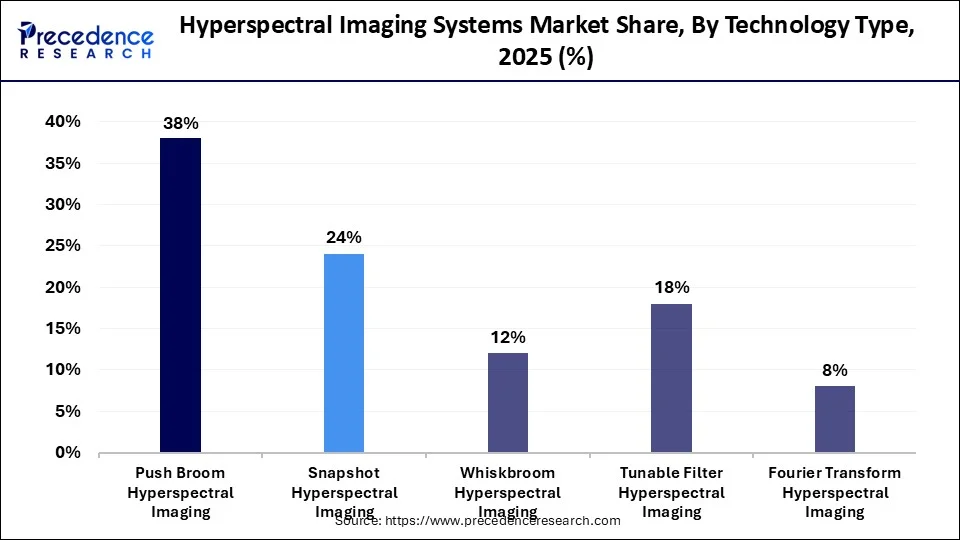
The snapshot hyperspectral imaging segment held a 24% share of the market in 2025 and is expected to grow at the fastest CAGR of 17.2% between 2026 and 2035, driven by increasing preference for real-time hyperspectral analysis without mechanical scanning.
Spectral Range Insights
How Did Visible Near-Infrared (VNIR) Secure the Largest Share of the Global Hyperspectral Imaging Systems Market?
The visible near-infrared (VNIR) segment dominated the market with a share of 42% in 2025, due to growing deployment of precision agriculture, industrial automation, and laboratory-based spectral analysis across developed and emerging economies.
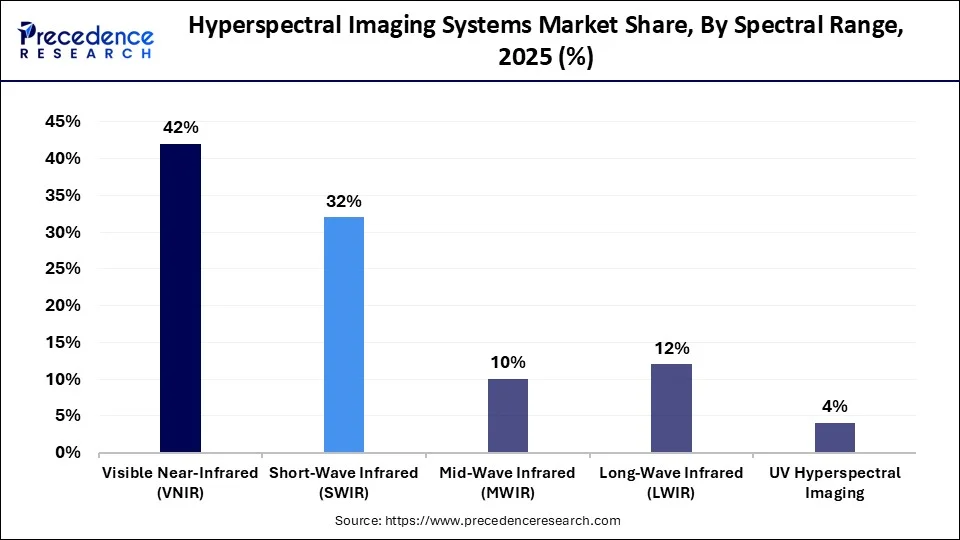
The short-wave infrared (SWIR) segment held a 32% share of the market in 2025 and is expected to grow at the fastest CAGR of 16.5% between 2026 and 2035, driven by rising demand for advanced non-destructive inspection across high-value manufacturing industries.
System Component Insights
Why Were Cameras the Leading System Component in the Global Hyperspectral Imaging Systems Market?
The cameras segment dominated the market with a share of 84% in 2025, due to the increasing installation of automated vision systems requiring integrated hyperspectral camera platforms.
Hyperspectral Imaging Systems Market Share, By System Component, 2025 (%)
| System Component | Market Share (%) | CAGR (%) |
| Cameras | 36.00% | 14.6% |
| Spectrometers | 18.00% | 13.9% |
| Light Sources | 8.00% | 12.7% |
| Sensors | 22.00% | 16.8% |
| Data Processing Software | 12.00% | 15.9% |
| Integration Hardware | 4.00% | 13.5% |
The sensors segment held 22% of market share and is expected to grow at the highest CAGR of 16.8% between 2026 and 2035, owing to the rising demand for high-performance spectral detection across next-generation imaging applications.
Application Insights
What Drove Agriculture & Precision Farming to Dominate the Global Hyperspectral Imaging Systems Market?
The agriculture & precision farming segment dominated the market with a share of 24% in 2025, driven by rising adoption of precision farming technologies supporting sustainable agricultural production worldwide.
Hyperspectral Imaging Systems Market Share, By Application, 2025 (%)
| Application | Market Share (%) | CAGR (%) |
| Agriculture & Precision Farming | 24.00% | 15.1% |
| Healthcare & Life Sciences | 18.00% | 17.8% |
| Industrial Inspection | 17.00% | 14.9% |
| Food & Beverage Inspection | 12.00% | 15.6% |
| Defense & Security | 14.00% | 13.7% |
| Environmental Monitoring | 7.00% | 14.4% |
| Mining & Mineral Exploration | 5.00% | 13.8% |
| Remote Sensing & Space Research | 3.00% | 16.2% |
The healthcare & life sciences segment held a 18% share of the market in 2025 and is expected to grow at a rapid CAGR of 17.8% between 2026 and 2035, due to increasing investment in non-invasive diagnostic technologies and precision medicine research.
Platform Insights
How Did Ground-Based Systems Emerge as the Dominant Platform in the Global Hyperspectral Imaging Systems Market?
The ground-based systems segment dominated the market with a share of 55% in 2025, due to the expanding use of hyperspectral imaging in quality assurance, biomedical research, and industrial process optimization.
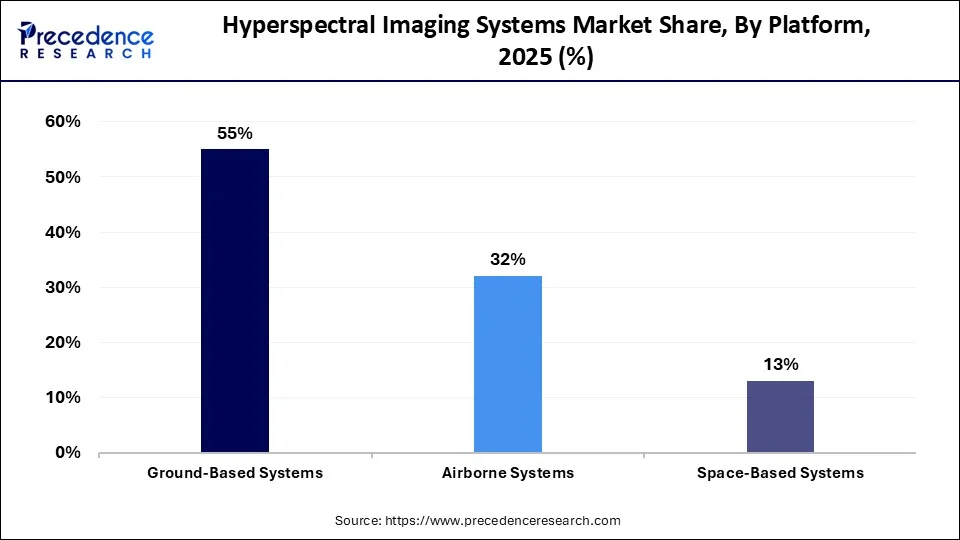
The airborne systems segment held 32% of market share in 2025 and is expected to grow at the fastest CAGR of 16.9% between 2026 and 2035, owing to the increasing demand for high-resolution remote sensing across environmental and infrastructure monitoring projects.
End User Insights
What Helped Research Institutes & Universities Capture the Largest Share of the Global Hyperspectral Imaging Systems Market?
The research institutes & universities segment dominated the market with a share of 22% in 2025, due to increasing emphasis on advanced optical research and government-supported scientific innovation.
Hyperspectral Imaging Systems Market Share, By End User, 2025 (%)
| End User | Market Share (%) | CAGR (%) |
| Research Institutes & Universities | 22.00% | 13.8% |
| Government Agencies | 15.00% | 14.5% |
| Defense Organizations | 16.00% | 14.2% |
| Healthcare Providers | 14.00% | 17.6% |
| Agricultural Companies | 12.00% | 15.9% |
| Food Processing Companies | 8.00% | 15.2% |
| Industrial Manufacturers | 8.00% | 14.7% |
| Mining Companies | 3.00% | 13.9% |
| Environmental Organizations | 2.00% | 14.8% |
The healthcare providers segment held 14% of market share in 2025 and is expected to grow at the fastest CAGR of 17.6% between 2026 and 2035, owing to the increasing demand for precision diagnostics and image-guided medical interventions.
Distribution Channel Insights
Why Did Direct Sales Remain the Preferred Distribution Channel in the Global Hyperspectral Imaging Systems Market?
The direct sales segment dominated the market with a share of 58% in 2025, due to the growing demand for tailored imaging systems designed for application-specific performance requirements.
Hyperspectral Imaging Systems Market Share, By Distribution Channel, 2025 (%)
| Distribution Channel | Market Share (%) | CAGR (%) |
| Direct Sales | 58.00% | 14.4% |
| System Integrators | 24.00% | 16.2% |
| Specialized Distributors | 14.00% | 13.7% |
| Online Procurement Platforms | 4.00% | 15.5% |
The system integrators segment held 24% of market share in 2025 and is expected to grow at the fastest CAGR of 16.2% between 2026 and 2035, owing to the rising need for customized end-to-end hyperspectral imaging solutions across advanced industrial environments.
Market Dynamics
Market Drivers
Rising Demand for Precision Analytics Across Industries
Industries in all fields have seen the demand for gaining more material, biological, and environmental precision and insight. Than that offered by standard imaging. Hyperspectral sensors detect chemicals, moisture, and contamination that are not visible to the human eye. Expansion in biomedical applications in acquisition approaches, spectral feature extraction, and machine learning techniques for diagnosis was summarized in a 2026 review. This has increased adoption of the technology by manufacturers, healthcare centers, and environmental agencies.
Increasing Automation in Industrial Manufacturing
Efforts in the Industrial Manufacturing industry are advancing into the fourth Industrial Revolution. Factories are increasingly being automated and driven by sensors to ensure quality control. In 2025, Cubert was able to attract strategic investment from Emtek Holdings to expand its hyperspectral technology in several industrial sectors worldwide. Such investment is indicative of the effect of demand for automation on component supply chains and the focus of sensor manufacturing.
Growing Need for Advanced Agricultural Monitoring
Investments in managing and monitoring agriculture for precision agriculture are increasing. Growers demand more information about their crop health, earlier and more accurately. Hyperspectral sensors notify days ahead of visible stress about nutrient deficiencies as well as disease. Furthermore, agribusinesses begin to fund larger scale deployment programs of hyperspectral tech through 2026.
Increasing Defense and Security Applications
Hyperspectral imaging is a technology that continues to be used by defense and security organizations. Utilizing it for surveillance, target identification, and camouflage detection. Camouflage patterns and hidden equipment can be detected. Further allowing for the identification of subtle spectral reflection differences that are not seen by RGB cameras, which are used in UAV hyperspectral systems. At DSEI 2025, Cubert will demonstrate real-time hyperspectral defense systems, establishing spectral intelligence as a strategic reconnaissance enabler.
Market Restraints
High Initial Cost of Hyperspectral Imaging Systems
There is a high initial cost of hyperspectral imaging systems. Including the price of advanced sensors and calibration systems, as well as the integration of these technologies. Many small manufacturers and start-ups will not be able to take advantage of hyperspectral systems with these barriers in the years 2025 and 2026.
Complexity of Hyperspectral Data Processing
Large hyperspectral data sets require skilled researchers or analysts and significant processing power to handle effectively. Low amounts of labeled data, highly dimensional data, and computational complexity are also ongoing challenges for the market.
Limited Awareness Among Emerging Market Users
Smaller industries and emerging regions usually don't know about the viability of using hyperspectral imaging. R&D continues to drive adoption but outside of these well-established areas. Further limiting technical training and unclear ROI are preventing uptake.
Market Opportunities
Development of Compact and Portable Hyperspectral Systems
Miniaturization is creating real opportunities for miniaturized hyperspectral systems to go on the job site and become handheld systems. The Cubert ULTRIS X20 Plus is a compact camera designed specifically for remote sensing from the air and for field use by UAVs. This trend toward smaller devices is now powering demand for more intelligent and automated language services translation.
AI-Powered Automated Interpretation Platforms
AI-powered automated interpretation platform software is being demanded. By software providers as remote classifications and detection of anomalies increase. As hyperspectral imaging is being driven towards diagnosis by healthcare providers. These automatic platforms are becoming particularly valuable.
Expansion into Healthcare Diagnostics
Healthcare diagnostics are significant commercial possibilities in the field for hyperspectral technology suppliers. In a 2026 review, scientists reported the increased use of biomedical applications. Such as acquisition design, spectral development and feature extraction, and methods for guiding surgical procedures during operation accounted for by image guidance.
Growth of Commercial UAV Hyperspectral Applications
Strong growth in agricultural, mining, and infrastructure inspection market applications. Corrosion, material fatigue, and insulation faults on power lines and pipelines can now be detected by inspection drones using hyperspectral cameras before they become apparent.
Market Challenges
Technical Challenges in Real-Time Imaging
The major challenges that are impeding real-time hyperspectral applications are the speed of the technical challenges. The 2026 lightweight transformer architecture was able to reconstruct in real-time with parameters less than 1.4M. On the other hand, calibration drift and acquisition speed remain their main impediments to further deployment. Their further effort to accomplish tasks in the fast-paced industry of production and defense activities.
Integration Challenges Across Different Industries
Adapting hyperspectral systems across different operating environments remains genuinely difficult. The industry standardisation 2025 project was introduced by Specim and other industry leaders. That seek to establish uniform performance and calibration parameters across manufacturers.
Hyperspectral Imaging Systems Market Ecosystem Analysis
Hyperspectral Imaging Value Chain
Hyperspectral imaging exists within an ecosystem of different groups. From sensor manufacturers, optical component suppliers, and more specialized system developers. Advanced optics and photonic materials can be provided by companies such as Corning to the high-performance sensors world. Software vendor then constructs an analytic platform and translates the raw spectral cubes back into useful analytics for the customer to purchase. The integrators and distributors connect the farmers, the militaries, and medical device companies to the end users. This multiparty configuration continues to evolve as more specialties join each tier in the value chain.
Key Industry Participants Across the Ecosystem
The ecosystem includes technology companies such as Specim, Headwall Photonics, and Cubert. They are continuing their influence on hardware innovation in a diverse range of industries. Foundational algorithms are developed by research institutions or universities and commercialised via licensing. Satellite-based hyperspectral missions are directly funded by government agencies. Such as space programs in the USA, Europe, and Asia. Furthermore, apart from government buyers, commercial companies from the food processing sector, mining, and pharmaceuticals shape the direction product roadmaps will take.
Collaboration and Partnership Landscape
The collaboration and partnership landscape between hardware manufacturers and AI companies is transforming them into analytics superpowers. Cubert joined forces with Emtek Holdings in 2025 to establish the EMTEK Hyperspectral Group. Promote research in industrial, defense, and medical applications.
Universities provide enterprises with much needed deep learning technology outside of their own walls. Development programs are a regular part of defense organizations' requirements. They are usually a joint effort between the organization and the sensor manufacturer. Agricultural technology companies are also getting closer to UAV manufacturers to provide integrated crop monitoring solutions by 2026.
Market Regional Analysis: North America, Europe, Asia-Pacific
Why Did North America Lead the Market?
North America led the market, capturing the largest revenue share in 2025, accounting for an estimated 38% market share, due to the substantial investments supporting photonics research, aerospace innovation, and advanced manufacturing infrastructure.
U.S. Hyperspectral Imaging Systems Market Size and Growth 2026 to 2035
The U.S. hyperspectral imaging systems market size was evaluated at USD 114.02 million in 2026 and is projected to reach around USD 382.17 million by 2035, growing at a CAGR of 14.38% from 2026 to 2035.
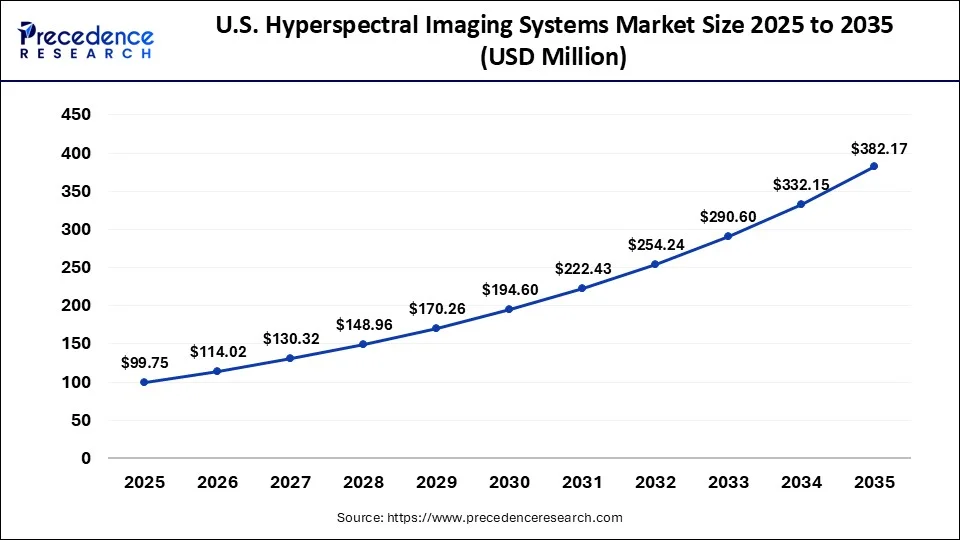
United States
The United States dominated the regional market with a lead in extensive defense imaging programs, NASA hyperspectral missions, and leading university research on hyperspectral imaging.
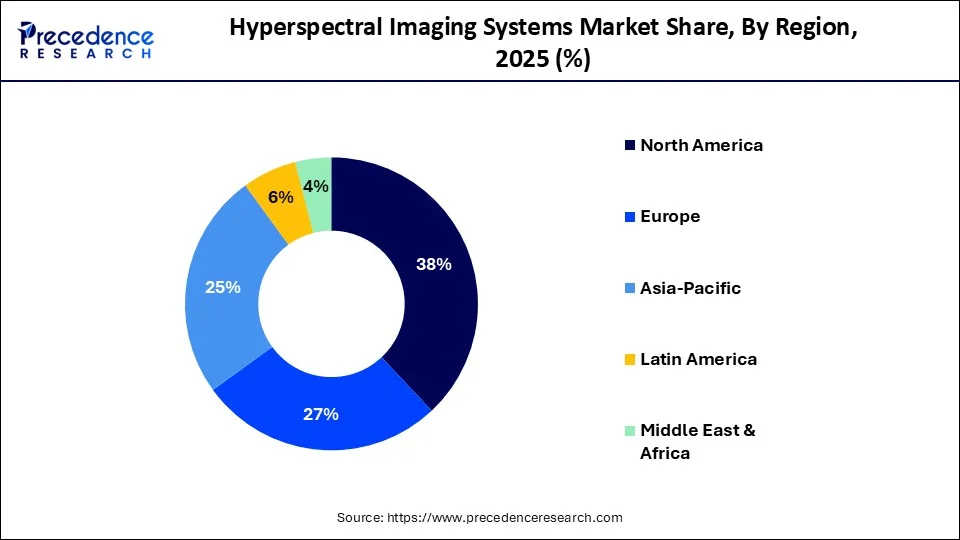
The Asia Pacific Region Expected to Grow With a CAGR of 17.2% of Market Share in 2025
Asia Pacific is expected to hold 24% of the market in 2025 and is estimated to grow at a strong CAGR of 17.2% over the projected period, supported by regional industries continuing to expand investments in advanced imaging technologies and intelligent manufacturing.
China
The increasing use of hyperspectral imaging in electronics manufacturing, semiconductor production, mining, and environmental monitoring projects all contributed to China gaining new market opportunities through rapid industrial automation, government backed research in photonics, and its ongoing research of this technology.
India
India saw robust development in precision agriculture, crop monitoring using drones, and soil analysis and management with hyperspectral imaging spread among its farmers, contributing to the growth of the market.
Europe Held Significant Market Share of 27% in 2025
The Europe region held a 27% share of the market in 2025 and is expected to grow at a 14.5% CAGR between 2026 and 2035, driven by strong industrial automation, environmental sustainability initiatives, and advanced optical engineering capabilities.
Germany
Germany held its dominant position within the region, thanks to its modern industrial manufacturing capabilities, its high rate of use of Industry 4.0, and the use of hyperspectral imaging for automated inspection in automotive and electronics production, as well as in pharmaceutical production.
Latin America Held Notable Market Share with 6% in 2025
The Latin America region is expected to grow at a notable CAGR of 14.8% between 2026 and 2035, as public research organizations also expand spectral imaging applications for biodiversity conservation and environmental analysis.
Brazil
Among the countries in the Latin American region, Brazil was one of the leaders in the implementation of commercial agriculture, the spread of precision farming, and the use of hyperspectral systems to monitor crops, forests, and environmental protection programs.
Middle East & Africa Held a Considerable Market Share of 4% in 2025
The Middle East & Africa region is expected to grow at a strong CAGR of 15% between 2026 and 2035, fuelled by increased procurement of advanced imaging technologies supporting national security and smart city initiatives.
United Arab Emirates (UAE)
The United Arab Emirates increased its adoption in the region by investing in smart infrastructure, defence technologies, environmental monitoring, and sophisticated research programs using hyperspectral imaging for strategic use.
Saudi Arabia
Saudi Arabia also increased market opportunities in the economy diversification programs that promote the adoption of advanced sensing technologies in the field of mining, monitoring the environment, industrial development, and modernization projects in the defense sector.
Pricing Analysis
Hyperspectral Imaging System Pricing Structure
The price ranges are different for different spectral, resolution, and application. The cost of handheld and benchtop units is usually much cheaper. Than the airborne or satellite grade units. Ruggedization and calibration requirements mean defense and space-grade systems sell for a higher price. In the middle ground between durability and production-line cost are industrial inspection units. With further maturation of manufacturing techniques, configuration-based pricing tiers should continue to ease in most application categories.
Manufacturing Cost Analysis
In any hyperspectral system build. The sensors and optics are the biggest single cost drivers. Much of this initial cost is due to specialized filters, calibration equipment, and precision lenses. IMEC's on-chip filter technology costs the optical components by creating a filter that is part of the sensor wafer itself. There are also costs for electronics and processing units. They are becoming less expensive day-by-day, but still faster and more expensive than using a chip. On the other hand, the grain-of-sand-scale spectrometer chip developed by SPIE is an example of the cost savings in the assembly and integration of components in the future.
Average Selling Price Trends (2025–2035)
The selling price is generally declining because of miniaturization of the components throughout the industry. As technology has advanced, especially in the field of chip-based sensor designs. The costs have become more compacted that typically needed for bulky optical assemblies. Filters-on-chip sensors are shown to be feasible in CubeSats at ESA's RAINBOW project, capturing 30-plus spectral channels at an affordable price. This type of miniaturization is driving up the costs of entry level systems. Further leveling closer to the budget of smaller agricultural and industrial buyers. In 2035, there will be growing distinctions between inexpensive. Consumer-oriented units and more costly specialised instruments.
Regional Pricing Comparison
Average prices are higher in North America and Europe, where certification and defense standard requirements are more stringent. Asia-Pacific prices are usually more competitive. Owing to growing local manufacturing capacity. Relative pricing is also high in emerging markets in Latin America and the Middle East. They are strongly reliant on imports. Additionally, these developing areas have high costs due to limited manufacturing capabilities. Domestic component production is also expected to grow in Asia-Pacific. This should help to bring regional price differentials down through the early 2030s.
Supply Chain Analysis
Upstream Component Supply Chain
The hyperspectral value chain starts with the sensor and optics suppliers. Patent activity up to 2026 indicates. Sony and Philips have top semiconductor and medical imaging component holdings in various regions. In November 2025, GlobalFoundries bought Advanced Micro Foundry, a company in Singapore. Bolstering its silicon photonics fabricator position. This merger of two foundries has a direct impact on component availability and pricing to hyperspectral sensor manufacturers that are seeking specialized optical chips.
Manufacturing and System Integration Landscape
The production processes are very different for handheld units and large satellite grade instrument assemblies. Optics engineers, software developers, and application specialists all need to work closely together. They customize a product to meet the needs of the application. As the capabilities of integration become more and more important. The customer expects the system to be complete rather than a combination of hardware and software. Sensors, processing, and analytics are increasingly being combined into deployable, integrated UAV payloads by companies such as Cubert.
Distribution and Service Network
High-value defense and satellite grade hyperspectral systems are still sold directly to the government. Much of the mid-market is served by system integrators. They just package hardware and calibration and analytics services. Specialized distributors serve smaller industrial and agricultural customers that require shorter purchasing and support lead times. More organisations transition to field-deployed systems. The aftermarket support, such as calibration servicing and software updates, is increasingly critical.
Competitive Landscape
Market Structure Analysis
Competition is heating up for the market as mature optics companies and nimble startups vie for a portion of the market. The focus of technology differentiation is on spectral range and the level of integration between AI and technology in use. In 2026, Hexagon acquired a Canadian airborne hyperspectral and thermal imaging specialist, ITRES. This enhanced its expertise in advanced mapping solutions. The market is still quite fractured. This consolidation indicates that larger firms are acquiring specialized niche capabilities.
Competitive Benchmarking
Companies' key differences are technology portfolios, application focus, and geographic reach. UK-based Hypervision Surgical, a developer of real-time surgical hyperspectral imaging. Developed its next-generation sensing technology in collaboration with Imec. Other new entrants such as HyperSpectral have the advantage of novelty in playing with speed. They are geared towards fast growth in biotech, industrial and defence applications.
Strategic Developments
Across the industry, mergers, funding rounds, and product launches are picking up the pace in the coming years. HyperSpectral raised USD 7 million in October 2025 by investing in a Series A-2 round. They saw former Coherent Corp CEO Chuck Mattera join as board chairman.
Hypervision Surgical raised USD 23 million in an oversubscribed Series A round led by Heal Capital, with Angelini Ventures representing another investor. These investments suggest investors are betting heavily on both industrial spectral intelligence and clinical hyperspectral applications heading into the rest of 2026.
Hyperspectral Imaging Systems Market Companies
- BaySpec, Inc.
- Corning Inc.
- HAIP Solutions GmbH
- Headwall Photonics
- imec
- Norsk Elektro Optikk
- Resonon Inc.
- Specim
- Spectral Imaging Ltd.
- Surface Optics Corporation
- Telops
- XIMEA GmbH
Investment & Funding Analysis
Venture Investment in Hyperspectral Imaging Technologies
Orbital imaging-based technology, artificial intelligence-based analytics, and sensors continue to be fertile grounds for VCs. In October 2025, HyperSpectral raised USD 7 million in Series A-2 funding. They also have plans for a Series B round in 2026. Pixxel has raised USD 95 million to date to support its advancement of global mining, agronomic, and energy technologies. It is now directly impacting the sector to support expanding manufacturing capacities, which are backed by this growing investor confidence.
Industry Expansion Investments
Industry Manufactures is moving things along at a rapid rate. Companies are racing to get ready for the fast-growing global hyperspectral market. In 2026, PIXxel will launch its ‘Gigapixel' facility, taking the company's satellite production capacity from 25 to 100 in a year. Corning also announced a big optics plant expansion to triple SWIR lens output by the end of 2026. The expansion partnership activities are creating new windows of investment opportunity into the next wave of commercialisation opportunities for hyperspectral technology.
Future Investment Opportunities
Imaging applications for the healthcare space are gaining traction with growing surgical as well as diagnostic applications. There's also significant potential with the UAVs for systems. As the survey based on these devices continues to become less expensive in agriculture and mining. AI-enhanced analytics tools are also very interesting, with automated interpretation helping to drive hardware adoption. Expect more convergence of space-based platforms, clinical diagnostics, and AI-driven spectral analytics for investors monitoring the 2025 & 2026 funding activity.
Patent & Innovation Analysis
Patent Activity Overview
Innovation is gaining momentum with M&A activity across the globe in sensor design, reconstruction algorithms, and system miniaturization. More than 60 records of miniaturization and AI cultivation of reconstruction technology in 2005-2026. They were mapped through a 2026 patent landscape analysis. Northrop Grumman, Saint-Gobain, and the Hefei Institutes of Physical Science were the only ones to file for hyperspectral use outside the realm of medicine and agriculture. This filing trend clearly indicates a change in patent strategy to creating a software-only model, rather than hardware-only.
Emerging Technology Developments
Next generation sensors miniaturization and real-time AI processing are powering micro level hyperspectral imaging technologies. UC Davis researchers announced a silicon spectrometer chip that performed hyperspectral analysis. Equivalent to that in a laboratory, just in 0.4 square millimeters. These technologies are integrated, compact, low-cost platforms helping bring hyperspectral imaging to impossible-to-reach consumer electronics and point-of-care diagnostic applications.
Future Market Outlook (2026–2035)
Short-Term Outlook (2026–2028)
Commercial deployment is rapidly growing, as satellites are being launched and defense modernization initiatives are being taken. In early 2026, defence officials confirmed that hyperspectral imaging also has the ability to detect camouflage targets, as it can differentiate between the slight changes in the surfaces of targets. By 2028, cost reduction, quicker calibration, and increased UAV use, especially in the midmarket, should be key technology improvements.
Medium-Term Outlook (2028–2032)
The most significant growth is expected in the medium-term outlook for diagnostics and inspection in the industrial sector in the healthcare segment. The use of UAVs in agriculture and minerals is expected to become routine for many projects. Integration of industrial machine vision must continue, with manufacturers making spectral sensors an integral part of the standard production line architectures.
Long-Term Outlook (2032–2035)
The market is expected to be more mature with enhanced and more independent use of AI in imaging systems. Autonomous satellite constellations will most likely be able to capture and analyze spectral information on-board to avoid having to wait for data analysis from the ground. Evolving machine learning algorithms and decreasing component prices. Further making hyperspectral imaging a common sensing layer throughout transportation and environmental infrastructure worldwide.
Strategic Recommendations
Recommendations for Hyperspectral Imaging Manufacturers
Manufacturers are encouraged to focus more on product innovation with miniaturization and the ability to process with AI in real time. ENVI's partnership with Headwall on ENVI analytics and software integration partnerships boost competitive positioning a great deal. Satellite defense orders will grow in the region with particular focus on manufacturing in the Asia Pacific hub. That will be more important in the years to come as well.
Recommendations for Investors
The segments worth investment include high-growth surgical diagnostics, AI powered analytics platforms, and satellite manufacturing capacity. Another sector to keep a close eye on is clinical hyperspectral imaging. Similar to the oversubscribed financing round of Hypervision Surgical earlier this year. Partnership announcements will be watched closely by investors, as it can be a natural sign of technology readiness.
Recommendations for End Users
End users need to carefully match the technology with the spectral range and resolution required. Most industrial buyers can expect a better ROI with a field deployed system with UAV capability than with a fixed lab system. Organisations have the opportunity to test calibration accuracy and integration with the deployment workflow of new hyperspectral imaging technologies. Prior to committing to major capital investments.
Hyperspectral Imaging Systems Market Segments
By Technology Type
- Push Broom Hyperspectral Imaging
- Snapshot Hyperspectral Imaging
- Whiskbroom Hyperspectral Imaging
- Tunable Filter Hyperspectral Imaging
- Fourier Transform Hyperspectral Imaging
By Spectral Range
- Visible Near-Infrared (VNIR)
- Short-Wave Infrared (SWIR)
- Mid-Wave Infrared (MWIR)
- Long-Wave Infrared (LWIR)
- UV Hyperspectral Imaging
By System Component
- Cameras
- Spectrometers
- Light Sources
- Sensors
- Data Processing Software
- Integration Hardware
By Application
- Agriculture & Precision Farming
- Healthcare & Life Sciences
- Industrial Inspection
- Food & Beverage Inspection
- Defense & Security
- Environmental Monitoring
- Mining & Mineral Exploration
- Remote Sensing & Space Research
By Platform
- Ground-Based Systems
- Airborne Systems
- Space-Based Systems
By End User
- Research Institutes & Universities
- Government Agencies
- Defense Organizations
- Healthcare Providers
- Agricultural Companies
- Food Processing Companies
- Industrial Manufacturers
- Mining Companies
- Environmental Organizations
By Distribution Channel
- Direct Sales
- System Integrators
- Specialized Distributors
- Online Procurement Platforms
By Region
- North America
- Latin America
- Europe
- Asia-Pacific
- Middle and East Africa
For inquiries regarding discounts, bulk purchases, or customization requests, please contact us at sales@precedenceresearch.com
Frequently Asked Questions





Ask For Sample
No cookie-cutter, only authentic analysis – take the 1st step to become a Precedence Research client
 Get a Sample




 sales@precedenceresearch.com
 Schedule a Meeting
