






 Request Consultation
Industrial laser cladding rejuvenates worn components, applies protective coatings, and extends service life across sectors like aerospace, automotive, and energy. Its precision, minimal material use, and compatibility with automation and AI make it a sustainable, efficient solution for modern surface engineering challenges, driving reduced downtime, environmental impact, and operational costs.
In the ongoing quest for more robust and durable industrial components, laser cladding has become a game-changing process for painstakingly reconstructing, protecting, enhancing, and repairing surfaces accurately.
Industrial production always trades off between performance and lifespans. The machines must be working at higher speeds for extended periods of operation, and tolerance to harsh conditions. However, concerns over replacements and downtime are lingering issues. More recently, laser cladding has emerged as a pioneering tool in both advanced manufacturing techniques and surface design. It rejuvenates worn-out parts by upgrading them and frequently even exceeding their original service life. Whether it's the turbines deployed in aeronautics or the implants employed in medicine, that new technology is subtly changing industry practices from repair work and performance enhancement to sustainable production methods.
Comprehending Laser Cladding: A Surface Engineering Technique with Precision
Laser cladding is a method for surface enhancement that melts the coating material in the form of metal powder or wire by a high-intensity laser and then bonds it with the surface element underneath. The resulting metallurgically fused protective layer will enhance the mechanical characteristics of the material.
Laser cladding technology is more accurate than thermal spraying or welding overlays for common coating methods. Inside the laser, it forms a concentrated melting zone with a rapid solidification time, resulting in a dense and tightly glued coating with minimum dilution of the substrate. This leads to improved wear and corrosion resistance, decreased heat distortion, accurate control of material usage, and a longer lifetime of the parts.
The Importance of Laser Cladding in Contemporary Manufacturing
In the contemporary industrial environment, the use of laser cladding is not limited to manufacturing metal foil; it also produces different kinds of surface layers of metal to suit the specific requirements of today. The machinery must stand to intense thermal and mechanical demands, in addition to abrasive and corrosive conditions of modern industrial practice. Laser systems to satisfy these demands can be customized to include a surface layer with certain properties and performance tailored for the conditions of the construction.
For example, turbine blades used in power generation experience high temperatures and oxidation. The material of the applied alloys or types of surfaces puts them under high stress but with lower resistance to heat, and can produce better durability, due to the use of nickel-based alloys or coatings in laser cladding materials. Industries such as oil and gas extraction, mining machinery, and heavy manufacturing rely on continuous production schedules.
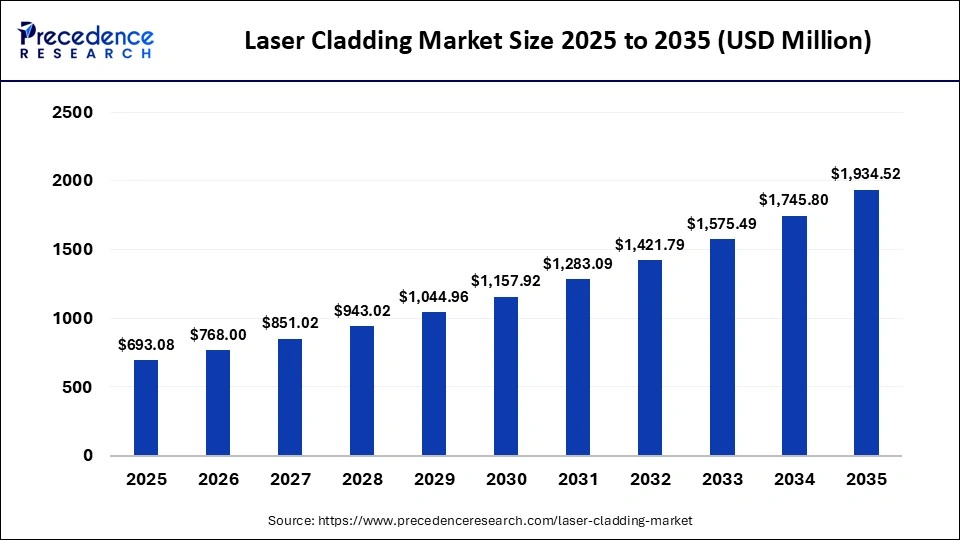
What is the Laser Cladding Market Size in 2026?
The global laser cladding market size accounted for USD 693.08 million in 2025 and is predicted to increase from USD 768.00 million in 2026 to approximately USD 1,934.52 million by 2035, expanding at a CAGR of 10.81% from 2026 to 2035.
Industries Driving the Adoption of Laser Cladding
- Aerospace and AviationThe aerospace industry is among the largest users of laser cladding technology. Turbine blades, landing gear, and engine parts are made to withstand intense operating conditions while complying with stringent safety regulations. This system enables builders to repair worn surfaces and accurately restore dimensions without damage to the structure. Cladded elements are also more resilient to wear than their original counterparts.
- Automotive ManufacturingDurability and efficiency are of vital importance in the automobile business. Crankshafts, camshafts, and cylinder liners are typical engine parts with extreme mechanical load during operation. Through laser cladding, manufacturers can make these parts life-sustaining and resilient by adding protective coatings to the engine itself. And thanks to this approach, molds can be refurbished in stamping and injection molding. Instead of wasting worn parts, engineers can restore damaged sections through laser cladding, saving time and resources.
- Power Generation and EnergyPower plants use turbines, boilers, and other equipment that operate in very harsh conditions and are often subject to oxidation, corrosion, or high-temperature fatigue. Laser cladding provides protective coatings that enhance resistance to these problems. For instance, gas turbine blades can be repaired with unique alloys that restore function but also extend service life. Laser cladding of turbine parts is now being investigated in the renewable energy sector (wind, etc.) to mitigate erosion.
- Oil and Gas IndustryThe oil and gas industry faces ongoing challenges from abrasive materials and high-pressure corrosive fluids that cause damage to equipment such as drill pipes, valves, pumps, and pipelines, which demand strong protective coatings to ensure reliability in continuous operation. This is improved through laser cladding enhancements against erosion and corrosion effects, enabling operators to significantly reduce replacement frequency and minimize downtime.
Technology Evolution: Transition from Repair to Intelligent Manufacturing Process
Initially developed for repair applications, laser cladding is widely used in digital manufacturing. Artificial intelligence (AI) plus advanced sensors and robotics, working together, to accurately analyze the cladding performance; these robots are perfecting the cladding process. These sophisticated applications constantly track temperature levels, material flow rates, and the deposition of the material in real time, and the ultimate delivery of effective results during the manufacturing process.
Automation is particularly crucial, as precision-driven industries need it. Therefore, robotic laser cladding methods have become an important solution since they operate autonomously with minimal human intervention, which increases efficiency and reduces operational errors. Laser cladding is now the cornerstone of additive manufacturing strategies. Laser cladding for hybrid construction is not just repairing parts; it helps to build new things piece by piece and layer by layer. Thus, the marriage of additive manufacturing and surface engineering is paving the way for new products and processes.
The Significance of Digital Simulation in Cladding Design
With the development of laser cladding technology, digital simulation tools have gained great significance nowadays. After all, engineers, in the present time, tend to make a model of the cladding process prior to any material ever being put down. Digital simulation programs can predict heat distribution across the substrate, predict melt pool behavior, and estimate the evolution of thickness in the finished coating.
Through virtual experimentation, manufacturers can optimize critical parameters like laser power, scanning speed, and powder feed rate. Such prediction power reduces the number of trial-and-error processes in manufacturing. It also reduces material waste and speeds up development stages. So, in complex tasks such as the repair of aerospace turbines, simulations guarantee that the cladding process complies with strict dimensional and mechanical requirements even before starting up with only one laser pulse.
Innovations in Laser Cladding Materials
Materials that are chosen for coating also play an important role in the effectiveness of laser cladding. Research and development efforts continue with manufacturers focused on developing advanced powders and alloys designed for different industrial purposes.
Commonly Used Materials include:
- Nickel-based alloys
- Cobalt-based alloys
- Stainless steel powders
- Carbide-reinforced composites
Materials chosen are those that are very resistant to wear, corrosion, and high temperatures. Hybrid coatings with metal-ceramic composites integrating hardness with thermal stability are innovations now in research, enabling engineers to fine-tune coatings for individual requirements within their own system.
Challenges Facing the Laser Cladding Industry
The laser cladding system requires advanced technical equipment such as high-powered lasers, powder delivery devices, and precision robots. Such systems can have relatively high up-front costs, which can deter smaller manufacturers from using them.
Also, suitable cladding involves high precision, and as a part of this, control of laser power, scanning speed, and powder feed rate needs to be achieved. Improper settings may result in cracks, porosity problems, or inadequate bonding.
A limitation is that the workforce must be qualified with a sound knowledge of materials science and laser process expertise. Ongoing training is essential to obtain better results. However, continuous progress in automation and process monitoring is gradually easing these challenges.
Sustainability and the Circular Economy
A key advantage of laser cladding lies in its role in promoting sustainable manufacturing. Conventional industrial maintenance generally requires whole components to be replaced once their surface has been damaged, with much in the way of raw materials or energy expended. Laser cladding, however, offers an alternative remedy. Renovating worn surfaces rather than disposing of components will help industries drastically reduce both material and carbon emissions. Often, components subjected to laser cladding will have up to several times the life of those without it. Less need for new materials, with less environmental impact, thanks to longer life span.
Environmental Benefits Beyond Material Savings
Although an increase in longevity of parts is one of the often cited advantages of laser cladding in sustainability, environmental impact goes beyond that in many aspects. It requires relatively minimal additional materials compared to conventional manufacturing processes. With only a thin layer of coating, it lowers the energy cost, normally needed to produce entirely new components.
Furthermore, transportation emissions can be diminished thanks to local repairs to components as opposed to replacing them through large worldwide supply chains. Many industrial facilities are beginning to roll up their sleeves and add new on-site cladding, which helps reposition worn components in a quick manner. These incremental improvements reduce resource consumption dramatically when considered in the context of industrial sustainability.
The Future of Laser Cladding
The future of laser cladding lies at the intersection of digital manufacturing, materials science, and sustainability. Several trends are likely to shape the industry in the coming decade:
- Integration with Smart ManufacturingProcesses can be streamlined and made more efficient due to the introduction of robotics, AI, and machine learning technologies. With real-time monitoring, automated technologies, and uniform coating quality, running costs will be ensured.
- Growth into New SectorsLaser cladding is poised to expand into sectors such as renewable energy technologies, hydrogen storage solutions, and advanced electronics production. This is a significant concern in a range of industries requiring materials that withstand extreme conditions, and hence with its rising importance in advanced surface coatings.
- Hybrid Additive ManufacturingBy integrating laser cladding with additive manufacturing methods, fresh design prospects will arise for engineers. Engineers could design parts with complex components and layer more protective elements at the same time.
- Development of Advanced MaterialsAdvances in alloys, composites, and high-entropy materials can increase the performance profiles of laser-cladded surfaces. This means we will find even more challenging applications for them now.
Expert Advise
According to Precedence Research, the laser cladding industry is witnessing robust growth owing to the burgeoning industries, such as aerospace, automotive, oil and gas, and power generation. The rapidly developing infrastructure, especially among emerging economies, promotes the use of innovative materials to prevent corrosion and withstand changing climatic conditions. The shifting trend towards environmental sustainability leads to reduced material waste and the use of minimal materials, driving the circular economy. The rise of digitization is revolutionizing the sector, resulting in enhanced efficiency and cost savings. Moreover, the future of laser cladding finds its extensive use in novel industries, further expanding the scope of the industry.
About the Authors

Aditi Shivarkar
Aditi, Vice President at Precedence Research, brings over 15 years of expertise at the intersection of technology, innovation, and strategic market intelligence. A visionary leader, she excels in transforming complex data into actionable insights that empower businesses to thrive in dynamic markets. Her leadership combines analytical precision with forward-thinking strategy, driving measurable growth, competitive advantage, and lasting impact across industries.



Aman Singh
Aman Singh with over 13 years of progressive expertise at the intersection of technology, innovation, and strategic market intelligence, Aman Singh stands as a leading authority in global research and consulting. Renowned for his ability to decode complex technological transformations, he provides forward-looking insights that drive strategic decision-making. At Precedence Research, Aman leads a global team of analysts, fostering a culture of research excellence, analytical precision, and visionary thinking.

Piyush Pawar
Piyush Pawar brings over a decade of experience as Senior Manager, Sales & Business Growth, acting as the essential liaison between clients and our research authors. He translates sophisticated insights into practical strategies, ensuring client objectives are met with precision. Piyush’s expertise in market dynamics, relationship management, and strategic execution enables organizations to leverage intelligence effectively, achieving operational excellence, innovation, and sustained growth.