






 Request Consultation
Explore a detailed comparison of SDLC Partners and CitiusTech, focusing on their investments, product innovations, and competitive strategies in robotic process automation (RPA) and revenue cycle automation. This analysis highlights each companys strengths, healthcare automation capabilities, AI-driven solutions, and market positioning to help organizations understand the evolving landscape of healthcare operational efficiency.
Introduction to Healthcare Automation and Revenue Cycle Transformation
Automation technologies such as RPA, AI, GenAI, and IPA are revolutionizing modern healthcare by accelerating reimbursements, streamlining clinical workflows, and drastically reducing administrative burdens. Moreover, these systems cut operational costs, eliminate data-entry errors, and free up medical staff to focus entirely on direct patient care. Healthcare organizations are now investing in digital transformation to replace manual, fragmented workflows with intelligent, interoperable, along with consumer-centric digital ecosystems. These investments leverage technologies such as artificial intelligence, cloud platforms, and robotic process automation to streamline operations and deliver data-driven, value-based healthcare.
CitiusTech and SDLC Partners are two major forces driving healthcare technology transformation. While CitiusTech functions worldwide with over 7,700 technologists, SDLC Partners brings localized Pittsburgh-rooted consulting expertise, thus specializing heavily in US payer markets.
- CitiusTech: It is backed by private equity heavyweights such as Bain Capital and BPEA EQT; CitiusTech has executed aggressive M&A, which includes the acquisition of SDLC Partners, Health Data Movers, and FluidEdge, to scale globally.
- SDLC Partners: Historically functioned as a highly specialized regional consultancy before being obtained by CitiusTech. Its main investment model centers on targeted talent acquisition and refining regional US payer offerings.
Understanding the Growing Role of RPA and Revenue Cycle Automation in Healthcare
Healthcare organizations are adopting robotic process automation along with artificial intelligence to streamline operations. By utilizing natural language processing for medical coding, automated claims scrubbing, and even predictive analytics, providers prevent errors before submission, accelerating reimbursements, limiting claim denials, and maximizing overall financial performance. AI-based platforms cross-reference clinical documentation with payer policies and coding guidelines in real-time, effectively removing manual coding errors before submission. Generative AI tools are also used to draft personalized, context-aware denial appeals, significantly enhancing overturn rates.
AI, predictive analytics, cloud platforms, and digital engineering are shifting revenue cycle management from reactive, manual processing to proactive, automated operations. This digital transformation decreases claim denials, lowers administrative costs, and accelerates cash flow by streamlining everything from patient scheduling to back-end collections. It determines vast amounts of historical billing data and payer behavior to forecast claim outcomes. It flags high-risk claims before submission along with predicts denial trends so billing staff can prioritize the most valuable interventions.
Why Healthcare Organizations Are Accelerating Automation Investments
Healthcare organizations are increasingly adopting business process automation to combat surging administrative costs along with severe staffing shortages. A significant section of healthcare budgets is tied to non-clinical, paper-heavy tasks. Automating these workflows directly decreases back-office expenses and accelerates time-to-reimbursement. Moreover, navigating complex, shifting policies such as price transparency, patient privacy, and accreditation demands intensive resources. Automation tools simplify compliance by standardizing reporting, thus tracking required outcomes and reducing human risk.
With healthcare labor expenses escalating and clinical burnout at critical levels, automation serves as a digital workforce. It offloads repetitive tasks, like scheduling, data entry, and patient intake, enabling human staff to focus on critical, value-added duties.
Evolution from Traditional RPA to Intelligent Automation and Generative AI
Automation has evolved from rigid, rule-driven systems into dynamic, cognitive ecosystems that do not just execute predefined commands, but actively think, learn, and also adapt. Traditional robotic process automation depends on strict "if-this, then-that" scripts, meaning a single formatting change or unprogrammed exception which could break the entire workflow. But now, the integration of advanced artificial intelligence technologies has changed automation into an autonomous agentic framework capable of managing ambiguity, predicting future results, and optimizing its own logic in real time.
Advanced tools such as the AdaptFlow Framework continuously monitor error rates and even bottleneck patterns. They dynamically alter routing rules or branch logic without needing developer intervention. Thus, GenAI workflows search internal company wikis, historical decision logs, along with regulatory compliance documents to guarantee that the actions taken align with company policies.
Revenue Cycle Automation as a Strategic Priority
Healthcare revenue cycle automation utilizes software to eliminate manual, repetitive tasks across the financial lifecycle of a patient encounter, from registration and insurance verification via coding, claims submission, denial management, and even payment collection. Patients experience the revenue cycle via registration forms, billing statements, payment requests, and collection calls. Automation enhances every touchpoint: digital intake reduces wait times, real-time eligibility provides accurate expense estimates upfront, electronic statements replace paper bills, and then automated payment plans reduce collection friction.
Manual data entry introduces errors at every step. Further, automation ensures that demographic data, clinical codes, insurance information, and financial transactions are consistent across systems.
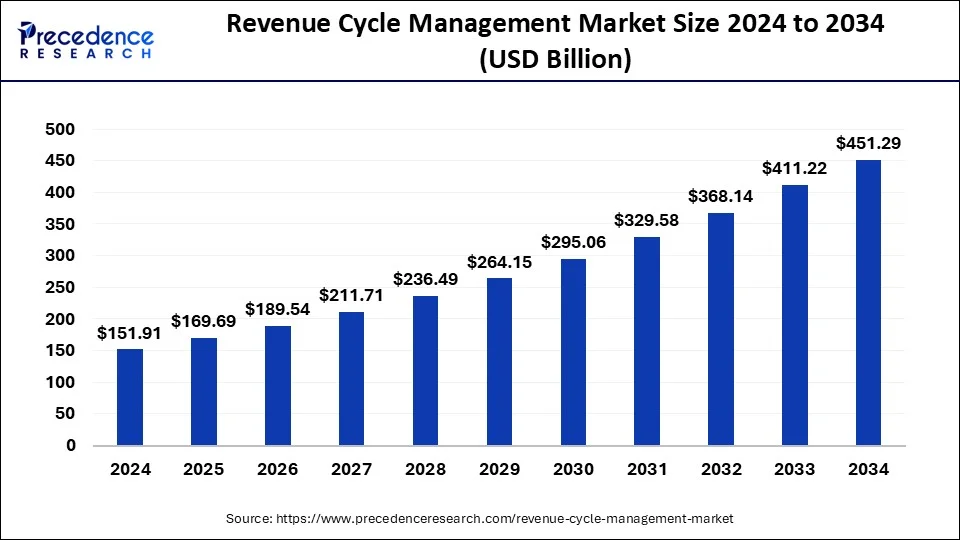
Revenue Cycle Management Market Size and Forecast 2026 to 2035
The global revenue cycle management market was valued at USD 169.69 billion in 2025 and is estimated to remain at USD 169.69 billion in 2026. The market is projected to reach approximately USD 493.37 billion by 2035, growing at a CAGR of 11.26% from 2026 to 2035. The increasing need to efficiently manage unstructured healthcare data is driving market growth, while the rising emphasis on patient-centric care is accelerating the adoption of revenue cycle management solutions.
Get a Free Sample Report with Key Market Trends: https://www.precedenceresearch.com/sample/1065
Company Profiles: SDLC Partners and CitiusTech
Before its 2021 acquisition by CitiusTech, SDLC Partners specialized in three pillars of health payer operations: technology transformation, consulting, along with automation. Their specialized expertise involved member experience management, intelligent automation for front- and back-office processes, healthcare data and analytics, and even core application modernization. Their capabilities were boosted by CyLumena, their dedicated cybersecurity firm launched in 2017.
SDLC Partners Company Overview
SDLC Partners is a premier healthtech consultancy, functioning with a team of over 350 professionals. The company specializes in digital transformation, data analytics, intelligent automation, and cybersecurity to assist healthcare payers in transitioning to member-centric, value-based models. SDLC offers strategic advisory and delivery services to bridge business needs with IT. They assist CIOs and enterprise leaders in mapping out the optimal path for ROI, emphasizing iterative change, requirement clarity, alongside seamless stakeholder alignment. SDLC applies intelligent automation and even front-to-back-end process automation to eliminate bottlenecks. This drives down administrative expenses and increases operational throughput.
CitiusTech Company Overview
CitiusTech is a leading global technology and consulting services company dedicated exclusively to the healthcare and life sciences industries. Thus, their business model blends deep domain expertise with next-gen technology, using proprietary frameworks and accelerators to assist over 140 healthcare enterprises in accelerating digital transformation, improving clinical outcomes, and achieving operational efficiency. By thus focusing exclusively on healthcare for over two decades, CitiusTech avoids a generalist approach to better solve complex clinical along with regulatory challenges. They build and support custom software and medical devices.
CitiusTech assists clients in migrating from on-premise legacy systems to scalable, secure cloud environments such as AWS, Azure, GCP. Through their specialized division, CitiusTech.AI, they offer enterprise-grade and Generative AI solutions. A major offering is CitiusTech Knewron, a healthcare-native AI platform that assists organizations in operationalizing AI securely.
Strategic Acquisition of SDLC Partners by CitiusTech
CitiusTech’s acquisition of SDLC Partners targeted to accelerate health plans' shift toward value-based, member-centric operating models. Further, by integrating SDLC’s deep payer expertise and specialized technical team, CitiusTech widened its market reach, enabling it to win larger digital transformation contracts and then modernize core administrative applications. By incorporating SDLC’s data along with process automation capabilities, CitiusTech enabled payers to optimize both front-end, like member experience, and back-end, like claims and enrollment operations, to lower administrative costs.
SDLC’s core strengths in member experience management and even data analytics perfectly complemented CitiusTech’s existing digital health portfolio, thus giving payers the unified technology stack required to transition away from legacy systems.
Investment Strategies Driving Healthcare Digital Transformation
CitiusTech and SDLC Partners have heavily invested in comprehensive technology strategies to speed up digital transformation across the healthcare and life sciences industries. Investment priorities in the healthcare sector have changed from standalone tech solutions to integrated operating systems. This capital allocation directly funds the industry's push to lower expenses and improve patient outcomes. Investment dollars target digital infrastructure which complies with FHIR-based integrations and improves cyber resilience. This ensures that patient data and results are uniformly tracked across the entire care continuum.
CitiusTech partners with major hyperscalers, which include AWS, Microsoft Azure, and Google Cloud, to assist enterprises in transitioning from monolithic on-premises systems to secure, cloud-native environments.
Investments in Artificial Intelligence and Intelligent Automation
CitiusTech's strategic acquisition of SDLC Partners was programmed to accelerate health plans' transitions to member-centric, value-driven operating models. By integrating SDLC's 350+ experts, CitiusTech broadened its payer footprint and improved end-to-end capabilities across multiple core technology pillars. CitiusTech's consulting bandwidth was improved by combining SDLC’s deep domain expertise with its existing advisory arm, allowing the delivery of comprehensive member experience management and even data analytics strategies. It provided the scale and technological backing required to position CitiusTech at the center of large-scale payer modernization, shifting clients away from legacy systems and even into agile, data-driven digital architectures.
Investments in Cloud Infrastructure and Digital Engineering
Cloud migration, modern architectures, interoperability, APIs, along with digital engineering, modernize healthcare operations by breaking down data silos, thus securing sensitive information and enabling real-time collaboration. It changes infrastructure away from expensive, localized data centers, offering scalable computing power for handling patient surges and continuous availability for electronic health records. It also unlocks enterprise-grade security and even disaster recovery. Migrating healthcare data integrations to the cloud directly supports infrastructure modernization by creating a foundation that allows organizations to transition their entire IT ecosystem to cloud-based systems.
Investments in Healthcare Data and Analytics Platforms
Healthcare and life sciences organizations have now long relied on reporting tools to analyze historical performance. But modern business intelligence in the healthcare industry goes beyond static reports and even siloed dashboards. It integrates data across clinical, financial, and operational systems and then transforms it into actionable insights that support real-time and strategic decision-making. Machine learning algorithms and predictive models embedded at the point of care aid providers in detecting adverse trends earlier, optimizing treatment pathways, and benchmarking outcomes. Advanced data visualization dashboards surface real-time bottlenecks in bed management, patient access, and supply chain management, while predictive analytics forecast staffing demands to limit burnout.
Innovation Strategies in RPA and Revenue Cycle Automation
Innovation in healthcare automation centers on integrating AI and machine learning to streamline the administrative and clinical ecosystem. It revolutionizes disjointed workflows into intelligent, data-driven processes, enabling organizations to reduce costs, accelerate cash flow, and redirect valuable staff time toward direct patient care. Further, AI scribes can translate physician-patient conversations into structured clinical notes in real time. Subsequently, NLP tools scan these notes along with medical charts to autonomously assign the most appropriate ICD-10 and CPT codes. This reduces human error, decreases compliance risks, and then ensures documentation fully supports medical necessity.
SDLC Partners' Intelligent Automation Approach
SDLC Partners functioned as a specialized, Pittsburgh-based technology and consulting firm. Their methodology aimed on modernizing healthcare payer operations by unifying Agile principles, intelligent automation, along with process engineering into a seamless enterprise delivery model. Before GenAI ubiquity, SDLC Partners now leveraged frameworks that combined robotic process automation with rules-based workflow automation. This allowed payers to automate repetitive, routine tasks, like prior authorization intake and also claims adjudication, while routing complex, nuanced cases to human experts.
CitiusTech's Revenue Cycle Automation Platform
CitiusTech uses hyper-automation, Generative AI, and machine learning to change healthcare revenue cycle management and clinical operations. Their solutions streamline administrative workflows, decrease manual workloads, and optimize financial performance. By streamlining data flows and cognitive automation, they speed up claims resolution and contract compliance, ensuring healthcare organizations maximize their revenue and decrease lost reimbursements.
Integrating robotic process automation, AI, cloud technologies, along with Generative AI, modernizes revenue cycle management by revolutionizing repetitive data-entry tasks into intelligent, full-cycle orchestration.
Integration of AI, GenAI, and Hyperautomation
Advanced automation technologies, usually referred to as intelligent automation, integrate AI, machine learning, natural language processing, robotic process automation, predictive analytics, and workflow automation to form a cohesive digital workforce. This convergence drives operational efficiency and enhances financial performance across the healthcare sector. It determines vast datasets to identify historical patterns and forecast results. ML continuously learns from new data to enhance accuracy over time.
Revenue Cycle Automation Capabilities Comparison
CitiusTech and SDLC Partners offer highly complementary approaches to healthcare revenue cycle management and modernization. CitiusTech is an AI-based, healthcare-native engineering powerhouse, whereas SDLC brings specialized consulting along with intelligent automation experience, specifically for health plans. CitiusTech offers end-to-end digital transformation for the wider healthcare and life sciences market, while SDLC Partners aims heavily on intelligent automation and execution for payer organizations.
Patient Access and Front-End Revenue Cycle Automation
Optimizing healthcare front-office workflows demands integrated platforms that automate manual tasks such as booking, registration, and also prior authorization. Solutions bridge the gap between clinical intent and revenue cycles by reducing redundant data entry, preventing claim denials, and decreasing staff administrative hours.
- Appointment Scheduling: It enables patients to self-schedule online 24/7 or use AI voice assistants. Cross-checks slot availability, provider network, and also care-pathway rules.
- Patient Registration: It automates intake via secure digital forms, optical character recognition of IDs, and also direct write-back to Electronic Health Records.
Claims Processing and Billing Automation
Automation solutions change the healthcare revenue cycle by connecting electronic health records, clearinghouses, and even payer portals into a seamless workflow. By replacing manual data entry with intelligent bots as well as predictive algorithms, organizations drastically decrease claim rejections, accelerate cash flow, and limit preventable revenue leakage.
Denials Management and Revenue Optimization
Predictive analytics, automation, AI, along with intelligent workflows transform the revenue cycle by shifting billing from a reactive, manual process to a proactive, data-based system. This technology stack drastically cuts first-pass denial rates, thus accelerates claim turnaround times, and secures financial stability by removing errors and administrative bottlenecks.
Technology Partnerships Strengthening Automation Capabilities
Technology partnerships integrate modular solutions from diverse vendors into cohesive ecosystems. By combining cloud platforms, AI frameworks, enterprise software, interoperability standards, and robotic process automation, these alliances overcome fragmented IT landscapes. They allow seamless, secure, and data-driven healthcare operations across clinical and administrative workflows. Platforms such as electronic health records and enterprise resource planning thus act as the central nervous system, centralizing patient and financial data across care networks.
Cloud and Enterprise Platform Partnerships
Partnerships between cloud providers, analytics platforms, enterprise software vendors, and healthtech ecosystems are central to healthcare digital transformation. They unify siloed data from electronic health records along with sensors to power artificial intelligence and predictive insights, ultimately lowering expenses and improving patient care. Companies such as Amazon Web Services and Microsoft Cloud for Healthcare supply the secure, HIPAA-compliant infrastructure, thus serving as the digital backbone for massive healthcare databases.
RPA Technology Partnerships
Healthcare organizations are accelerating digital transformation via strategic collaborations with RPA vendors, AI firms, and workflow providers to streamline operations such as revenue cycle management, medical record summarization, and prior authorization. These ecosystems integrate rule-driven automation with cognitive intelligence for faster, more accurate patient care.
Competitive Position in Healthcare Digital Transformation
CitiusTech and SDLC Partners thus represent a powerful synergy of payer-specific business consulting and global digital engineering. SDLC Partners functions as a dedicated subsidiary of CitiusTech, significantly bolstering CitiusTech's health plan along with payer market reach with onshore technology transformation and even automation expertise.
Customer Reach
- SDLC Partners: Built a strong regional footprint, thus giving them highly localized, onshore engagement capabilities with vast US payer organizations.
- CitiusTech: Possesses a vast global footprint. They serve across 140+ large healthcare enterprises, thus establishing relationships with 40% of all Fortune 500 healthcare organizations.
Implementation & Integration Expertise
- SDLC Partners: Highly skilled at front- and back-end process automation, member portal design, along with data strategies to accelerate digital roadmaps specifically for health plans.
- CitiusTech: Deeply embedded with leading hyperscalers and platforms, driving vast cloud and digital ecosystems. They thus leverage established partnerships with major vendors such as Snowflake, Redox, Salesforce, and ServiceNow to scale health data exchange and EHR integrations.
Healthcare Provider Market Position
Provider-focused automation boosts healthcare transformation by integrating AI and digital engineering into clinical and financial workflows. Further, it streamlines operations, optimizes revenue cycles, and drives interoperability. It connects fragmented EHR systems, payers, along with clinical departments for secure, real-time data exchange and seamless care coordination.
Healthcare Payer Market Position
Modernizing healthcare operations decreases administrative burdens and optimizes the bottom line. Leveraging AI-driven claims automation, real-time prior authorization, along with predictive analytics yields measurable ROI. It changes from reactive communication to personalized digital touchpoints, which include omnichannel member service advocates, portals, and AI-enabled chatbots.
Competitive Advantages Supporting Market Leadership
Comprehensive healthcare digital transformation demands seamlessly integrating domain expertise, automation accelerators, along with proprietary frameworks with consulting capabilities. Leveraging technology partnerships and even digital services modernizes clinical workflows, lowers administrative expenses, and achieves rapid, scalable interoperability. Pre-built solution accelerators, for instance, RPA, AI-driven clinical documentation improvement, and also AI-enabled revenue cycle management, drastically decrease manual workloads. End-to-end modernization includes cloud migration, omnichannel patient engagement, interoperability platforms, and real-time analytics.
Major Customer Segments and Industry Applications
Healthcare and life sciences organizations serve the main customer segments, including healthcare providers, health plans, MedTech organizations, life sciences companies, diagnostic laboratories, and health tech vendors. Automation strategies are tailored to the operational, distinct regulatory, and clinical goals of each specific customer group.
- Healthcare Providers: It focuses on clinical workflow along with revenue cycle management. Solutions use conversational AI and robotic process automation for automated patient intake, EHR documentation, and even insurance prior authorizations to reduce administrative burdens.
- Healthcare Technology Vendors: It focuses on interoperability, scalable integrations, and continuous deployment. Automation depends heavily on CI/CD pipelines, MLOps, and monitoring tools to guarantee models and APIs perform reliably across different enterprise environments.
Healthcare Providers
Automation in healthcare alleviates administrative burdens, decreases claim denials, and lowers wait times. By streamlining appointment scheduling, electronic health records management, and patient intake, automation tools enable clinicians to dedicate significantly more time to patient care.
Health Insurance Payers
Modern healthcare payer workflow automation seamlessly unifies core administrative and clinical operations. It leverages AI orchestration, robotic process automation, along with unified data interoperability to reduce expenses, eliminate manual bottlenecks, and accelerate turnaround times across the healthcare enterprise.
Life Sciences and Medical Technology Organizations
Digital transformation initiatives across the life sciences optimize operations by deploying Industrial Internet of Things for smart manufacturing, Artificial Intelligence for predictive research, and cloud ecosystems for regulatory compliance. These technologies drastically decrease drug development times, strengthen supply chains, and allow personalized medicine. Implement e-Clinical Platforms and decentralized, virtual trial tools to expand patient enrollment, manage e-consent, and even track real-world data in real-time.
Recent Developments, Investments, and Innovation Initiatives
Enterprise investments in healthtech increased to billion in early 2026 as organizations shift from experimental point solutions to consolidated, AI-native infrastructure. The main goal is decreasing the billion in excess administrative spending via scalable cloud computing and clinical workflow optimization. Ambient clinical documentation is reaching 100% adoption among surveyed health systems, enabling clinicians to generate records in the background and focus on patient care. Collaborations between major tech companies and medical providers, like Oracle Health's expanded cloud-enabled EHR capabilities and the Lilly-Nvidia lab, are establishing unified data utility.
Comparative Analysis of SDLC Partners and CitiusTech
To compare the healthcare consulting and technology market, it is important to evaluate firms based on their distinct areas of specialization, service delivery, and even market positioning. The industry is generally segmented into strategy consultancies, which dominate business model design, and IT & Technology Giants who boost the digital backbone.
Organizations prioritize partners with deep and native expertise in clinical and regulatory compliance. Leading healthcare consulting companies focus on workflow integration, while major tech firms provide scalable data ecosystems.
AI adoption in RCM is anticipated to nearly double. Platforms now feature end-to-end touchless claims management, proactive denial prevention, and even automated prior authorizations.
Private equity and tech giants are funding clinical-intelligence and even workflow-automation solutions, enabling early adopters to lower administrative costs and expand market share.
Comparison Based on Innovation and Automation Capabilities
Evaluating enterprise approaches to AI and Intelligent Automation demands looking beyond isolated tools and assessing how organizations orchestrate GenAI, RPA, and predictive analytics to achieve true end-to-end digital transformation.
- Artificial Intelligence: Organizations deploy specialized AI agents along with foundational models to automate complex, unstructured tasks, improve decision-making, and personalize experiences at scale.
- Predictive Analytics: Predictive models scan historical data to forecast trends, determine bottlenecks, or detect risks before they occur, thus acting as the "decision engine" that prioritizes automated actions.
Comparison Based on Industry Expertise and Client Focus
Top-tier healthcare consulting and IT companies deliver end-to-end digital transformation, integrating domain specialization, payer or provider expertise, along with technology implementation. They work with clinical workflows and financial operations with customizable, scalable, and HIPAA- or CMS-compliant solutions.
- Strategy-to-execution roadmaps that tackle market shifts, value-based care models, profitability analysis, and even long-term digital enterprise growth.
- Large-scale deployment of massive enterprise platforms and health systems such as Salesforce Health Cloud, Pega Care Management, along with the TriZetto or Facets suite.
Comparison Based on Long-Term Growth Strategy
Current enterprise tech strategy prioritizes changing from isolated AI experiments to autonomous "agentic" platforms and even multi-region cloud resilience. Organizations must optimize expenses to fund this innovation, restructuring portfolios to prioritize high-margin capabilities while streamlining or divesting redundant traditional IT functions. Moreover, enterprises are shifting from bespoke, manual IT solutions to scalable, and IP-led platforms to improve efficiency. Platform development heavily depends on data management roadmaps, agentic AI, and agent-based automation to create measurable enterprise value.
Challenges Facing Healthcare Automation Providers
Healthcare automation providers navigate a complex matrix of obstacles. These barriers thus range from strict data-protection mandates to the technical realities of deploying autonomous systems in environments built for human clinicians. Further, healthcare breaches remain highly costly and prevalent. Moreover, systems must constantly balance patient data accessibility with hardened, zero-trust architectures to protect against ransomware and adversarial AI attacks.
Companies address market challenges, like disruption, shifting consumer demands, and sustainability, by accepting strategic innovation and targeted investments. Rather than relying on incremental improvements, they reshape their business models and even leverage digital technologies to create competitive differentiation, enhance resilience, and drive long-term value. Enterprises expand their reach by collaborating with external entities, like startups, experts, and customers, while establishing clear partnership guidelines to protect proprietary information.
Integration with Legacy Healthcare Systems
Modernizing healthcare IT demands balancing innovation with patient safety. Major challenges which includes untangling outdated legacy code, achieving interoperability across fragmented systems, and then preventing clinical downtime during transitions. Healthcare data is frequently siloed in different formats. Widespread acceptance of frameworks such as HL7 FHIR is helping, but mapping data consistently across disparate electronic health record systems remains complex. Moreover, system outages or latency during the deployment phase can delay critical lab results, medication administration, along with emergency response.
Security, Compliance, and Data Privacy
In healthcare automation, these five pillars form the foundation for trust, patient safety, along with regulatory compliance. They protect highly sensitive data during digital transformations, preventing severe breaches and even maintaining operational integrity. Legally mandates the privacy and even security of medical records. In automated workflows, it guarantees that electronic systems, third-party integrations, and even algorithms only process personal health information within established legal boundaries.
Modernizes infrastructure by enabling scalable data processing while depending on built-in technical safeguards. It ensures that patient data is fully encrypted, both at rest and in transit, and allows centralized logging and automated monitoring to mitigate risks during data migration.
Future Outlook for RPA and Revenue Cycle Automation
Healthcare automation is changing from isolated, rules-based tasks to cognitive, self-optimizing ecosystems. By converging AI reasoning, virtual modeling, along with predictive insights, the industry is overcoming traditional integration barriers, thus reclaiming valuable clinician time, eliminating trial-and-error medicine, and even creating frictionless operational workflows. Intelligent revenue cycle transformation is driving a vast industry shift. Providers, payers, and technology partners are heavily investing in AI, predictive analytics, and automation. This ecosystem evolution changes operations from reactive, paper-heavy workflows to proactive, "RCM 3.0" platforms which maximize cash realization and ease the administrative burden on clinical staff.
Generative AI Will Redefine Revenue Cycle Management
Generative AI transforms healthcare operations by automating unstructured, narrative-heavy, and document-intensive workflows. It changes administrative processes from reactive manual tasks to proactive ones, reducing paperwork, AI-assisted operations, and preventing costly bottlenecks. Further, ambient AI scribes listen to patient-physician encounters and even automatically generate structured, narrative-heavy electronic health record notes. GenAI automates the submission process by extracting necessary information from the EHR and structuring it into payer-specific forms. It then evaluates incoming clinical evidence against established insurance guidelines along with medical necessity rules.
Integrated Healthcare Automation Ecosystems Will Drive Future Growth
Interoperable cloud platforms will become the base of future healthcare operations by securely breaking down data silos, centralizing patient data, along with powering AI-driven clinical insights. Further, these platforms transform health data from fragmented records into real-time utilities that enhance patient outcomes and operational efficiency. End-to-end digital transformation strategies serve as the base of future healthcare operations by unifying fragmented data into continuous, intelligent care ecosystems. This change moves hospitals from reactive, siloed environments to proactive, connected networks which optimize workflows, reduce operational expenses, and elevate patient outcomes.
Conclusion: Healthcare Automation Is Becoming a Strategic Competitive Advantage
SDLC Partners' specialized payer consulting, along with CitiusTech's scalable digital platforms, accelerates healthcare automation by assisting payers in transitioning to member-centric models. By combining these strengths, the organizations streamline complex operations such as member experience management, claims processing, and even data interoperability.
The 2021 acquisition of SDLC Partners remarkably strengthened CitiusTech’s leadership in revenue cycle modernization, intelligent automation, and even digital transformation. By combining CitiusTech's deep domain expertise with SDLC’s technology capabilities, the firm expanded its healthcare solutions portfolio to deliver end-to-end modernization.
Continued investments in AI, RPA, cloud technologies, along with analytics, are not just modern upgrades; and they are the bedrock of future-proof healthcare revenue cycle management. These technologies transformation billing from a reactive, manual burden into a streamlined, proactive driver of cash flow and even operational excellence. Cloud-based platforms remove data silos and enable real-time interoperability between electronic health records (EHRs) and billing systems. They provide the scalability needed to handle complex reimbursement landscapes securely.
About the Authors

Aditi Shivarkar
Aditi, Vice President at Precedence Research, brings over 15 years of expertise at the intersection of technology, innovation, and strategic market intelligence. A visionary leader, she excels in transforming complex data into actionable insights that empower businesses to thrive in dynamic markets. Her leadership combines analytical precision with forward-thinking strategy, driving measurable growth, competitive advantage, and lasting impact across industries.



Aman Singh
Aman Singh with over 13 years of progressive expertise at the intersection of technology, innovation, and strategic market intelligence, Aman Singh stands as a leading authority in global research and consulting. Renowned for his ability to decode complex technological transformations, he provides forward-looking insights that drive strategic decision-making. At Precedence Research, Aman leads a global team of analysts, fostering a culture of research excellence, analytical precision, and visionary thinking.

Piyush Pawar
Piyush Pawar brings over a decade of experience as Senior Manager, Sales & Business Growth, acting as the essential liaison between clients and our research authors. He translates sophisticated insights into practical strategies, ensuring client objectives are met with precision. Piyush’s expertise in market dynamics, relationship management, and strategic execution enables organizations to leverage intelligence effectively, achieving operational excellence, innovation, and sustained growth.