



Liquefied Petroleum Gas (LPG) Tanker Market Size, Companies, Share, Vehicle Production Volume, Sales Performance, Export & Import Analysis, Technology Adoption, Competitive Positioning, and Demand Trends
Liquefied Petroleum Gas (LPG) Tanker Market (By Vessel Type: Very Large Gas Carriers (VLGC) , Large Gas Carriers (LGC) , Medium Gas Carriers (MGC) , Small Gas Carriers (SGC) ; By Tank Type: Fully Pressurized , Semi-Refrigerated , Fully Refrigerated ; By Application: Residential LPG Transportation, Commercial LPG Transportation, Industrial/Petrochemical Transportation ; By Transportation Mode: Ocean Transportation, River/Inland Waterways Transportation) - Global Industry Analysis, Size, Trends, Leading Companies, Regional Outlook, and Forecast 2026 to 2035
Source: https://www.precedenceresearch.com/liquefied-petroleum-gas-tanker-market
 Get a Sample
 Table Of Content


What is the Liquefied Petroleum Gas (LPG) Tanker Market Size in 2026?
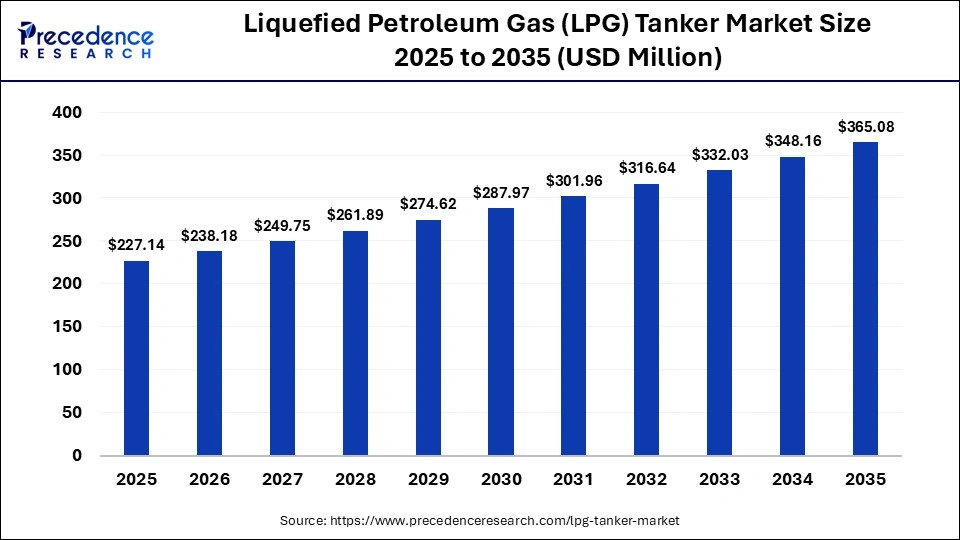
The global liquefied petroleum gas (LPG) tanker market size was calculated at USD 227.14 million in 2025 and is predicted to increase from USD 238.18 million in 2026 to approximately USD 365.08 million by 2035, expanding at a CAGR of 4.86% from 2026 to 2035. The liquified petroleum gas (LPG) tanker market is experiencing unprecedented growth, driven by the surge in shale gas production, increasing demand for liquefied petroleum gas (LPG) in developing nations, and significant investment in terminal infrastructure and storage facilities.
Key Takeaways
- Asia Pacific dominated the market with 35% revenue share in 2025 and is expected to further grow at the fastest CAGR of 5.0% during the forecast period.
- By vessel type, the very large gas carriers (VLGC) segment held the largest market share of approximately 50% in 2025.
- By vessel type, the small gas carriers (SGC) segment is expected to grow at the fastest CAGR of 3.8% between 2026 and 2035.
- By tank type, the fully pressurized segment contributed the biggest revenue share of 52% in the liquefied petroleum gas (LPG) tanker market in 2025.
- By tank type, the semi-refrigerated segment is expected to expand at the fastest growth rate of 4.2% between 2026 and 2035.
- By application, the residential LPG transportation segment held a dominant share of 40% in 2025.
- By application, the industrial/petrochemical transportation segment is expected to grow at the highest CAGR of 4.1% from 2026 to 2035.
- By transportation mode, the ocean transportation segment registered its dominance with a revenue share of 60% during 2025.
- By transportation mode, the river/inland waterways transportation segment is expected to grow at the highest CAGR of 4.3% during the forecast period.
Market Overview
The Liquefied Petroleum Gas (LPG) tanker market refers to vessels and transportation systems designed to carry liquefied petroleum gas, including propane and butane, across domestic and international routes. LPG tankers are specialized ships equipped with pressurized or refrigerated tanks to safely store and transport gas in liquid form. These tankers play a critical role in global energy logistics, enabling efficient bulk transportation from production hubs to consumption markets for residential, industrial, petrochemical, and commercial applications.
How are AI-driven Innovations Impacting the Growth of the Market?
In the rapidly evolving technological landscape, the integration of Artificial Intelligence (AI) emerges as a changer and is significantly accelerating the growth of the Liquefied Petroleum Gas (LPG) tanker market by enhancing operational efficiency, improving safety & risk mitigation, boosting sustainability, and optimizing supply chain logistics. AI-driven predictive analytics allows for continuous monitoring of cargo conditions to enhance both efficiency and safety.
AI algorithms efficiently analyze sensor data to predict equipment failures before they occur, which reduces downtime and lowers maintenance costs. AI-powered systems can analyze sea currents, weather patterns, and vessel performance in real time. AI can optimize cargo loading, maximize space utilization, and improve stability, which allows LPG tankers to handle larger volumes. An AI-driven system can monitor emissions by tracking greenhouse gas emissions, such as methane leaks, assisting companies in complying with stringent international maritime regulations.
What are the Emerging trends in the Market?
- The stringent global emission regulations, along with the increasing demand for LPG as a cleaner alternative to traditional fuels for cooking, heating, and industrial applications is expected to accelerate the growth of the liquefied petroleum gas (LPG) tanker market during the forecast period.
- The escalating awareness of environmental concerns and rising global focus on cleaner energy sources is likely to make liquefied petroleum gas a widely preferred fuel option among households, bolstering the market's expansion in the coming years. The regulations implemented by the International Maritime Organization (IMO) have substantially increased the adoption of sustainable and alternative fuel technologies to combat greenhouse gas emissions.
- The rising trade relationships between the Asia Pacific region and the United States for shale gas, mainly driven by the reduced cost of transportation, are anticipated to bolster the market's growth in the coming years.
- The rapid urbanization and rising government initiatives to expand access to clean cooking fuels are expected to contribute to the overall growth of the liquefied petroleum gas (LPG) tanker market.
- The rapid advancements in tanker technology and design are expected to enhance operational efficiency, promoting the market's growth during the forecast period. Innovations such as highly efficient refrigeration, semi-refrigerated techniques, and improved pressure vessel design increase safety and efficiency. The rising adoption of autonomous navigation and advanced vessel tracking systems reduces operational costs.
Market Scope
| Report Coverage | Details |
| Market Size in 2025 | USD 227.14 Million |
| Market Size in 2026 | USD 238.18 Million |
| Market Size by 2035 | USD 365.08 Million |
| Market Growth Rate from 2026 to 2035 | CAGR of 4.86% |
| Dominating Region | Asia Pacific |
| Base Year | 2025 |
| Forecast Period | 2026 to 2035 |
| Segments Covered | Vessel Type, Tank Type, Application, Transportation Mode, and region |
| Regions Covered | North America, Europe, Asia-Pacific, Latin America, and Middle East & Africa |
Segmental Insights
Vessel Type Insights
What caused the Very Large Gas Carriers (VLGC) segment to dominate the Market?
The very large gas carriers (VLGC) segment held the largest liquefied petroleum gas (LPG) tanker market share of 50% in 2025. The very large gas carriers (VLGC) are capable of carrying a higher volume of gas and loading between 100,000 cubic meters and 200,000 cubic meters of gas into large tanks. These tanks are generally built under the deck and regulate gas unloading and loading using a system of pumps and valves. Many of the very large gas carriers are fully-refrigerated and mainly employed for longer distances across various countries. Additionally, the ongoing trade relationships between major LPG-producing nations and significant investments in shipbuilding technology are anticipated to drive the segment's growth.
The small gas carriers (SGC) segment is expected to grow at a remarkable CAGR of 3.8% between 2026 and 2035. Small gas carriers (SGC) are widely preferred for regional trade, coastal distribution, and smaller port deliveries. These vessels are generally in high demand for shorter regional routes, owing to specialized cargo-handling capabilities and their lower fuel consumption. SGC often uses semi-pressurized and semi-refrigerated containment systems for flexibility.
Tank Type Insights
What has led the Fully Pressurized segment to dominate the Market?
The fully pressurized segment contributed the highest liquefied petroleum gas (LPG) tanker market share of 52% in the market during 2025. Fully pressurised tanks are small and mainly preferred over shorter regional routes, supporting the ongoing demand for small-scale and last-mile LPG delivery. The design of a fully pressurised vessel is the simplest, and they carry their cargoes at ambient temperature without insulation, which reduces construction costs.
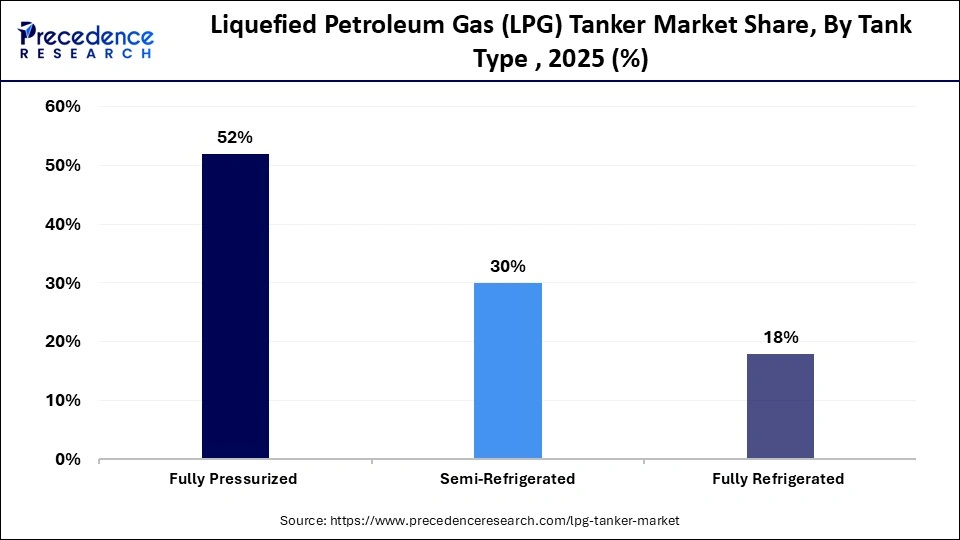
The semi-refrigerated segment is expected to expand at a remarkable growth rate of 4.2% from 2026 to 2035, owing to its excellent versatility and ability to combine refrigeration and pressure to carry numerous cargoes such as butane, propane, and petrochemical gases. These tankers are favored for handling smaller, flexible, and efficient transport requirements. Semi-refrigerated ships feature Type C tanks that can carry gases at different temperatures and pressures.
Application Insights
Which Application Dominated the Market in 2025?
The residential LPG transportation segment held the largest market share of 40% in the liquefied petroleum gas (LPG) tanker market during 2025. The segment dominance is mainly driven by the rising trend of urbanization in developing economies and increasing global demand for LPG cooking and heating. Liquefied petroleum gas (LPG) is considered a cleaner-burning and more efficient fuel over traditional options like coal and wood. Additionally, the rising government initiatives to promote clean energy have resulted in increased residential consumption rates. Therefore, the rising adoption of LPG in households necessitates robust, safe, and efficient transportation.
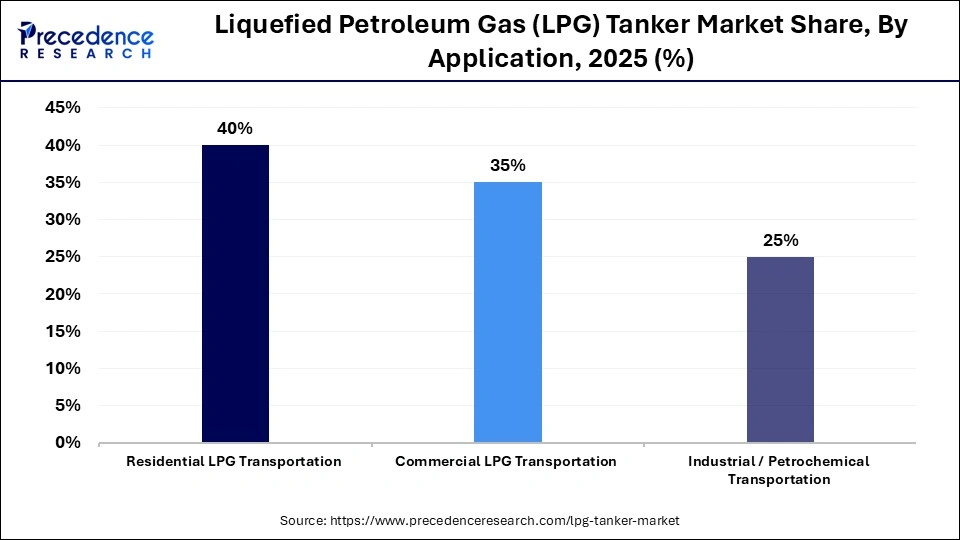
The industrial/petrochemical transportation segment is expected to witness the fastest growth in the market with a remarkable CAGR of 4.1% over the forecast period, owing to the increasing demand for LPG in chemical manufacturing, expanding petrochemical applications, and rising shale gas exports from the U.S. to the Asia-Pacific. The strict environmental emission regulations are increasingly favoring LPG as a cleaner-burning energy source in industrial processes, which further accelerates its usage in manufacturing. The rising investments in LPG storage and terminal infrastructure have substantially increased the capability to receive and process, strengthening the industrial demand.
Transportation Mode Insights
What factors are contributing to the Dominance of the Ocean Transportation Segment in the Market?
The ocean transportation segment accounted for the largest liquefied petroleum gas (LPG) tanker market share of nearly 60% in the market. The segment's growth is driven by the surge in exports from the Middle East and the United States, increasing demand for LPG in the Asia Pacific region, and a rise in international trade. The rising production of shale gas, particularly in the US, has increased the need for global exports, creating a high demand for large and efficient LPG tankers such as Very Large Gas Carriers (VLGCs). Moreover, the increasing need to transport LPG from key producing regions to high-consumption markets in Asia (China, Japan, and India) and Europe are antipated to propel the growth of the segment during the forecast period.
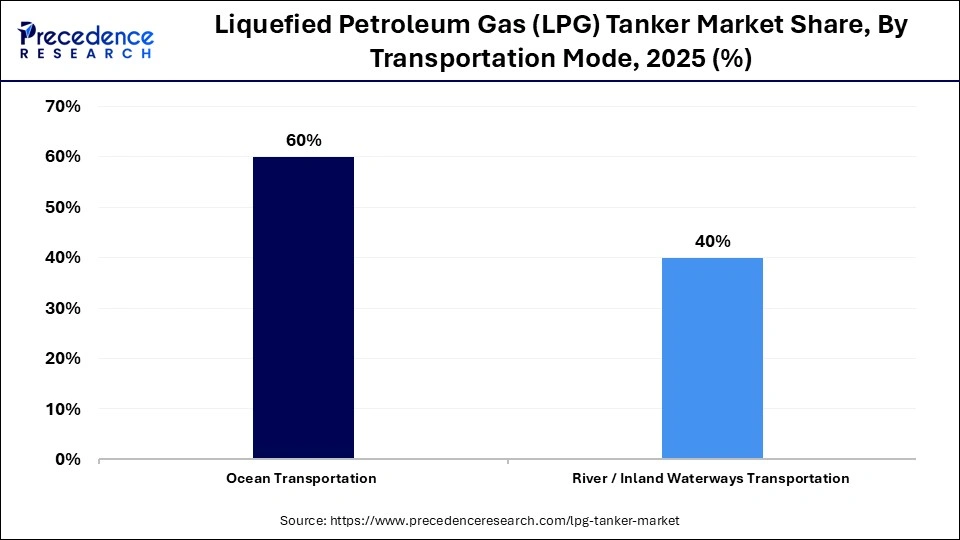
The river/inland waterways transportation segment is expected to grow with the highest CAGR of 4.3% in the liquefied petroleum gas (LPG) tanker market during the studied year. Water transport is generally the cheapest way to transport LPG gas, with significantly lower operating costs per metric tonne per kilometer compared to road transport. The increasing use of large LGP tankers enables economies of scale and allows for higher volumes per trip. The rapid development of inland waterway infrastructure is experiencing significant growth, driven by substantial government investment, the expansion of operational waterways, and the construction of river jetties and multimodal terminals.
According to the article published by the Press Information Bureau (PIB) in January 2026, the Inland Waterways Development Council (IWDC 3.0) meeting in Kochi approved projects exceeding 1,500 crore to boost green mobility, strengthen multimodal logistics, and promote river-led economic development. Foundation stones were laid for projects exceeding 150 crore, including river cruise jetties in Kerala, Gujarat, Karnataka, Odisha, and Telangana, supporting the expansion of cruise tourism circuits across the country.
Regional Insights
Asia Pacific Liquefied Petroleum Gas (LPG) Tanker Market Size and Growth 2026 to 2035
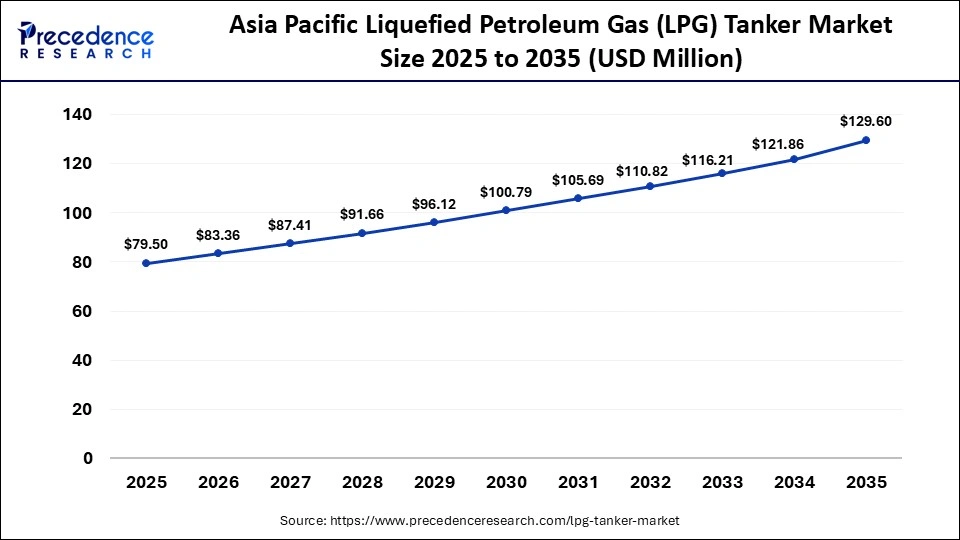
The Asia Pacific liquefied petroleum gas (LPG) tanker market size is expected to be worth USD 129.60 million by 2035, increasing from USD 79.50 million by 2025, growing at a CAGR of 5.01% from 2026 to 2035.
Asia Pacific Liquified petroleum gas (LPG) tanker market Analysis
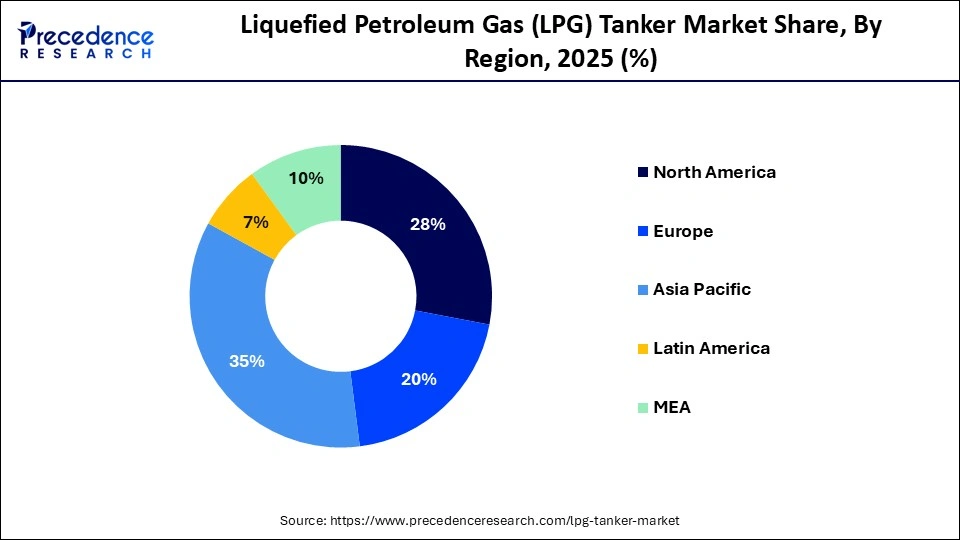
Asia Pacific held the largest share of 35% in 2025 and is expected to further grow at the fastest CAGR of 5.0% in the liquefied petroleum gas (LPG) tanker market during 2026-2035. The expanding petrochemical industry in Asia-Pacific relies heavily on a steady, high-volume supply of LPG for production, which further boosts the demand for specialized and efficient LPG tankers. The rise in the production of shale gas in the United States has led to higher, cost-effective exports to the Asia-Pacific. The rapid urbanization in countries like India, Japan, South Korea, China, and others is driving the demand for LPG in cooking and heating. The rising investment in port infrastructure, storage, and distribution networks across various countries in the region has substantially increased import capacity.
India Liquefied Petroleum Gas (LPG) Tanker Market Analysis
India holds a substantial share of the market. India is the second-largest consumer of LPG worldwide. India is aggressively investing in its import infrastructure, including new terminals on the east and west coasts. The country's rapid growth is also largely driven by the rapid industrialization, increasing adoption of very large gas carriers (VLGC), rapid expansion of the petrochemical industry, and rising innovation in tanker technology. Several industries in the region are moving toward engines that can use LPG as fuel, which reduces greenhouse gas emissions and operational costs. The rapid urbanization in the country has increased the consumption of LPG for cooking and heating, creates need for robust and safe transportation. Several government sustainability initiatives in the country are encouraging the adoption of LPG as a cleaner residential and industrial fuel. Such a combination of factors is anticipated to bolster the growth of the market in the country.
North America Liquified petroleum gas (LPG) tanker market Analysis
The North America region is expected to grow at a significant CAGR in the liquefied petroleum gas (LPG) tanker market during the forecast period. The region is a major global supplier, driven by the booming shale gas production. North America has abundant shale gas reserves, which boost the LPG exports. The region heavily benefits from the ongoing domestic and international demand for LPG, particularly for residential heating and cooking applications. The region's growth is also supported by continued investment in export terminal expansions.
The U.S. Liquified petroleum gas (LPG) tanker market Analysis
The U.S. holds a notable revenue share. The rising trade relationships between the U.S. and the APAC region for shale gas, owing to the reduced cost of transportation, are driving the demand for liquefied petroleum gas (LPG) tankers. The U.S. is recognized as the world's largest producer and exporter of LPG. The country exports LPG globally, mainly to Asia (particularly China, India, Japan, and South Korea) and Latin America (Mexico), often leveraging Gulf Coast export terminals.
The growth of the country is largely driven by the increasing investment in export infrastructure, increasing use of very large gas carriers (VLGCS), rising transition towards cleaner fuels, and rising investments in advanced vessel design. Supportive government policies fostering energy export initiatives and trade agreements. These collective factors are anticipated to drive the country's growth during the forecast period.
Liquefied Petroleum Gas (LPG) Tanker Market Companies
- BW LPG
- Dorian LPG Ltd.
- EXMAR NV
- Navigator Holdings Ltd.
- Nakilat
- Teekay Gas Group
- Mitsui O.S.K. Lines
- Kawasaki Kisen Kaisha
- Hyundai Heavy Industries
- Samsung Heavy Industries
- Mitsubishi Heavy Industries
- Daewoo Shipbuilding & Marine Engineering
- STX Offshore & Shipbuilding
- Great Eastern Shipping Company
- NYK Line
Recent Developments
- In February 2026, the Isla Group expanded its logistics capabilities with the launch of the vessel PURE GRACE, a dedicated liquefied petroleum gas (LPG) carrier developed in partnership with Magsaysay Shipping and Logistics (MSL). The vessel, formally blessed and named in a ceremony marking the start of operations, will serve as Isla Group's official carrier for transporting Solane LPG across Luzon, Visayas, and Mindanao. The deployment is expected to enhance the safe, reliable, and timely delivery of LPG products to households and businesses nationwide.(Source: https://portcalls.com)
- In January 2026, Aygaz, an Istanbul-based fuel company, announced on Thursday that it had signed a shipbuilding agreement worth $119 million with South Korean shipyard HD Hyundai Samho for the construction of a dual-fuel Very Large Gas Carrier (VLGC). (Source: https://www.turkiyetoday.com)
Segment Covered in the Report
By Vessel Type
- Very Large Gas Carriers (VLGC)
- Large Gas Carriers (LGC)
- Medium Gas Carriers (MGC)
- Small Gas Carriers (SGC)
By Tank Type
- Fully Pressurized
- Semi-Refrigerated
- Fully Refrigerated
By Application
- Residential LPG Transportation
- Commercial LPG Transportation
- Industrial/Petrochemical Transportation
By Transportation Mode
- Ocean Transportation
- River/Inland Waterways Transportation
By Region
- North America
- Latin America
- Europe
- Asia-pacific
- Middle and East Africa
For inquiries regarding discounts, bulk purchases, or customization requests, please contact us at sales@precedenceresearch.com
Frequently Asked Questions





Ask For Sample
No cookie-cutter, only authentic analysis – take the 1st step to become a Precedence Research client
 Get a Sample




 sales@precedenceresearch.com
 Schedule a Meeting
