



Middle East Standalone SMR-Based Radioisotope Market Size, Companies, Share, Patient Volume, Treatment Adoption Rates, Pricing Analysis, Regulatory Landscape, Competitive Positioning, and Demand Forecast
Middle East Standalone SMR-Based Radioisotope Market (By Radioisotope: Molybdenum-99 (Mo-99), Iodine-131 (I-131), Lutetium-177 (Lu-177), Cobalt-60 (Co-60), Iridium-192 (Ir-192), Yttrium-90 (Y-90), Holmium-166 (Ho-166), Samarium-153 (Sm-153), Phosphorus-32 (P-32), Rhenium-188 (Re-188), Actinium-225 (Ac-225), Other SMR-Produced Radioisotopes; By Reactor Type: Pressurized Water Reactor (PWR)-Based SMRs, Heavy Water Reactor (HWR)-Based SMRs, High-Temperature Gas-Cooled Reactor (HTGR)-Based SMRs, Lead-Cooled Fast Reactor (LFR)-Based SMRs, Sodium-Cooled Fast Reactor (SFR)-Based SMRs, Microreactor-Based Systems; By Application: Diagnostic Applications, Therapeutic Applications, Theranostic Applications; By End User: Radiopharmaceutical Manufacturers, Hospitals, Nuclear Medicine Centers, Research Institutes & Academic Organizations, Industrial End Users) - Industry Analysis, Size, Trends, Leading Companies, Regional Outlook, and Forecast 2026 to 2035
Source: https://www.precedenceresearch.com/middle-east-standalone-smr-based-radioisotope-market
 Get a Sample
 Table Of Content
What is the Middle East Standalone SMR-Based Radioisotope Market Size?
The market is expected to witness significant growth, driven by increasing government interest in nuclear energy diversification, rising demand for a secure and uninterrupted supply of medical radioisotopes, advancements in Small Modular Reactor (SMR) technologies, and the growing adoption of targeted radionuclide therapies. Furthermore, increasing investments in nuclear infrastructure, localization of radioisotope production, and the development of next-generation reactor technologies are anticipated to accelerate the commercialization of SMR-based radioisotope production across the Middle East.
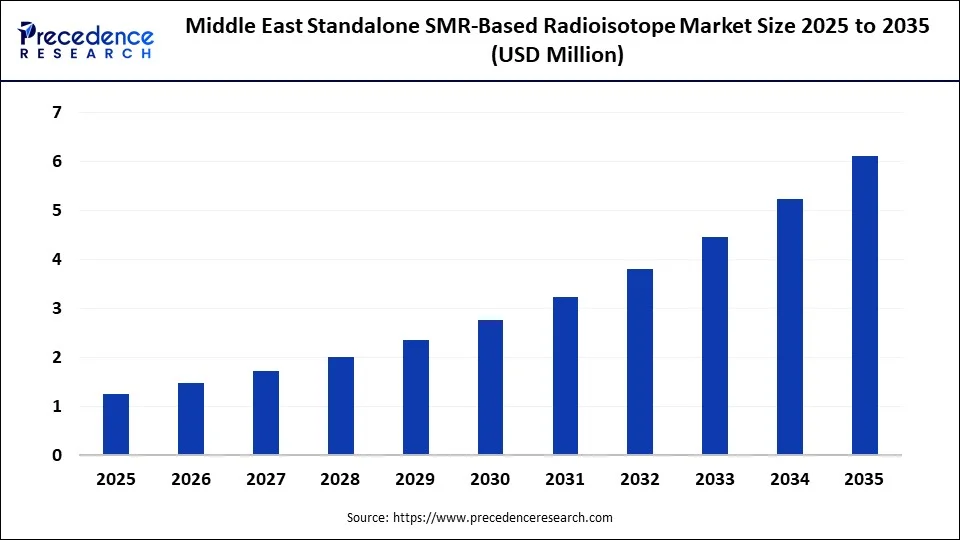
Key Takeaways
- Saudi Arabia accounted for the largest share of the market in 2025 due to its strong nuclear development initiatives and healthcare investments, while the United Arab Emirates is expected to register the fastest growth through 2035.
- By radioisotope, Molybdenum-99 (Mo-99) dominated the market in 2025 owing to its critical role in Technetium-99m production for nuclear diagnostic procedures, whereas Lutetium-177 (Lu-177) is anticipated to witness the fastest growth during the forecast period due to the expanding adoption of targeted radionuclide therapies and theranostic applications.
- By reactor type, Pressurized Water Reactor (PWR)-Based SMRs held the largest market share in 2025 owing to their advanced commercialization status and widespread global development activities. The Molten Salt Reactor (MSR)-Based SMRs segment is projected to grow at the fastest pace during the forecast period due to their potential advantages in medical isotope production, operational flexibility, and inherent safety characteristics.
- By application, Therapeutic Applications accounted for the largest market share in 2025, while Theranostic Applications are expected to witness the fastest growth due to the increasing clinical adoption of precision oncology and personalized nuclear medicine.
- By end user, Radiopharmaceutical Manufacturers dominated the market in 2025, whereas Research Institutes & Academic Organizations are expected to grow at the fastest rate owing to increasing investments in SMR research, isotope development, and commercialization programs.
Market Overview
The Middle East Standalone SMR-Based Radioisotope Market refers to the ecosystem involved in the production, processing, and commercial utilization of medical and industrial radioisotopes generated using dedicated Small Modular Reactors (SMRs) operating independently for isotope production. Unlike conventional large nuclear reactors, standalone SMRs are designed to provide flexible, scalable, and dedicated neutron irradiation capabilities for the efficient production of high-value radioisotopes used in nuclear medicine, cancer therapy, industrial applications, scientific research, and advanced manufacturing. Their compact design, enhanced safety systems, and modular deployment approach make them an emerging platform for ensuring a secure and sustainable supply of critical radioisotopes.
SMR-based radioisotopes such as Molybdenum-99 (Mo-99), Lutetium-177 (Lu-177), Iodine-131 (I-131), Cobalt-60 (Co-60), Iridium-192 (Ir-192), Actinium-225 (Ac-225), Yttrium-90 (Y-90), Holmium-166 (Ho-166), and Samarium-153 (Sm-153) are expected to play an increasingly important role in diagnostic imaging, targeted radionuclide therapy, brachytherapy, industrial irradiation, sterilization, and advanced scientific research. As global demand for therapeutic radioisotopes continues to increase, SMRs are gaining attention as a next-generation production platform capable of improving isotope availability while reducing dependence on aging conventional research reactors.
The Middle East is gradually emerging as a strategic region for future SMR deployment, supported by national nuclear development programs, healthcare modernization initiatives, and growing investments in nuclear medicine infrastructure. Countries including Saudi Arabia, the United Arab Emirates, Egypt, and Jordan are actively strengthening their nuclear capabilities through regulatory development, international collaborations, research partnerships, and long-term energy diversification strategies. As SMR technologies advance toward commercialization, the region is expected to create significant opportunities for localized radioisotope production, improved supply chain resilience, and enhanced access to advanced nuclear medicine throughout the forecast period.
Major Market Trends
Growing Interest in SMRs for Medical Radioisotope Security
Governments and nuclear technology developers are increasingly recognizing standalone SMRs as a long-term solution for securing a reliable supply of critical medical radioisotopes. Dedicated SMR-based production facilities are expected to reduce dependence on aging research reactors while improving production reliability and regional supply resilience.
Rising Demand for Therapeutic Radioisotopes
The rapid expansion of targeted radionuclide therapies and precision oncology is driving demand for therapeutic isotopes such as Lutetium-177, Actinium-225, Holmium-166, and Yttrium-90. This trend is expected to accelerate investments in advanced reactor technologies capable of supporting large-scale isotope production.
Increasing Government Support for Nuclear Infrastructure
Several Middle Eastern countries are strengthening their nuclear energy strategies through long-term government programs focused on healthcare modernization, energy diversification, and localization of strategic nuclear capabilities. These initiatives are expected to create a favorable environment for future SMR deployment and radioisotope production.
Advancements in Next-Generation SMR Technologies
Continuous innovation in reactor design, passive safety systems, digital instrumentation, modular construction, and fuel technologies is improving the commercial viability of standalone SMRs. These advancements are expected to enhance operational flexibility while supporting efficient production of a broad range of medical and industrial radioisotopes.
Expansion of International Partnerships and Nuclear Collaboration
Governments, reactor developers, research organizations, and healthcare institutions are increasingly establishing strategic collaborations to accelerate SMR commercialization, strengthen nuclear regulatory frameworks, and expand medical isotope production capabilities across the Middle East.
Market Report Coverage and Key Metrics
| Report Coverage | Details |
| Base Year | 2025 |
| Forecast Period | 2026-2035 |
| Market Covered | Middle East Standalone SMR-Based Radioisotope Market |
| Segments Covered | Radioisotope, Reactor Type, Application, End User, and Region |
| Countries Covered | Saudi Arabia, United Arab Emirates, Israel, Egypt, Jordan, Qatar, Kuwait, Oman, Bahrain, and Rest of Middle East |
Ecosystem & Value Chain Analysis
The Middle East standalone SMR-based radioisotope market operates through a highly specialized nuclear value chain that integrates reactor technology developers, nuclear fuel suppliers, engineering companies, radioisotope production facilities, radiopharmaceutical manufacturers, and healthcare providers. Unlike conventional radioisotope production, standalone SMRs are designed to function as dedicated neutron sources, enabling reliable, scalable, and long-term production of medical and industrial radioisotopes while improving regional supply security and reducing dependence on aging research reactors.
The report evaluates the complete industry ecosystem by assessing upstream nuclear fuel and reactor component suppliers, midstream SMR operators and radioisotope production facilities, and downstream radiopharmacies, hospitals, nuclear medicine centers, research organizations, and industrial end users. It further examines stakeholder relationships, value creation, distribution networks, and key supply chain constraints that are expected to influence future commercialization.
This section covers
This chapter provides a comprehensive assessment of the complete value chain supporting standalone SMR-based radioisotope production across the Middle East. It evaluates the roles of nuclear fuel suppliers, SMR technology developers, reactor operators, radioisotope manufacturers, logistics providers, and end users while analyzing stakeholder relationships, value creation, revenue distribution, and supply chain bottlenecks shaping the emerging industry.
What this section provides to clients
This chapter enables stakeholders to understand the complete commercial ecosystem supporting standalone SMR-based radioisotope production, identify strategic partnerships across the value chain, evaluate localization opportunities, assess supply chain risks, and develop long-term commercialization strategies.
Technology Landscape
Standalone Small Modular Reactors (SMRs) represent a new generation of nuclear reactor technology capable of supporting dedicated radioisotope production with enhanced operational flexibility, passive safety systems, modular construction, and scalable deployment. Unlike conventional large nuclear reactors, SMRs are expected to provide continuous neutron irradiation capabilities specifically suited for the production of high-value therapeutic and diagnostic radioisotopes. Continuous innovation in reactor design, fuel technologies, digital instrumentation, target handling systems, and waste management solutions is expected to significantly improve the commercial viability of SMR-based isotope production.
The report evaluates the evolving technology landscape by comparing reactor technologies, neutron irradiation methods, radioisotope production processes, fuel systems, safety technologies, digital control platforms, and emerging SMR concepts that are expected to influence future commercialization across the Middle East.
This section covers
This chapter analyzes the technological ecosystem supporting standalone SMR-based radioisotope production by evaluating reactor technologies, neutron irradiation methods, fuel technologies, target handling systems, passive safety features, digital instrumentation, waste management solutions, and emerging reactor concepts. It also benchmarks the technology readiness of leading SMR platforms currently under development.
What this section provides to clients
This chapter helps technology developers, investors, utilities, and healthcare organizations evaluate the maturity of various SMR technologies, compare reactor capabilities, assess commercialization readiness, identify future technology trends, and support strategic technology selection for radioisotope production projects.
Regulatory & Nuclear Licensing Landscape
The deployment of standalone SMRs for radioisotope production requires compliance with comprehensive nuclear regulatory frameworks governing reactor licensing, nuclear safety, radiation protection, radioactive material transportation, environmental protection, and medical isotope production. As Middle Eastern countries continue strengthening their civilian nuclear programs, regulatory authorities are progressively establishing licensing pathways that support future SMR deployment while maintaining international safety and non-proliferation standards.
The report provides a detailed assessment of the regional regulatory landscape by evaluating nuclear licensing procedures, reactor approval processes, radioisotope production regulations, radiation safety standards, transportation requirements, import-export regulations, and anticipated regulatory developments influencing future SMR commercialization.
This section covers
This chapter evaluates the regulatory and licensing environment governing standalone SMR deployment and radioisotope production across the Middle East. It analyzes country-level nuclear regulations, reactor licensing frameworks, safety requirements, radiation protection standards, transportation regulations, and future policy developments expected to shape commercialization of SMR-based isotope production.
What this section provides to clients
This chapter enables reactor developers, investors, utilities, and healthcare organizations to understand regional licensing requirements, evaluate regulatory readiness, identify compliance challenges, and assess the regulatory pathways necessary for successful deployment of standalone SMR-based radioisotope production facilities.
Government Policies & Nuclear Development Initiatives
Government policy is expected to play a pivotal role in the commercialization of standalone SMR-based radioisotope production across the Middle East. Several countries have incorporated nuclear energy into their long-term economic diversification strategies, recognizing its importance in strengthening energy security, supporting advanced healthcare infrastructure, and developing domestic capabilities in nuclear science and medical isotope production. National nuclear development programs, localization initiatives, and international cooperation agreements are expected to accelerate the deployment of next-generation reactor technologies across the region.
The report evaluates regional policy frameworks, national nuclear development strategies, public sector investments, localization initiatives, international collaborations, and government roadmaps that are expected to influence the future deployment of standalone SMRs and associated radioisotope production infrastructure.
This section covers
This chapter provides a comprehensive assessment of government policies supporting nuclear development and future SMR deployment across the Middle East. It analyzes national nuclear strategies, public investments, localization initiatives, international cooperation programs, medical isotope development policies, and long-term government roadmaps shaping the regional nuclear ecosystem.
What this section provides to clients
This chapter helps stakeholders understand policy-driven market opportunities, evaluate government support mechanisms, identify priority investment regions, assess localization strategies, and align future business plans with national nuclear development objectives.
Healthcare Infrastructure & Nuclear Medicine Readiness
The successful commercialization of standalone SMR-based radioisotope production will depend not only on reactor deployment but also on the maturity of the regional healthcare ecosystem. The expansion of nuclear medicine centers, PET-CT and SPECT imaging infrastructure, radiopharmacy networks, oncology treatment facilities, and skilled healthcare professionals will determine the future demand for domestically produced radioisotopes. As governments continue investing in healthcare modernization and precision medicine, nuclear medicine readiness is expected to become a key indicator of future market potential.
The report evaluates healthcare infrastructure across the Middle East by assessing nuclear medicine capabilities, oncology infrastructure, radiopharmacy networks, diagnostic imaging capacity, healthcare workforce availability, and country-level readiness for the adoption of SMR-produced medical radioisotopes.
This section covers
This chapter assesses the readiness of the regional healthcare ecosystem to support future adoption of SMR-produced radioisotopes. It evaluates healthcare infrastructure, nuclear medicine facilities, PET-CT and SPECT installations, radiopharmacy capabilities, oncology infrastructure, skilled workforce availability, and country-level preparedness for expanding nuclear medicine services.
What this section provides to clients
This chapter enables healthcare providers, reactor developers, investors, and policymakers to evaluate regional demand readiness, identify infrastructure gaps, prioritize future deployment markets, and assess long-term opportunities for integrating standalone SMR-based radioisotope production into the Middle East healthcare ecosystem.
Cancer Epidemiology & Disease Burden Analysis
The increasing burden of cancer across the Middle East is expected to be one of the key long-term drivers supporting the deployment of standalone SMR-based radioisotope production facilities. Rising incidences of breast, colorectal, prostate, lung, thyroid, and neuroendocrine cancers are accelerating demand for advanced nuclear medicine procedures, targeted radionuclide therapies, and therapeutic radioisotopes such as Lutetium-177, Iodine-131, Actinium-225, and Yttrium-90. As healthcare systems continue expanding precision oncology capabilities, ensuring a secure and sustainable domestic supply of medical radioisotopes is expected to become increasingly important.
The report provides a comprehensive assessment of the regional disease burden by evaluating cancer incidence, prevalence, mortality, country-level disease trends, eligible patient populations for nuclear medicine procedures, and the future demand outlook for therapeutic and diagnostic radioisotopes.
This section covers
This chapter evaluates the epidemiological landscape influencing future demand for SMR-produced radioisotopes across the Middle East. It analyzes country-wise disease burden, cancer incidence and prevalence, mortality trends, indication-wise patient populations, and the projected utilization of nuclear medicine and radionuclide therapies over the forecast period.
What this section provides to clients
This chapter enables healthcare providers, reactor developers, policymakers, and investors to quantify future market demand, identify high-priority therapeutic indications, evaluate country-level growth opportunities, and forecast radioisotope requirements based on evolving regional disease trends.
Production Landscape
The commercialization of standalone SMR-based radioisotope production is expected to transform the regional supply chain by enabling dedicated, continuous, and scalable production of high-value medical and industrial radioisotopes. Unlike conventional research reactors, standalone SMRs are designed to provide flexible neutron irradiation capacity while supporting localized isotope production and reducing dependence on imported radioisotopes. As several Middle Eastern countries continue advancing their nuclear development programs, planned SMR deployments are expected to significantly enhance future production capabilities and strengthen long-term supply security.
The report evaluates the regional production outlook by analyzing existing isotope production infrastructure, planned SMR deployment capacity, future production potential, country-wise production capability, supply-demand gaps, domestic production versus import dependence, and long-term commercialization prospects.
This section covers
This chapter provides a forward-looking assessment of standalone SMR-based radioisotope production across the Middle East by evaluating existing production infrastructure, planned reactor capacity, production potential, country-level deployment plans, capacity utilization, supply gaps, and future domestic production capabilities expected to emerge as SMRs progress toward commercialization.
What this section provides to clients
This chapter enables stakeholders to evaluate future production capabilities, identify supply shortages, benchmark planned reactor deployments, assess localization opportunities, estimate future production economics, and understand the long-term outlook for domestic radioisotope manufacturing across the region.
Trade Analysis
The Middle East currently relies heavily on international suppliers for several strategically important medical radioisotopes due to limited domestic production capacity. The deployment of standalone SMRs is expected to gradually reduce this dependence by enabling localized production of critical therapeutic and diagnostic isotopes. As domestic manufacturing capabilities expand, regional trade dynamics are anticipated to shift from import dependency toward improved self-sufficiency and enhanced intra-regional supply networks.
The report evaluates current and future trade patterns by assessing import and export trends, supply source diversification, country-level import dependency, cross-border distribution, trade risks, and the potential impact of future SMR deployment on regional radioisotope trade.
This section covers
This chapter analyzes the evolving trade landscape for medical radioisotopes across the Middle East by evaluating import and export patterns, trade flows, major supplier countries, import dependency, domestic production potential, supply chain resilience, and future changes in regional trade resulting from standalone SMR commercialization.
What this section provides to clients
This chapter helps clients understand current procurement challenges, evaluate future import substitution opportunities, identify regional supply hubs, assess trade risks, and develop long-term sourcing strategies aligned with the anticipated deployment of standalone SMR-based radioisotope production.
Standalone SMR Project Pipeline Analysis
The development pipeline for standalone SMRs represents one of the most critical indicators of the future commercial potential of SMR-based radioisotope production. Across the Middle East, governments, nuclear agencies, and technology developers are evaluating multiple SMR technologies through feasibility studies, licensing activities, international collaborations, and long-term deployment strategies. While commercial deployment remains at an early stage, the growing pipeline of planned projects is expected to create significant opportunities for future medical isotope production and nuclear infrastructure expansion.
The report provides a comprehensive assessment of regional project pipelines by analyzing country-level SMR developments, reactor technologies, project developers, commercialization timelines, development stages, and planned radioisotope production facilities.
This section covers
This chapter evaluates the regional pipeline of standalone SMR projects by assessing project announcements, feasibility studies, licensing activities, construction timelines, reactor technologies, project developers, commercialization schedules, and planned radioisotope production initiatives expected to shape the future market.
What this section provides to clients
This chapter enables investors, reactor developers, policymakers, and healthcare organizations to track future project opportunities, benchmark competing technologies, evaluate commercialization timelines, and identify high-potential markets for strategic investment and partnership.
SMR Deployment Readiness by Country
The successful deployment of standalone SMRs for radioisotope production will depend on each country's regulatory maturity, nuclear infrastructure, technical capabilities, skilled workforce, investment environment, and overall readiness to support commercial nuclear projects. While several Middle Eastern countries have established ambitious nuclear development programs, the level of preparedness varies significantly depending on policy frameworks, infrastructure availability, institutional capabilities, and long-term national strategies.
The report assesses the deployment readiness of key Middle Eastern countries through a comprehensive readiness framework covering regulatory preparedness, infrastructure maturity, technical capabilities, investment attractiveness, workforce availability, nuclear supply chain development, and commercial readiness.
This section covers
This chapter provides a comprehensive country-level readiness assessment for standalone SMR deployment by evaluating regulatory preparedness, infrastructure availability, technical capabilities, investment climate, workforce readiness, nuclear supply chain maturity, and overall commercialization potential across the Middle East.
What this section provides to clients
This chapter helps technology developers, investors, governments, and healthcare stakeholders identify the most attractive deployment markets, benchmark country-level readiness, prioritize investment opportunities, assess implementation risks, and develop phased market entry strategies for standalone SMR-based radioisotope production.
Investment & Funding Landscape
The commercialization of standalone SMR-based radioisotope production will require substantial long-term investments across reactor development, nuclear infrastructure, radioisotope processing facilities, regulatory preparedness, and healthcare integration. Governments across the Middle East are increasingly prioritizing nuclear energy diversification, advanced healthcare infrastructure, and localization of strategic industries, creating a favorable investment environment for future SMR deployment. At the same time, growing participation from international reactor developers, technology providers, institutional investors, and public-private partnerships is expected to accelerate commercialization of dedicated medical isotope production facilities.
The report evaluates regional investment trends by assessing government funding programs, private investments, foreign direct investments (FDI), strategic partnerships, joint ventures, public-private partnership (PPP) models, research funding, and country-level investment opportunities supporting future SMR deployment.
This section covers
This chapter provides a comprehensive assessment of the investment ecosystem supporting standalone SMR-based radioisotope production across the Middle East. It evaluates government funding programs, private capital investments, foreign direct investments, research funding initiatives, strategic partnerships, and country-level investment opportunities expected to drive future commercialization.
What this section provides to clients
This chapter enables investors, reactor developers, healthcare organizations, and policymakers to identify emerging investment opportunities, benchmark regional funding trends, evaluate government support mechanisms, and develop long-term investment strategies aligned with future SMR deployment.
Market Dynamics
Drivers
Increasing Demand for Secure Domestic Medical Radioisotope Production
The growing dependence on imported medical radioisotopes and the aging global fleet of research reactors are encouraging governments to explore alternative production technologies capable of ensuring long-term supply security. Standalone SMRs offer dedicated, scalable, and reliable radioisotope production capabilities, making them an attractive solution for strengthening domestic isotope availability while supporting expanding nuclear medicine and precision oncology programs across the Middle East.
Restraint
High Capital Investment and Lengthy Nuclear Licensing Process
The commercialization of standalone SMR-based radioisotope production requires significant capital investment in reactor construction, nuclear infrastructure, regulatory compliance, safety systems, and specialized workforce development. In addition, lengthy licensing procedures, evolving regulatory frameworks, and complex nuclear safety requirements are expected to increase project development timelines and create barriers to early commercialization.
Opportunity
Expansion of National Nuclear Programs and SMR Commercialization
The increasing adoption of long-term nuclear development strategies, combined with growing investments in healthcare modernization and localization of critical medical technologies, presents significant opportunities for standalone SMR-based radioisotope production. As reactor technologies continue advancing toward commercial deployment, the Middle East is expected to emerge as a strategic market for dedicated isotope production facilities serving both domestic and international demand.
Segment Insights
Radioisotope Insights
The Molybdenum-99 (Mo-99) Segment Dominated the Market in 2025
The Molybdenum-99 (Mo-99) segment accounted for the largest share of the Middle East standalone SMR-based radioisotope market in 2025 owing to its indispensable role in producing Technetium-99m (Tc-99m), the world's most widely utilized diagnostic radioisotope. Growing demand for nuclear imaging procedures, increasing healthcare investments, and the strategic importance of ensuring a secure domestic supply of Mo-99 are expected to sustain its market leadership throughout the forecast period.
Middle East Standalone SMR-Based Radioisotope Market Share, By Radioisotope, 2025 (%)
| Radioisotope | Market Share (2025) |
| Molybdenum-99 (Mo-99) | 34.80% |
| Iodine-131 (I-131) | 12.40% |
| Lutetium-177 (Lu-177) | 14.60% |
| Cobalt-60 (Co-60) | 9.10% |
| Iridium-192 (Ir-192) | 6.80% |
| Yttrium-90 (Y-90) | 5.70% |
| Holmium-166 (Ho-166) | 3.80% |
| Samarium-153 (Sm-153) | 2.90% |
| Phosphorus-32 (P-32) | 2.10% |
| Rhenium-188 (Re-188) | 2.40% |
| Actinium-225 (Ac-225) | 2.30% |
| Other SMR-Produced Radioisotopes | 3.10% |
The Lutetium-177 (Lu-177) segment is anticipated to register the fastest growth during the forecast period due to the rapid expansion of targeted radionuclide therapies, increasing adoption of precision oncology, and rising commercialization of theranostic radiopharmaceuticals. The growing demand for No-Carrier-Added (NCA) Lu-177 is further expected to accelerate future production through standalone SMR platforms.
Reactor Type Insights
The Pressurized Water Reactor (PWR)-Based SMRs Segment Held the Largest Market Share in 2025
The Pressurized Water Reactor (PWR)-Based SMRs segment dominated the market in 2025 owing to their relatively advanced technology maturity, ongoing commercialization efforts, and extensive global development pipeline. Their proven reactor design established regulatory familiarity, and suitability for continuous isotope production make them the leading technology platform for future deployment.
Middle East Standalone SMR-Based Radioisotope Market Share, By Reactor Type, 2025 (%)
| Reactor Type | Market Share (2025) |
| Pressurized Water Reactor (PWR)-Based SMRs | 39.50% |
| Heavy Water Reactor (HWR)-Based SMRs | 15.80% |
| High-Temperature Gas-Cooled Reactor (HTGR)-Based SMRs | 11.90% |
| Molten Salt Reactor (MSR)-Based SMRs | 10.80% |
| Fast Neutron Reactor (FNR)-Based SMRs | 7.20% |
| Lead-Cooled Fast Reactor (LFR)-Based SMRs | 5.40% |
| Sodium-Cooled Fast Reactor (SFR)-Based SMRs | 6.10% |
| Microreactor-Based Systems | 3.30% |
The Molten Salt Reactor (MSR)-Based SMRs segment is projected to witness the fastest growth during the forecast period due to its inherent passive safety features, operational flexibility, high neutron economy, and strong potential for efficient radioisotope production.
Application Insights
The Therapeutic Applications Segment Dominated the Market in 2025
The Therapeutic Applications segment held the largest market share in 2025 due to the increasing clinical adoption of radionuclide therapies for cancer treatment and the growing demand for therapeutic isotopes such as Lutetium-177, Iodine-131, Holmium-166, and Actinium-225. Expanding precision medicine initiatives and advancements in targeted cancer therapies are expected to continue driving this segment.
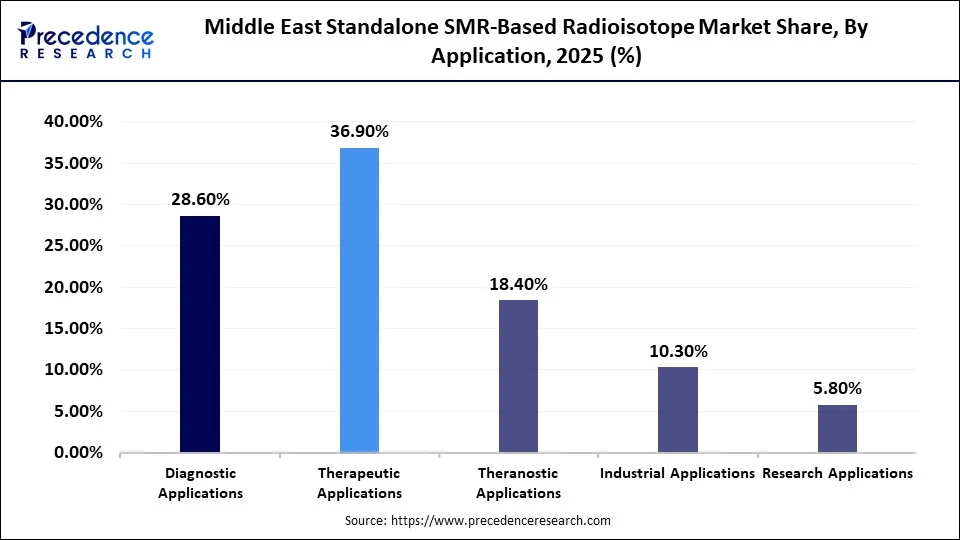
The Theranostic Applications segment is expected to grow at the fastest rate during the forecast period owing to increasing integration of diagnostic imaging with targeted radionuclide therapy, enabling personalized treatment planning and improved clinical outcomes.
End User Insights
The Radiopharmaceutical Manufacturers Segment Dominated the Market in 2025
The Radiopharmaceutical Manufacturers segment accounted for the largest market share in 2025 as these organizations are expected to be the primary commercial users of SMR-produced medical radioisotopes for the development and manufacturing of diagnostic and therapeutic radiopharmaceuticals.
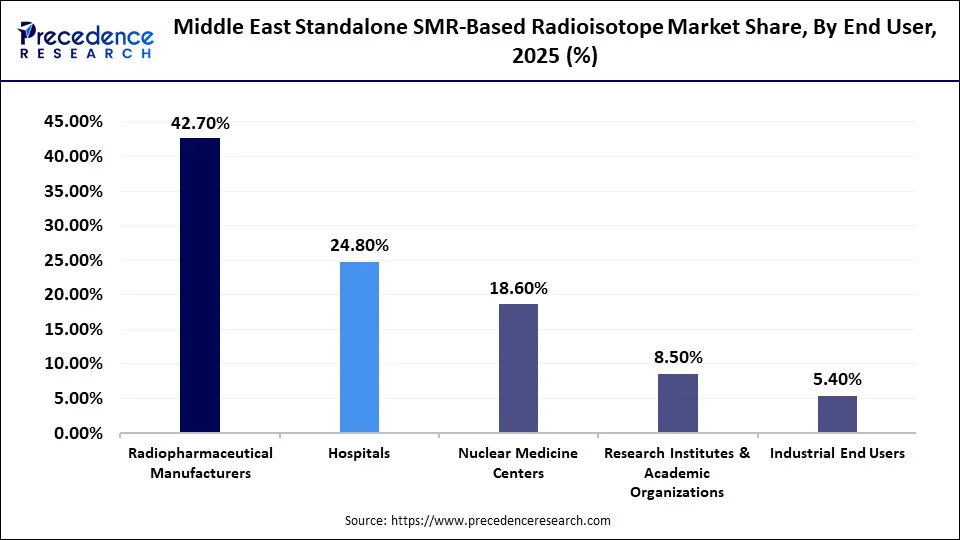
The Research Institutes & Academic Organizations segment is projected to witness the fastest growth during the forecast period owing to increasing investments in SMR research, isotope development programs, nuclear technology innovation, and collaborative commercialization initiatives.
Country Level Insights
Saudi Arabia
Saudi Arabia dominated the Middle East standalone SMR-based radioisotope market in 2025 owing to its ambitious nuclear development strategy, strong government commitment toward economic diversification under Vision 2030, increasing investments in healthcare modernization, and ongoing initiatives to establish advanced nuclear infrastructure. The country's long-term focus on domestic nuclear capabilities and medical isotope security positions it as the leading future market for standalone SMR deployment.
What Makes the United Arab Emirates the Fastest-Growing Market?
The United Arab Emirates is anticipated to witness the fastest growth during the forecast period due to its progressive nuclear energy program, well-established regulatory framework, advanced healthcare infrastructure, and strong commitment to innovation in nuclear technologies. Continued investments in nuclear medicine, research collaborations, and future SMR deployment initiatives are expected to strengthen the country's position within the regional market.
Israel Market Analysis
Israel possesses a highly advanced nuclear research ecosystem, internationally recognized scientific expertise, and a mature radiopharmaceutical research environment. Continuous innovation in nuclear medicine, isotope research, and reactor technologies is expected to position the country as a key contributor to future SMR-enabled radioisotope production and technology development.
Egypt Market Analysis
Egypt is expected to emerge as an important future market due to ongoing nuclear infrastructure development, expansion of healthcare services, and increasing investments in oncology and nuclear medicine. The country's long-term nuclear energy roadmap is anticipated to create opportunities for future deployment of standalone SMRs supporting domestic radioisotope production.
Rest of Middle East
Countries including Jordan, Qatar, Kuwait, Oman, and Bahrain are gradually strengthening their nuclear regulatory frameworks, healthcare infrastructure, and nuclear medicine capabilities. Although commercial SMR deployment remains at an early stage, increasing government interest in advanced nuclear technologies and regional collaboration is expected to support future market development.
Competitive Landscape
The competitive landscape of the Middle East standalone SMR-based radioisotope market is currently characterized by emerging reactor technology developers, nuclear engineering companies, and research organizations actively advancing next-generation SMR technologies for future medical isotope production. Competition is primarily centered around reactor technology innovation, commercialization readiness, licensing progress, strategic partnerships, and project development rather than commercial production volumes. As SMR deployment progresses, technology differentiation, regulatory approvals, and first-mover advantages are expected to become key competitive factors shaping the regional market.
The report provides a comprehensive competitive assessment by benchmarking SMR developers based on reactor technology, commercialization status, radioisotope production capabilities, strategic collaborations, project pipeline, and long-term technology roadmaps. It also evaluates competitive positioning and future market leadership across the emerging SMR ecosystem.
This section covers
This chapter evaluates the competitive landscape by comparing leading SMR technology developers based on reactor technology, commercialization progress, project pipeline, licensing activities, radioisotope production capabilities, strategic partnerships, and future development roadmaps. It also benchmarks technology maturity and competitive positioning across the emerging market.
What this section provides to clients
This chapter enables stakeholders to benchmark competing reactor technologies, evaluate technology leadership, identify strategic collaboration opportunities, monitor commercialization progress, and assess the future competitive outlook of the standalone SMR-based radioisotope industry.
Company Landscape
The Middle East standalone SMR-based radioisotope market is currently in the early stages of commercialization and is characterized by a limited number of specialized reactor technology developers actively pursuing dedicated SMR platforms for future medical radioisotope production. Competition is centered on reactor innovation, technology readiness, licensing progress, strategic collaborations, demonstration projects, and commercialization roadmaps rather than current production capacity or market share. Companies are increasingly collaborating with governments, research organizations, healthcare institutions, and nuclear agencies to accelerate technology validation and future deployment.
The report provides detailed company profiles covering reactor technology portfolios, technology readiness levels (TRLs), target radioisotopes, commercialization strategies, project pipelines, strategic collaborations, regulatory progress, and long-term expansion plans, enabling stakeholders to benchmark emerging SMR developers and assess their future market potential.
Company Profiles Covered
- Company 1
- Company 2
- Company 3
- Company 4
- Other Emerging Companies
Recent Developments
- May 2025: The Emirates Nuclear Energy Company (ENEC) and GE Vernova Hitachi Nuclear Energy signed a Memorandum of Understanding (MoU) to jointly evaluate the global deployment of the BWRX-300 Small Modular Reactor (SMR) technology under ENEC's ADVANCE Program, strengthening the UAE's role in advanced nuclear technologies.
- February 2025: ENEC signed a strategic cooperation agreement with newcleo to explore the deployment of Lead-Cooled Fast Reactor (LFR) technology for future nuclear projects across Europe and the Middle East, supporting the advancement of next-generation SMR technologies in the region.
- July 2025: ENEC and Samsung C&T Corporation signed a Memorandum of Understanding to collaborate on advanced nuclear energy projects, including the future deployment of Small Modular Reactors (SMRs), reinforcing the UAE's long-term strategy for advanced nuclear infrastructure development.
- January 2025: Egypt's Nuclear Power Plants Authority (NPPA) received regulatory approval to construct the spent nuclear fuel storage facility for the El Dabaa Nuclear Power Plant, marking another key milestone in the country's nuclear infrastructure development and future nuclear technology ecosystem.
- November 2025: Egypt and Rosatom signed a new cooperation program during the El Dabaa Nuclear Power Plant project, expanding collaboration beyond power generation to include medical radioisotopes, nuclear technologies, and technical applications, strengthening Egypt's long-term capabilities in peaceful nuclear technologies.
Segments Covered in the Report
By Radioisotope
- Molybdenum-99 (Mo-99)
- Fission-Based Mo-99
- Non-HEU Mo-99
- Iodine-131 (I-131)
- Lutetium-177 (Lu-177)
- Carrier-Added (CA) Lu-177
- No-Carrier-Added (NCA) Lu-177
- Cobalt-60 (Co-60)
- Iridium-192 (Ir-192)
- Yttrium-90 (Y-90)
- Holmium-166 (Ho-166)
- Samarium-153 (Sm-153)
- Phosphorus-32 (P-32)
- Rhenium-188 (Re-188)
- Actinium-225 (Ac-225)
- Other SMR-Produced Radioisotopes
By Reactor Type
- Pressurized Water Reactor (PWR)-Based SMRs
- Heavy Water Reactor (HWR)-Based SMRs
- High-Temperature Gas-Cooled Reactor (HTGR)-Based SMRs
- Molten Salt Reactor (MSR)-Based SMRs
- Fast Neutron Reactor (FNR)-Based SMRs
- Lead-Cooled Fast Reactor (LFR)-Based SMRs
- Sodium-Cooled Fast Reactor (SFR)-Based SMRs
- Microreactor-Based Systems
By Application
- Diagnostic Applications
- Nuclear Imaging
- Diagnostic Radiopharmaceutical Manufacturing
- Therapeutic Applications
- Targeted Radionuclide Therapy
- Brachytherapy
- External Beam Radiotherapy Source Production
- Theranostic Applications
- Industrial Applications
- Industrial Radiography
- Sterilization
- Industrial Irradiation
- Research Applications
By End User
- Radiopharmaceutical Manufacturers
- Hospitals
- Nuclear Medicine Centers
- Research Institutes & Academic Organizations
- Industrial End Users
By Country
- Saudi Arabia
- United Arab Emirates
- Israel
- Egypt
- Jordan
- Qatar
- Kuwait
- Oman
- Bahrain
- Rest of Middle East
For inquiries regarding discounts, bulk purchases, or customization requests, please contact us at sales@precedenceresearch.com
Frequently Asked Questions





Ask For Sample
No cookie-cutter, only authentic analysis – take the 1st step to become a Precedence Research client
 Get a Sample




 sales@precedenceresearch.com
 Schedule a Meeting
