



Multi-Cloud Computing Market Trends, Companies, Revenue / Sales Performance, Subscriber Growth, Pricing Strategies, Cloud Adoption, Infrastructure Expansion, Competitive Landscape, and Industry Outlook
Multi-Cloud Computing Market (By Deployment Type: Public Cloud, Private Cloud, Hybrid cloud; By Component: Cloud Services, Cloud Management Tools, Cloud Security Solutions; By Model: Infrastructure-as-a-Service, Platform-as-a-Service, Software-as-a-Service; By End-user: Small and Medium Enterprises, Large Enterprises, Government) - Global Industry Analysis, Size, Trends, Leading Companies, Regional Outlook, and Forecast 2026 to 2035
Source: https://www.precedenceresearch.com/multi-cloud-computing-market
 Get a Sample
 Table Of Content


What is the Multi-Cloud Computing Market Size in 2026?
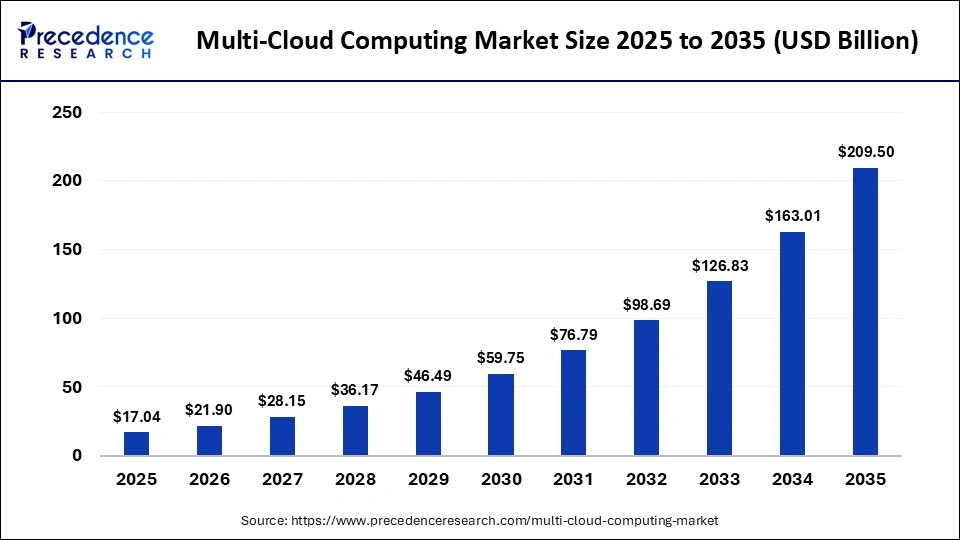
The global multi-cloud computing market size was calculated at USD 17.04 billion in 2025 and is predicted to increase from USD 21.90 billion in 2026 to approximately USD 209.50 billion by 2035, expanding at a CAGR of 28.52% from 2026 to 2035. The market is expanding rapidly as organizations seek greater operational flexibility, improved cost efficiency, and reduced dependency risk by leveraging multiple cloud service providers.
Key Takeaways
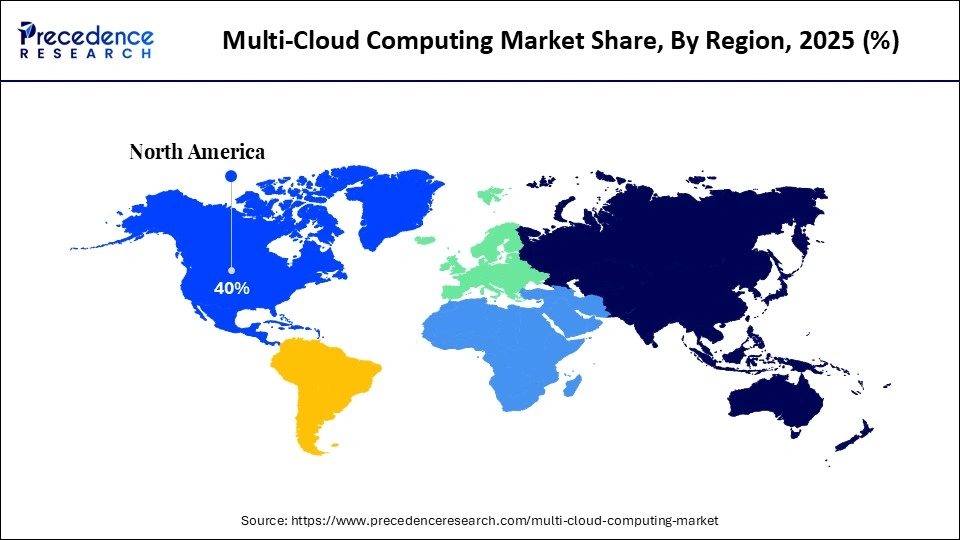
- North America dominated the market with the largest share of 40% in 2025.
- Asia Pacific is expected to grow at the fastest CAGR during the forecast period.
- By deployment type, the hybrid cloud segment dominated the market with the largest share in 2025.
- By deployment type, the private cloud segment is expected to grow at a significant CAGR during the forecast period.
- By component, the cloud services segment dominated the market with the largest share in 2025.
- By component, the cloud management tools segment is expected to grow at the fastest CAGR during the forecast period.
- By service model, the software-as-a-service segment dominated the market with the largest share in 2025.
- By service model, the infrastructure-as-a-service segment is expected to grow at the fastest CAGR during the forecast period.
- By end-user, the large enterprises segment dominated the market with the highest CAGR in 2025.
- By end-user, the small and medium enterprises segment is expected to grow at the fastest CAGR during the forecast period.
What is the Multi-cloud Computing Market?
Multi-cloud computing refers to the strategic adoption of services from two or more public or private cloud providers within a single operational framework to achieve business objectives. Organizations implement this model to minimize vendor dependency, strengthen negotiation leverage, improve system reliability through distributed workloads, and enhance cost efficiency by selecting the most suitable environment for each application. Complementing this approach, multi-cloud networking enables integration of separate cloud environments into a unified and well-coordinated infrastructure.
Through specialized networking technologies and services, enterprises can establish seamless connectivity, streamline management, and achieve consistent performance across cloud platforms.
This supports organizations of varying sizes and is widely adopted across industries, including IT and IT-enabled services, banking, and financial services, insurance, retail, e-commerce, healthcare and life sciences, transportation and logistics, manufacturing, media and entertainment, and energy and utilities.
How is Artificial Intelligence Impacting the Multi-Cloud Computing Market?
Artificial intelligence (AI) is emerging as a transformative force in multi-cloud computing, enabling smarter data-driven control over complex cloud ecosystems. By leveraging machine learning and advanced analytics, AI strengthens security through proactive threat identification and anomaly detection, with a dominant incident response. It enhances visibility across distributed environments by consolidating insights into intelligent monitoring platforms that support faster, more informed decision-making.
AI can optimize workload placements beyond security by analyzing performance patterns, cost, and usage trends. It can recommend or automatically execute efficient resource allocation. This technology helps predict analytics that anticipate system failures and capacity constraints. There was reduced downtime and improved service reliability. AI-driven automation also functions as configuration management, provisioning, and compliance monitoring, which allows teams to focus on strategy initiatives and improve overall operational efficiency.
Multi-Cloud Computing Market Trends
- Growing adoption of multi-cloud strategies: Organizations are increasingly implementing multi-cloud models to enhance resilience, scalability, and operational control of these services. From multiple providers, businesses can be operated optimally, maintain compliance, and reduce dependency risks.
- Sustainability focus: Enterprises are incorporating sustainability goals into their cloud strategies by prioritizing energy efficiency, reducing electronic waste, and improving hardware lifecycle management with alignment of multi-cloud operations with ESG objectives.
- Startup ecosystem influence: Startups are driving innovation in areas such as cloud security, regulatory compliance, containerization, and application portability. Growth in digital commerce and direct-to-consumer platforms is further accelerating cloud adoption.
- Acceleration of digital transformation: Rapid modernization initiatives are pushing organizations, startups, and enterprises towards cloud-based solutions to improve agility, streamline operations, and enhance competitiveness, increasing demand for efficient multi-cloud computing platforms.
- Security and risk management requirements: With sensitive data distributed across multiple platforms, organizations are prioritizing robust security frameworks, encryption governance, compliance monitoring, and advanced identity and access management (IAM). Strong risk mitigation strategies are essential amid tightening regulatory standards.
- Expansion of edge computing and IoT: There is a rapid growth of edge computing and IoT devices, generating vast amounts of distributed data that must be processed in real time. Multi-cloud platforms are needed to enable seamless integration between edge environments and central cloud systems, creating new growth opportunities. This trend is particularly significant in industrial IoT, autonomous vehicles, and Smart City applications.
Market Scope
| Report Coverage | Details |
| Market Size in 2025 | USD 17.04 Billion |
| Market Size in 2026 | USD 21.90 Billion |
| Market Size by 2035 | USD 209.50 Billion |
| Market Growth Rate from 2026 to 2035 | CAGR of 28.52% |
| Dominating Region | North America |
| Fastest Growing Region | Asia Pacific |
| Base Year | 2025 |
| Forecast Period | 2026 to 2035 |
| Segments Covered | Deployment Type, Component, Model, End-user, and Region |
| Regions Covered | North America, Europe, Asia-Pacific, Latin America, and Middle East & Africa |
Market Dynamics
Driver
Growing Need to Avoid Vendor Lock-In
Multi-cloud computing refers to an approach where businesses utilize multiple clouds as opposed to relying on just one cloud infrastructure. Multi-cloud systems bring about more flexibility and ensure that the workload is evenly distributed, hence leading to business continuity. In such a system, businesses choose services depending on their performance, cost-effectiveness, and particular business needs.
Restraint
Complexity in Cloud Management and Integration
Multi-platform cloud management results in more complications for businesses. There might be difficulties connected with workload migration, application management, and monitoring across various cloud platforms as well as security management. There is a necessity of hiring qualified experts and investing in specialized management software which leads to increased operational expenses. This problem prevents rapid multi-cloud adoption, especially in the case of SMEs.
Opportunity
Rising Adoption of AI, Big Data, and Hybrid Cloud Solutions
Increasing use of artificial intelligence, machine learning, big data analytics, and hybrid clouds is providing many opportunities for the multi-cloud computing market. Companies are investing in multi-cloud systems for supporting their data-intensive applications and achieving scalability. Growing instances of digital transformation across different industry verticals have resulted in increased adoption of cloud computing. This development will present great business opportunities for cloud service providers and technology vendors.
Segment Insights
Deployment Type Insights
Why Did the Hybrid Cloud Segment Dominate the Multi-Cloud Computing Market?
The hybrid cloud segment dominated the market while holding the largest share in 2025. The dominance of the segment is attributed to the increasing use of integrated cloud solutions that combine both public and private platforms. Hybrid cloud offers advantages such as better cost, improved scalability, enhanced operational flexibility, and security management. Additionally, hybrid cloud supports regulatory compliance, disaster recovery, and seamless workload management, making it the preferred choice for enterprises seeking robust multi-cloud strategies.
The private cloud segment is expected to grow at the fastest rate in the coming years. This is because it offers enhanced security, control, and compliance, which are critical for enterprises handling sensitive data. Organizations prefer private clouds to customize infrastructure, optimize performance, and meet strict regulatory requirements while still integrating with public clouds for scalability.
The public cloud is expected to grow at a notable rate, mainly due to the increasing demand for secure, scalable, and cost-effective cloud solutions. Businesses are adopting public cloud services to support digital transformation and manage growing data storage needs across major economies. A rising preference for multi-cloud strategies, which help organizations maintain flexibility and reduce vendor dependencies, is expected to support segmental growth.
Component Insights
What Made Cloud Services the Dominant Segment in the Multi-Cloud Computing Market?
The cloud services segment dominated the market in 2025 because it provides scalable, on-demand resources that enable organizations to deploy, manage, and optimize applications across multiple cloud environments efficiently. Cloud services, including IaaS, PaaS, and SaaS, offer cost-effectiveness, operational flexibility, and faster time-to-market, allowing businesses to focus on core activities rather than infrastructure management. Furthermore, the increasing adoption of digital transformation initiatives and remote work solutions has fueled demand for cloud services, making them the leading component in multi-cloud strategies.
The cloud management tools segment is expected to grow at the fastest CAGR in the market because organizations face increasing complexity when managing multiple cloud environments. These tools provide centralized monitoring, governance, cost optimization, and security management, enabling enterprises to efficiently control workloads across public, private, and hybrid clouds. Additionally, the rising adoption of multi-cloud strategies and the need for automation, compliance, and performance optimization are driving demand for advanced cloud management solutions.
Service Model Insights
Why Did the Software-as-a-Service Segment Lead the Market?
The software-as-a-service segment led the multi-cloud computing market in 2025 because it offers ready-to-use applications that can be accessed from anywhere, reducing the need for on-premises infrastructure and IT management. SaaS provides scalability, cost-effectiveness, and rapid deployment, making it ideal for organizations seeking flexible solutions across multiple cloud environments. Additionally, the growing adoption of remote work, digital collaboration, and enterprise software solutions has further strengthened SaaS dominance in the market.
The infrastructure-as-a-service segment expected to grow at the highest CAGR in the upcoming period because it provides flexible, scalable, and on-demand computing resources that allow organizations to run workloads without investing in physical infrastructure. IaaS enables businesses to quickly deploy applications, optimize costs, and manage high-volume or variable workloads across multiple cloud environments. Additionally, increasing adoption of digital transformation initiatives, big data analytics, and enterprise IT modernization is driving strong demand for IaaS solutions.
End-user Insights
Why Did the Large Enterprises Segment Dominate the Multi-Cloud Computing Market?
The large enterprises segment dominated the market in 2025 due to their advanced IT systems and strong financial capabilities. These organizations typically operate across multiple cloud platforms to improve scalability, avoid vendor lock-in, and ensure business continuity. They also invest heavily in multi-cloud solutions to meet strict regulatory and security requirements. Large enterprises are early adopters of advanced technologies, including AI-driven tools that optimize the migration process and resource management. This continues to drive sustained growth and innovation in the multi-cloud computing market.
The small and medium enterprises segment is expected to expand at the fastest CAGR over the forecast period, mainly due to their increasing focus on agility and digital competitiveness. As cloud technologies become more accessible, SMEs are finding it easier to adopt multi-cloud strategies without heavy infrastructure and investments. The SaaS platforms and managed services now give smaller IT teams access to access enterprise grade tools and make cloud governance and management much simpler.
Regional Analysis
North America Multi-Cloud Computing Market Size and Growth 2026 to 2035
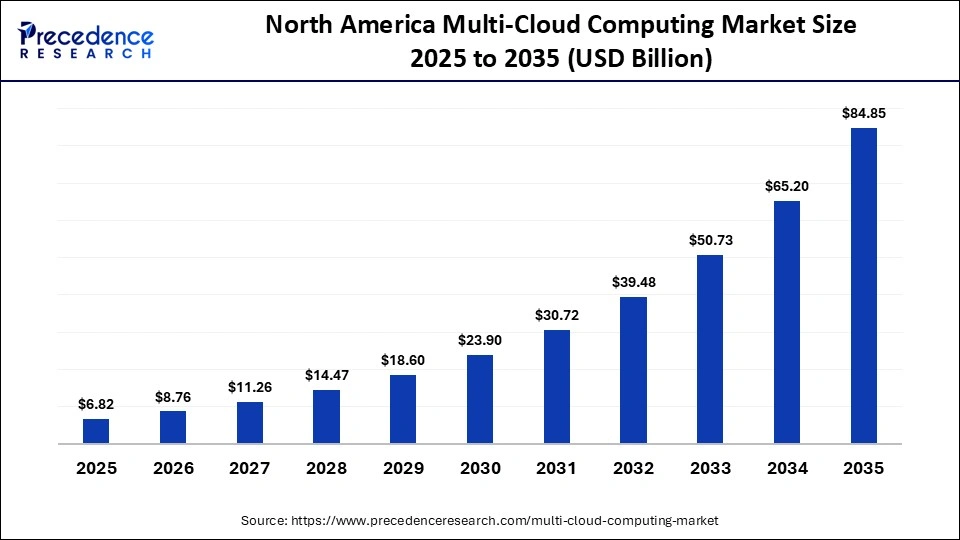
The North America multi-cloud computing market size is estimated at USD 6.82 billion in 2025 and is projected to reach approximately USD 209.50 billion by 2035, with a 28.67% CAGR from 2026 to 2035.
What Made North America the Dominant Region in the Multi-Cloud Computing Market?
North America dominated the multi-cloud computing market, holding the highest share in 2025. This region's dominance is mainly driven by its mature cloud infrastructure and early adoption of advanced technologies such as AI, IoT, blockchain, and automation. The strong presence of major cloud providers and technology innovators such as Google and Microsoft continues to accelerate enterprise cloud adoption across industries. Businesses in North America heavily invest in hybrid and multi-cloud platforms to drive innovation, improve efficiency, and strengthen service delivery. In addition, data sovereignty regulations in the U.S. and Canada are expanding cross-border digital operations, further supporting regional market growth.
U.S. Multi-Cloud Computing Market Size and Growth 2026 to 2035
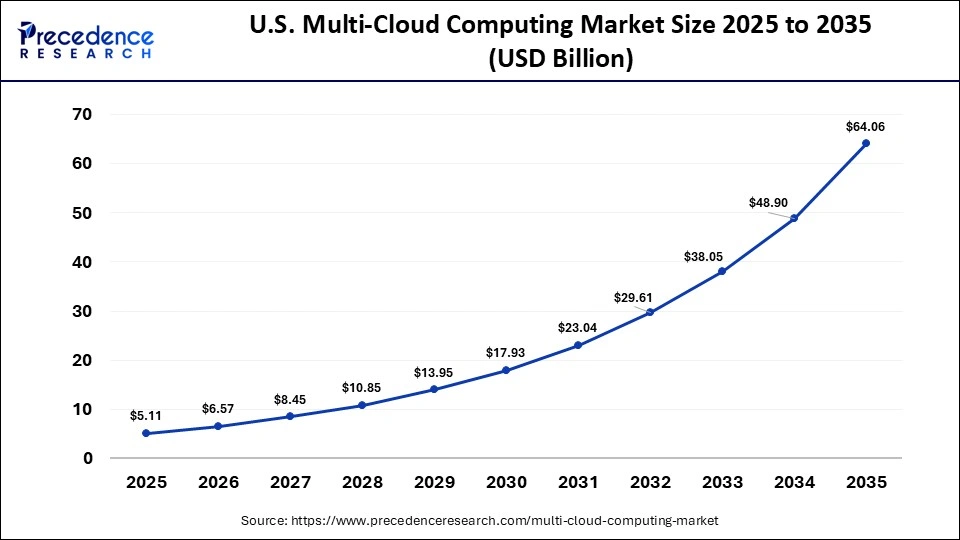
The U.S. multi-cloud computing market size is calculated at USD 5.11 billion in 2025 and is expected to reach nearly USD 64.06 billion in 2035, accelerating at a strong CAGR of 28.77% between 2026 and 2035.
U.S. Market Trends
U.S. dominates the North American multi-cloud computing market. The country's focus on cost optimization and AI-driven automation continues to fuel multi-cloud adoption. The area implements multi-cloud strategies to achieve unified management, reduce vendor dependency, and maintain regulatory compliance. The rising deployment of hybrid cloud models, along with containerization technologies such as Kubernetes, strengthens cloud modernization efforts. Key industries such as financial services, media, and technology have built well-structured multi-cloud ecosystems backed by skilled talent and strong digital connectivity.
Why is Asia Pacific Considered the Fastest-Growing Region in the Multi-Cloud Computing Market?
Asia Pacific is emerging as the fastest-growing region in the multi-cloud computing market, driven by rapid digital transformation and expanding IT infrastructure. Businesses across the region are increasingly adopting cloud technologies to improve scalability, agility, and competitiveness. Strong growth of startups and SMEs, along with rising enterprise cloud migration, is accelerating demand. In addition, government initiatives promote digital economies, smart infrastructure, and advanced technologies such as AI and IoT. As organizations modernize their operations, there is a need for secure, scalable, and regionally compliant multi-cloud strategies, contributing to the growth of the market.
India Market Analysis
India is one of the emerging markets within Asia Pacific. The country's large-scale digital transformation programs and expansion of digital public infrastructure are pushing both government and private enterprises toward cloud adoption. Growing Internet penetration, a booming startup ecosystem, and rapid enterprise modernization are key growth drivers. With strong growth in Fintech, e-commerce, telecom, and AI-driven applications, India continues to create significant demand for secure and scalable multi-cloud platforms.
China Market Analysis
China is one of the major contributors to the Asia Pacific multi-cloud computing market, supported by accelerated enterprise digitalization and evolving regulatory requirements. There is high demand for low-latency processing and distributed cloud infrastructure across industries such as manufacturing, telecom, and IT. Businesses are investing heavily in cloud-native technology and IoT ecosystems. As digital transformation advances across sectors, China remains one of the key high-growth markets in the global multi-cloud landscape.
How is Europe Growing in the Multi-Cloud Computing Market?
Europe is considered to be a significantly growing area, due to data sovereignty, cybersecurity, and regulatory compliance. Multi-cloud systems allow organizations to store sensitive data in geographically dispersed infrastructures while providing organizations with operational flexibility through local infrastructures. In 2026, AWS introduced its European Sovereign Cloud initiative as a means of supporting EU compliance. Continued growth of the regional market is being supported by strong digital transformation initiatives and the growing adoption of AI.
Germany Market Trends
Germany ranks first in Europe due to its leading position in the rapid digitalization of industry and high levels of enterprise-level cloud usage. German companies are deploying multi-cloud infrastructures to support their Industry 4.0 operations and AI analytics, and to enable secure production systems. In 2026, AWS increased its investment in its EU Sovereign Cloud operations in Germany to enable secure cloud infrastructure for enterprise and government customers who require data protection standards that are substantially more secure than those of Ireland and other EU countries.
Will the Middle East and Africa Grow in the Multi-Cloud Computing Market?
The Middle East and Africa region is expected to grow at a notable CAGR in the foreseeable future, due to increased government digital transformation initiatives, smart city programs, and the increasing investments in AI infrastructures. Companies have begun to adopt multi-cloud environments to enhance their data protection, scalability, and compliance with regional legislation. Large cloud service providers (CSPs) such as Microsoft, AWS, Google Cloud, and Oracle are simultaneously working to expand their data centers in the region and build new sovereign cloud offerings across the region.
Saudi Arabia Market Trends
Saudi Arabia has emerged as the leader among countries in the region, a position driven largely by significant government investment in digital transformation initiatives as part of Vision 2030. Major CSPs such as AWS, Google Cloud, Oracle, and Microsoft are investing considerable resources to expand cloud and AI infrastructure in Saudi Arabia. Banks, telecommunications, healthcare, and energy sectors have begun to implement multi-cloud architectures in order to provide digital services and AI operations to their customers more effectively.
Which Factors Drive the Multi-Cloud Computing Market in Latin America?
Latin America is expected to grow at a considerable CAGR in the upcoming period, driven by an increase in funding for cloud infrastructure, growing internet penetration, and increasing transition from businesses to a digital enterprise. In addition, corporations located in Latin America are making investments into multi-cloud adoption as a way to enhance their operational continuity and support new ways to deliver digital banking, retail, and telecommunications services.
Brazil
Brazil is emerging as the leader within the LATAM market because of its large-scale implementations of cloud-based financial services, e-commerce platforms, and hybrid and fully digital enterprise systems. Brazil has several cloud regions maintained by AWS, Microsoft Azure, Google Cloud, and Oracle Cloud. The increase in startups in Brazil and an increase in the need for high-quality, secure/cloud to house data have also contributed to the development of this new multi-cloud industry.
Competitive Landscape
Multi-Cloud Computing Industry is semi-consolidated, having competition among cloud computing providers, software firms, and managed services. The major players in this industry are Amazon Web Services, Microsoft, Google Cloud, IBM, and Oracle. They have been maintaining their strong presence in the market due to large-scale cloud offerings and partnerships. Organizations concentrate on mergers and acquisitions, alliances, product launches, and research & development activities. Innovations in the AI-based cloud management, automation, cybersecurity, and workloads are the key innovations. Heavy investment in infrastructure, high compliance standards, security issues, and technical complexities constitute the market entry barriers.
Multi-Cloud Computing Market Companies
- Flexera Software LLC
- CloudBolt Software Inc.
- Citrix Systems Inc.
- CoreStack Inc.
- Dell Technologies Inc.
- VMware Inc.
- Oracle Corp.
- Juniper Networks Inc.
- Cloudflare Inc.
- Nutanix Inc.
- Microsoft Corp. (Azure Arc)
- Amazon Web Services Inc.
- Google Cloud Platform
- IBM Corp. (Turbonomic)
- Cisco Systems Inc.
- HashiCorp Inc.
- Platform9 Systems
Recent Developments
- In April 2026, Oracle launced Cloud region for Casablanca, Morocco, is now available for the use of Artificial Intelligence, cloud computing, and digital transformation. The camapny expanded multi-cloud ecosystem by offering local enterprises safe cloud computing services, artificial intelligence features, and better data sovereignty solutions. (Source: https://techafricanews.com)
- In October 2025, The Oracle launced its Multicloud Services Reseller Program and Multicloud Universal Credits were unveiled by Oracle Corporation, giving the partners the ability to offer Oracle Database services on multiple clouds including AWS, Microsoft Azure, and Google Cloud. (Source: https://www.crn.com)
- In December 2025, Amazon Web Services (AWS) and Google Cloud jointly introduced a first-of-its-kind multi-cloud networking service, which enables enterprises to establish private high-speed connectivity between AWS and Google Cloud in simplifying multi- cloud connectivity and improving performance and reliability. This collaboration combines AWS Interconnect, multi-cloud, and Google Cloud's Cross-Cloud Intercell, making a major step towards Seamless Multi-cloud Networking.
- In July 2025, Hewlett Packard Enterprise (HPE) completed its acquisition of Juniper Networks, significantly expanding its networking portfolio and positioning the combined entity to deliver enhanced cloud native AI driven network solutions that support hybrid and multi-cloud environments.
- In December 2025, Hewlett Packard Enterprise (HPE) unveiled its first infrastructure offering based on AMD's Helios platform aimed at cloud service providers and Next Gen ‘Neoclouds'.
- In October 2025, Nutanix's CEO announced that India had become the company's fastest-growing market and largest region in the Asia Pacific, with higher adoption of hybrid multi-cloud computing technologies. This accelerates multi-cloud deployments, especially for Kubernetes-based modern applications and platforms.
- In December 2025, Palo Alto Networks and Google's cloud expanded alliance to help enterprises securely execute cloud and AI initiatives with a strategic cloud and AI partnership. This collaboration focuses on secure Development and recruitment of cloud and AI workloads.
- In April 2025, Persistent Systems won the Google Cloud infrastructure modernization partner award (Asia Pacific) for helping large enterprises modernize and migrate workloads to Google's cloud and indirectly boosting multi-cloud enablement.
Segments Covered in the Report
By Deployment Type
- Public Cloud
- Private Cloud
- Hybrid cloud
By Component
- Cloud Services
- Cloud Management Tools
- Cloud Security Solutions
By Model
- Infrastructure-as-a-Service
- Platform-as-a-Service
- Software-as-a-Service
By End-user
- Small and Medium Enterprises
- Large Enterprises
- Government
By Region
- North America
- Europe
- Asia-Pacific
- Latin America
- Middle East & Africa
For inquiries regarding discounts, bulk purchases, or customization requests, please contact us at sales@precedenceresearch.com
Frequently Asked Questions





Ask For Sample
No cookie-cutter, only authentic analysis – take the 1st step to become a Precedence Research client
 Get a Sample




 sales@precedenceresearch.com
 Schedule a Meeting
