



Optical Sorter Market Trends, Companies, Revenue / Sales Performance, Manufacturing Yield, Fab Capacity, Export & Import Dynamics, Supply Chain Analysis, Competitive Landscape, and Growth Forecast
Optical Sorter Market (By Technology Type: Camera-based Sorters, Laser Sorters, NIR Sorters, Hyperspectral & Combined Sorters, Others; By Platform Type: Belt, Freefall, Lane/Channel, Hybrid; By Application / End-User: Food Processin, Recycling, Mining, Pharmaceutical, Others) - Global Industry Analysis, Size, Trends, Leading Companies, Regional Outlook, and Forecast 2026 to 2035
Source: https://www.precedenceresearch.com/optical-sorter-market
 Get a Sample
 Table Of Content


What is the Optical Sorter Market Size in 2026?
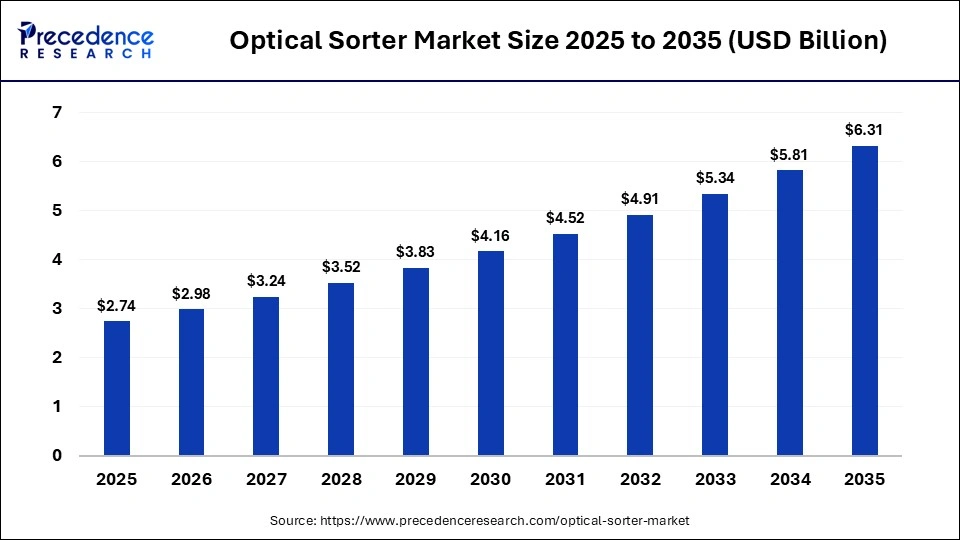
The global optical sorter market size was calculated at USD 2.74 billion in 2025 and is predicted to increase from USD 2.98 billion in 2026 to approximately USD 6.31 billion by 2035, expanding at a CAGR of 8.70% from 2026 to 2035.The market is driven by rising demand for automated, accurate, and high-speed sorting to improve quality and reduce waste.
Key Takeaways
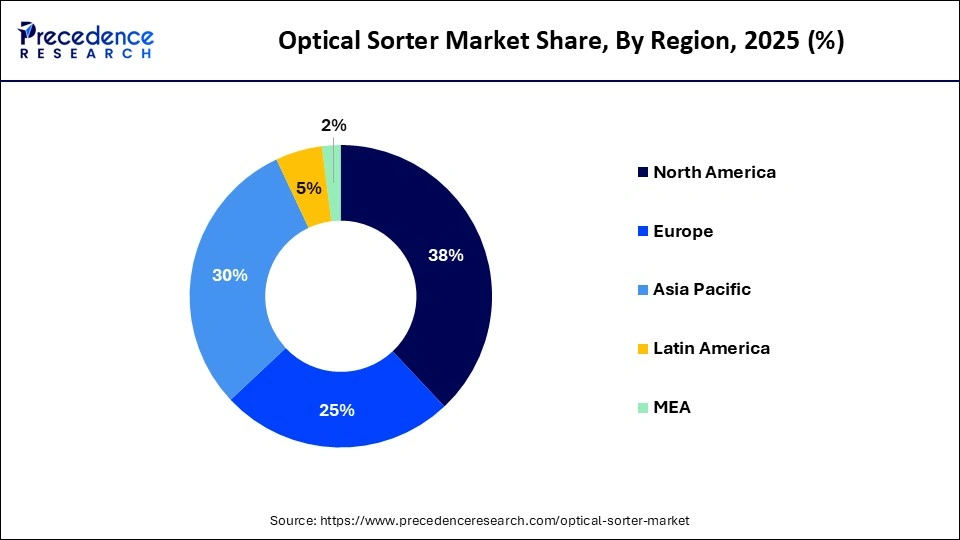
- North America dominated the optical sorter market with a share of 38% in 2025.
- The Asia Pacific is expected to grow at the fastest CAGR of 9.0% in the market during the forecast period.
- By technology type, the camera-based sorters segment holds a dominant position in the market, capturing a share of 34% in 2025.
- By technology type, the hyperspectral & combined sorters segment is expected to expand at a significant rate between 2026 and 2035.
- By platform type, the belt segment accounted for a major share of 42% in the market in 2025.
- By platform type, the hybrid segment is expected to grow with the highest CAGR of 7.5% in the market during the studied years.
- By application / end-user, the food processing segment led the global market with a share of 45% in 2025.
- By application / end-user, the pharmaceutical segment is expected to expand rapidly in the market in the coming years.
Market Overview
An optical sorter is an advanced sorting system that is composed of high-resolution cameras, near-infrared sensors, hyperspectral imaging, laser scanners, and artificial intelligence algorithms to sort and identify materials according to color, size, shape, texture, and chemical composition. These sorters are commonly used in various industries, including food processing, recycling, mining, and pharmaceutical. Optical sorters are important in eliminating defects, contamination, and foreign bodies in production lines with minimal human intervention. The market is expanding due to the growing industrial automation and the necessity to find solutions with high speed and high accuracy. Also, the increase in recycling programs and sustainability requirements is driving the need for automated waste segregation systems.
How is AI Influencing the Optical Sorter Market?
The optical sorter market is being revolutionized due to artificial intelligence that improves the quality of sorting, speed, and flexibility. AI-based sorters are continuously developing and changing with the patterns of data. AI enables sorters to identify defects. This skill is particularly applicable where the variability of products is high, and in food processing, recycling, and mining, where the quality level is high. The integration of AI also enables real-time data analytics, allowing operators to monitor system performance continuously, identify anomalies, and adjust sorting parameters on the fly. In addition, AI-supported predictive maintenance helps reduce downtime by anticipating potential equipment failures before they occur, ensuring smoother operations and higher overall efficiency.
Optical Sorter Market Trends
- Integration of artificial intelligence and machine learning algorithms is improving detection rates of defects, enabling real-time classification of materials, and increasing overall sorting speeds on high-speed industrial production lines.
- The use of optical sorting systems is rising to meet the high standards of safety, to eradicate food contaminants, and to manufacture high-quality products with minimal human influence.
- Automated waste separation is growing in demand due to sustainability policies, circular economy initiatives, and the need to recover plastics, metals, and glass efficiently.
- Advanced sensor technologies, including hyperspectral imaging, allow identification of materials based on chemical composition, enhancing sorting accuracy in complex mining and recycling operations.
- Manufacturers are offering more modular, customizable, and scalable optical sorting solutions that can be tailored to different materials, capacities, and integration needs, increasing adoption flexibility.
Market Scope
| Report Coverage | Details |
| Market Size in 2025 | USD 2.74 Billion |
| Market Size in 2026 | USD 2.98 Billion |
| Market Size by 2035 | USD 6.31 Billion |
| Market Growth Rate from 2026 to 2035 | CAGR of 8.70% |
| Dominating Region | North America |
| Fastest Growing Region | Asia Pacific |
| Base Year | 2025 |
| Forecast Period | 2026 to 2035 |
| Segments Covered | Technology Type, Platform Type, Application/End-User, and region |
| Regions Covered | North America, Europe, Asia-Pacific, Latin America, and Middle East & Africa |
Segment Insights
Technology Type Insights
Why Did the Camera-Based Segment Dominate the Optical Sorter Market?
The camera-based sorters segment dominated the market while holding a major share of 34% in 2025. This is because of their wide applicability in several industries, cost-effectiveness, and proven reliability. These sorters use high-resolution cameras with the visible spectrum to identify changes in color, size, and shape, which makes them very precise in food processing, agricultural sorting, and simple recycling. These systems require relatively lower capital investment compared to hyperspectral or laser-based sorters, making them more accessible to small and mid-sized businesses. In addition, advancements in software and AI-based recognition algorithms have significantly improved detection accuracy and speed, enhancing overall sorting efficiency.
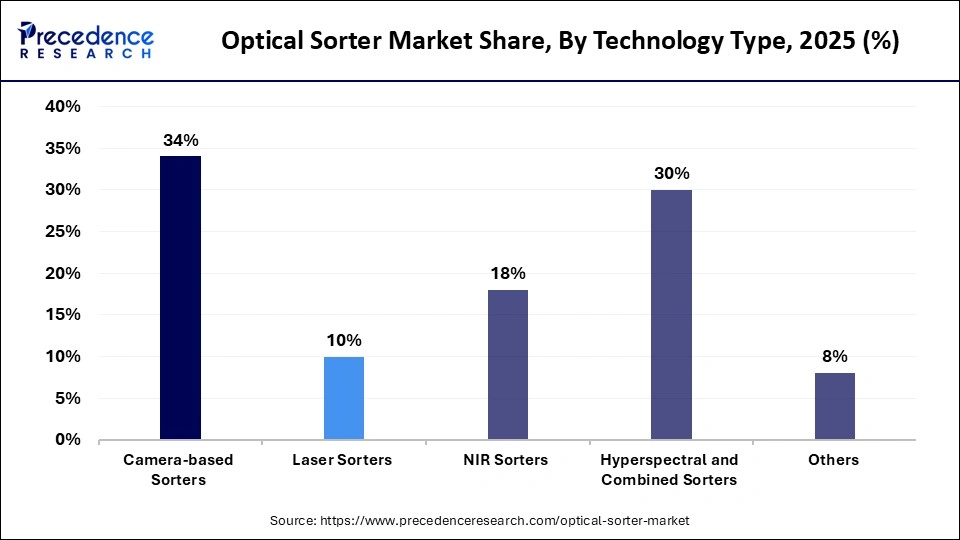
The hyperspectral & combined sorters segment is expected to grow at the fastest CAGR over the forecast period due to its superior ability to identify materials based on chemical composition rather than just color or shape. Hyperspectral sorters use more than one spectral wavelength to analyze materials and, thus, detect materials by chemical composition and not merely by their visual appearances. This enables very sharp isolation of complex substances, impurities, and fine faults that might have been overlooked by the conventional systems.
The food processing industry, advanced recycling, and mining are aware of the growing need for high-purity products and adherence to rigid regulatory rules, which fuel the demand for such advanced technologies. There is also a high demand for joint sorter systems that combine hyperspectral, NIR, and camera technologies, which are even more efficient and versatile in sorting.
Platform Type Insights
Why Did the Belt Segment Hold a Major Share of the Optical Sorter Market?
The belt segment dominated the global market by holding a major share of 42% in 2025. This is because of its stability, high throughput capacity, and versatility across industries. Belt-based systems evenly distribute materials on a moving conveyor, allowing sensors to scan at precise points and maintain consistent sorting performance. This controlled material presentation minimizes overlapping and enhances detection accuracy, particularly in food processing and mining applications. Additionally, belt systems are well-suited for handling delicate products such as fruits and vegetables, reducing the risk of damage during sorting.
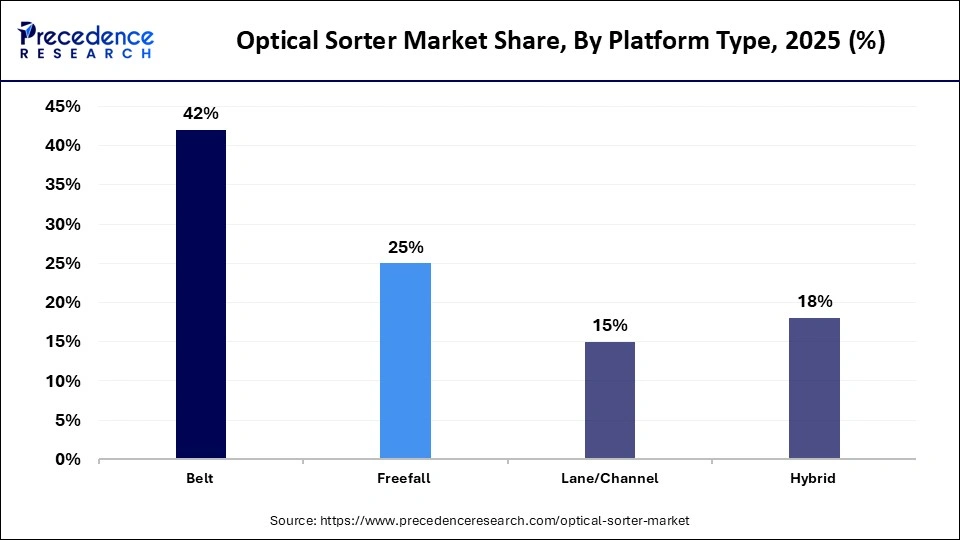
The hybrid segment is expected to grow at a healthy CAGR of 7.5% between 2026 and 2035, as it is more flexible and allows more technologies to be integrated. Hybrid systems are an integration of the belt, chute, and sophisticated sensor systems to optimize the accuracy of sorting various material streams. This layout allows the processors to process mixed, irregular, or high-contamination materials more efficiently than single-platform systems. The growing demand for multifunctional solutions in the recycling and mining industries is driving the adoption of hybrid optical sorter systems. These systems enhance recovery rates and separation efficiency, directly supporting both profitability and sustainability goals for operators.
Application / End-User Insights
Why Did the Food Processing Segment Lead the Optical Sorter Market?
The food processing segment led the market with a major revenue share of 45% in 2025 due to the increasing food safety regulations worldwide and the increased use of processed and packaged food products. Laws and regulations surrounding contamination control and quality assurance force food manufacturers to employ improved optical sorting machines. The growing globalization of food supply chains has increased the importance of having quality inspection technologies to ensure quality standards of exports. Also, there is a growing consumer awareness of food safety and high-quality products, and this is pushing manufacturers to invest in precision sorting equipment.
The pharmaceutical segment is expected to grow at the fastest rate during the projection period due to the increasing need for high-precision sorting to ensure product quality, safety, and regulatory compliance. Optical sorters help detect contaminants, defective tablets, and foreign particles, which is critical in maintaining strict standards in drug manufacturing. Additionally, the rise in pharmaceutical production, coupled with automation initiatives, is driving the adoption of advanced sorting systems to improve throughput and reduce manual inspection. The integration of AI and sensor-based technologies further enhances accuracy, making these solutions increasingly attractive to pharmaceutical manufacturers.
The recycling segment is expected to expand at a notable rate during the forecast period, driven by the increasing sustainability standards and the growing regulatory pressure to enhance the global practices of waste management. The world has been witnessing the enforcement of tougher regulations by governments and environmental organizations on landfill waste and on encouraging the implementation of these regulations. Optical sorters greatly enhance the recovery rates of materials because they can adequately sort plastics, metals, glass, paper, and other recyclable materials in mixed waste streams. With the increased amounts of waste produced by urbanization and industrialization, recycling facilities are finding high-throughput and automated solutions to be more and more efficient in handling the increasing amounts.
Region Insights
North America Optical Sorter Market Size and Growth 2026 to 2035
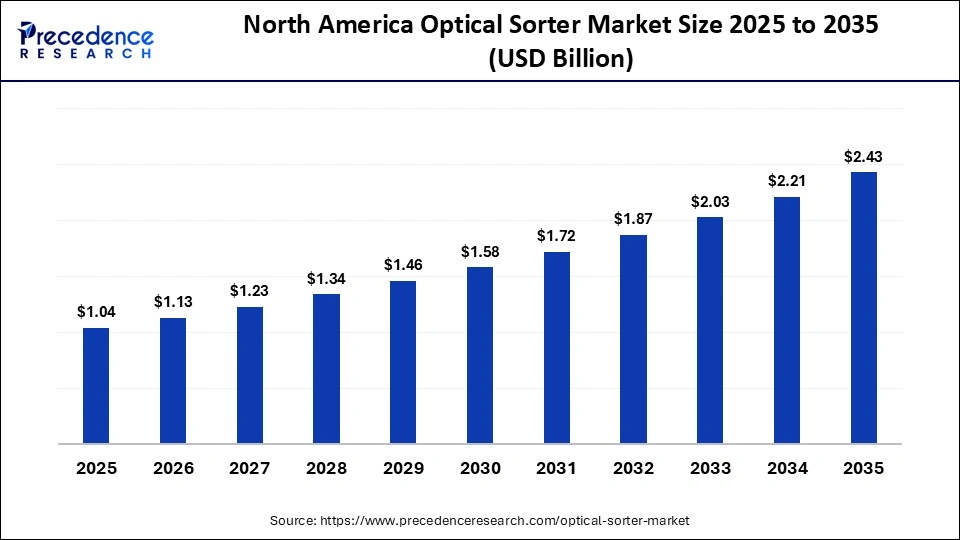
The North America optical sorter market size is estimated at USD 1.04 billion in 2025 and is projected to reach approximately USD 2.43 billion by 2035, with a 8.86% CAGR from 2026 to 2035.
Why Did North America Lead the Global Optical Sorter Market?
North America dominated the global optical sorter market with a share of 38% in 2025. This is because of its advanced industrial infrastructure, widespread adoption of automation technologies, and stringent regulatory requirements in food safety and waste management. The region has a well-established food processing sector that relies on optical sorters to maintain high-quality standards and prevent contamination. Additionally, robust recycling systems and sustainability regulations in the United States and Canada have accelerated the deployment of high-precision sorting technologies in material recovery facilities. Rising labor costs and the drive for productivity optimization are also supporting the continued growth of automation, contributing to steady market expansion.
U.S. Optical Sorter Market Size and Growth 2026 to 2035
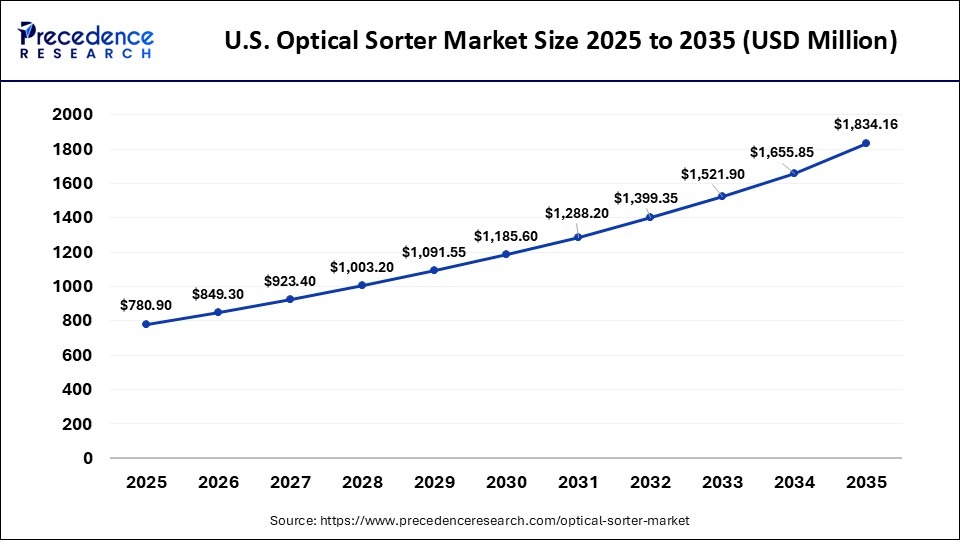
The U.S. optical sorter market size is calculated at USD 780.90 million in 2025 and is expected to reach nearly USD 1,834.16 million in 2035, accelerating at a strong CAGR of 8.91% between 2026 and 2035.
U.S. Market Analysis
The optical sorter market in the U.S. is growing due to increasing automation across food processing, recycling, and industrial manufacturing sectors, where high precision and efficiency are critical. Rising regulatory standards for food safety and quality, along with stricter recycling and sustainability policies, are driving demand for advanced sorting technologies. Additionally, technological advancements in AI, hyperspectral imaging, and sensor integration are making optical sorters more effective and accessible, encouraging broader adoption. The presence of leading manufacturers and large-scale industrial operations also supports strong market growth in the region.
Why is Asia Pacific Undergoing the Fastest Growth?
Asia Pacific is expected to grow at the fastest CAGR in the upcoming period because of the rapid industrialization, expansion of the food processing companies, and stricter environmental regulations. China, India, Japan, and Southeast Asian countries are experiencing an immense growth in the production of packaged foods, agricultural exports, and recycling facilities. The increase in population and urbanization is creating more demand for safe and quality food products, which is forcing manufacturers to use advanced optical sorting methods. The rise of technologies and growing awareness of the quality control norms are placing Asia Pacific as the most dynamic region in the market.
Why is the European Optical Sorter Market Experiencing Notable Growth?
The market in Europe is expected to grow at a notable rate in the coming years, driven by regulatory frameworks and industrial policies focused on sustainability. Stringent food safety and environmental standards set by the European Union are encouraging the adoption of optical sorting technologies in the food processing and recycling sectors. The region's strong emphasis on circular economy initiatives and reduced landfill use has fueled demand for advanced waste sorting facilities. Growth is further supported by technological innovation and the robust R&D capabilities of European manufacturers.
Optical Sorter Market Companies
- TOMRA Systems ASA
- Bühler Group
- Key Technology, Inc.
- Hefei Meyer Optoelectronic Technology Inc.
- Satake Corporation
- Allgaier Werke GmbH
- STEINERT GmbH
- Sesotec GmbH
- Binder+Co AG
- Raytec Vision S.p.A.
- National Recovery Technologies LLC
- Hefei Taihe Intelligent Technology Group
- AWETA
- Cimbria A/S
- CP Manufacturing
Recent Developments
- In December 2025, BRT HARTNER GmbH introduced the BRT HARTNER AS Automatic Sorter, marking its first sensor-based, AI-supported separation system, developed in partnership with RTT System GmbH. The solution delivered high sorting efficiency through sensor fusion and HSI camera technology, combining an acceleration belt, optical sensors, and compressed air sorting, an approach already well established in the market, as stated by Executive Manager Andre Berlage.(Source: https://recyclinginside.com)
- In September 2025, TOMRA Systems ASA introduced FINDER COLOR, the next-generation color sorting system, which can be used to recover high-purity metals of a wide range of metals. The system provides outstanding throughput and higher recovery rates, making the company a firm in advanced metal recycling solutions.(Source: https://www.tomra.com)
- In June 2025, Satake Corporation launched Pellet Sorter II, an optical sorter exclusively developed for plastic pellets. Designed to remove defects such as specks and discoloration from raw plastic pellets, the system delivers a high throughput of up to 3.0 t/h. It features a 600 mm-wide conveyor belt and front and rear 4K high-definition cameras for precise inspection, while Satake Intelligent Software instantly identifies accept and reject materials, with high-speed piezo ejector valves efficiently removing defective pellets.(Source: https://www.satake-group.com)
- In March 2025, Buhler (Switzerland) collaborated with West-Link (U.S.) to establish an optical sorting research and training facility with state-of-the-art technology in Stockton, California. The partnership meant that Western American food processors could access the most recent optical sorting technologies, practical training, and sophisticated product testing services offered by Buhler, as well as improving regional support options.(Source: https://www.buhlergroup.com)
Segments Covered in the Report
By Technology Type
- Camera-based Sorters
- Laser Sorters
- NIR Sorters
- Hyperspectral & Combined Sorters
- Others
By Platform Type
- Belt
- Freefall
- Lane/Channel
- Hybrid
By Application / End-User
- Food Processing
- Recycling
- Mining
- Pharmaceutical
- Others
By Region
- North America
- Europe
- Asia-Pacific
- Latin America
- Middle East & Africa
For inquiries regarding discounts, bulk purchases, or customization requests, please contact us at sales@precedenceresearch.com
Frequently Asked Questions
Tags





Ask For Sample
No cookie-cutter, only authentic analysis – take the 1st step to become a Precedence Research client
 Get a Sample




 sales@precedenceresearch.com
 Schedule a Meeting
