



Particle Therapy Market Size, Companies, Share, Patient Volume, Treatment Adoption Rates, Pricing Analysis, Regulatory Landscape, Competitive Positioning, and Demand Forecast
Particle Therapy Market (By Type: Proton Therapy, Heavy Ion Therapy; By System : Single Room Systems, Multi-room Systems; By Application: Treatment, Clinical Research; By Cancer Type: Pediatric Cancer, Breast Cancer, Lung Cancer, Head and Neck Cancer, Others) - Global Industry Analysis, Size, Trends, Leading Companies, Regional Outlook, and Forecast 2026 to 2035
Source: https://www.precedenceresearch.com/particle-therapy-market
 Get a Sample
 Table Of Content


What is the Particle Therapy Market Size in 2026?
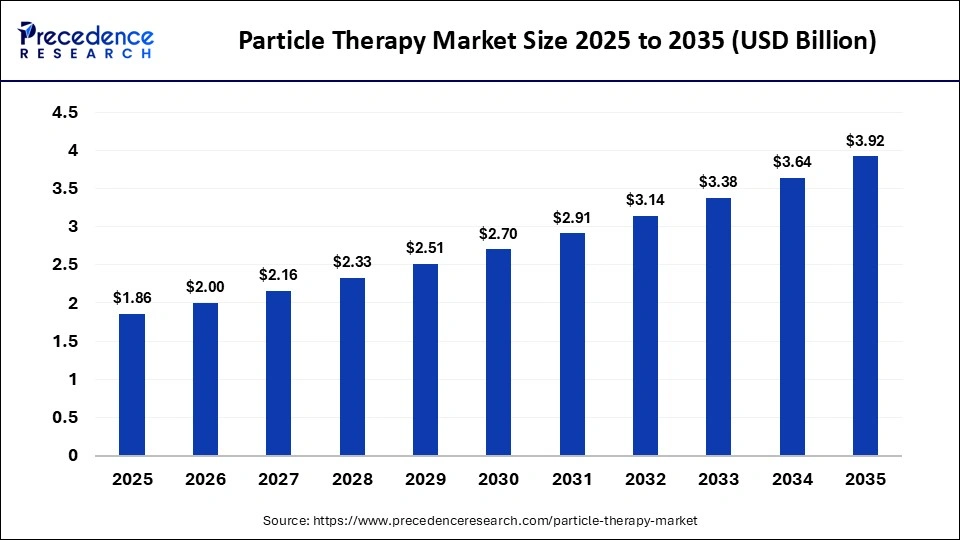
The global particle therapy market size was calculated at USD 1.86 billion in 2025 and is predicted to increase from USD 2.00 billion in 2026 to approximately USD 3.92 billion by 2035, expanding at a CAGR of 7.75% from 2026 to 2035. Particle therapy is renowned as a developing area of external-beam radiotherapy with unique advantages over photon therapy, and it assists in the management of renal-cell carcinoma.
Market Highlights
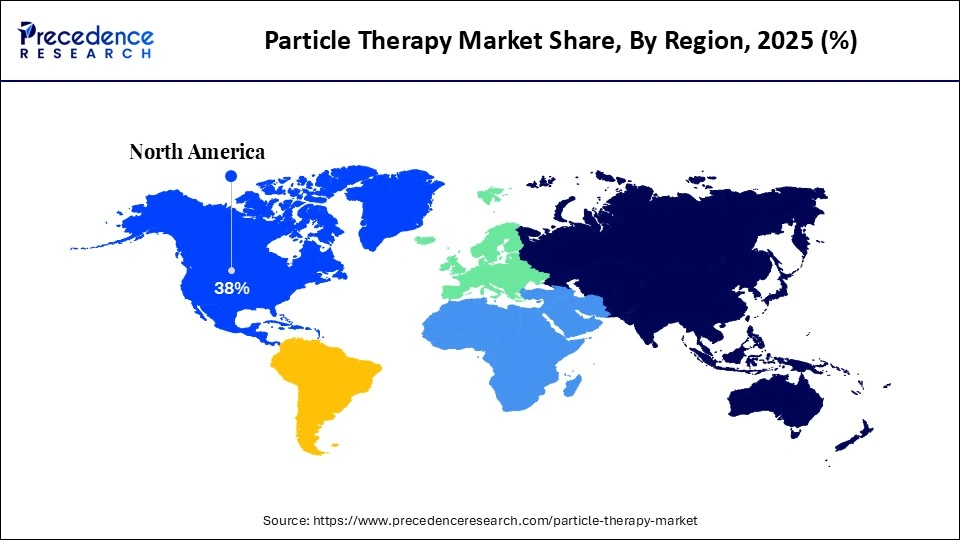
- North America dominated the market with the largest market share of 38% in 2025.
- Asia Pacific is expected to grow at the fastest CAGR in the market during the forecast period.
- By type, the proton therapy segment held the major market share of 88% in 2025.
- By type, the heavy ion therapy segment in the market is expected to grow at the fastest CAGR in the market during the forecast period.
- By system, the multi-room systems segment dominated the particle therapy market in 2025.
- By system, the single room systems segment is expected to grow at the fastest rate in the market in 2025.
- By application, the clinical research segment dominated the market in 2025.
- By application, the treatment segment is expected to grow at the fastest CAGR in the market during the forecast period.
- By cancer type, the pediatric cancer segment dominated the market in 2025.
- By cancer type, the breast cancer segment is expected to grow at the fastest CAGR in the market during the forecast period.
Particle Therapy: The Rise of Particle Radiation Research
The particle therapy market is experiencing a boom in cancer research and treatments, while offering promising results, clinical benefits, and improved patient outcomes. Particle therapy has the potential to minimize the dose to the surrounding tissues compared to conventional photon therapy. It is mostly used to treat tumors that are radioresistant to conventional photon beam radiotherapy. It holds a feature that enables precise delivery of the radiation dose to the tumor while protecting normal organs.
How is AI Impacting the Particle Therapy Market?
AI contributes to treatment decision, imaging or simulation, treatment planning, plan approval, quality assurance, radiotherapy delivery, and follow-up care. In treatment planning, AI aids in the selection of beam angle, dose mimicking, dose calculation, and fully automatic planning of treatments. These applications result in more efficient workflows and standardized planning of treatments that further drive the market. In quality assurance and treatment delivery, AI helps in deep-learning dose calculation, patient positioning, and treatment monitoring. This leads to improved accuracy in the detection of issues and delivery of real-time actionable data.
- In May 2026, Flatiron Health launched the Flatiron Telescope. Flatiron Telescope is an AI-enabled platform designed to provide accurate insights about cancers to researchers. (Source: https://resources.flatiron.com)
Particle Therapy Market Trends
- Particle Therapy in Clinics: Clinical studies for this therapy are increasing, which are mostly based on carbon ion therapy and proton therapy. Moreover, current research also focuses on other heavy particle therapies. The clinical research centers that are using helium ion therapies are delivering good results.
- Precision Targeting: It has become essential to treat tumors that are located near vital and sensitive structures such as the spinal cord, brainstem, heart, or optic nerve. There is a strong focus on delivering high doses to the tumor while reducing the integral dose to surrounding healthy organs.
- Safe Treatment Options: The particle therapy market revolves around a promising approach to provide a standard, safe, and preferred treatment for specific tumor types. These tumors include skull base tumors, ocular tumors, and deep-seated or inoperable tumors. This therapy is considered a safe option for patients who suffer from the recurrence of cancer.
Market Scope
| Report Coverage | Details |
| Market Size in 2025 | USD 1.86 Billion |
| Market Size in 2026 | USD 2.00 Billion |
| Market Size by 2035 | USD 3.92 Billion |
| Market Growth Rate from 2026 to 2035 | CAGR of 7.75% |
| Dominating Region | North America |
| Fastest Growing Region | Asia Pacific |
| Base Year | 2025 |
| Forecast Period | 2026 to 2035 |
| Segments Covered | Type, System, Application, Cancer Type ,and region |
| Regions Covered | North America, Europe, Asia-Pacific, Latin America, and Middle East & Africa |
Segments Insights
Type Insights
How did the Proton Therapy Segment Dominate the Particle Therapy Market in 2025?
The proton therapy segment dominated the market in 2025, owing to high-precision dose delivery to the tumor target and its importance in advanced radiotherapy. The proton therapy is growing and expanding due to technological innovations such as image-guided proton therapy, compact superconducting accelerators, ultra-high dose rate FLASH radiotherapy, and pencil beam scanning. The other technologies, like AI, are advancing proton therapy toward real-time adaptive precision radiotherapy.
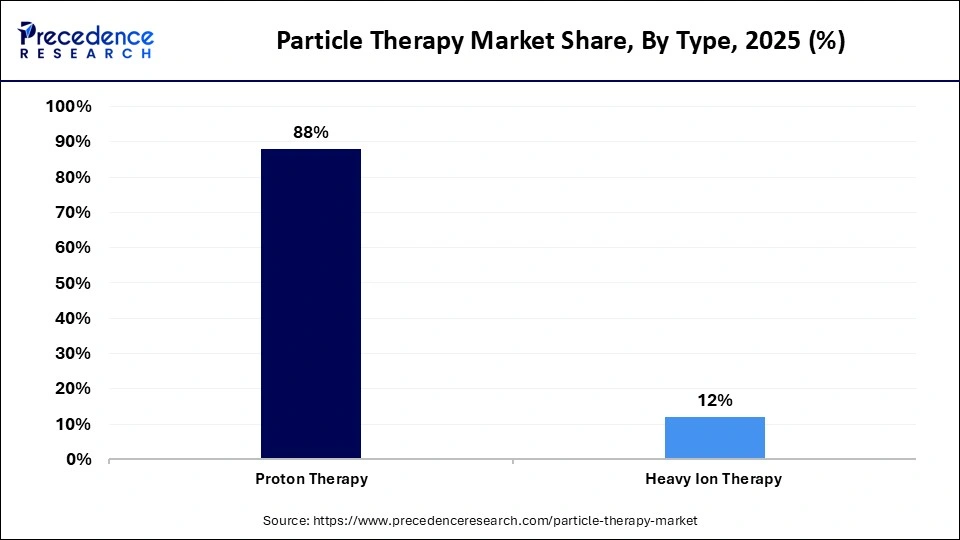
The heavy ion therapy segment is expected to grow at the fastest CAGR in the market during the forecast period due to the increased efforts of researchers on combining oxygen, carbon, and helium ions to optimize biological effects. Research has been conducted on nature physics involving radioactive ion beams and FLASH therapy using neon ions to reduce toxicity to healthy tissues. The other major growth drivers are precision targeting, multi-ion systems, and the biological effectiveness of carbon, helium, and oxygen.
System Insights
What made multi-room systems the Dominant Segment in the Particle Therapy Market in 2025?
The multi-room systems segment dominated the market in 2025, owing to their role as operational hubs for large university hospitals and national cancer institutes that manage a large number of patients. Academic centers play a vital role in providing one room from a multi-room complex for clinical trials and protocol enrolment. These systems prioritize the use of a single large accelerator to power multiple treatment rooms.
The single room systems segment is estimated to grow at the fastest rate in the market during the predicted timeframe due to the efficient design of these compact systems to fit into existing radiation oncology departments. They also reduce the need for heavy new construction. The single room systems allow urban cancer centres and regional hospitals to offer advanced therapies without heavy investments in multi-room complexes.
Application Insights
How did the Clinical Research Segment ominate the Particle Therapy Market in 2025?
The clinical research segment dominated the market in 2025, owing to the robust clinical research studies on radioresistant tumors and combination treatments with immunotherapy. Research also focuses on the rising incidence of local cancers like nasopharyngeal carcinoma. Researchers conduct studies on ultra-high-dose rates, which aim to reduce toxicity and the time of treatments.
The treatment segment is anticipated to grow at a notable rate in the market during the upcoming period due to the principal role of particle therapy in the treatment of radioresistant tumors, childhood cancers, and tumors of the skull base, spine, and the central nervous system. This therapy results in a reduced risk of developmental issues and secondary cancers in children. Carbon ion therapy is widely used for treating tumors that do not respond well to chemotherapy, photons, osteosarcomas, and unresectable pancreatic cancer.
Cancer Type Insights
Why did the Pediatric Cancer Segment dominate the Particle Therapy Market in 2025?
The pediatric cancer segment dominated the market in 2025, owing to the rising incidence of central nervous system tumors, sarcomas, and eye tumors. Particle therapy is the preferred treatment for pediatric cancers due to its potential to protect developing healthy tissues from unnecessary radiation. The ongoing research focuses on the use of heavier ions like helium and carbon for treating pediatric cases and radioresistant tumors.
The breast cancer segment is predicted to grow at a rapid rate in the market during the studied period due to the preferred option of particle therapy for recurrent breast cancer. This therapy is highly recommended for treating left-sided breast cancer and its associated nodes near the heart. It is suitable for patients dealing with bilateral breast cancer and pre-existing lung or heart conditions.
Regional Insights
North America Particle Therapy Market Size and Growth 2026 to 2035
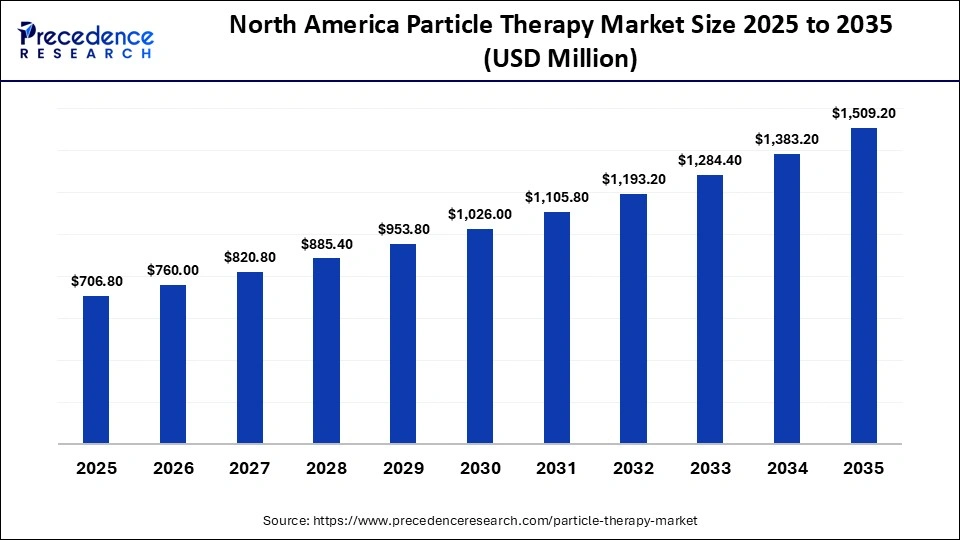
The North America particle therapy market size is estimated at USD 706.80 million in 2025 and is projected to reach approximately USD 1,509.20 million by 2035, with a 7.88% CAGR from 2026 to 2035.
How does North America dominate the Particle Therapy Market in 2025?
North America dominated the market in 2025, owing to the increased patient pool, the rising demand for advanced radiation therapies, and the launch of smaller and more affordable single-room proton therapy systems. The government and public-private initiatives focus on expanding access to advanced treatments like heavy ion therapy and proton therapy across the U.S. and Canada. The Government of Canada and Ontario introduced the national strategy for rare diseases, which aims to improve access to revolutionary diagnostics and treatments, including treatments for rare cancers.
- In February 2026, BIOEMTECH and Northstar Medical Radioisotopes announced a strategic supply agreement to secure a reliable supply and provide Actinium for use in preclinical studies that are conducted by customers of BIOEMTECH. This agreement and the launch of reliable isotopes are a major success of BIOEMTECH that will enable its customers to conduct higher-impact and more predictable studies using its imaging platforms.
U.S. Particle Therapy Market Size and Growth 2026 to 2035
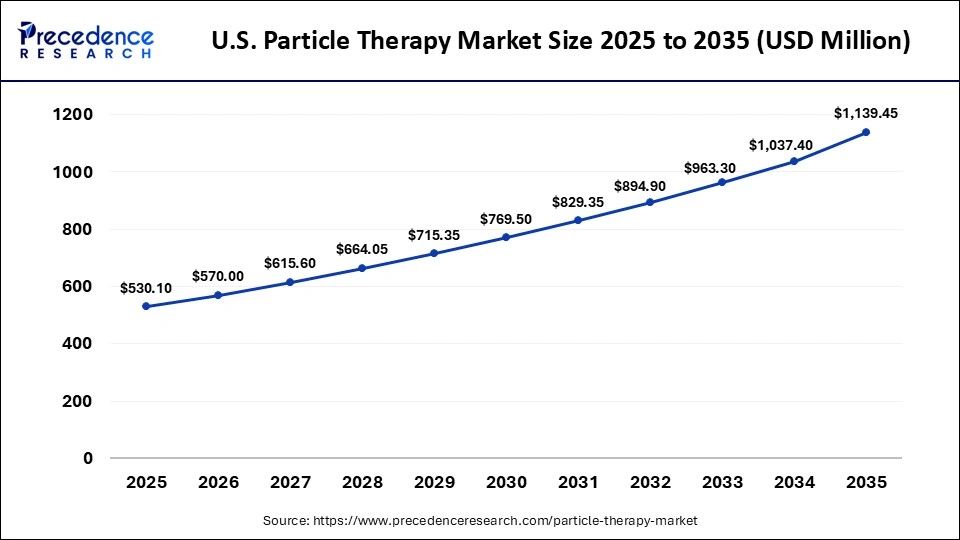
The U.S. particle therapy market size is calculated at USD 530.10 million in 2025 and is expected to reach nearly USD 1,139.45 million in 2035, accelerating at a strong CAGR of 7.95% between 2026 and 2035.
U.S. Market Analysis
The U.S. witnesses a massive growth due to supportive Medicare policy, shift to compact systems, and integration of AI-based treatment planning that boosts the growth of the particle therapy market. In November 2024, Starget Pharma, a leading company with operations in the U.S., secured a $5.1 million investment for targeted cancer therapy. It is dedicated to precise cancer diagnosis and targeted radiotherapy.
What is the Potential of the Particle Therapy Market in the Asia Pacific?
Asia Pacific is expected to grow at the fastest CAGR in the market during the forecast period due to the presence of hubs for affordable particle therapy, the rising trend of medical tourism, and investments in oncology research infrastructure. The major government initiatives include Japan's national innovation fund by the Ministry of Health, Labour, and Welfare (MHLW), Tokyo Metropolitan Government Project, Karnataka State initiative, China's leading position, and Thailand's global destination strategy. The collaborative platforms launched by the leading companies aim to deliver standardized cancer treatment across the region.
India Market Trends
India is advancing through technological and research advancements, affordable and high-tech healthcare facilities, and the rising cancer burden across the expanding particle therapy market. In March 2025, Bharat Biotech of India launched a cell and gene therapy facility for which it has invested $75 million in the southern Indian state of Telangana, and predicted that its new therapies will expand the market in the next three years.
What Factors Drive Europe's Notable Growth in the Market?
Europe is expected to grow at a notable rate in the market, owing to favorable reimbursement frameworks, increased government funding for specialized treatment centers, and integration of real-time image-guided systems. The European strategy for particle physics reached a revolutionary success in developing a visionary plan that will advance human knowledge into fundamental physics through a flagship project. The new project of the European Union aims to advance plasma accelerator technologies to benefit Science and industry, and enable applications in healthcare, ultrafast science, manufacturing, and compact colliders. This development will also enable the production of photon beams and unique particles.
Germany Particle Therapy Market Analysis
The increasing demand for precision oncology, the large number of advanced oncology centers, and the adoption of smart systems are driving the market in Germany. In July 2025, Coriolis Pharma, a leading provider of formulation R&D services for biologics, announced the investment of $10 million to establish a state-of-the-art research laboratory and create 50 new employment opportunities in Morrisville.
Why is Latin America expected to be the Notable Growth Region in the foreseeable period?
The increasing prevalence of cancer, the advancements in healthcare facilities, and the increasing attention towards precision oncology treatment are driving the Latin America particle therapy market. The growing prevalence of cancer, the advancements in healthcare facilities, and increased attention towards precision oncology treatment is steering the growth of the Latin America particle therapy market. Advanced radiation therapy technologies have come to the forefront as an investment in the private healthcare sector and governments to provide better treatment for cancer. The increasing understanding of proton therapy and its advantages for minimally invasive cancer treatments is also driving market growth.
Brazil Particle Therapy Market Analysis
Brazil is the leader in Latin America as it has a high density of oncology patients, a rising share of healthcare expenditure, and a growing number of special cancer treatment centers. Rising demand for advanced radiation oncology services and the modernization of healthcare in Mexico are leading to significant growth. Additionally, the market is steadily developing in Argentina, driven by the enhancement of medical facilities and the rise of precision cancer treatment technologies.
Why is Middle East and Africa expected to be the Notable Growth Region in the foreseeable period?
The Middle East & Africa is notably growing in the market by holding on to a significant amount of share, as the prevalence of cancer is rising and government investments in advanced healthcare technologies is also increasing in the region. The precision radiation therapies and increasing medical tourism are also driving the market growth across the region. Increasing awareness around precision radiation therapies and the growth of medical tourism are further fuelling the market growth in the region. Furthermore, collaboration with overseas healthcare institutions is enhancing the availability of advanced cancer treatment technologies.
Saudi Arabia Particle Therapy Market Trends
Saudi Arabia leads the regional market due to significant investments in healthcare, growing oncology hospitals, and rising demand for sophisticated radiation therapy equipment. The United Arab Emirates is experiencing significant expansion driven by its efforts for modernization of the healthcare sector, the growing medical tourism and the investment in cancer specialist centres. South Africa is also becoming an important market with the strengthening of oncology services and growing awareness of advanced cancer treatments.
UAE Particle Therapy Market Trends
The increasing cases of prostate cancer among men, along with the growing awareness of cancer diagnosis, have propelled the market expansion. Moreover, the rapid investment by medical device companies to open new production centers is contributing to the industrial development.
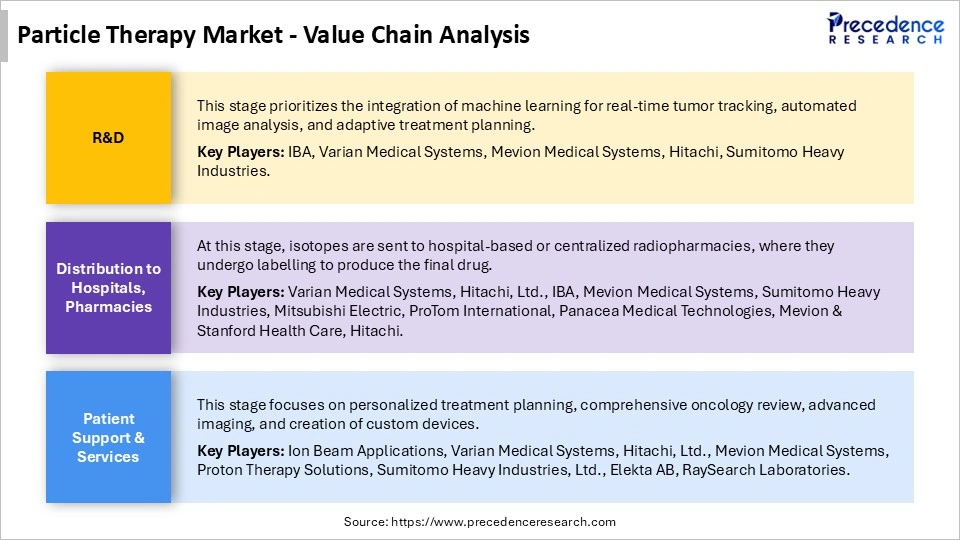
Particle Therapy Market Value Chain Analysis
Competitive Landscape
Due to the high capital investment, technology expertise, and regulatory approvals needed to develop particle therapy systems, the market is very consolidated, with a few global companies dominating the market. Competition is driven by key players offering advanced proton and heavy ion therapy technologies, global installation capabilities, and long-term collaborations with oncology centres, among other factors. The trend of compact particle therapy devices, AI-driven treatment planning, and image-guided radiation technologies is driving a shift towards greater precision and efficiency in treatment delivery. The market is becoming more competitive with the rising demand for new and emerging non-invasive cancer therapies and growing investments in precision oncology facilities.
The particle therapy market is being transformed by strategic moves like hospital collaborations, new proton therapy centre deployment, technology licensing and ongoing research and development investments. Companies are focusing on innovation in their treatment accuracy, their patient workflow optimisation, and their accelerator systems. Partnerships between healthcare institutions and technology suppliers are speeding up the process of creating a cost-effective and highly targeted particle therapy solution for cancer treatment. But high infrastructure requirements, low reimbursement rates, regulatory requirements, and the need for specialized medical skills remain significant hurdles for new players.
Particle Therapy Market Companies
- Ion Beam Applications S.A.
- Varian Medical Systems
- Hitachi, Ltd.
- Mevion Medical Systems, Inc.
- Sumitomo Heavy Industries, Ltd.
- Mitsubishi Electric Corporation
- Toshiba Energy Systems and Solutions
- ProTom International, Inc.
- Advanced Oncotherapy plc
- P-Cure Ltd.
Recent Developments
- In May 2026, Mevion launched the MEVION S250-FIT proton therapy system. This system was designed to enhance the treatment of cancer patients living in Europe and North America. (Source: https://www.sttinfo.fi/tiedote)
- In April 2026, Stanford Medicine established a proton therapy facility in California. This new facility was inaugurated to deliver proton therapy to children suffering from cancer. (Source: https://physicsworld.com)
- In January 2026, the government of Assam in India announced to invest around Rs 500 crores. This investment was made to install a proton therapy unit in the Cancer Institute of Gauhati Medical College Hospital. (Source: https://www.indiatodayne.in)
- In July 2025, Hitachi Ltd. received an order to establish a new proton therapy facility at Tokyo Metropolitan Cancer and Infectious Diseases Center Komagome Hospital. This new facility will be well-equipped with advanced features such as one accelerator system, a compact layout, and two rotating gantry treatment rooms.(Source: https://www.hitachi.com).
- In May 2024, Varian Medical Systems presented its innovations and commitments with enhanced outcomes for cancer patients and cancer care teams at the 2024 annual meeting of the European Society for Radiation Oncology (ESTRO). It has showcased the Hypersight imaging solution on TrueBeam, Edge, Ethos, and Halcyon. It has also announced the launch of the ARIA CORE oncology management solution to deliver more personalized care and treatment. (Source: https://www.siemens-healthineers.com).
Segments Covered in the Report
By Type
- Proton Therapy
- Heavy Ion Therapy
By System
- Single Room Systems
- Multi-room Systems
By Application
- Treatment
- Clinical Research
By Cancer Type
- Pediatric Cancer
- Breast Cancer
- Lung Cancer
- Head and Neck Cancer
- Others
By Region
- North America
- Latin America
- Europe
- Asia-pacific
- Middle and East Africa
For inquiries regarding discounts, bulk purchases, or customization requests, please contact us at sales@precedenceresearch.com
Frequently Asked Questions
Tags





Ask For Sample
No cookie-cutter, only authentic analysis – take the 1st step to become a Precedence Research client
 Get a Sample
.webp)



 sales@precedenceresearch.com
 Schedule a Meeting
