



Plant Factory Market Size, Companies, Share, Crop Production Volume, Yield Analysis, Export & Import Trends, Pricing Metrics, Competitive Positioning, and Demand Forecast
Plant Factory Market (By Facility Type: Greenhouses, Indoor/Vertical Farms; By Growing System: Hydroponics, Aeroponics, Aquaponics, Others (Soil-based/Hybrid); By component: Hardware (LEDs, HVAC, Sensors), Software and Services; By Crop Type: Vegetables (Leafy Greens, Tomatoes), Fruits (Berries), Flowers & Ornamentals, Others (Herbs/Microgreens)) - Global Industry Analysis, Size, Trends, Leading Companies, Regional Outlook, and Forecast 2026 to 2035
Source: https://www.precedenceresearch.com/plant-factory-market
 Get a Sample
 Table Of Content


What is Plant Factory Market Size in 2026?
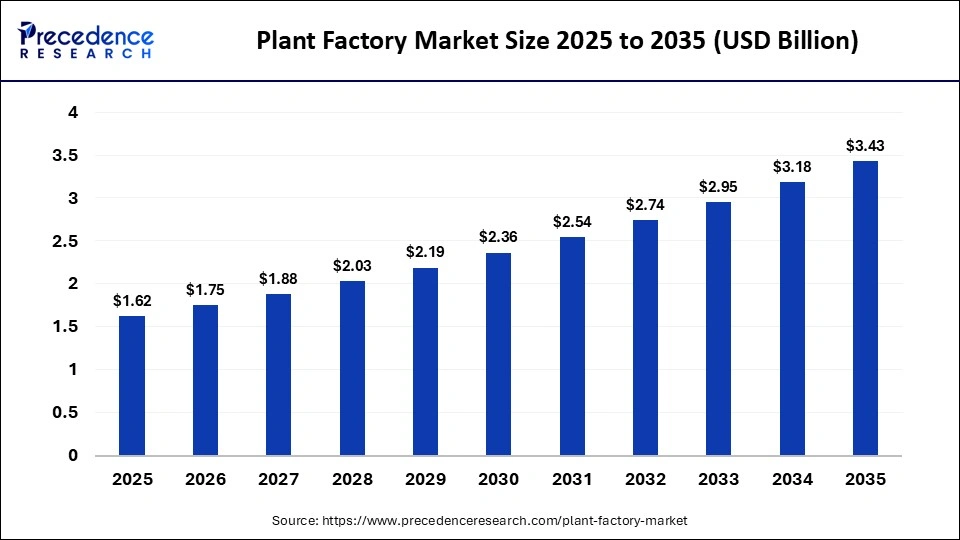
The global plant factory market size was calculated at USD 1.62 billion in 2025 and is predicted to increase from USD 1.75 billion in 2026 to approximately USD 3.43 billion by 2035, expanding at a CAGR of 7.78% from 2026 to 2035. Market expansion is driven by demand for sustainable and high-efficiency food production to meet the pressing food needs and increased urbanization.
Key Takeaways
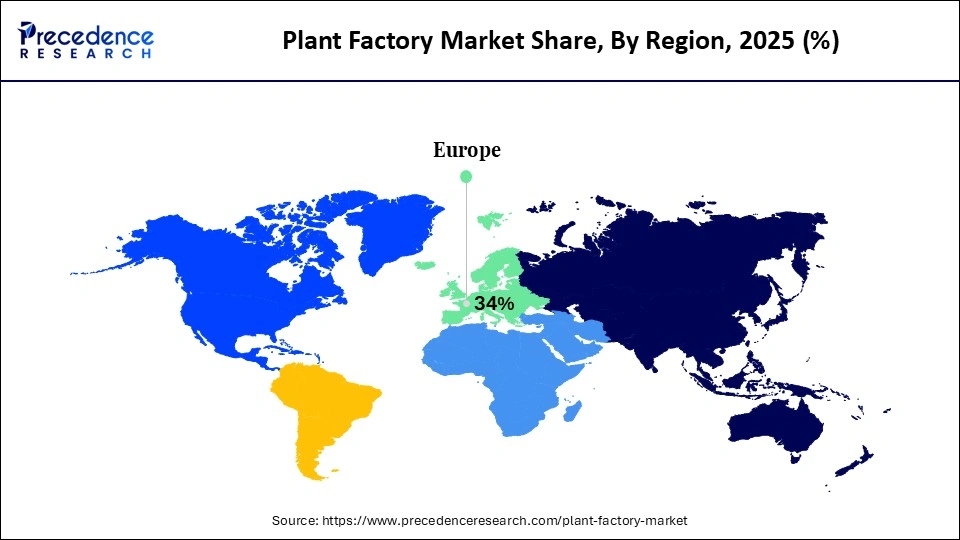
- Europe was the dominant region in the plant factory market with a market share of approximately 34% in 2025.
- Asia Pacific is the fastest-growing region in the market with the highest CAGR during the projected period.
- By facility type, the greenhouses segment dominated the market with a market share of approximately 70% in 2025.
- By facility type, the indoor/vertical farms segment is expected to be the fastest-growing segment with a high CAGR during the forecasted period.
- By growing system, the hydroponics segment led the segment with a market share of approximately 55% in 2025.
- By growing system, the aeroponics segment is expected to be the fastest-growing segment and is predicted to grow with a high CAGR over the projected period.
- By component, the hardware segment dominated the market with a market share of approximately 62% in 2025.
- By component, the software and services segment is expected to grow rapidly with a high CAGR during the projected period.
- By crop type, the vegetables segment led the plant factory market with a market share of approximately 58% in 2025.
- By crop type, the fruits segment is expected to be the fastest-growing segment with a high CAGR during the projected period.
Market Overview
The plant factory market is also known as indoor farming or vertical farming. It is a closed or semi-closed crop production system that produces crops year-around where the growth environment includes artificially controlled temperature, light, humidity, and nutrient delivery. The market growth is driven rapidly as demand for sustainable, high-efficiency food production systems continues to rise. The market is expanding rapidly due to the convergence of pressing food needs, continuing urbanization, and advancing controlled environment agriculture technologies. Plant factories improve production efficiency, shorten supply chains, and support a consistent food supply.
The trend of vertical farming and urban agriculture by incorporating IoT-based monitoring and AI technologies in the market is gaining momentum in the plant factory market. Government initiatives supporting vertical farming and controlled-environment agriculture are expected to accelerate adoption, positioning plant factories as a key solution for the future of food production and sustainable agriculture.
How is AI Contributing to the Market Growth?
AI plays a major role in accelerating the growth of the plant factory market by enabling precise, automated, and controlled growing environments. Advanced data analytics, machine learning, and multiple sensors implementation to continuously monitor and adjust major parameters like light intensity, temperature, humidity, and nutrient delivery in real time. Integration of AI improves crop yield and quality while minimizing resource consumption, energy usage, and waste generation. This AI-based technology allows to scale precision agriculture, converting plant factories from small-scale into commercially viable, large-scale food production models.
AI-assisted smart algorithms are used to forecast crop growth cycles, detect plant stress or disease in advance through computer vision, and optimize irrigation and lighting schedules for maximum production. Integrating AI with robotics and IoT-based monitoring enables automating planting and harvesting of crops, leading to reduced labor, enhanced consistency, and real-time decision-making. Another significant contribution of AI in the growth of plant factories is that it enables supply chain optimization by predicting demand and improving harvest planning.
What are the Plant Factory Market Trends?
- Real-time monitoring of climate, nutrients, and crop health has increased adoption of AI, IoT, and automation.
- To reduce labor dependency and improve efficiency of planting, harvesting, and quality control integration robotics system is the new trend. To improve yield forecasting and supply chain planning, there is increased adoption of data analytics and predictive modelling. Modular container-based plant factories have enabled flexible deployment in urban and remote locations.
- To reduce operational costs, increased focus on energy optimization, including renewable energy integration.
shift towards resource-efficient farming, reduced water consumption, and optimized energy usage through smart lighting. - Increasing consumer preference for traceable and clean-label food products.
- Diversification of crop varieties beyond leafy greens to fruits and medicinal plants.
- Government initiatives encouraging adoption of indoor farming and increased investment in controlled-environment agriculture (CEA) driven by food security and climate change concerns.
Market Scope
| Report Coverage | Details |
| Market Size in 2025 | USD 1.62 Billion |
| Market Size in 2026 | USD 1.75 Billion |
| Market Size by 2035 | USD 3.43 Billion |
| Market Growth Rate from 2026 to 2035 | CAGR of 7.78% |
| Dominating Region | Europe |
| Fastest Growing Region | Asia Pacific |
| Base Year | 2025 |
| Forecast Period | 2026 to 2035 |
| Segments Covered | Facility Type, Growing System, Component, Crop Type, and region |
| Regions Covered | North America, Europe, Asia-Pacific, Latin America, and Middle East & Africa |
Segment Insights
Facility Type Insights
How Did the Greenhouses Segment Lead the Plant Factory Market?
The greenhouses segment led the market with a market share of approximately 70% in 2025. It serves as a controlled environment farming solution, enabling plant growth throughout the year, higher yields, and protection from climate change. Greenhouses require lower capital investment, making them widely accessible to commercial growers. The main factors that affect greenhouse growth are temperature, humidity, heat, and wind; by regulating these factors, the growers can extend the growing season. Rising food demand, limited arable land, and automation and advanced monitoring technologies are driving their dominance in the market.
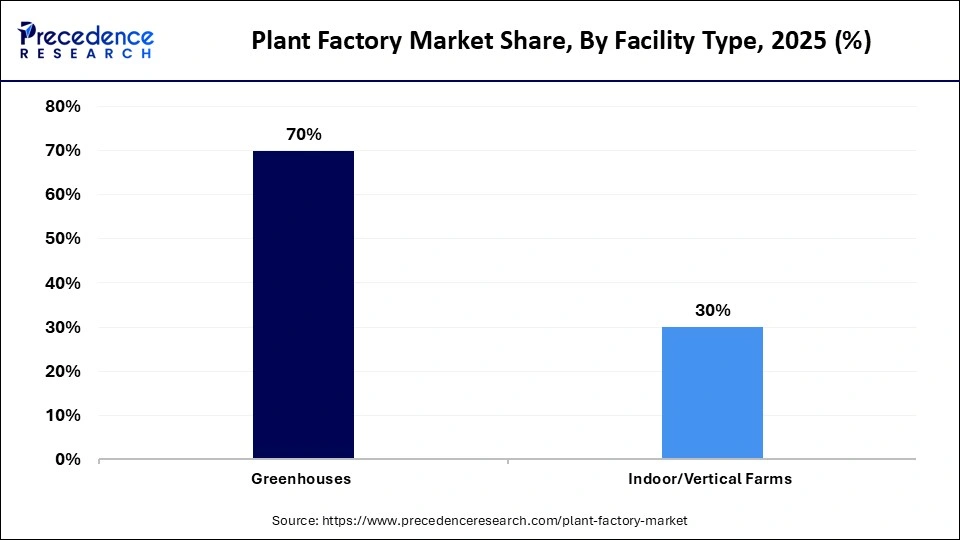
The indoor/vertical farms segment is expected to grow at the highest CAGR during the projected period. They enable year-round production and higher yields through highly controlled growing conditions. Factors such as temperature, light, humidity, and CO2 are precisely managed to improve crop quality and efficient use of water and nutrients. Rising concerns about food security, climate change, and environmental sustainability have accelerated the adoption of indoor farming technologies.
Growing System Insights
How did the Hydroponics Segment Dominate the Plant Factory Market?
The hydroponics segment dominated the plant market with a market share of approximately 55% in 2025. It is a highly efficient and soil-free growing method that has faster crop cycles, higher yields, and significantly lower water usage. Hydroponics can be scaled easily and automated to implement across a range of crops. Hydroponics is the most widely adopted system and commercially viable growing system in plant factories.
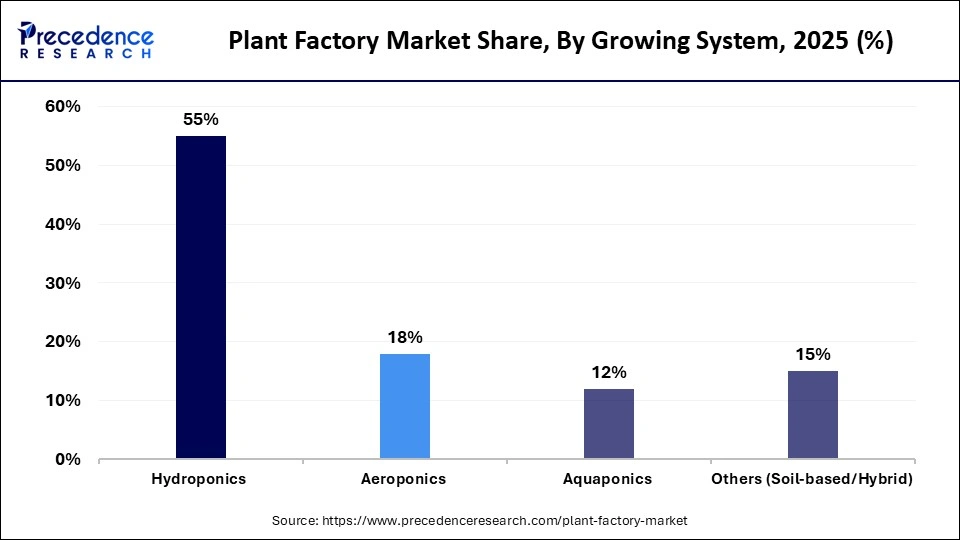
The aeroponics segment is estimated to be the fastest-growing segment with a high CAGR during the forecast period. It is a soilless system, delivering high resource efficiency and productivity. Due to the fact that plant roots are suspended in air and nutrients are delivered through fine mist, water and nutrient usage is drastically less compared to a hydroponic system. It also reduces the possibility of soil-borne diseases caused by the media. It is highly sophisticated technology and attractive for high yields per square meter, which is important for growing high-value crops and space-constrained urban farming.
Component Insights
What made the Hardware Segment Dominate the Plant Factory Market in 2025?
The hardware segment dominated the market and accounted for a market share of 62% in 2025. The dominance is due to the reason that indoor farming systems are highly dependent on infrastructure to control growing conditions and ensure high yield. Plant factories require LED lighting, climate control sensors, an HVAC system, and hydroponics or aeroponics setups year-round. Growing adoption of autonomation, precision agriculture, and the need for maintenance drive the segment in the market.
Plant Factory Market Share, By Component, 2025 (%)
| Component |
Market Share (%)
|
| Hardware (LEDs, HVAC, Sensors) | 62% |
| Software and Services | 38% |
| Aquaponics | 12% |
| Others (Soil-based/Hybrid) | 15% |
The software and services segment is expected to grow at a faster rate during the projected period. Indoor farming is highly adopting digital technologies to manage the controlled environment for high yield. Integration of AI, IoT sensors, and data analytics regulates key parameters such as temperature, humidity, light, CO2, and nutrient delivery. Digital technology enables remote and real-time monitoring and predictive crop management, making the software and services segment essential for precision agriculture and large-scale plant factory expansion.
Crop Type Insights
Why the Vegetables Segment Dominates the Plant Factory Market?
The vegetables segment dominated the market with a market share of approximately 58% in 2025. The rising need for locally grown, fresh produce, plant factories cultivate vegetables with uniform size, color, flavor, and pesticide-free. Vegetables are also high-value crops with fast-growing cycles, which make them suitable for indoor farming where there is a shortage of space.
Plant Factory Market Share, By Crop Type, 2025 (%)
| Crop Type | Market Share (%) |
| Vegetables (Leafy Greens, Tomatoes) | 58% |
| Fruits (Berries) | 15% |
| Flowers and Ornamentals | 12% |
| Others (Herbs/Microgreens) | 15% |
The fruits segment is expected to be the fastest-growing segment during the projected period. The segment is growing faster due to technological advancements such as LED lighting, hydroponics, and climate control sensors. Rapid urbanization in metropolitan settings and demand for fresh, locally grown, high-quality fruits are driving the segment in the market of plant factories.
Regional Insights
Europe Plant Factory Market Size and Growth 2026 to 2035
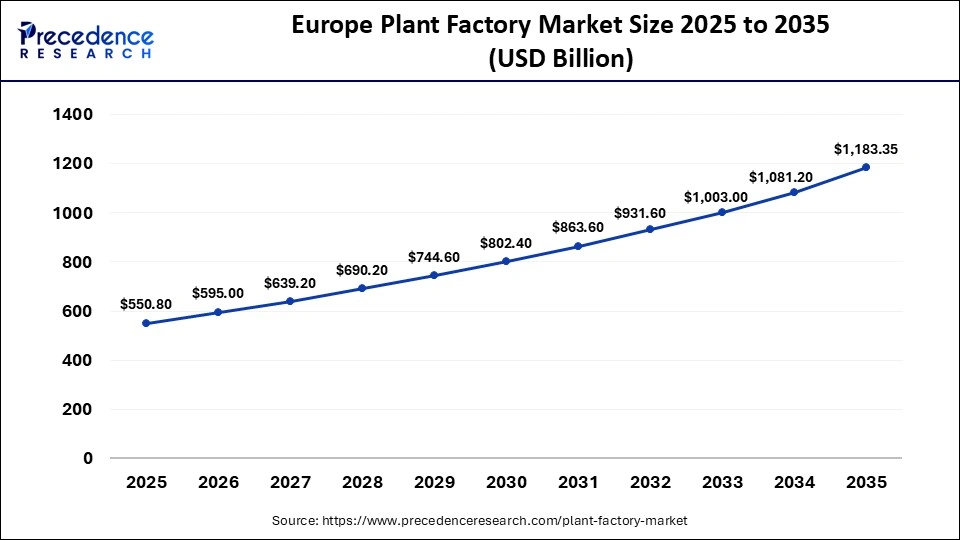
The Europe plant factory market size has grown strongly in recent years. It will grow from USD 550.8 million in 2025 to USD 1,183.35 million in 2035, expanding at a compound annual growth rate (CAGR) of 7.95% between 2026 to 2035
What Factors Have Driven the Dominance of Europe in the Market?
Europe dominated the plant factory market with a market share of approximately 34% in 2025. The region has rapidly adopted technological advancements, has supportive policies, sustainability goals, and high consumer demand for locally grown fresh food, which is driving the market. Europe has a well-established agricultural infrastructure and advanced greenhouse facility enabling year-round crop production and high-efficiency farming. Countries like the Netherlands, Germany, France, and the UK are the major contributors to agricultural research, water management, and agricultural innovation.
Europe has a long history of greenhouse production technology, sustainable food production, and policy support from the government. Germany and the UK lead the expansion of vertical farming and investments in plant factories. Strict environmental regulations, high urbanization, and demand for pesticide-free food drive the plant factory across the region.
The Germany Plant Factory Market Trends Analysis
The Germany market is growing rapidly, driven by urbanization and demand for sustainable, pesticide-free produce. Key trends include AI-driven automation, vertical farming expansion, and energy-efficient LED technology, supported by government initiatives for local food security in urban areas.
What makes Asia Pacific the Fastest Growing Region in the Market of plant factories?
The Asia Pacific region is the fastest-growing region in the market of plant factories and is expected to grow with a higher CAGR during the projected period. Rapid urbanization, population growth, and shrinking arable land in this region create an urgent market need for sustainable and local food production solutions. Government and private sectors across the Asia-Pacific are heavily investing in plant factories to ensure food security and sustainable agriculture. China, Japan, and South Korea are some of the leading regions in the market of plant factories due to their strong government policies promoting urban agriculture. The region is highly adopting advanced technologies, automation, AI, and LED lighting technologies, driving the region's rapid market expansion.
The India Plant Factory Market Trends Analysis
India's market is surging, driven by urbanization and demand for pesticide-free food. Key trends include AI-driven automation, hydroponics, and CEA (Controlled Environment Agriculture) technologies. The market is shifting toward vertical farming to maximize limited arable land, expanding across urban areas.
North America Plant Factory Market Trends
North America is experiencing steady growth in the market of plant factories. The regional market is driven by the adoption of strong technological innovation, high investments by the government in the plant factory, and growing demand for locally produced fresh food. The U.S. and Canada are experiencing rapid expansion of indoor and vertical farming systems, due to increased demand for pesticide-free and year-round supply of food. The region has well-established agriculture infrastructure, advanced research and development infrastructure, and leading agri-tech companies, which boost the plant factory market. Investment in automated farming technologies such as hydroponics, LED lighting, and AI integration accelerate commercialization of plant factories and reduces climate variability, supply chain disruptions, and urban food security concerns.
Plant Factory Market Companies
- AeroFarms
- Plenty Unlimited Inc.
- Bowery Farming
- Gotham Greens
- BrightFarms
- Signify Holding (Philips Lighting)
- Spread Co., Ltd.
- Mirai Co., Ltd.
- Sky Greens
- Lufa Farms
- AppHarvest
- Vertical Harvest
- Iron Ox
- Sananbio
- Infarm
Recent Developments
- In February 2026, a decade after losing his entire crop to drought, an Indian entrepreneur bounced back with a ₹214 crore investment in AI-powered hydroponics to cultivate premium medicinal plants and spices. (Source: https://www.thehindubusinessline.com)
- In February 2026, YesHealth Group is growing its presence in Taiwan by partnering with Seasons Future Farm Co., Ltd. to build a massive indoor vertical farm in Taichung's Xinshe District. This new facility will use YesHealth's proven vertical farming technology to boost local food security and promote sustainable agriculture in the region. (Source: https://www.verticalfarmdaily.com)
Segments Covered in the Report
By Facility Type
- Greenhouses
- Indoor/Vertical Farms
By Growing System
- Hydroponics
- Aeroponics
- Aquaponics
- Others (Soil-based/Hybrid)
By component
- Hardware (LEDs, HVAC, Sensors)
- Software and Services
By Crop Type
- Vegetables (Leafy Greens, Tomatoes)
- Fruits (Berries)
- Flowers & Ornamentals
- Others (Herbs/Microgreens)
By Region
- North America
- Europe
- Asia-Pacific
- Latin America
- Middle East & Africa
For inquiries regarding discounts, bulk purchases, or customization requests, please contact us at sales@precedenceresearch.com
Frequently Asked Questions
Tags





Ask For Sample
No cookie-cutter, only authentic analysis – take the 1st step to become a Precedence Research client
 Get a Sample



 sales@precedenceresearch.com
 Schedule a Meeting
