



3D Protein Structures Analysis Market Revenue to Attain USD 6.29 Bn by 2033
Published: 01 Oct 2025
Author: Precedence Research



3D Protein Structures Analysis Market Revenue and Trends 2025 to 2033
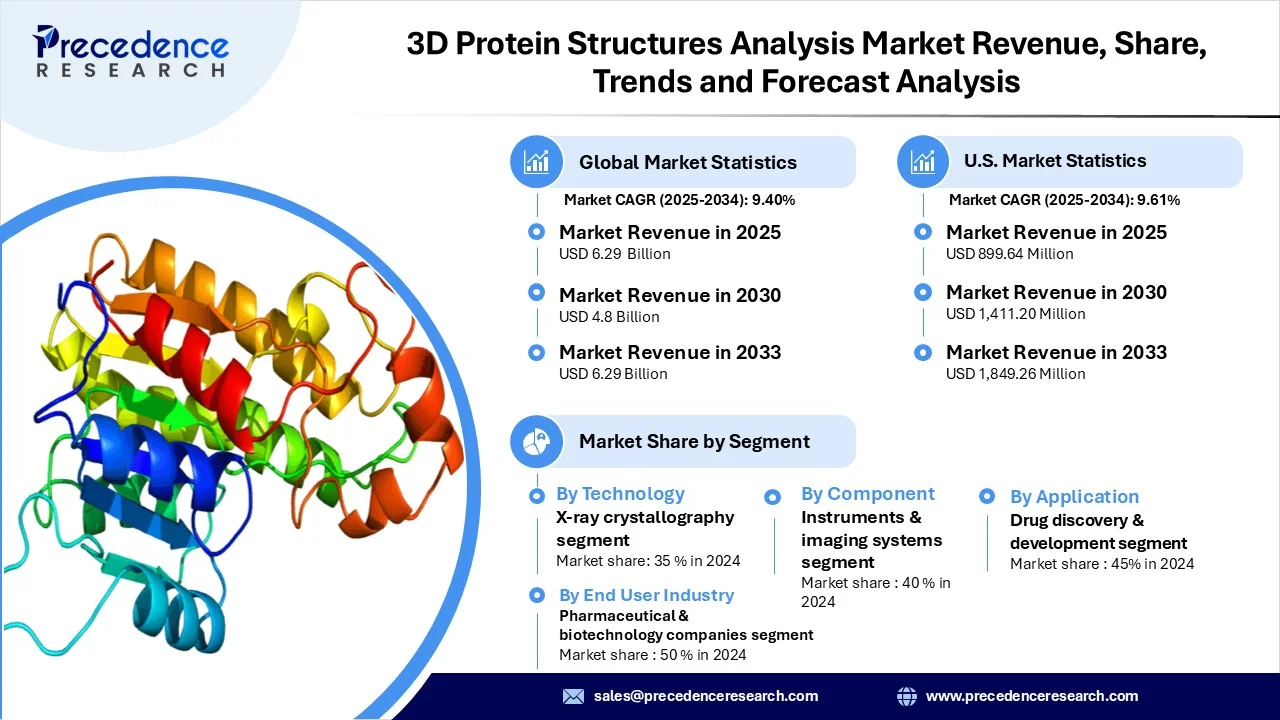
The global 3D protein structures analysis market revenue reached USD 3.06 billion in 2025 and is predicted to attain around USD 6.29 billion by 2033 with a CAGR of 9.40%. The market growth is attributed to rising volume of research & development activities in drug discovery, advances in imaging and computational technologies, and growing demand for precision medicine.
Unlocking the Growth Potential of the Market:
A significant factor boosting the growth of the 3D protein structures analysis market is the rise in R&D investments by public and private sectors in structural genomics and biologic therapeutics. Access to precise protein 3D conformations can enhance drug design, improve target drug binding, reduce side effects, and increase efficacy. Advances in imaging technologies, miniaturization, and automation of lab workflows are also reducing time and cost barriers. AI and machine learning tools that predict protein folding and model binding sites are increasingly important. The growing prevalence of chronic, infectious, and protein-related diseases is driving pharmaceutical and biopharmaceutical companies to accelerate discovery.
Segment Insights:
- By technology, the X-ray crystallography segment dominated the market in 2024, as it is a well-established method for elucidating molecular and atomic-level structures.
- By component, the instruments & imaging systems segment dominated the market with the largest share in 2024 due to their essential role in providing high-resolution, accurate visualizations of protein structures, which are crucial for drug discovery and therapeutic development.
- By application, the drug discovery & development segment dominated the market in 2024 due to the high demand for 3D analysis of protein structures to support the development of biologics and precision medicine.
- By end-use industry, the pharmaceutical & biotechnology segment dominated the market in 2024. This is mainly due to their extensive use of structural biology in drug discovery, including the development of biologics and precision medicine.
Regional Insights:
North America dominated the 3D protein structures analysis market with the largest share in 2024. The region’s dominance is attributed to its robust infrastructure for R&D, biotech, and pharmaceutical investment, as well as the presence of leading academic and private organizations. U.S. funding agencies and government grants significantly advance structural biology efforts. National labs, synchrotron facilities, and large equipment manufacturers also contribute, making the region a major revenue generator.
Asia Pacific is experiencing rapid growth in the market, driven by increased spending on life science research activities, expanded research capacity, government support, and rising healthcare expenditures. Countries such as China, India, Japan, and South Korea are expanding their structural biology labs and cryo-EM facilities. Lower labor costs, a growing scientific skillset, and supportive regional policies further enhance market penetration.
3D Protein Structures Analysis Market Coverage
| Report Attribute | Key Statistics |
| Market Revenue in 2025 | USD 3.06 Billion |
| Market Revenue by 2033 | USD 6.29 Billion |
| CAGR from 2025 to 2033 | 9.40% |
| Quantitative Units | Revenue in USD million/billion, Volume in units |
| Largest Market | North America |
| Base Year | 2024 |
| Regions Covered | North America, Europe, Asia-Pacific, Latin America, and the Middle East & Africa |
3D Protein Structures Analysis Market Key Players
- Thermo Fisher Scientific Inc
- Bruker Corporation
- Oxford Instruments plc
- Bio-Rad Laboratories, Inc.
- Rigaku Corporation
- Waters Corporation
- Agilent Technologies, Inc.
- Merck KGaA
- Creative Biostructure
- Schrodinger, Inc.
- Dassault Systèmes
- Lonza Group AG
- WuXi AppTec
- GenScript Biotech Corporation
- Cambridge Crystallographic Data Centre
Recent Development:
- In September 2025, Quantum-Si has launched its V4 Sequencing Kit, compatible with both Platinum® and Platinum® Pro instruments, enhancing protein analysis capabilities. The kit introduces glycine (G) recognition, improved alanine (A) and serine (S) recognition, an enzyme designed to cleave amino acids preceding proline (P), and advanced algorithms for better precision and handling of protein mixtures. (Source- https://www.quantum-si.com)
Get this report to explore global market size, share, CAGR, and trends, featuring detailed segmental analysis and an insightful competitive landscape overview @ https://www.precedenceresearch.com/sample/6903
You can place an order or ask any questions, please feel free to contact us at sales@precedenceresearch.com |+1 804 441 9344