



Additive Manufacturing for Medical Devices Market Revenue to Attain USD 23.87 Bn by 2035
Published: 14 May 2026
Author: Precedence Research



Additive Manufacturing for Medical Devices Market Revenue and Trends 2026 to 2035
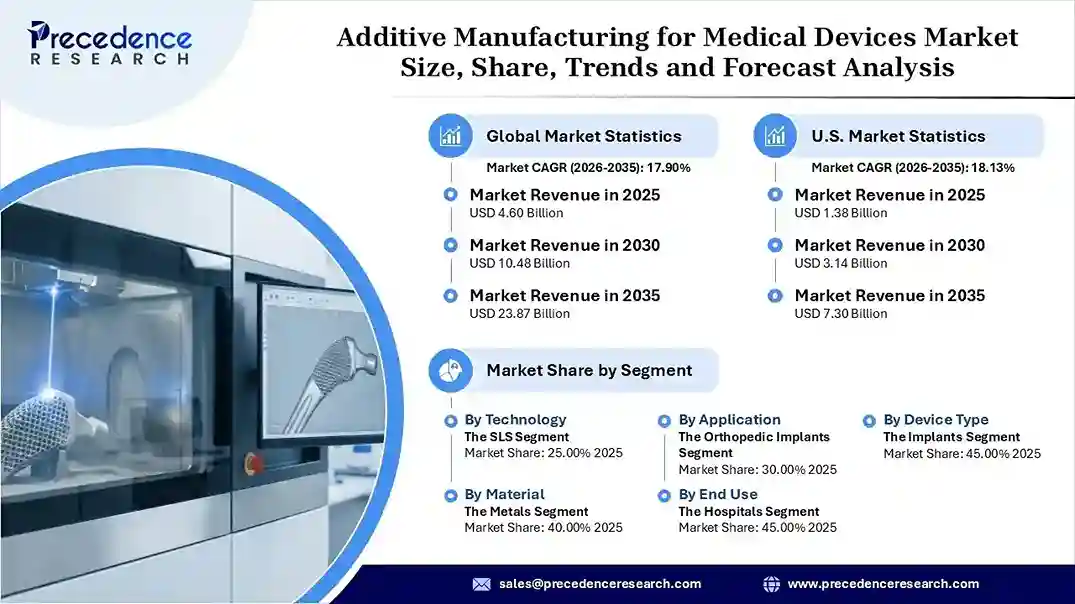
The global additive manufacturing for medical devices market revenue reached USD 4.60 billion in 2025 and is predicted to attain around USD 23.87 billion by 2035 with a CAGR of 17.90%. The market is driven by the increasing need to manufacture customized implants and orthopedic prostheses with intricate geometry that cannot be achieved using conventional manufacturing techniques.
Additive Manufacturing for Medical Devices: The Future of Personalized Healthcare
The additive manufacturing for medical devices market consists of applications of 3D printing technology in producing medical devices, surgical instruments, implants, prostheses, and anatomical models. Orthopedic implants like customized hip, knee, and spinal cages are manufactured from titanium or cobalt-chrome powder. This market also has applications in cranial and facial reconstruction implants, dental restorations including crowns, bridges, and dentures, and guides for implant positioning.
This market also involves bioprinting for creating tissue scaffolds and eventually live tissue in the future. These solutions cater to hospitals, surgical centers, laboratories, research organizations, and military medical units. Additive manufacturing has been adopted by institutions that need to create their own patient-matched devices, which have complex internal lattice structures and can shorten surgery duration.
What are the Key Trends Influencing the Market?
Use of Ceramic 3D Printing in the Fabrication of Patient-Specific Implants
The emerging trend in the additive manufacturing for medical devices market is the usage of ceramic 3D printing techniques, whereby they create dense load-bearing ceramic implants that have bone-like rigidity and excellent surface properties ideal for osseointegration. It eliminates the risk related to metal implants, such as corrosion and interference with imaging processes. Ceramic implants are customized based on patient anatomy, hence eliminating the use of standard metal prosthetics in favor of patient-specific implants that promote biological fixation.
- In 2026, Nivalon Medical Technologies successfully created the world’s first patient-specific, motion-retaining, and metal-free spinal implant using XJet’s NanoParticle Jetting ceramic 3D printing technique. Its unique ceramic structure, made up of zirconia-toughened alumina, is designed to mimic bone behavior with a compressive strength of 14.6 kN.
Implementation of Point-of-Care 3D Printing Within Hospitals
The market is benefiting from the adoption of point-of-care 3D printing within hospitals that facilitate surgeons to develop patient-specific models, surgical tools, and implantable parts on-site instead of sending their designs to off-site producers. This technique slashes production time from weeks to mere days and permits on-the-spot revisions in design according to intraoperative discoveries.
- In 2026, Siriraj Hospital in Bangkok made history when it created custom titanium hip sockets through its own 3D printing technique for a medical outreach program in Laos, resulting in artificial bones that are better suited for patients. This technique helped to minimize the risk of complications and promote faster healing.
Government Initiatives to Develop 3D Printed Medical Devices
Governments across the world have introduced dedicated funding initiatives, regulatory modernization plans, and infrastructure projects to foster the deployment of additive manufacturing for medical devices. Governments are providing extramural funding for regulatory science research focused on advanced manufacturing techniques. In 2025, the Maryland Department of Commerce, U.S., issued a grant of USD 6.95 million to LaunchPort via the Build Our Future Grant Pilot Program to set up commercial 3D printing services and advanced manufacturing processes for various medical devices.
OsseoLabs Validates AI Surgical Platform for More Than 300 Clinical Cases
OsseoLabs reported in January 2026 that their surgical intelligence platform, powered by AI, called OsseoVision, had been successfully tested in more than 300 clinical cases, resulting in more than 90% reduction in design time. It also resulted in 50% decrease in device cost in four automated surgical indications. These advantages are due to OsseoLabs’ proprietary technology of bioresorbable magnesium 3D printing that will eliminate the need for additional surgeries to remove implants, which is prevalent in 100 percent of some craniofacial and trauma patients.
Market Segmentation Overview
- By Technology: The selective laser sintering (SLS) segment led the additive manufacturing for medical devices market with 25% share in 2025, since it utilizes a powerful laser that sinters powder-based polymers like nylon into robust components without any supporting mechanisms. This makes it the most suitable method for manufacturing patient-specific surgical guides, anatomical models, and prosthetic components.
- By Technology: The direct metal laser sintering (DMLS) segment is expected to expand at the highest CAGR during the forecast period. This is due to its capability to provide fully dense metal components with high strength, utilizing metals like titanium, cobalt-chrome, and stainless steel to produce patient-specific orthopedic implants, spinal implants, cranial implants, and dental implants.
- By Material: The metals segment dominated the market with 40% share in 2025, owing to their ability to provide porosity in the lattices that allow bone ingrowth in the implants permanently, and their widespread adoption in knee replacements, stainless steel cranial plates, and customized hip stems.
- By Material: The biomaterials segment is expected to grow at the fastest rate from 2026 to 2035, due to its extensive adoption in making tissue scaffolds, drug-eluting implants, and temporary fixation devices that degrade over time and are replaced by biological tissues without needing to undergo secondary surgery.
- By Application: The orthopedic implants segment led the market with 30% share in 2025, owing to the fact that it constitutes the largest volume and most valuable application in medical 3D printing, with millions of joint replacements and spinal surgeries being carried out around the globe each year.
- By Application: The tissue engineering segment is expected to expand at the highest CAGR during the forecast period, because it tackles the issue of organ shortage faced by hundreds of thousands of patients waiting for donors each year, and the use of 3D bioprinting technology enables the fabrication of various organs.
- By End-Use: The hospitals segment dominated the market with 45% share in 2025, since they often have in-house printing units to produce patient-specific anatomical models and guides that would be used instantly during surgery. Many hospitals have started using metal printers to customize their implants, decreasing the waiting time as compared to third-party providers.
- By End-Use: The academic & research institutes segment is expected to grow at the fastest rate from 2026 to 2035, because it is the main driver behind the innovation in the field of bioprinting, development of new biomaterials, and tissue engineering, and extensive government and private funding boosts research operations.
- By Device Type: The implants segment led the additive manufacturing for medical devices market with 45% share in 2025, because it constitutes the highest value product category for 3D printing technology. Since implants have to reside inside the human body, they therefore go through strict approval processes and need to use biocompatible materials.
- By Device Type: The prosthetic devices segment is expected to expand at the highest CAGR during the forecast period, owing to the ability of 3D printing to manufacture bespoke, light-weight prosthetic sockets and hands, which can be manufactured within days at a lower price than conventionally produced prosthetics.
Regional Analysis
North America dominated the additive manufacturing for medical devices market with 40% share in 2025. This is because of the presence of the most advanced healthcare infrastructure in the world, widespread acceptance of personalized medicine, an excellent approval process by the FDA for 3D printed devices, and favorable insurance reimbursement policies for customized implants and surgical guides. The U.S. led the market in North America owing to a high number of hospitals that have their own 3D printing units and a large number of medical device companies working on additive manufacturing technology. Canada witnessed notable market growth due to the presence of academic and research institutes involved in the development of additive manufacturing technology, and early adoption of 3D printed anatomical models and surgical guides in major teaching hospitals in Toronto, Montreal, and Vancouver.
Asia Pacific is expected to grow at the fastest rate from 2026 to 2035 because of high incidences of chronic illnesses and injury cases, rapid improvement in the quality of healthcare infrastructure, and fast-paced adoption of 3D printing technology. China led the market in Asia Pacific due to its “Made in China 2025” policy to boost indigenous manufacturing, a huge and aging population base with increased demand for orthopedic and dental implants, and favorable approval policies for 3D-printed medical devices. India witnessed significant market growth owing to increased efforts by the government for local production of medical devices and a highly active engineering and medical ecosystem engaged in the development of additive manufacturing techniques.
Additive Manufacturing for Medical Devices Market Coverage
| Report Attribute | Key Statistics |
| Market Revenue in 2025 | USD 4.60 Billion |
| Market Revenue by 2035 | USD 23.87 Billion |
| CAGR from 2026 to 2035 | 17.90% |
| Quantitative Units | Revenue in USD million/billion, Volume in units |
| Largest Market | North America |
| Base Year | 2025 |
| Regions Covered | North America, Europe, Asia-Pacific, Latin America, and the Middle East & Africa |
Top Companies in the Additive Manufacturing for Medical Devices Market
3D Systems, Stratasys, EOS GmbH, Renishaw, Desktop Metal, EnvisionTEC, Prodways, and Formlabs are some of the key additive manufacturing companies that provide 3D printers, materials, and software. Materialise is a pure software and service company that provides FDA-approved processes and personalized design services related to medical 3D printing. GE Additive specializes in the production of metal 3D printed implants for dental and orthopedic uses. Stryker, Zimmer Biomet, Medtronic, and Johnson and Johnson are medical device producers that have implemented internal additive manufacturing capabilities to manufacture patient-specific implants and surgical instruments.
Segments Covered in the Report
By Technology
- Stereolithography (SLA)
- Selective Laser Sintering (SLS)
- Fused Deposition Modeling (FDM)
- Electron Beam Melting (EBM)
- Direct Metal Laser Sintering (DMLS)
By Material
- Metals
- Polymers
- Ceramics
- Biomaterials
By Application
- Orthopedic Implants
- Dental Implants
- Prosthetics & Orthotics
- Surgical Instruments
- Tissue Engineering
By End-Use
- Hospitals
- Specialty Clinics
- Academic & Research Institutes
- Medical Device Companies
By Device Type
- Implants
- External Wearable Devices
- Surgical Guides
- Custom Medical Devices
By Region
- North America
- Europe
- Asia Pacific
- Middle East & Africa
- Latin America
Get this report to explore global market size, share, CAGR, and trends, featuring detailed segmental analysis and an insightful competitive landscape overview @ https://www.precedenceresearch.com/sample/8406
You can place an order or ask any questions. Please feel free to contact us at sales@precedenceresearch.com |+1 804 441 9344