



AI in Omics Studies Market Revenue to Attain USD 6.11 Bn by 2035
Published: 14 Apr 2026
Author: Precedence Research



AI in Omics Studies Market Revenue and Trends 2026 to 2035
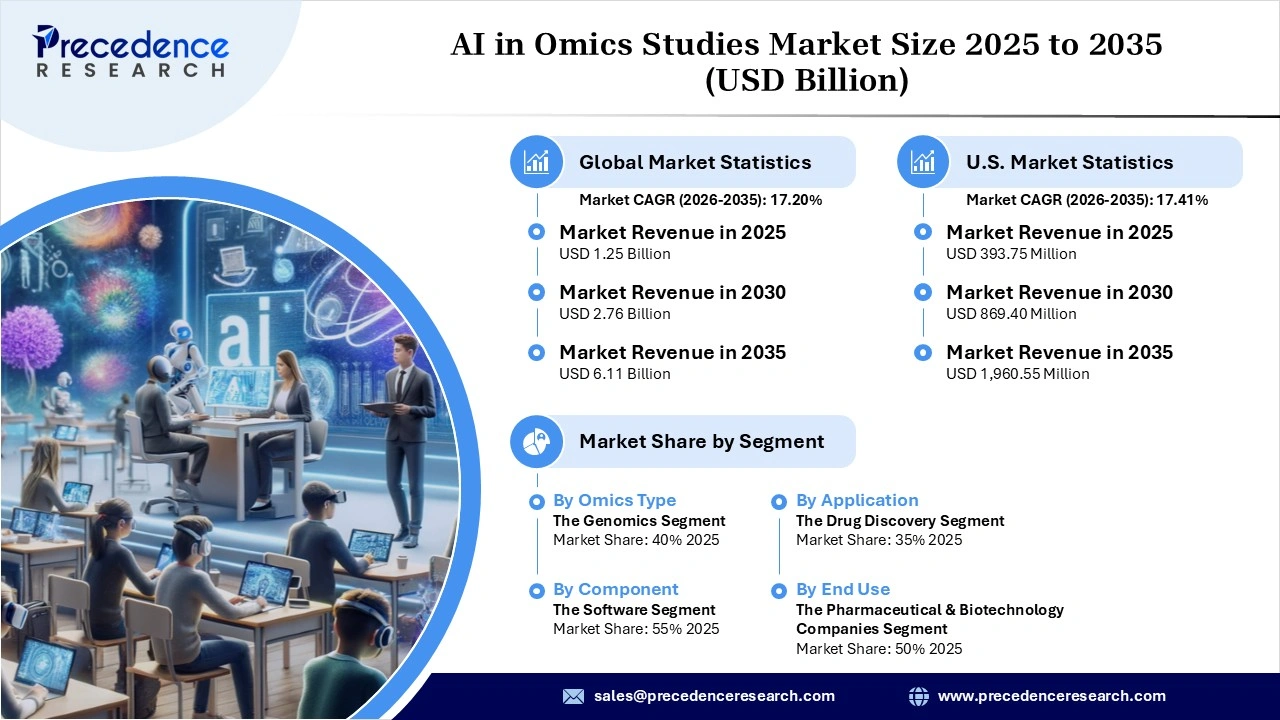
The global AI in omics studies market revenue was valued at USD 1.25 billion in 2025 and is expected to attain around USD 6.11 billion by 2035, growing at a CAGR of 17.20% during forecast period. The use of artificial intelligence in omics studies is rising due to the complexity of genomic, proteomic, and metabolomic data, which drives the market.
Market at a Glance
Artificial intelligence in omics involves the use of machine learning and computational models to process biological data such as genomes, proteins, and metabolites. AI technologies make it possible to uncover insights that traditional methods might miss, turning raw genetic sequences into testable hypotheses and influencing clinical decisions. At the intersection of biology and technology, AI is revolutionizing disease treatment by enhancing our ability to interpret clinical data, monitor patient responses, and provide actionable insights in real-time, ultimately reshaping medical practices and advancing personalized medicine.
Artificial intelligence in omics extends from raw data analysis to applications in healthcare, including drug development, biomarker identification, and personalized medicine. Its influence reaches beyond laboratories, impacting hospitals and clinics where multi-omics strategies are becoming routine in patient care. By integrating AI, these institutions are enhancing their diagnostic and treatment capabilities, making precision medicine more accessible and effective for a wider range of conditions.
Market Forecast
- Increasing Complexity of Biological Data: The vast amount of genomic, proteomic, and metabolomic data being generated through high-throughput technologies has surpassed the capacity of traditional analytical methods. AI algorithms, particularly machine learning (ML) and deep learning (DL), are crucial for analyzing this complex data, uncovering hidden patterns, and providing insights that were previously unattainable.
- Rising Demand for Precision Medicine: As the healthcare industry moves toward personalized treatments, AI's ability to analyze multi-omics data is helping to tailor treatments based on individual genetic profiles. This drives the demand for AI-powered omics analysis, as it enables more precise diagnostics and therapeutic decisions, improving patient outcomes.
- Technological Advancements and Reduced Costs: The continued advancements in AI technologies and the reduction in computational costs have made AI more accessible to researchers and healthcare providers. This has led to a wider adoption of AI in omics studies, as it allows for more cost-effective, efficient, and scalable analysis, especially in drug discovery, diagnostics, and disease monitoring.
Breakthroughs in the Market
In October 2025, Illumina launched a new business centered on informatics and artificial intelligence software for drug developers to analyze large amounts of DNA sequencing and multi-omics data. The company is also diversifying into protein analysis, spatial transcriptomics, and single-cell analysis by increasing the power of its sequencers. Illumina also acquired SomaLogic, a proteomics firm from Standard BioTools, for $425 million.
In June 2025, at the BIO convention, BioAro launched PanOmiQ Research, an AI-powered platform for multi-omics and drug development. The system features multilingual clinical reporting and an AI-driven drug discovery module (currently in beta), positioning it as the first comprehensive, scalable omics-to-therapeutics solution.
Market Segmentation Overview
- By omics type, the genomics segment held a major share of 40% in the AI in omics studies market in 2025. The segment’s dominance is driven by large-scale sequencing data and the increasing use of AI for genomic analysis, variant detection, and personalized medicine, making it more clinically relevant.
- By omics type, the proteomics segment held the second-largest market share of 20% in 2025 and is expected to grow at a significant rate over the projection period. This is because of AI's ability to predict protein structure and analyze pathways has become more precise, helping to map interactions and identify drug targets, deepening our understanding of disease mechanisms beyond genetics.
- By component, the software segment held a major revenue share of 55% in the AI in omics studies market in 2025, as software solutions are crucial for interpreting raw omics data, transforming large, unstructured datasets into valuable insights and actionable understanding.
- By component, the services segment was the second-largest shareholder in the market in 2025, driven by organizations that preferred outsourcing processes like AI model building, data analytics, and consulting, especially smaller research institutions dealing with multi-omics complexities and lacking infrastructure. This significantly boosts the demand for professional services.
- By application, the drug discovery segment accounted for a share of 35% in the market in 2025, driven by AI's ability to reduce long development timelines. There is a strong focus on target identification and enhancing success rates, boosting the adoption of AI in the R&D of drugs.
- By application, the precision medicine segment is expected to grow at the fastest CAGR during the forecast period, as AI facilitates custom treatment plans based on genetic and molecular traits. This has become particularly prevalent in oncology, where therapies are increasingly tailored to individual biological markers.
- By end-use, the pharmaceutical & biotechnology companies segment accounted for the largest share of 50% in the AI in omics studies market in 2025, driven by their high investments in AI-enhanced drug discovery and omics research. They focus on improving drug pipelines and reducing attrition rates, which aligns well with AI’s ability to provide faster, more reliable biological analysis.
- By end-use, the research institutes segment held the second-largest share of the market in 2025 and is expected to grow at a significant rate in the upcoming period. This is because of their role as key innovators in genomics and multi-omics research.
Regional Insights
North America dominated the global AI in omics studies market with a 42% share in 2025, driven by strong capital investment, advanced computational capabilities, and a robust research infrastructure. The U.S. led with large-scale sequencing initiatives and significant private investments, while Canada contributed by fostering strong academic-industry collaborations in data-driven biology. Together, these factors have transformed omics from an experimental field to an operational one, where AI is at the core of analysis rather than an added enhancement.
Asia Pacific is expected to grow at the fastest CAGR in the market during the forecast period, fueled by expanding genomics initiatives and rising healthcare spending. China is set to lead the market with government-backed genomics programs and widespread AI integration. India is significantly contributing to the market due to growing R&D funding. Japan and South Korea further support market growth with their focus on precision medicine.
AI in Omics Studies Market Coverage
| Report Attribute | Key Statistics |
| Market Revenue in 2025 | USD 1.25 Billion |
| Market Revenue by 2035 | USD 6.11 Billion |
| CAGR from 2026 to 2035 | 17.20% |
| Quantitative Units | Revenue in USD million/billion, Volume in units |
| Largest Market | North America |
| Base Year | 2025 |
| Regions Covered | North America, Europe, Asia-Pacific, Latin America, and the Middle East & Africa |
Top Companies in the Artificial Intelligence in Omics Studies Market
Illumina, Inc. and Thermo Fisher Scientific Inc. remain key players in the AI in omics studies market, driving sequencing capabilities and laboratory integration. QIAGEN N.V. and Agilent Technologies, Inc. build upon this foundation by focusing on data interpretation. Meanwhile, tech giants like NVIDIA Corporation, IBM Corporation, Microsoft Corporation, and Google (Alphabet Inc.) play a crucial role in processing vast biological data, turning computational power into actionable biological insights at scale.
Segments Covered in the Report
By Omics Type
- Genomics
- Proteomics
- Transcriptomics
- Metabolomics
Others
By Component
- Software
- Services
- Hardware
By Application
- Drug Discovery
- Precision Medicine
- Biomarker Discovery
- Clinical Diagnostics
- Others
By End-Use
- Pharmaceutical & Biotechnology Companies
- Research Institutes
- Hospitals & Clinics
- Others
By Region
- North America
- Latin America
- Europe
- Asia-pacific
- Middle and East Africa
Get this report to explore global market size, share, CAGR, and trends, featuring detailed segmental analysis and an insightful competitive landscape overview @ https://www.precedenceresearch.com/sample/8296
You can place an order or ask any questions, please feel free to contact us at sales@precedenceresearch.com |+1 804 441 9344