



Automotive Climate Control Market Revenue to Attain USD 20.08 Bn by 2035
Published: 23 Dec 2025
Author: Precedence Research



Automotive Climate Control Market Revenue and Trends 2026 to 2035
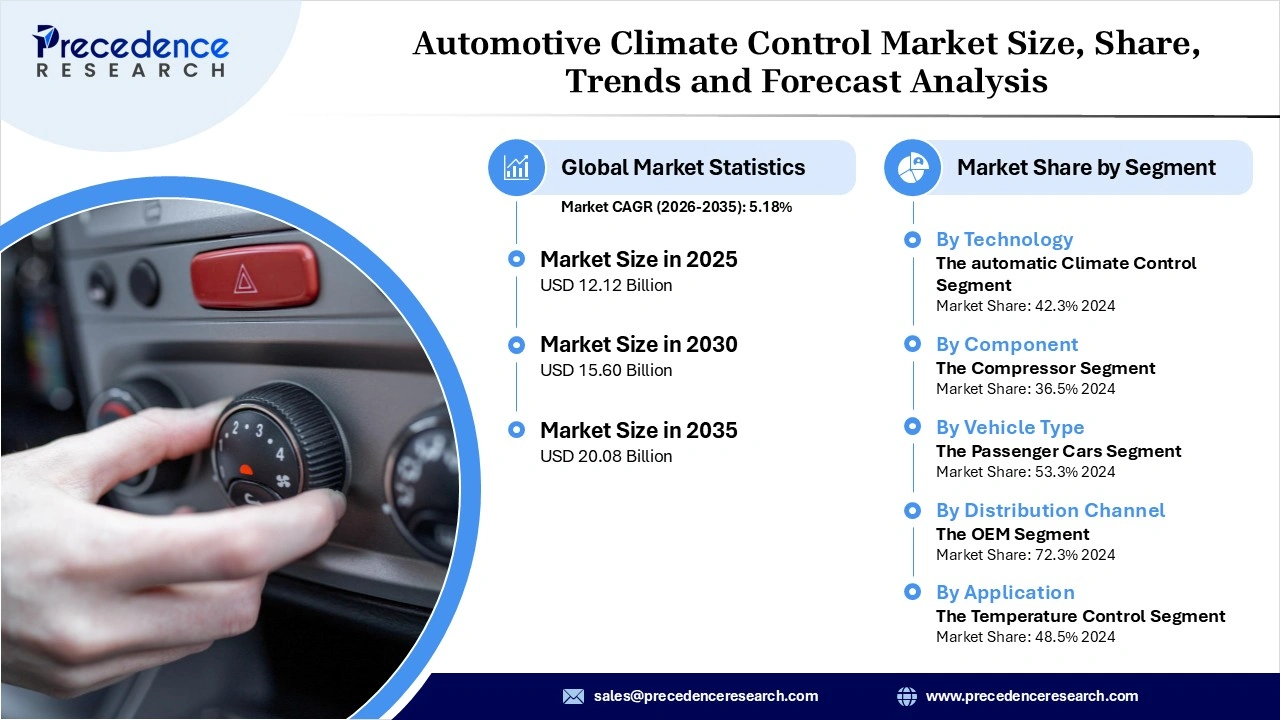
The global automotive climate control market revenue was valued at USD 12.12 billion in 2025 and is expected to attain around USD 20.08 billion by 2035, growing at a CAGR of 5.18% during forecast period. The market is significantly growing due to the growing demand for advanced in-car comfort systems and the adoption of climate control within modern vehicles.
What are the Driving factors of the Automotive Climate Control Market?
The automotive climate control market is experiencing a huge shift and is driven by factors like increasing integration of climate control systems with cutting-edge technologies for power efficiency and comfort at the same time, and increasing consumers' preference for comfortable travelling. The integrated climate control solutions are on the rise due to the growing emphasis on sustainability, eco-friendliness, and eco-friendly plus energy efficient system designs. Innovations like smart climate control systems that leverage sensors and AI systems are widely accepted by manufacturers and consumers as well.
Segments Insights
- By technology, the automatic climate control segment held the largest market share in 2025. The segment is dominating as it offers energy efficiency and cabin comfort continuously. It can further integrate with vehicles electronics system seamlessly.
- By component, the compressor segment held the largest market share owing to its essential role in controlling cabin temperature and maintaining air-conditioning effects continuously.
- By vehicle type, the passenger cars segment led the global automotive climate control market, as many climate control systems are crucial to be embedded with passenger vehicles for a luxury and comfortable experience for long-term travelling.
- By distribution channel, the OEM segment held the largest market share in 2025, as many vehicles prefer standard control systems by original manufacturers to avoid misalignments of critical parts and smooth system integration with a warranty period.
- By application, the temperature control segment held the largest market share in 2025 due to its efficiency and compatibility for internal combustion systems and electric vehicles, along with the adjustment of hot and cold settings as per climate changes, which is essential for comfortable traveling.
Regional Insights
Asia Pacific held the largest market share in 2025. The region's growth is attributed to the increasing demand for cars equipped with technologies related to safe automotive climate systems, growing disposable incomes, and the explosive growth of urbanization with a growing population rate, inclining to leverage comfortable travelling experiences.
Countries such as China, India, Japan, and South Korea account for a large share of global vehicle production and sales, which directly drives demand for integrated heating, ventilation, and air conditioning systems across passenger and commercial vehicles. Rising middle-class income levels in China and India have increased consumer preference for vehicles with advanced thermal comfort features, including automatic climate control and multi-zone HVAC systems.
High ambient temperatures and humidity levels across many Asia-Pacific markets make reliable climate control a functional requirement rather than a premium feature, further reinforcing adoption across mass-market vehicle segments. Local automotive OEMs and suppliers are also expanding production capacity and integrating more efficient climate systems to meet regulatory expectations around cabin safety, air quality, and energy efficiency.
North America is projected to grow rapidly during the foreseeable period. The region’s growth is driven by strong customer preferences for comfortable interior features of automotive, technological advancement that supports seamless integration of robust climate control systems with various types of vehicles and their cabins. Also, the increasing adoption of EVs and hybrid models is further fuelling the demand for automotive climate control systems in the region.
In the United States and Canada, consumers increasingly expect advanced climate features such as dual-zone and tri-zone temperature control, heated and ventilated seats, and intelligent cabin air filtration as standard offerings. Automakers in the region are integrating climate control systems with vehicle electronics, sensors, and infotainment platforms to enable automated temperature regulation and improved energy management.
The rapid growth of electric and hybrid vehicles is particularly significant, as these platforms require highly efficient thermal management systems to balance passenger comfort with battery performance and driving range. As a result, demand is rising for advanced automotive climate control technologies optimized for both internal combustion and electrified vehicle architectures across North America.
Automotive Climate Control Market Coverage
| Report Attribute | Key Statistics |
| Market Revenue in 2025 | USD 12.12 Billion |
| Market Revenue by 2035 | USD 20.08 Billion |
| CAGR from 2026 to 2035 | 5.18% |
| Quantitative Units | Revenue in USD million/billion, Volume in units |
| Largest Market | North America |
| Base Year | 2025 |
| Regions Covered | North America, Europe, Asia-Pacific, Latin America, and the Middle East & Africa |
Recent Developments
- In September 2025, a leading global automotive and thermal management supplier, Hanon Systems- a subsidiary of Hankook and the company group- revealed that they have surpassed 1 million units of eCompressors by using eco-friendly refrigerant- R744.(Source: https://www.hanonsystems.com)
Get this report to explore global market size, share, CAGR, and trends, featuring detailed segmental analysis and an insightful competitive landscape overview @ https://www.precedenceresearch.com/sample/7225
You can place an order or ask any questions, please feel free to contact us at sales@precedenceresearch.com |+1 804 441 9344